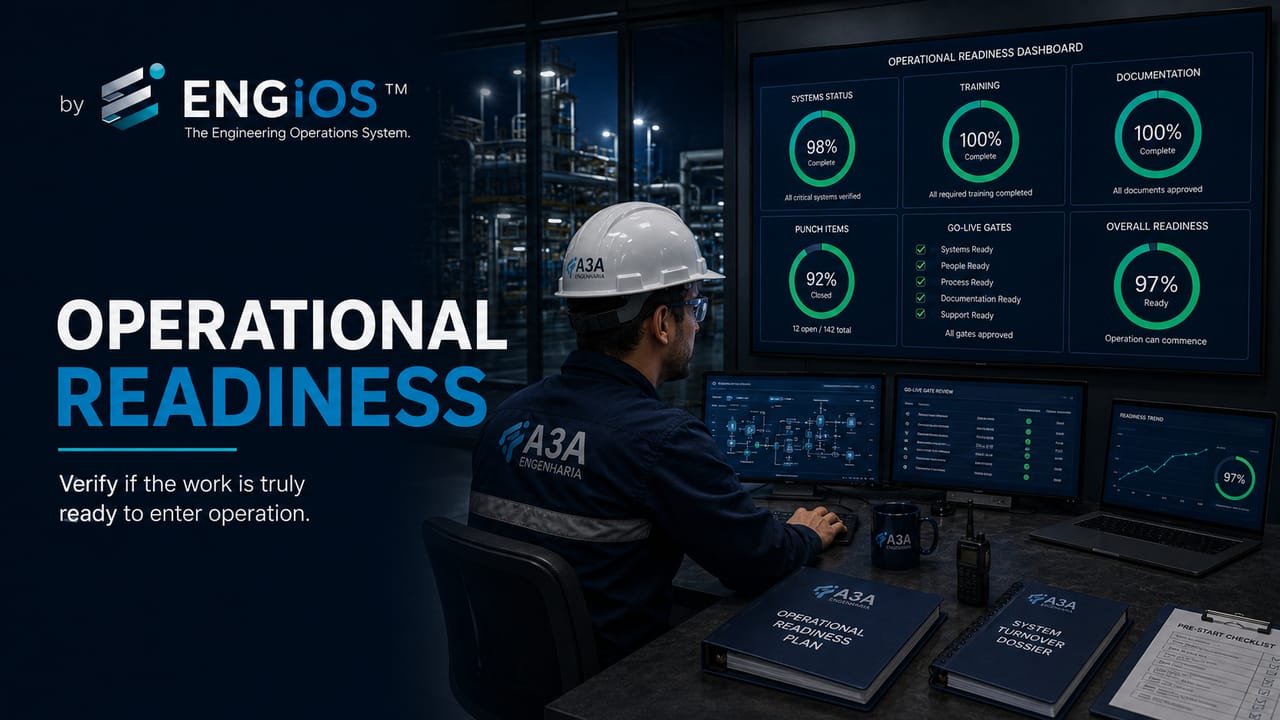
Learn how to assess whether a public work is truly ready to operate through completion, testing, documentation, people, maintenance, licenses, handover and readiness criteria.
Check it out!
A public work is not ready to operate merely because it has reached 100% physical completion, received final finishes or had its main equipment energized. Operational readiness is the condition in which facilities, systems, documentation, teams, safety, maintenance, supplies, licenses and operating routines have been verified in an integrated manner and there is sufficient evidence for the public authority to take over the asset without transferring unresolved implementation problems to operations.
In practice, the transition from construction to operation is one of the stages where gaps most often emerge: installed equipment without complete testing, systems that work separately but fail when integrated, incomplete manuals, outdated As-Built documentation, untrained teams, warranties without traceability, critical spare parts not delivered, open items classified as “minor” that prevent functionality, and licenses or authorizations that still do not permit the intended use.
In a public work, this problem has an additional effect. Contractual acceptance must be supported by evidence and defined responsibilities. Brazilian Law 14,133/2021 provides for provisional and final acceptance after verification of technical and contractual requirements, allows total or partial rejection of nonconforming work, and establishes that tests, trials and other evidence of proper execution required by official technical standards must be performed according to the applicable regime. Therefore, the decision to place the asset in service should not rely solely on a visual inspection or a percentage of progress.
An operational-readiness assessment structures this transition. It asks not only “is the project finished?” but “can the asset perform its function safely and with sufficient performance, documentation, people and support to operate sustainably?”
Completed work, accepted work and an asset ready to operate are different things
When the work appears complete but questions remain about testing, documentation, punch list, training and acceptance conditions, an independent assessment helps prevent the public authority from assuming hidden implementation risks.
Technical Acceptance of Public Works and Engineering Services
Physical completion is an execution milestone. Acceptance is a contractual milestone. Operational readiness is a functional and organizational state. These three elements may occur close together in time, but they are not equivalent.
A building may have its civil works completed and still depend on adjustments to fire protection, automation, power, HVAC, access control or communications systems. A hospital may have complete building systems but lack sufficient procedures, training, calibration and validation for safe use. A school may be built but still have open items involving AVCB, accessibility, electrical documentation or system integration. A treatment plant may be assembled but lack startup conditions, reagents, procedures, trained personnel or performance testing.
This distinction is already present in the concept of technical handover: delivery is not merely the physical transfer of the asset, but the structured transfer of information, responsibilities, documentation and operating conditions.
| Milestone | Main question | Typical evidence | Risk if confused |
| Physical completion | What was built? | measurement, inspection, physical progress | considering something complete when it is functionally incomplete |
| Contractual acceptance | Does the deliverable comply with the contract? | detailed acceptance record, inspections, tests, documentation | accepting open items incompatible with the contract |
| Operational readiness | Can the asset operate safely and perform as required? | integrated tests, training, procedures, licenses, maintenance | transferring implementation risks to operations |
The practical consequence is important: the Administration may need to distinguish open items that prevent contractual acceptance, items that prevent operation, and residual items that may be handled during a stabilization phase without compromising safety, performance or the public function.
The eight domains of operational readiness
A mature assessment is not limited to a generic checklist. The asset should be evaluated across interconnected domains. The required level varies by project type, but eight domains appear frequently.
1. Physical and completion readiness
The first question is whether the systems and subsystems required for the asset’s function are physically complete. This includes civil works, equipment, installations, utilities, supporting infrastructure, signage, access and safety elements.
The critical point is not simply “installed or not installed.” The assessment must classify each system in terms of completion, inspection, testing, documentation and open items. Installed but unenergized equipment, for example, cannot be treated in the same way as equipment whose tests are complete and approved.
The logic of pre-commissioning helps distinguish completed installation from a condition ready for functional testing.
2. Functional and performance readiness
After completion, each system must be shown to perform its intended function. This involves functional tests, interlocks, alarms, redundancies, degraded modes, integration among subsystems and, where applicable, performance testing.
ABNT NBR IEC 62337:2020, although focused on electrical, instrumentation and control systems in process industries, provides a useful milestone logic: erection completion, pre-commissioning, commissioning, startup, performance testing and plant acceptance. The principle can be applied by methodological analogy to many projects: robust acceptance requires a distinction among installation, function and performance.
In public works with multiple systems, failures often appear at interfaces. The pump works, the sensor works and the supervisory system works, but the automatic command does not respond to the actual event. The generator starts independently but does not assume the load as designed. The access-control system recognizes credentials but does not release doors correctly under emergency conditions. The fire system detects the event but does not activate all required interfaces.
3. Documentation readiness
Operations must receive a reliable representation of what was built. This includes As-Built drawings, manuals, equipment lists, certificates, test reports, warranties, datasheets, parameter settings, licenses, inspection records and maintenance instructions.
A well-structured construction Data Book turns scattered documents into a traceable set. Without it, the operations team becomes dependent on informal memory, supplier files and drawings that do not represent the installed condition.
4. People and competency readiness
The infrastructure may be technically ready while the organization still lacks the operational capability to use it. It is necessary to verify whether responsible personnel, shifts, access profiles, procedures, training and minimum competencies have been defined.
Training should not be treated as a supplier sales presentation. For critical systems, it is advisable to verify learning, normal operation, failure response, contingency, reset, isolation, basic maintenance and escalation criteria.
5. Maintenance and support readiness
Entry into operation begins the asset life cycle. Before that milestone, maintenance plans, frequencies, responsibilities, warranties, support channels, service contracts, spare parts and special tools should already be defined.
A project that delivers sophisticated equipment without a maintenance strategy merely shifts risk into the following months. The Maintenance Plan should be based on criticality, manufacturer recommendations, applicable standards and actual operating conditions.
6. Legal, regulatory and safety readiness
The asset may be technically functional and still not be authorized to operate. Depending on the project, environmental licenses, health permits, AVCB/CLCB fire-safety authorizations, utility approvals, registrations, inspections, specific releases or compliance with permit conditions may be required.
The readiness lead should maintain a matrix with document, authority, condition, validity period, responsible party and the impact of its absence. This matrix should be integrated into the delivery schedule.
7. Supplies and consumables readiness
Operation requires resources that are not always part of the construction scope: consumables, reagents, fuel, spare parts, tools, technical cleaning materials, batteries, software licenses, digital certificates, connectivity contracts and initial stock.
The absence of a seemingly small item may prevent the entire system from being available. The approach should be based on criticality and replacement lead time.
8. Governance and failure-response readiness
Before entry into service, it should be clear who decides, who operates, who maintains, who engages suppliers and how events are recorded. The initial period is precisely when fine adjustments, latent failures and questions of responsibility appear.
A RACI matrix, escalation channels, incident procedures and a routine for monitoring stabilization reduce the risk of every problem turning into a dispute among the contractor, suppliers, inspection team and operations.
How to structure an operational-readiness assessment
The assessment should begin with a matrix of systems and requirements. The objective is to turn the abstract question “is it ready?” into verifiable criteria.
Each system or package should have, as applicable:
- functional requirement;
- reference design document;
- completion condition;
- required inspections and tests;
- acceptance criteria;
- open items;
- required documentation;
- associated training;
- maintenance requirements;
- licenses and authorizations;
- release authority;
- readiness status.
The assessment becomes more robust when gate criteria are used. A system only advances to the next stage when minimum conditions have been met.
This logic prevents pressure for inauguration or contract closeout from replacing technical criteria.
The punch list must distinguish severity, functionality and operating condition
One of the greatest sources of conflict at delivery is the open-item list. If all items are treated the same way, the team loses the ability to distinguish a paint touch-up from a failure in a safety system.
A useful classification may use three groups:
- Class A — blocking: compromises safety, legal compliance, an essential function, a critical test or operating condition;
- Class B — non-blocking but relevant: does not prevent controlled operation, but requires correction within a defined period and follow-up;
- Class C — residual: finishes, secondary documentation or minor adjustments with no functional impact, provided they are contractually admissible.
The criterion should be defined in advance. Classification cannot be used to convert incomplete work into an “acceptable open item.”
The open items, RFIs and nonconformities management solution helps preserve traceability among issue, responsible party, deadline, closure evidence and acceptance.
Isolated tests do not demonstrate project readiness
Multidisciplinary systems need to be verified as a whole. Commissioning structures requirements, procedures, test witnessing, failure traceability and evidence to demonstrate that the installation performs the intended functions.
Engineering Commissioning for functional and integrated verification
A multidisciplinary project operates as a system of systems. Equipment tests and discipline-specific tests are therefore necessary but insufficient to demonstrate overall readiness.
Commissioning should progress from component verification to functional and integrated tests. In a public building, a power-loss scenario may involve the utility, UPS, generator, electrical panels, elevators, emergency lighting, IT systems, fire protection, access control and automation. If each discipline was tested in isolation, the integrated response remains unknown.
The article on FAT and SAT shows how factory and site tests complement each other. The article on commissioning of buildings and building systems addresses integrated verification in the built environment.
Acceptance under Law 14,133 and operational readiness
Article 140 of Brazilian Law 14,133/2021 establishes, for works and services, provisional acceptance by the person responsible for monitoring and inspection, through a detailed record after technical requirements have been verified, and final acceptance by a designated public servant or committee, also through a detailed record demonstrating compliance with contractual requirements.
This provision does not itself establish an operational-readiness methodology. What it does is reinforce the need for evidence and verification. The Administration must define in the contract which results, documents, tests and criteria characterize compliance.
The Terms of Reference and the design should therefore anticipate delivery. If the procurement documents require only “installation and operation” without describing tests, documentation, training, performance and acceptance criteria, the dispute returns at the end of the contract.
The article on Article 140 of Law 14,133 as applied to acceptance should be read together with commissioning and handover planning.
What must be ready on the Administration’s side
Readiness is not solely the contractor’s responsibility. Public operations must also be prepared to receive the asset.
Before entry into service, the public authority should verify:
- designated and trained team;
- available operations and maintenance budget;
- required support contracts mobilized;
- access, credentials and profiles defined;
- initial supplies available;
- inspection and maintenance routines established;
- documentation received and stored;
- warranties and supplier contacts recorded;
- contingency procedures approved;
- incident governance and escalation defined.
This point is especially important in works financed through intergovernmental agreements or investment programs. Delivering CAPEX without OPEX capacity can result in a completed but underused or unavailable asset.
Readiness criteria by project type
The methodological structure is common, but the criteria must reflect the public service being delivered.
| Asset type | Additional critical criteria |
| School | fire safety, accessibility, power, water, IT, furniture and building operation |
| Health-care facility | critical utilities, gases, HVAC, emergency power, validations and health requirements |
| Administrative building | building systems, security, IT, accessibility, automation and training |
| Treatment plant | process, instrumentation, reagents, laboratory, startup, disposal and performance |
| Substation | protection, automation, telecom, energization, selectivity, documentation and safe operation |
| Control center | system availability, redundancy, communications, cybersecurity and procedures |
| Road infrastructure | signage, drainage, lighting, ITS systems, safety and releases |
A universal checklist tends to be superficial. The assessment should begin with the functions and risks of each asset.
How to measure readiness without creating a false 100% score
Consolidated indices may be useful for management, but they should not allow many low-risk items to offset a single critical blocker. A project may have 95% of its items complete and still not be ready because a license, a protection test or an essential safety condition is missing.
A more robust approach combines:
- mandatory gates: binary requirements that must be met;
- score by domain: completion percentage for documentation, training, maintenance, etc.;
- critical open items: blocking items explicitly highlighted;
- residual risk: assessment of the risk that will remain after entry into operation.
The readiness dashboard should show not only a score, but also blockers and responsible parties.
When to commission an independent readiness assessment
An independent assessment is appropriate when the project is complex, there is an information asymmetry between those who implemented it and those who will receive it, the Administration lacks sufficient staff, there is a history of nonconformities, or the asset will have critical operations.
The scope may include document review, inspections, witnessing of tests, punch-list assessment, training review, Data Book review, verification of maintenance plans and issuance of a technical opinion on readiness.
This work may be contracted as part of Technical Acceptance of Public Works and Engineering Services or integrated into Engineering Commissioning, depending on the phase and complexity.
Operational readiness after a stalled public work
During a restart, verification should be even more rigorous. Partially completed systems may have deteriorated; warranties may have expired; equipment may have been stored under inadequate conditions; design revisions may have accumulated; and the original team may no longer be available.
The eight-step protocol for restarting stalled public works reconstructs the physical and contractual situation. Operational readiness is the final gate: proving that the restart resulted in an asset that is actually usable.
For older or preserved items, recommissioning, additional inspection or repeat testing may be necessary. The decision should consider criticality, exposure time, available records and manufacturer recommendations.
What to contract to take a project from completion to operation
The transition between implementation and operation requires governance over suppliers, documentation, interfaces, risks and acceptance criteria. In complex projects, Owner’s Engineering technically represents the owner throughout this transition.
The contracting approach should reflect the public authority’s actual gap. In simpler projects, structured technical acceptance may be sufficient. In complex projects, combining different services is common.
Commissioning
Appropriate when it is necessary to plan and perform verifications, functional and integrated tests, trace requirements and produce performance evidence.
Technical acceptance
Appropriate when the focus is verifying technical and documentary compliance to support provisional and final acceptance.
Handover and Data Book
Necessary when the main gap is ensuring that operations receives drawings, manuals, records, parameter settings, warranties and test history in an organized manner.
Assisted Operation
Appropriate when the asset has already entered service but requires a controlled period of stabilization, support, indicator monitoring, adjustments and knowledge transfer.
Owner’s Engineering
Appropriate when the owner needs to integrate design, suppliers, quality, commissioning, documentation, operations and technical decisions under a single governance structure.
These activities do not need to be fragmented into multiple contracts. What matters is that the scope defines responsibilities, deliverables, acceptance criteria and boundaries among contractor, consultant, inspection and operations.
How Assisted Operation completes readiness without replacing acceptance
Assisted Operation is a phase after the entry-into-operation gate. It serves to stabilize the asset under real conditions, monitor initial failures, adjust parameter settings and consolidate team knowledge.
It should not be used to conceal incomplete work. Blocking open items must be resolved beforehand. Assisted Operation is appropriate for stabilization and operational learning, not as a substitute for mandatory tests or as a means of accepting nonconforming systems.
An exit criterion may combine a minimum operating period, absence of critical failures, closure of open items, document delivery, completed training and performance indicators within defined ranges.
A practical gate model for entry into operation
Before authorizing entry into service, the responsible committee or team may consolidate a readiness declaration with objective answers:
- essential systems complete and identified;
- functional tests approved;
- critical integrated scenarios approved;
- Class A open items closed;
- Class B open items with accepted plans and deadlines;
- essential documentation delivered;
- As-Built available at the level required for operations;
- manuals and configuration parameters delivered;
- team trained and access permissions released;
- maintenance and support mobilized;
- critical spare parts and consumables available;
- licenses and authorizations valid;
- emergency procedures tested;
- post-delivery responsibilities defined;
- Assisted Operation or stabilization plan approved, when applicable.
The decision may be ready, ready with controlled restrictions or not ready. Any intermediate condition should record risks, responsible parties, deadlines and limits of use.
Evidence blocks that should make up the readiness dossier
An operational-readiness dossier does not need to repeat the entire Data Book, but it should reference essential evidence:
| Block | Evidence |
| Completion | certificates, checklists, inspections, punch list |
| Testing | procedures, results, witnessing, failure and retest reports |
| Performance | parameters, curves, measurements and contractual criteria |
| Documentation | As-Built, manuals, asset lists, warranties |
| People | training records, competency matrix |
| Maintenance | plans, spares, contracts and resources |
| Legal | licenses, authorizations, conditions |
| Handover | transfer record, responsibilities, residual open items |
Traceability is what turns technical judgment into a defensible decision.
Operational readiness as a tool to prevent waste of public resources
The work only creates value when the associated public service begins to function. An empty building, unavailable system or equipment without an operator does not deliver the benefit that justified the investment.
Readiness therefore needs to be planned before the final phase. Operating requirements should be incorporated into the design, procurement documents, measurement criteria and test plan. The later the Administration discovers missing documents, training, licenses or interfaces, the more expensive and contentious the correction becomes.
The Project Readiness approach helps assess readiness before advancing between phases. Operational readiness applies the same discipline to the final major gate: the transition from implementation to actual use.
Final considerations
A public work may be complete on paper and still not be ready to fulfill its function. Operational readiness is the integrated verification that what was built is complete, tested, documented, authorized, maintainable and operable by an organization prepared to assume the asset.
The value does not lie in creating another checklist, but in connecting engineering evidence to an entry-into-operation decision. When the public authority defines gates, classifies open items, plans tests, structures handover and prepares the operations team, it reduces the risk of inaugurating incomplete assets, transferring defects to maintenance and losing traceability after contract closeout.
For more complex projects, the combination of commissioning, technical acceptance, Owner’s Engineering and Assisted Operation enables this transition to be built independently and verifiably. The final objective is not merely to close the construction contract: it is to deliver a public asset capable of operating safely, with performance and sustainability.
After the readiness gate, Assisted Operation creates a controlled period for stabilization, monitoring of initial failures, adjustments and knowledge transfer without confusing construction open items with operational learning.
Technical references
[1] BRAZIL. Law No. 14,133 of April 1, 2021. Public Procurement and Administrative Contracts Law. Available at: https://www.planalto.gov.br/ccivil_03/_ato2019-2022/2021/lei/l14133.htm.
[2] BRAZILIAN ASSOCIATION OF TECHNICAL STANDARDS. ABNT NBR IEC 62337:2020 — Commissioning of electrical, instrumentation and control systems in process industries — Specific phases and milestones.
[3] BRAZILIAN FEDERAL COURT OF ACCOUNTS. Procurement and Contracts: TCU guidance and case law. Available at: https://licitacoesecontratos.tcu.gov.br/.
[4] A3A ENGENHARIA. Technical Handover Framework for Works and Systems: from completion to operation. Available at: https://a3aengenharia.com.br/conteudo/whitepapers/framework-handover-tecnico-obras-sistemas-operacao/.
Frequently asked questions
It is the condition in which the asset has not only been built, but is also tested, documented, authorized, maintainable and operable, with people, procedures, supplies and responsibilities prepared for entry into service.
No. Physical progress measures execution. Entry into operation still requires functional and integrated testing, documentation, licenses, training, maintenance, closure of critical open items and evidence of compliance with requirements.
Acceptance verifies technical and contractual compliance of the deliverable. Operational readiness extends the analysis to the actual ability to place the asset in use, including staff, maintenance, support, supplies, procedures and regulatory conditions.
Only when they are classified as non-blocking and there is a technical and contractual basis for doing so. Open items that affect safety, legality, essential function or a critical test must be resolved before release.
Readiness is the gate before entry into service. Assisted Operation is the subsequent period in which the asset already operates under real conditions with reinforced support for stabilization, adjustments and knowledge transfer.
When the asset is complex or critical, there are many systems and interfaces, there is a history of nonconformities, the internal team is limited, or the public authority needs independent evidence to support acceptance and entry into operation.
They normally include As-Built documentation, Data Book, manuals, asset lists, test reports, warranties, maintenance plans, training records, licenses and authorizations, punch list and handover record.
Commissioning, technical acceptance, Owner’s Engineering, documentation review, handover, Assisted Operation, QA/QC and, in specific cases, recommissioning and specialized testing.
Complementary technical materials
Related solutions
- Requirements, Evidence and Acceptance Criteria Management
- Open Items, RFIs and Nonconformities Management
- Document Governance and Document Management System
- Contract, Scope and Deliverables Management
Related services
- Engineering Commissioning
- Technical Acceptance of Public Works and Engineering Services
- Assisted Operation
- Owner’s Engineering
Main content on the topic
- Commissioning of Public Works and Buildings
- Technical Handover in Engineering
- Assisted Operation in Engineering
- Article 140 of Law 14,133: Acceptance of Public Works and Services