
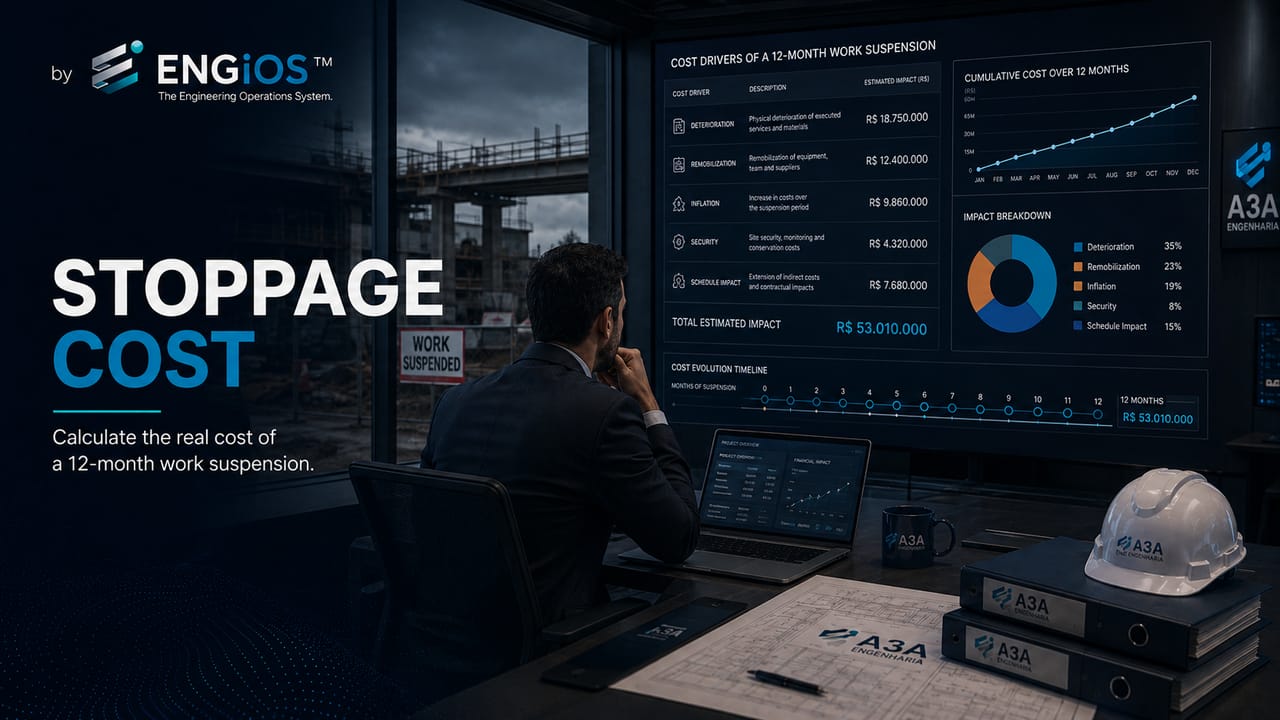
See how to calculate the real cost of leaving a public work stalled for 12 months, including price escalation, preservation, security, remobilization, deterioration, rework and redesign.
Check it out!
Leaving a public work stalled for 12 months costs far more than simply applying an inflation index to the contract balance. The real cost of stoppage combines price escalation of the remaining work, preservation of what has already been built, site security, demobilization and future remobilization, deterioration of materials and systems, loss of warranties, rework, redesign, extended administration and, depending on the case, economic-financial rebalancing effects and regulatory changes. There is also a social cost: the investment remains immobilized without delivering the public service for which it was conceived.
There is no universal percentage that allows one to state that “a project stalled for one year costs X% more.” Two projects with the same value may have completely different exposure profiles. A protected and stabilized concrete structure behaves one way; a building with open façades, partially installed systems and stored equipment behaves another; a treatment plant with motors, panels and instrumentation installed may accumulate much greater preservation and commissioning risks. A technically defensible calculation must be built by cost component, with traceable evidence and assumptions.
The mistake of calculating stoppage cost using inflation alone
Monetary adjustment of the balance is part of the problem, but it does not represent the total cost. In June 2026, the SINAPI National Civil Construction Index had accumulated 7.26% over 12 months, according to IBGE. This figure is useful for demonstrating that the cost environment changes during a stoppage, but it should not be applied automatically as if it represented the total loss of every project.
There are at least three reasons.
First, the national index is an aggregate reference. Each project has its own composition of labor, materials, equipment, logistics and specialized services.
Second, contractual price adjustment follows the legal framework and the index defined in the contract, which may differ from the variation observed in a national basket.
Third, stoppage creates costs that would not exist under continuous execution: protection, additional inspections, restoration, remobilization, design review and productivity losses.
Therefore, the correct question is not “which inflation rate should be applied?” but which additional costs were caused by the 12-month interruption and what evidence supports each component?
A stalled public work continues to consume resources
The image of an inactive construction site may suggest that spending has stopped. In practice, a partially completed asset continues to require actions to prevent loss of value.
Depending on the project, the following may still be required:
- site security;
- access control;
- fencing and signage;
- temporary drainage;
- pumping;
- cleaning and vegetation control;
- protection of openings;
- covering stored materials;
- minimum energization of systems;
- dehumidification or ventilation;
- inspection of temporary structures;
- maintenance of preserved equipment;
- periodic rotation of motors;
- lubrication;
- battery charging and monitoring;
- corrosion control;
- climate-controlled storage of sensitive components;
- insurance and administrative responsibilities;
- document management and monitoring of licenses.
When these actions are not performed, the cost does not disappear: it migrates into deterioration, replacement and future rework.
The cost of stoppage should be separated into components
A practical methodology is to structure the incremental cost of 12 months into blocks. The sum can be represented conceptually as:
Cost of stoppage = preservation + security + demobilization/remobilization + deterioration + rework + escalation of remaining work + extended administration + redesign/licenses + other demonstrated effects.
Not every component appears in every contract. The purpose of the structure is to prevent double counting and require the team to demonstrate the origin of each amount.
1. Preservation of work already completed
Preservation is the cost of keeping the partially completed asset in a recoverable condition. It should be planned from the moment the stoppage ceases to be a very short event and begins to threaten materials, systems or structures.
Structures and building envelope
In buildings, water is one of the main agents of damage. Incomplete roofs, waterproofing without protection, open façades and uninstalled windows allow wetting cycles that affect masonry, finishes, systems and metal components.
Preservation may require temporary closures, membranes, temporary gutters, drainage and periodic inspections.
Electrical and electronic systems
Exposed cables, panels without adequate environmental control, open terminations, partially energized equipment and humid environments increase the risk of contamination, corrosion and dielectric degradation.
Before restart, insulation-resistance testing, retightening, thermographic inspection after energization, technical cleaning, component replacement and recertification may be necessary.
Hydraulic systems and piping
Open piping may collect debris. Sections of fire-protection or water networks may remain with stagnant water. Valves and pumps may require specific preservation measures.
Mechanical and electromechanical equipment
Manufacturers normally define storage and preservation requirements. When the contract stops, these routines must be transferred to a conservation plan. Without records, the Administration may lose the ability to demonstrate that warranties and manufacturer conditions were maintained.
Preservation, therefore, should not be treated as “optional maintenance.” It is a way to protect capital already invested.
2. Asset security and physical safety of the construction site
Inactive construction sites are targets for theft, vandalism and unauthorized occupation. Cables, metals, equipment, plumbing fixtures, tools and high-value components are particularly exposed.
Beyond the direct loss, vandalism can damage adjacent work. Cable theft can damage conduits and panels; removal of windows exposes interiors; broken seals permit water infiltration; unauthorized access creates civil-liability and accident risks.
Security costs may include:
- on-site guards;
- temporary CCTV;
- lighting;
- access control;
- perimeter closure;
- reinforcement of doors and gates;
- patrols;
- insurance;
- inspection of risk areas.
When the stoppage is prolonged, this expense must be included in the comparison between keeping the site facilities in place, partially demobilizing or implementing permanent closure measures.
3. Demobilization and remobilization
Continuous execution spreads mobilization costs over the contract period. Stoppage breaks this logic.
Demobilization may involve removing equipment, dismantling temporary facilities, disconnecting utilities, returning areas, transporting materials and terminating support contracts.
Future remobilization repeats part of these costs:
- transporting equipment;
- reinstalling site facilities;
- new temporary utility connections;
- mobilizing labor;
- safety induction;
- reopening access routes;
- reinstalling warehouses and offices;
- equipment rental;
- new logistics planning;
- rebuilding engineering and supervision teams.
For remote projects or projects involving heavy equipment, this component may be materially significant.
4. Physical deterioration of the asset
Deterioration is different from preservation. Preservation is the preventive action; deterioration is the actual loss that must be corrected.
After 12 months, the team should compare current conditions with those recorded when the project stopped. Photographs, reports, tests, construction daily reports, measurements and previous inspections are essential for establishing this baseline.
Examples of deterioration in civil works
- cracking aggravated by exposure;
- reinforcement corrosion in vulnerable elements;
- loss of material from fills and slopes;
- erosion;
- degradation of exposed waterproofing;
- water infiltration;
- efflorescence;
- degradation of finishes;
- damage to gypsum or moisture-sensitive components;
- deformation or oxidation of temporary structures;
- contamination of stored materials.
Examples in technical systems
- oxidation of contacts;
- battery degradation;
- drying or aging of elastomers;
- internal contamination of piping;
- loss of calibration;
- lubricant degradation;
- improper storage damage to electronic equipment;
- expired consumables;
- firmware or software obsolescence;
- loss of warranty due to failure to meet preservation conditions.
Deterioration should be quantified through inspection and a recovery estimate, not by applying an arbitrary percentage to the value already executed.
5. Rework and loss of completed work
Part of the previous work may need to be demolished, redone or adapted to allow construction to continue.
This may occur because:
- materials deteriorated;
- temporary work became inadequate;
- the design was revised;
- an interface changed;
- standards or regulatory requirements evolved;
- the original solution became unavailable on the market;
- the remaining work requires a different construction sequence;
- concealed work lacks sufficient evidence of compliance.
Rework should be recorded separately so that it is not confused with the normal cost of the remaining work.
When the origin is a design failure, Law 14,133 requires investigation of the responsible technical professional when changes to public-works and engineering-services contracts result from those failures, in addition to measures to recover damages caused to the Administration.
6. Price escalation of the remaining work
The physical balance that still needs to be executed does not remain frozen in time. Labor, materials, equipment, freight and specialized services change in price.
SINAPI is Brazil’s main reference for public-works and engineering-service costs under the conditions defined by Decree No. 7,983/2013. CAIXA maintains the methodology, compositions and technical documentation, while IBGE is responsible for price surveys under the applicable system.
In June 2026, the national SINAPI index showed:
- monthly variation of 1.19%;
- year-to-date increase of 4.48%;
- 12-month increase of 7.26%;
- national average cost of R$ 1,976.37 per square meter for the system basket.
These data show the possible magnitude of cost movement, but they do not constitute a project estimate. The remaining work must be re-estimated using revised quantities, appropriate cost compositions, current reference prices and supplementary market research where necessary.
The article Price Research for Public Works and Engineering Services under Law 14,133 explains how the reference estimate is built.
7. Extended administration and indirect costs
Stoppage may extend the total duration of the project and generate additional management costs.
Even without full production, expenses may continue for:
- inspection staff;
- project management;
- administrative support;
- consulting engineering;
- insurance;
- licenses;
- information systems;
- rentals;
- legal and contractual support;
- document management;
- audits and inspections.
When construction restarts, the additional duration also extends the contractor’s site and head-office administration costs, depending on the contractual regime and each party’s responsibility.
Quantification must avoid turning every business expense into an automatic entitlement. The causal link among event, responsibility and cost must be demonstrated.
8. Redesign, design updates and new approvals
Twelve months may be sufficient for project conditions to change.
The site may have changed. New interferences may have been installed. Equipment may have been discontinued. Demand may have changed. Designs may contain errors identified during the first execution. Licenses may require renewal.
Restart may require:
- an updated cadastral survey;
- inspection of the as-built condition;
- review of the basic design;
- detailed design development;
- multidisciplinary coordination;
- review of design reports and specifications;
- updated cost estimate;
- new schedule;
- updated risk matrix;
- environmental revalidation;
- new approvals from utility companies;
- review of operation and maintenance requirements.
These services are part of the restart cost even if they did not appear in the original estimate.
9. Expired or changed licenses, permits and conditions
Some permits have expiration dates. Others depend on conditions that may change during stoppage.
The cost may include supplementary studies, fees, design adaptations, compliance with new conditions and repetition of administrative stages.
In linear infrastructure and sanitation projects, changes in urban and environmental occupation may alter the feasibility of previously planned sections.
The team should prepare a matrix with document, issuing authority, validity, conditions, current status and action required for restart.
10. Financial cost and the time value of money
Public funds invested in a project that has not been delivered remain immobilized. Even when there is no direct contractual financing cost, there is an economic cost: capital was consumed before the benefit was generated.
For investment analysis, this effect can be studied through present value, opportunity cost and delayed benefits. However, it is important to separate this economic analysis from recognizable contractual costs.
An Administration should not indiscriminately add “opportunity cost” to a contract-amendment worksheet. Economic analysis supports portfolio decisions and prioritization; contractual instruction follows its own legal criteria and evidence.
The article on the time value of money in engineering projects explores this distinction in greater depth.
11. The social cost of a stalled public work
An unfinished school does not provide seats. A closed health-care facility does not provide care. A wastewater plant does not reduce pollutant loads. A bridge does not reduce travel time. A drainage project does not protect the population from the event that justified the investment.
The social cost should not be confused with the contractual worksheet, but it must appear in restart prioritization.
Possible indicators include:
- number of people without service;
- education places not made available;
- health-care services not provided locally;
- volume of water or wastewater left untreated;
- travel time not reduced;
- flood risk not mitigated;
- accidents or interruptions not mitigated;
- public revenue or economic activity delayed;
- cost of temporary solutions maintained while the asset remains out of operation.
This component explains why two projects with similar financial costs may have very different priorities.
How to build the cost calculation for a 12-month stoppage
The calculation must be traceable. A recommended structure contains, for each component:
| Component | Calculation basis | Evidence | Responsibility | Value |
| Preservation | services actually required | plan, contracts, invoices, measurements | according to cause/allocation | R$ |
| Security | monthly cost × period | contracts and records | according to contract | R$ |
| Remobilization | resources required for restart | quotations/cost compositions | according to event | R$ |
| Deterioration | damaged items × recovery | condition report and estimate | cause to be determined | R$ |
| Rework | quantities redone | design/revision/RDO | cause to be determined | R$ |
| Escalation of remaining work | new estimate – comparable baseline | SINAPI/SICRO/market research | restart estimate | R$ |
| Redesign | deliverables and HTEs/scope | Terms of Reference/proposal/calculation | Administration/cause | R$ |
| Extended administration | demonstrated incremental resources | payroll, contracts, schedule | contractual nexus | R$ |
The table forces the team to separate observed cost from estimates and responsibility from mere occurrence.
Numerical example: why the final percentage varies so much
Consider, for illustration only, a project with a R$ 10 million remaining physical balance when it was interrupted. Assume that, after 12 months, the analysis identifies:
- reference escalation of remaining work: R$ 726 thousand;
- preservation and inspections: R$ 120 thousand;
- site security: R$ 180 thousand;
- remobilization: R$ 250 thousand;
- recovery of deteriorated work: R$ 400 thousand;
- design review, surveys and licenses: R$ 150 thousand;
- additional management and inspection costs: R$ 300 thousand.
The incremental cost would be R$ 2.126 million, equivalent to 21.26% of the hypothetical balance.
This figure is not a recommended rate and cannot be transferred to another project. It merely demonstrates that stoppage cost can be much greater than the price-escalation index. In another project, preservation and deterioration may be almost negligible; in a facility with critical equipment, they may dominate the calculation.
The example also shows why applying only 7.26% to the balance would fail to capture R$ 1.4 million in the other hypothetical components.
How to measure deterioration without arbitrarily assigning percentages
The real cost of a restart appears only when the physical condition of the asset is converted into quantities: what can be reused, what requires testing, what needs recovery and what must be replaced. Due Diligence creates this baseline before the new estimate.
The best approach is item by item.
Step 1 — establish the baseline
Use the last measurement before stoppage, photographs, RDOs, inspection reports, inspections, tests and storage records.
Step 2 — inspect current conditions
Record anomalies, exposure, damage, losses, material condition and equipment condition.
Step 3 — classify each item
- usable without intervention;
- usable after inspection/testing;
- recoverable;
- partially replaceable;
- not suitable for reuse;
- condition indeterminate until testing.
Step 4 — define the technical action
Cleaning, repair, testing, replacement, recalibration, reinstallation, protection or disposal.
Step 5 — estimate the action
Apply quantities, cost compositions, quotations and reference prices.
This process turns “deteriorated project” into a verifiable cost calculation.
What happens to materials purchased but not installed
Stored materials require a physical and documentary inventory.
For each item, verify:
- quantity;
- manufacturer and model;
- batch;
- manufacturing date;
- packaging condition;
- storage location;
- exposure to humidity and temperature;
- expiration date;
- warranty;
- fiscal documentation;
- certificate of conformity;
- correspondence with the current design;
- availability of replacement components from the same product family.
Materials that remain technically suitable are reusable assets. Obsolete or deteriorated materials represent additional cost. The decision must be documented to avoid both unnecessary disposal and use of unreliable items.
Equipment requires its own preservation and recommissioning strategy
In electrical systems, automation, HVAC, pumping, electronic security and process equipment, restart should not consist simply of energizing equipment that has remained idle.
It may be necessary to perform:
- detailed visual inspection;
- technical cleaning;
- retightening;
- insulation testing;
- continuity testing;
- grounding verification;
- mechanical inspection;
- lubrication;
- alignment;
- calibration;
- software update;
- input and output testing;
- functional testing;
- integrated testing;
- interlock verification;
- review of manufacturer documentation.
This effort is part of the real cost of restarting technical installations after a long interruption.
How stoppage changes the restart schedule
The new schedule does not start where the old one ended. Before normal production resumes, there is a phase for recovering readiness.
It may include:
- mobilization of the diagnostic team;
- survey of completed work;
- testing and inspections;
- design review;
- estimate update;
- regularization of licenses;
- procurement of the remaining work;
- mobilization of the new contractor;
- recovery and preservation;
- productive restart.
Ignoring these stages creates an artificially short schedule and increases the risk of delay at the very beginning of the new contract.
Stoppage also changes the risk of the new procurement
The remaining work on an old project does not have the same risk profile as a new project.
The new contractor will encounter:
- work executed by a third party;
- partially known concealed conditions;
- existing materials;
- legacy interfaces;
- possible discrepancies between design and field conditions;
- expired warranties;
- incomplete documentation;
- quality liabilities;
- access limitations;
- need to integrate legacy systems.
Therefore, the procurement documents must provide enough information for pricing and clearly define responsibility for preexisting defects, recovery, testing and interfaces.
The content on remaining public works details this preparation.
Who pays the costs of stoppage
This question cannot be answered simply because the project stopped. Cause, responsibility, risk matrix, contract, administrative decisions and causal nexus must be identified.
Some costs may arise from an event attributable to the Administration; others from contractor default; others from an allocated risk; others from design failure; and others may need to be treated as supervening conditions under the applicable legal regime.
Law 14,133 establishes mechanisms for contract changes and restoration of economic-financial balance in specific situations. It also requires, in Article 124, §1, investigation of the responsible technical professional when changes to public-works and engineering-services contracts result from design failures.
The record should separate:
- triggering event;
- date of the event;
- responsibility;
- effect on the critical path;
- incremental cost;
- mitigation measures;
- supporting documents.
Without this chain, the amount may even be correct, but the decision remains technically fragile.
How to prevent the cost from growing during stoppage
When interruption is unavoidable, the Administration should implement a project hibernation plan.
This plan should define:
- safe shutdown condition for each system;
- closure of work fronts;
- drainage;
- weather protection;
- equipment preservation;
- material inventory;
- asset control;
- inspection routines;
- security;
- minimum maintenance;
- documentation updates;
- responsible parties;
- recording frequency;
- restart criteria.
The cost of a preservation plan is usually much more controllable than the cost of discovering months later that entire systems require recovery.
The earlier the diagnosis, the lower the uncertainty in the restart estimate
After diagnosis, the remaining-work estimate must separate completion, recovery, remobilization and restart costs. This allows a reference price to be formed without hiding losses inside generic percentages.
After a stoppage, the first estimate is often an order-of-magnitude estimate. Accuracy increases as the team converts uncertainties into evidence.
The recommended sequence is:
- gather documents;
- establish the baseline of completed work;
- inspect current conditions;
- test critical items;
- classify reusability;
- review designs;
- survey remaining quantities;
- identify recovery services;
- update prices;
- include mobilization, management and commissioning;
- consolidate contingencies for residual risks.
Technical Engineering Due Diligence is particularly suitable for this phase because it integrates physical condition, documentation, compliance and risk before the new procurement.
An indicator model for portfolios of stalled public works
To compare several projects, the Administration can create an internal cost-of-waiting indicator without confusing it with a contractual entitlement.
For example:
Estimated monthly cost of waiting = preservation + security + minimum administration + expected deterioration + estimated escalation of remaining work + weighted social cost.
The social component can be normalized into points rather than currency. The purpose is to prioritize decisions.
A health-care project with a low physical cost of waiting but high social criticality may receive priority over another project with a higher absolute value.
The cost of a 12-month stoppage should influence the decision to suspend
Before a prolonged suspension, the manager should compare scenarios.
Scenario A — continue at a reduced pace
This may avoid demobilization but extend indirect costs and reduce productivity.
Scenario B — stop completely
This reduces production but creates preservation, security and remobilization costs.
Scenario C — perform technical closure and suspend
This completes systems necessary to protect the asset before hibernation.
Scenario D — terminate and immediately prepare the remaining work
This may accelerate a new procurement when continuing with the current contractor is unviable.
The decision should consider total cost, schedule, legal risk, asset condition and public benefit.
Final considerations
A public work stalled for 12 months does not have a universal “loss rate.” The real cost must be built as a technical calculation: escalation of remaining work, preservation, security, remobilization, deterioration, rework, redesign, extended administration, licenses and other demonstrated effects.
The SINAPI index accumulated over 12 months can demonstrate cost pressure, but it is only one layer. The most common mistake is to update the worksheet and ignore everything that happened to the asset while the contract was suspended.
The safest way to control the cost is to act early: record the condition of the work, implement a preservation plan, maintain inventory and documentation, monitor deterioration and prepare the restart diagnosis before knowledge about the project is lost.
When the Administration treats stoppage as a technical period that must be managed — rather than merely the absence of construction — it protects the investment already made and reduces the cost and uncertainty of the future completion contract.
Technical references
[1] BRAZILIAN INSTITUTE OF GEOGRAPHY AND STATISTICS. National Civil Construction Index accelerates to 1.19% in June. Rio de Janeiro: IBGE, July 10, 2026. Available at: https://agenciadenoticias.ibge.gov.br/agencia-sala-de-imprensa/2013-agencia-de-noticias/releases/47537-indice-nacional-da-construcao-civil-acelera-para-1-19-em-junho
[2] CAIXA ECONÔMICA FEDERAL. SINAPI — National System for Research on Civil Construction Costs and Indexes. Brasília, DF: CAIXA. Available at: https://www.caixa.gov.br/poder-publico/modernizacao-gestao/sinapi/Paginas/default.aspx
[3] CAIXA ECONÔMICA FEDERAL. SINAPI: Methodologies and Concepts. Brasília, DF, 2026. Available at: https://www.caixa.gov.br/Downloads/sinapi-metodologia/Livro_SINAPI_Metodologias_Conceitos.pdf
[4] BRAZILIAN CHAMBER OF THE CONSTRUCTION INDUSTRY. In interview, CBIC president discusses obstacles to resuming public works. Brasília, DF, May 28, 2019. Available at: https://cbic.org.br/em-entrevista-presidente-da-cbic-aborda-entraves-para-a-retomada-de-obras-publicas/
[5] BRAZILIAN CHAMBER OF THE CONSTRUCTION INDUSTRY. CBIC presents study on the main causes of stalled public works in Brazil. Brasília, DF, December 15, 2023. Available at: https://cbic.org.br/cbic-apresenta-estudo-sobre-principais-causas-de-obras-paralisadas-no-brasil/
[6] BRAZIL. Law No. 14,133 of April 1, 2021. Public Procurement and Administrative Contracts Law. Brasília, DF: Presidency of the Republic. Available at: https://www.planalto.gov.br/ccivil_03/_ato2019-2022/2021/lei/l14133.htm
Frequently asked questions
There is no average percentage that can technically be applied to every project. Cost depends on the remaining balance, asset exposure, preservation needs, deterioration, remobilization, price escalation, installed systems, licenses and other factors. The correct approach is to build a component-by-component cost calculation.
No. SINAPI helps assess cost references and movement in the sector, but stoppage also generates preservation, security, deterioration, rework, remobilization, redesign and management costs. Contractual price adjustment must also follow the regime and index applicable to the contract.
Establish the condition at the stoppage date, inspect current conditions, classify each item as usable, recoverable or replaceable, define the required technical intervention and estimate the quantities. Avoid applying a generic percentage to the value already executed.
Often, yes. The need depends on the equipment and manufacturer instructions, but inspection, cleaning, electrical and mechanical tests, lubrication, calibration, software updates and recommissioning may be required before operation.
It depends on the cause and risk allocation. The triggering event, responsibility, causal nexus, schedule effect and incremental cost must be demonstrated. Some situations are attributable to the Administration, others to the contractor, design failure or risks defined contractually.
It is the set of measures used to place an interrupted project in a safe and preserved condition: closing work fronts, drainage, weather protection, equipment preservation, inventory, security, periodic inspections, documentation and criteria for future restart.
Complementary technical materials
Related solutions
- Contracts, Scope and Deliverables Management
- Document Governance and Document Management System
- Project, Program and Portfolio Governance
Related services
- Technical Engineering Due Diligence
- Public Works and Engineering Services Cost Estimating
- Engineering Cadastral Survey
- Technical Analysis of Amendments, Scope Changes and Claims
- Technical Support for Public-Works and Engineering-Contract Inspection
- Owner’s Engineering
Key content on this topic
- Stalled Public Works in Brazil: Updated TCU Map and Most Affected Sectors
- How to Restart a Stalled Public Work: 8-Step Technical Protocol
- Survey of Completed Work and Condition Assessment
- Remaining Public Works: How to Procure What Is Left Without Inheriting the Previous Contract’s Problems
Related technical content
- Price Research for Public Works and Engineering Services under Law 14,133
- SINAPI Social Charges in Public Works
- Time Value of Money in Engineering Projects
- Economic-Financial Rebalancing in Engineering Contracts
- Delay Analysis and Time Impact Analysis in Engineering
- Complete Guide to Cost Engineering and Estimating
- Owner’s Engineering: Executive Framework for Contracting, Governance and Acceptance
