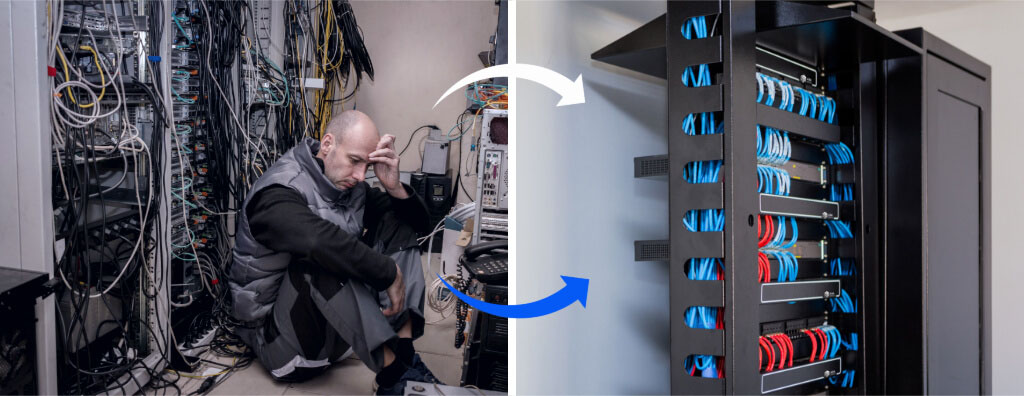
Understand the benefits of structured cabling: predictable performance, reliability, scalability, maintenance, documentation, certification and investment protection.
Check it out!
Structured cabling delivers benefits when it transforms the physical network into a planned, standardized, documented and verifiable infrastructure. The most relevant gains are greater performance predictability, fewer installation-related failures, easier maintenance, expansion capacity, better asset organization and a longer useful life for the investment. These results, however, do not come merely from choosing a cable category: they depend on design, pathways and spaces, installation, identification, certification and final documentation.
What are the main benefits of structured cabling?
The benefits only materialize when performance requirements, pathways, components, identification, testing and documentation are defined before installation.
A structured cabling system organizes the physical telecommunications layer independently of the specific applications that will use the infrastructure. Instead of creating point-to-point connections for each new need, the organization gains a common foundation for data, voice, Wi-Fi access points, IP telephony, IP video surveillance, access control, IoT devices and other compatible applications.
The most relevant benefits can be summarized in eight groups:
- predictable performance;
- greater physical-layer reliability;
- scalability;
- flexibility for changes;
- simpler maintenance and troubleshooting;
- better documentation and traceability;
- greater investment protection;
- objective testing and acceptance criteria.
These benefits are directly connected to the principles presented in the Complete Guide to Structured Cabling and to the design, installation and performance requirements addressed by NBR 14565.
Predictable performance
The main technical advantage is not simply “having a fast network,” but knowing in advance which applications, frequencies and performance classes the infrastructure was designed to support. Cabling category, link length, number of connections, component quality, bend radius, pulling practices, termination and proximity to interference sources all influence channel behavior.
When these elements are defined in the design and later verified in the field, performance no longer depends only on user perception and becomes demonstrable through measurable criteria. It is the difference between an installation that appears to work and an infrastructure whose capability has been technically proven.
Greater physical-layer reliability
Network failures are not always in switches, servers or applications. Poorly terminated connectors, unsuitable patch cords, damaged cables, improvised splices, excessive pulling tension, crushing, moisture and electromagnetic interference can produce intermittent symptoms that are difficult to diagnose.
Structured cabling reduces this risk by imposing an architecture, compatible components, installation procedures, identification and testing. The resulting reliability is especially important in environments where connectivity supports critical services or production processes.
Scalability without rebuilding the infrastructure
A properly sized infrastructure allows growth without turning every expansion into a new construction project. Spare ports, racks, fiber distribution frames, pathways, shafts, fibers and distribution capacity should be considered from the design stage.
Scalability in structured cabling designs does not mean installing unlimited capacity. It means defining reserves consistent with the facility life cycle and plausible growth scenarios.
When expansion has been considered from the beginning, adding new outlets, equipment or areas tends to require less physical intervention and cause less downtime.
Flexibility for layout changes and new applications
Offices, industrial plants, institutional buildings and mission-critical environments change throughout their service life. Teams move, areas are renovated, access points are repositioned and new applications emerge.
A structured architecture makes these changes easier because it separates permanent cabling from patching connections. Reconfiguration occurs primarily at consolidation points, patch panels, racks and distributors, avoiding unnecessary intervention in installed cabling.
This flexibility also favors IP convergence. Cameras, telephones, access points, controllers and sensors can share common physical distribution principles, provided their bandwidth, power, distance and environmental requirements are included in the design.
Faster maintenance and evidence-based troubleshooting
In existing networks, surveys and diagnostics make it possible to separate localized failures from systemic deficiencies before deciding on replacements or expansions.
In non-standard installations, much of the maintenance time is spent trying to determine where each cable starts, where it ends and what it serves. In a structured infrastructure, identification, port maps, drawings, diagrams, certification reports and As Built documentation reduce this uncertainty.
The physical organization of network racks and patch panels also reduces patching errors and facilitates component replacement.
When a certification baseline exists, a future problem can be compared with the delivery results. This comparison helps distinguish physical degradation, unauthorized changes and active-layer failures.
Documentation and traceability stop being accessories
The operational benefit of structured cabling depends directly on documentation. An outlet without reliable identification or a link without correspondence to drawings and reports loses much of the governance value that standardization should provide.
The documentation set should reflect the actual installed condition and include, as applicable to the scope:
- identification of racks, patch panels, fiber distribution frames, cables and outlets;
- drawings and infrastructure routes;
- outlet and port schedules;
- backbone diagrams;
- certification results;
- nonconformity and corrective-action records;
- As Built documentation.
This record set reduces dependence on informal knowledge and improves infrastructure handover between implementation, operation and maintenance.
Structured cabling protects the investment but does not eliminate engineering decisions
Passive infrastructure normally remains in service longer than many active devices. Switches, access points and servers may be replaced several times during the cabling life cycle. Therefore, a poor decision at the physical layer can constrain successive generations of equipment.
Investment protection comes from alignment between design and technology horizon. For copper cabling, for example, the choice between Cat6 and Cat6A should consider application, distance, electromagnetic environment, PoE, density and expected evolution — not only unit price. The technical comparison is detailed in Cat6 vs. Cat6A.
Likewise, optical fiber should be considered when distance, capacity, electromagnetic immunity, backbone or redundancy requirements justify its use.
Certification turns quality into an acceptance criterion
Another decisive benefit is the ability to objectively verify installation performance. For balanced copper links, field certification makes it possible to assess parameters defined for the applicable category or class, using a test instrument and configuration compatible with the link being accepted.
The result should be analyzed link by link and not merely summarized in a generic statement that “the network was tested.” Reports, identification and correspondence with the As Built are part of the acceptance process.
The article Network Certification: Process, Tests, Reports and Technical Acceptance covers this stage in greater depth.
Economic benefits: where the return actually appears
The return should not be treated as an automatic guarantee. It depends on the context, the cost of downtime, the volume of changes, the life cycle and the quality of implementation.
Economic gains normally appear in four areas:
| Area | Expected effect |
| Maintenance | less time spent identifying pathways, ports and faults |
| Changes | less need for physical intervention during rearrangements |
| Expansion | use of reserves and architecture sized in advance |
| Technology refresh | ability to replace active equipment without rebuilding the entire passive layer |
In environments where a network outage affects production, customer service, security or corporate operations, reducing failures and diagnostic time can have a greater economic impact than the savings obtained simply by choosing the lowest-priced component.
When the benefits do not appear
Installing cables of a good category does not automatically turn an installation into high-quality structured cabling. The benefits are reduced when there are:
- insufficient or nonexistent design;
- a mix of components without compatibility verification;
- undersized pathways;
- installation outside mechanical limits;
- lack of proper separation and treatment of interference;
- inconsistent identification;
- incomplete certification or incorrect test configuration;
- As Built documentation that differs from the installed condition.
For this reason, the process should be viewed as an engineering cycle: survey, requirements, design, procurement, implementation, inspection, testing, nonconformity correction and document handover.
How to turn the benefits into design requirements
The design should convert abstract objectives — performance, reliability, expansion — into verifiable requirements. These include topology, outlet quantities, categories and classes, backbone, pathways and spaces, racks, power for active equipment, grounding and bonding where applicable, identification, certification criteria and documentation.
The Structured Cabling Design page details how these requirements are structured before implementation.
For existing installations, the decision may require an as-is survey and diagnosis before defining what should be retained, corrected, expanded or replaced.
Final considerations
The main benefits of structured cabling are the result of standardization and engineering, not merely the presence of cables and connectors of a certain category. Predictable performance, reliability, scalability, flexibility, simplified maintenance, traceability and investment protection appear when the system is designed, installed, certified and documented as an integrated whole.
The best way to assess an infrastructure, therefore, is not only to ask “which cable was installed?” but also “which requirement was adopted, how was it installed, how was it tested and where is it documented?”
Certification and inspection turn infrastructure handover into an evidence-based acceptance process, reducing dependence on visual assessment or isolated functional tests.
Technical references
[1] BRAZILIAN ASSOCIATION OF TECHNICAL STANDARDS. ABNT NBR 14565:2019 — Structured cabling for commercial buildings. Rio de Janeiro: ABNT, 2019. Available at: https://www.abntcatalogo.com.br/
[2] ISO/IEC. ISO/IEC 11801-1:2017 — Information technology — Generic cabling for customer premises — Part 1: General requirements; including Amendment 1:2025. Available at: https://www.iso.org/standard/66182.html
[3] TELECOMMUNICATIONS INDUSTRY ASSOCIATION. ANSI/TIA-568.2-E — Balanced Twisted-Pair Telecommunications Cabling and Components Standard. Arlington: TIA, 2024. Available at: https://tiaonline.org/standardannouncement/tia-publishes-new-standards-ansi-tia-568-2-e-and-ansi-tia-568-5-1/
[4] IEC. IEC 61935-1:2019 — Specification for the testing of balanced and coaxial information technology cabling — Part 1: Installed balanced cabling. Available at: https://webstore.iec.ch/en/publication/31201
Frequently asked questions
The main benefits are predictable performance, greater physical-layer reliability, scalability, flexibility for changes, simpler maintenance, document traceability, investment protection and objective testing and acceptance criteria.
It can enable the performance intended for the application, but it does not by itself increase the speed of active equipment. The result depends on link category or class, lengths, components, installation, certification, and the connected switches and devices.
It can mainly reduce diagnostic, rearrangement and expansion time when the installation is identified, documented and certified. The economic gain depends on the environment and on the operational cost associated with interventions.
A structured architecture allows spare ports, racks, pathways, fibers and distribution capacity to be planned. This makes expansion possible with less physical intervention and lower risk of downtime.
Certification is fundamental to turning performance into a verifiable acceptance criterion. It does not replace inspection and documentation, but it demonstrates whether the tested links meet the limits defined for the applicable configuration and category or class.
Not as an isolated decision. Cat6A provides greater margin for 10 Gigabit Ethernet over 100 m and a higher nominal frequency, but the choice should consider application, distance, environment, PoE, density, physical space, cost and technology horizon.