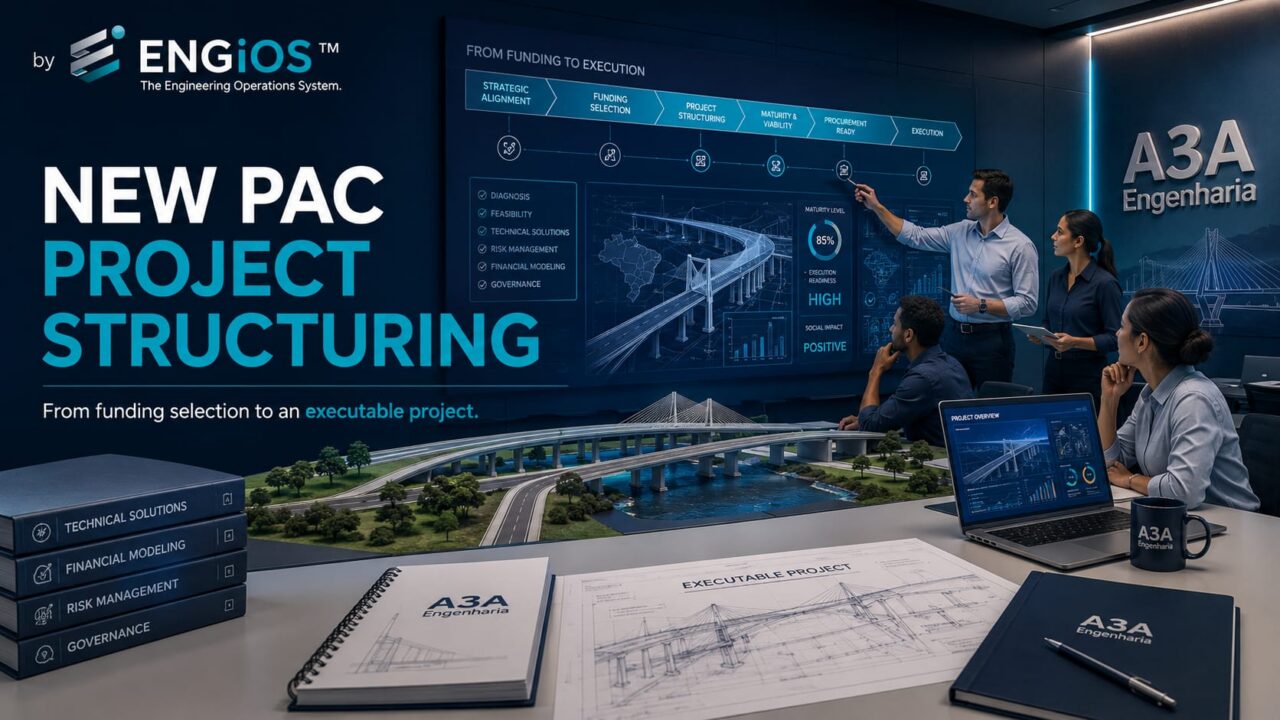
Understand how to structure Novo PAC public-works projects: maturity, studies, design, budgeting, procurement, operational capacity, inspection and delivery.
Check it out!
Under Novo PAC, being selected to receive investment is an important political and budgetary milestone, but it does not mean that a public-works project is ready for procurement or construction. Between selection and delivery lies an engineering phase that determines execution quality: structuring the project, maturing studies and designs, resolving site and licensing issues, developing a reliable budget, defining the contracting strategy, organizing governance, demonstrating operational capacity and preparing inspection, measurements and acceptance. When this phase is compressed, pressure to “start immediately” can produce exactly what the program seeks to avoid: rework, amendments, delays and stoppages.
Current Novo PAC regulations explicitly recognize this need. Joint Ordinance MGI/MF/CGU No. 32/2024, as subsequently amended, governs mandatory transfers through commitment agreements and now includes, among execution levels, scopes dedicated solely to plans, engineering designs, EVTEA and project structuring and modeling studies, as well as specific treatment for disaster-risk-reduction works. For the executing entity, the practical interpretation is clear: design is not a bureaucratic stage before construction; it is intellectual infrastructure that allows the investment to be contracted, executed and accepted safely.
Novo PAC: funding needs to reach an executable project
Novo PAC brings together investments from different sources and sectors and uses multiple execution arrangements. States, municipalities, consortia, federal agencies, state-owned companies and private agents may act as executors depending on the modality. This diversity prevents a single recipe, but there is one common principle: the project needs maturity proportional to its risk before execution contracts are committed.
In public works, maturity means reducing uncertainties that can be resolved before procurement. An executable project needs to answer enough about scope, site, interfaces, performance, quantities, budget, licenses, expropriations, risks, schedule and acceptance criteria for the market to price the work and for the Administration to inspect it.
The difference is critical. Selecting a scope called “construction of a facility,” “system expansion” or “infrastructure implementation” defines the public policy. Structuring the project converts that objective into a technical package that can be procured.
Selected, qualified, contracted and executed are different states
Official Novo PAC pages publish selected and qualified proposals by modality. These states should not be confused with a procured public work or a contract under execution.
From a management perspective, the project should be treated through successive gates:
- public need prioritized;
- proposal selected or classified;
- requirements and conditions identified;
- studies and design matured;
- budget and schedule validated;
- instrument and transfer conditions satisfied;
- contracting prepared;
- procurement completed and contract ready;
- physical execution mobilized;
- commissioning, acceptance and operation.
Skipping gates does not eliminate work; it only shifts decisions into a more expensive phase. A design error discovered before procurement is a revision. The same error discovered after the contractor has mobilized can become a stoppage, amendment, claim and time extension.
Novo PAC regulations explicitly created room for project structuring
Joint Ordinance No. 32/2024 governs mandatory transfers for Novo PAC actions executed through commitment agreements. In July 2026, Joint Ordinance No. 48 changed the classification of levels and included a specific level for isolated execution of plans, engineering designs, technical, economic and environmental feasibility studies and project structuring and financial-modeling studies, regardless of the transfer amount.
This evolution is relevant because it recognizes a recurring public-infrastructure problem: not every selected entity has, at the time of prioritization, a project ready for procurement. Funding or structuring the engineering phase may be more efficient than pressuring the Administration to procure an immature scope.
The manager should use this logic even when the project is not formally classified under that modality. Before thinking about the procurement date, the team should define which engineering deliverables need to exist for the contracting process to be technically defensible.
The first deliverable should be a project maturity map
Selection under Novo PAC should begin a disciplined structuring phase: diagnosis, alternatives, design, budget, risks and governance before the investment becomes a procurement notice.
Structuring should begin with diagnosis, not with automatic production of drawings. The team needs to understand what already exists, what is reliable and what is missing.
The maturity map can organize gaps into blocks:
| Dimension | Maturity questions |
| need and scope | has the public problem been translated into verifiable requirements? |
| site and ownership | is the site available and compatible with the scope? |
| surveys | are topography, records, geotechnical data and interferences sufficient? |
| licensing | which licenses, authorizations and studies are conditions? |
| engineering | are conceptual, basic and executive designs available at the required level? |
| budget | do quantities and costs reflect the current design? |
| schedule | does the schedule include licenses, procurements and interfaces? |
| contracting | are the delivery method and strategy compatible with maturity? |
| capacity | does the executor have the team and processes to govern the project? |
| operation | is it defined how the asset will be tested, accepted and operated? |
The diagnosis should result in a list of decisions and deliverables, each with an owner and deadline. This allows the entity to manage the pre-construction phase as a project in itself.
Feasibility studies prevent starting with the wrong solution
Significant projects should not begin with the question “what design are we going to draw?” but with “which alternative best meets the need considering cost, schedule, risk and operation?” Concept studies, EVTEA and comparative assessments reduce the risk of crystallizing a poor solution simply because it was the first one drawn.
In mobility, sanitation, energy, large buildings and urban infrastructure, route, technology, capacity, location and phasing alternatives can produce substantial differences in CAPEX, OPEX and socio-environmental impacts.
The Conceptual Engineering Design service is an example of a phase specifically intended to compare alternatives and define the solution architecture before detailed design.
Structuring a Novo PAC project means preserving room for this decision before budget and contracting prematurely close off options.
Surveys and local conditions come before detailing
Designing without understanding the site transfers uncertainty to the contractor. Structuring should identify which surveys support the disciplines: cadastral, topographic, geotechnical, hydrological, existing networks, interferences, structural condition, electrical demand, telecommunications, access and others depending on the scope.
The required accuracy depends on the phase. The problem is not lacking all data at the beginning; it is advancing phases without recognizing which assumptions remain open and what risk they create.
In retrofits or expansions of existing infrastructure, the cadastral gap tends to be even more critical. The design needs to reflect the actual asset, not only historical documents that may no longer match field conditions.
Ownership, expropriation and licensing cannot be left for later
Site, licensing and environmental conditions are classic causes of delay when treated as project attachments. The project needs early knowledge of land status, required strips, easements, expropriations, authorizations and licenses.
In the public-works cluster, the article on expropriation and licensing shows how these risks should be addressed in project structuring and contract allocation.
Under Novo PAC, some sector-specific selections already require specific documentation and studies. In urban mobility, for example, official criteria may require a functional design or pre-feasibility study and a land-status report. This reinforces that required maturity varies by modality and must be read in the regulations and manuals of the responsible agency.
Basic design must support decision-making, budgeting and inspection
Basic design should not be interpreted as an intermediate drawing produced only to satisfy a checklist. It needs to characterize the scope, develop the reference price, define methods and performance, identify relevant services and support future inspection.
When the Administration still needs to decide during construction issues that should have been defined in the basic design, the contract becomes an environment for developing the scope. This inversion increases risk.
The technical review of Terms of Reference for public works and engineering services and design review should verify consistency among drawings, specifications, technical narratives, spreadsheets, schedules and measurement criteria.
The article public works without an executive design: what Law 14,133 requires before starting complements the analysis by separating responsibilities according to the delivery method.
Standardized design does not eliminate local engineering
Standardized designs can accelerate programs with high repetition, such as schools, healthcare units and public facilities. But standardization does not mean copying a solution without adaptation.
Federal-transfer regulations were updated in 2026 to address declarations and responsibilities of recipients adopting standardized designs, including adaptations required by local characteristics, foundations, complementary works, compliance with local legislation and technical standards, and budget compatibility.
This exposes a practical point: the advantage of standardization lies in reusing intelligence where the problem is repeatable; local engineering remains responsible for what depends on soil, siting, climate, networks, access, licensing, loads, utilities and interfaces.
An entity that treats a standardized design as a closed package risks discovering incompatibilities only after construction starts.
The budget should come from the design, not run in parallel
Design and budget are two representations of the same scope. If they change separately, the process loses consistency.
During structuring, every significant design change should produce a cost and schedule assessment. Quantities need to be traceable to drawings and specifications. Cost compositions should use appropriate references, such as SINAPI and SICRO where applicable, while respecting project-specific characteristics and public-budget rules.
The content on SINAPI, BDI in public works and engineering services and price research for public works under Law 14,133 helps structure this layer.
A good practice is to close a technical-budget baseline before procurement: design version, budget, schedule and assumptions that form the contracting package.
The schedule needs to include decisions, not only construction activities
Poorly structured schedules show only excavation, structure, installations and finishes. The actual critical path may run through licenses, utility approvals, equipment manufacturing, imports, site release, executive design, testing or integration.
Under Novo PAC, where projects can face strong pressure for delivery, ignoring these dependencies produces political dates without a corresponding technical path.
The structuring schedule should integrate:
- design development and review;
- approvals and licenses;
- expropriation and site release;
- procurement and appeals;
- mobilization;
- long-lead procurements;
- execution by work fronts;
- testing and commissioning;
- documentary delivery;
- assisted operation where applicable.
The completion date should be a consequence of this dependency network, not merely a target inserted at the top of a spreadsheet.
Defining the delivery method requires understanding design maturity
Law No. 14,133/2021 provides different delivery methods for public works and engineering services. The choice cannot be based only on administrative preference.
The less mature the solution definition, the greater the need to understand which risks are being transferred and whether the market can assume those risks in a priceable manner. Integrated or semi-integrated contracting is not a mechanism for eliminating planning; it requires performance requirements, a consistent preliminary design, a risk allocation matrix and robust governance.
In contracts where detailed design is provided by the Administration, the quality of that design becomes even more central. Design errors may generate changes and specific responsibilities.
The risk allocation matrix should reflect risks actually identified during structuring, not a generic table copied from another project.
Procurement is a test of structuring quality
Before publication, design, Terms of Reference, budget and procurement notice need to tell the same technical story. An independent review reduces ambiguities that later appear as clarifications, amendments and claims.
See the technical review of procurement notices and attachments
When dozens of clarification requests arise around the same issue, proposals show very different interpretations or prices are extremely dispersed, it may signal that the market received an unclear scope.
Procurement also reveals whether qualification requirements are proportional and whether the reference budget matches market reality. Before publication, it is advisable to perform a technical review of the procurement notice and attachments to verify consistency among the documents.
After proposals are opened, the Administration needs to analyze feasibility methodically. Accepting a price without execution capacity does not save funding; it may only postpone the cost until termination or procurement of the remaining scope.
The executor must demonstrate capacity to govern the project
A national program can transfer resources at a scale much larger than the historical capacity of some executing entities. Therefore, structuring should assess not only the design, but also the organization that will administer it.
The article operational capacity to execute grant-funded public works presents a diagnosis covering governance, engineering, procurement, inspection, finance, systems and acceptance.
For Novo PAC projects, this assessment should determine whether the entity has:
- available managers and inspectors;
- compatible specialties;
- routines for decisions and changes;
- capacity to process measurements;
- a team for Transferegov.br and accountability;
- financial planning;
- document control;
- a structure to accept and operate the asset.
When gaps exist, they need to be corrected before execution accelerates.
Transferegov.br should follow the project’s actual lifecycle
Actions executed through federal transfers use Transferegov.br according to the applicable instrument. In the public-works module, the system organizes basic-design information, budget, procurement process, contract and execution monitoring, including measurements and certifications.
The guide to Transferegov agreements for public works shows the operational workflow. For Novo PAC, the key point is not to create two realities: one project executed on site and another updated late in the system.
Designs, contracts, measurements, changes and evidence need to remain consistent. This discipline facilitates oversight by the grantor or agent, accountability and decision-making by the executing entity itself.
Inspection should be designed before the notice to proceed
It is too late to decide “how to inspect” after the first services have been performed. Structuring needs to define responsibilities, inspection plans, evidence templates, measurement criteria, material approvals, RFI management, nonconformities, version control and change procedures.
Joint Ordinance No. 33/2023, applicable to agreements and transfer contracts, explicitly requires a qualified team and certification of measurements. The specific Novo PAC regime has its own regulations, but the principle of technical control remains.
The technical support service for inspection of public works and engineering contracts can reinforce public teams on projects whose interfaces or disciplines exceed internal capacity.
Change management needs to be born with the contract
No significant project ends exactly as it was conceived. Changes may be legitimate, but they require governance.
The process should record origin, justification, alternatives analysis, technical impact, schedule impact, financial impact, risk, responsible parties and decision. An informal change executed before authorization creates later difficulty for measurement and accountability.
In contracts with greater claim exposure, the Administration should structure a routine for analysis and negotiation. A Dispute Board is an alternative for certain contracts, while technical analysis of amendments and claims addresses the broader need to make evidence-based decisions.
Structuring delivery is as important as structuring the start
The objective of Novo PAC is not to produce a physical-completion percentage; it is to make functioning infrastructure available. Therefore, commissioning, acceptance and operation criteria should be incorporated into the design and procurement notice.
The plan should define tests, final documentation, as-built documents, manuals, training, spare parts, warranties, integration with existing systems and punch-list criteria.
The article on operational readiness in public works helps separate physical completion from operational availability. For critical systems, this difference can be decisive.
A 12-deliverable structuring roadmap
The Administration can organize the pre-construction phase into a set of deliverables that function as gates.
- Project charter and definition of the public problem.
- Stakeholder map and governance.
- Site diagnosis and required surveys.
- Alternatives study or concept definition.
- Licensing, ownership and expropriation plan.
- Basic design and performance requirements.
- Reference budget and quantity takeoff basis.
- Integrated schedule and supply strategy.
- Risk allocation matrix and contracting strategy.
- Procurement notice, Terms of Reference and attachments technically reconciled.
- Inspection, measurement and document-control plan.
- Commissioning, acceptance and operation plan.
The list is not universal. The principle is that each gate should reduce a class of uncertainty before financial commitment increases.
How to prioritize a portfolio of multiple projects
Municipalities and states may receive several selections simultaneously or execute a large portfolio. In this scenario, the risk is treating each project in isolation and competing for the same professionals, consultants, financial resources and inspection teams.
Structuring should rise to the portfolio level. Each project should be classified by maturity, complexity, value, risk, regulatory deadline and public impact.
A simple dashboard can separate:
- ready for procurement;
- under design;
- awaiting licensing or site;
- with budget under review;
- in procurement;
- contracted but not started;
- under normal execution;
- at risk of delay;
- stalled or under restart;
- in commissioning and closeout.
This view allows engineering and inspection resources to be allocated where risk is highest, rather than distributing attention equally among all projects.
Novo PAC is also an opportunity to standardize governance
Investment scale can produce learning scale. If every project uses different templates for reports, RFIs, measurements, change analysis, data books and acceptance, the entity loses the opportunity to build institutional capacity.
A Novo PAC portfolio can adopt common standards for:
- document coding;
- responsibility matrix;
- indicators;
- progress reports;
- material approvals;
- change control;
- measurement;
- inspections;
- as-built documentation;
- commissioning;
- acceptance.
Standardization does not eliminate technical specificities. It creates a repeatable management system so the team does not reinvent governance for every contract.
Structuring first reduces the risk of stalled public works
The relationship between low maturity and stoppage is intuitive: the more critical issues remain open after mobilization, the greater the probability that one of them will block a work front or generate a contractual conflict.
The technical diagnosis of stalled public works shows how, during restart, the Administration needs to reconstruct exactly the information that could have been better structured beforehand: scope, physical condition, design, remaining balance, risks, contract, documentation and completion path.
Structuring Novo PAC projects is therefore also a preventive policy against future unfinished public works.
Final considerations
Selection of a project under Novo PAC opens an investment window; engineering turns that opportunity into a delivered public asset. Managers should resist the false choice between “planning” and “executing.” In infrastructure, well-structured planning is part of execution because it reduces uncertainty before it becomes contractual cost.
Current regulations recognize the importance of plans, designs, EVTEA and structuring studies. For states and municipalities, this should be converted into a method: maturity diagnosis, gates, compatible designs, traceable budget, governance, operational capacity, coherent procurement, prepared inspection and acceptance focused on operation.
The more robust the structuring phase, the greater the probability that approved funding will produce a completed, functional and documented public work instead of merely another contract that has been started.
The execution phase needs to begin with inspection, evidence, measurement and change control already structured — especially in portfolios under strong schedule and delivery pressure.
Technical references
[1] BRAZIL. Ministry of Management and Innovation in Public Services; Ministry of Finance; Office of the Comptroller General. Joint Ordinance MGI/MF/CGU No. 32, June 4, 2024. 2024. Available at: https://www.gov.br/transferegov/pt-br/legislacao/portarias/portaria-conjunta-mgi-mf-cgu-no-32-de-4-de-junho-de-2024.
[2] BRAZIL. Ministry of Management and Innovation in Public Services; Ministry of Finance; Office of the Comptroller General. Joint Ordinance MGI/MF/CGU No. 48, July 20, 2026. 2026. Available at: https://www.gov.br/transferegov/pt-br/legislacao/portarias/portaria-conjunta-mgi-mf-cgu-no-48-de-20-de-julho-de-2026.
[3] BRAZIL. Office of the Chief of Staff of the Presidency of the Republic. Novo PAC — Transparency and project monitoring. 2026. Available at: https://www.gov.br/casacivil/pt-br/novopac/transparencia.
[4] BRAZIL. Ministry of Cities. Novo PAC Selections 2026. 2026. Available at: https://www.gov.br/cidades/pt-br/novo-pac-selecoes-2026.
[5] BRAZIL. Law No. 14,133, April 1, 2021 — Public Procurement and Administrative Contracts Law. 2021. Available at: https://www.planalto.gov.br/ccivil_03/_ato2019-2022/2021/lei/l14133.htm.
[6] TRANSFEREGOV.BR. Public Works Module — manuals, tutorials and execution-monitoring workflow. 2026. Available at: https://www.gov.br/transferegov/pt-br/manuais/transferegov/obras.
Frequently asked questions
No. Selection or qualification is a program milestone, but contracting depends on technical maturity and compliance with the specific conditions of the modality and instrument. Design, site, licensing, budget, contracting strategy and execution capacity need to be verified before procurement.
The regulations for Novo PAC mandatory transfers now provide a specific level for isolated execution of plans, engineering designs, EVTEA and structuring and modeling studies, under Joint Ordinance No. 32/2024 as amended by Ordinance No. 48/2026.
No. Even when the program uses a standardized design, adaptations are still required for local conditions, foundations, complementary works, applicable legislation, technical standards, interfaces and a budget compatible with actual implementation.
Transferring uncertainties in design, licensing, quantities and interfaces into the contract phase. This increases the probability of clarifications, amendments, claims, rework, delays and stoppage.
Use maturity gates that verify scope, surveys, site, licensing, design, budget, schedule, risks, contracting strategy, operational capacity, inspection and acceptance criteria.
Consulting engineering can support diagnosis, studies, design, independent review, budgeting, planning, procurement documents, risk allocation matrices, inspection, change management and commissioning. The Administration retains its own decisions and responsibilities.
Complementary technical materials
Related services
- Conceptual Engineering Design
- Technical Review of Terms of Reference for Public Works and Engineering Services
- Technical Review of Procurement Notices and Attachments for Engineering Procurement
- Technical Support for Inspection of Public Works and Engineering Contracts
Core content on the topic
- Operational Capacity to Execute Grant-Funded Public Works
- Transferegov Agreements for Public Works
- Parliamentary Amendments for Public Works