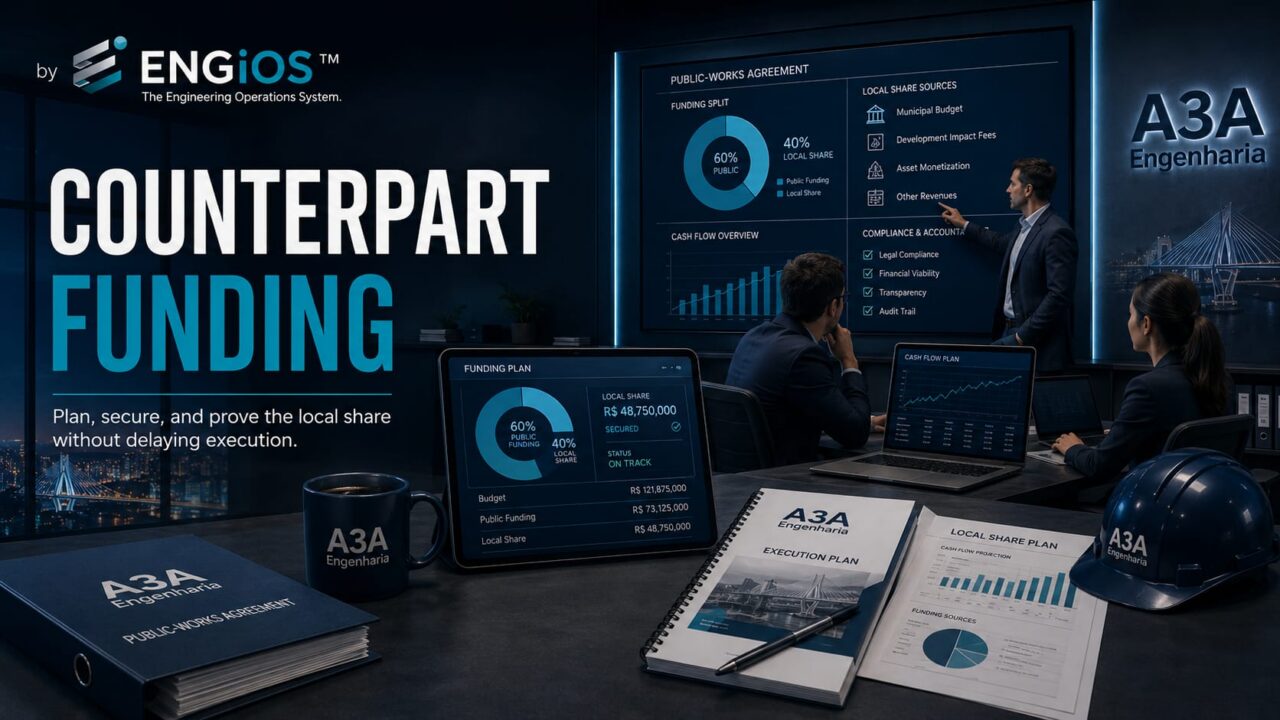
Understand how to calculate, plan, document and deposit matching funds in public-works agreements, with 2026 rules, financial risks and controls to prevent stoppages.
Check it out!
Matching funds in public-works agreements are the share of resources contributed by the recipient to complete the financing of the scope agreed with the Federal Government. For public agencies and entities, the contribution is exclusively financial, must be calculated on the total value of the scope according to the percentages and conditions of the Budget Guidelines Law in force on the date the agreement is executed, and must be supported by a budget appropriation before the instrument is signed. The deposit, however, does not necessarily need to be made all at once: the operational rule is to follow the disbursement schedule using the agreement’s specific account.
In practice, the problem is rarely the arithmetic formula. The risk lies in taking on a project whose cost, scope and schedule are not sufficiently mature and discovering, after procurement or during execution, that the municipality or state does not have the financial capacity to sustain its share, absorb differences not covered by the federal transfer, handle reprogramming or keep the asset operational after completion. Matching funds should therefore be treated as a requirement of financial capacity and project governance, not as a bureaucratic line completed in Transferegov.
In 2026, the federal Budget Guidelines Law establishes different matching-fund ranges according to the type of government entity, population and territorial or vulnerability classifications. The percentage actually agreed must be verified in the specific program and instrument. Engineering enters before signature: design, budget, permits, physical-financial schedule, procurement strategy and responsibility matrix must show whether the total project value is realistic and whether the local share fits the recipient’s cash flow.
When this analysis is performed early, matching funds cease to be a source of delay and become a controlled part of financial planning. When performed late, the result can be procurement without sufficient coverage, measured work without cash for payment, reprogramming requests, scope reductions, emergency local contributions and, ultimately, a project stoppage.
What are matching funds in a public-works agreement?
Federal Government agreements and transfer contracts establish a cooperative relationship to execute a scope of mutual interest. The granting authority transfers federal funds and the recipient assumes administrative, financial and technical obligations. When matching funds are required, they are part of the total value of the scope and become part of the resources tied to the instrument.
Joint Ordinance MGI/MF/CGU No. 33/2023, as currently amended, establishes that the recipient’s matching contribution is calculated on the total value of the scope, observing the federal Budget Guidelines Law in force when the agreement is executed. For public agencies and entities, the contribution must be exclusively financial, and its availability is demonstrated before execution through a budget appropriation.
This creates three concepts that should not be confused:
- federal transfer amount: the share financed with Federal Government funds;
- matching funds: the recipient’s own share defined in the instrument;
- total value of the scope: the sum of resources that will finance the agreed scope, considering the structure defined for the instrument.
The existence of a budget appropriation proves that the government entity provided for the expenditure. Actual financial availability throughout execution, however, depends on financial programming, revenue collection and cash management. A project may therefore have matching funds formally provided for and still suffer if the recipient’s financial schedule does not keep pace with construction measurements.
How to calculate matching funds
Matching-fund shortages almost always appear late because the problem began earlier: an incomplete design, a weak budget or a schedule disconnected from financial programming. An independent technical review before procurement reduces the recipient’s exposure to cost differences and emergency reprogramming.
Request a technical review of the Terms of Reference and contracting structure
The basic logic starts with the total value of the scope and the agreed matching-fund percentage. If the instrument establishes the matching contribution as a percentage of the total value, the expression is straightforward:
Matching funds = total value of the scope × matching-fund percentage
If a project has a total value of R$ 5,000,000 and the agreed matching contribution is 2%, the government entity must contribute R$ 100,000 and the remainder, according to the structure of the instrument, will be covered by the federal transfer.
The most important technical point is not to invert the basis without checking how the program and instrument present the values. In poorly structured projects, someone may apply the percentage to the federal transfer and treat the result as definitive. Joint Ordinance No. 33/2023 uses the total value of the scope as the reference.
Example involving a change in value before execution of the agreement
Consider a project initially estimated at R$ 8 million. During review of the basic design, the reference budget is corrected to R$ 8.6 million. If the granting authority maintains the same federal transfer ceiling, the difference must be addressed before procurement: an increase in the local contribution, a technically justified adjustment to the scope, another funding source or restructuring of the project.
Artificially maintaining the old value simply to “make the agreement fit” is not acceptable. In public works, an underestimated budget later reappears as failed procurement, an unfeasible bid, the need for inappropriate scope reductions or insufficient funding during execution. The article on price research for public works and engineering services examines how to build this reference before procurement.
What matching-fund percentages apply in 2026?
The 2026 Budget Guidelines Law — Law No. 15,321/2025 — establishes ranges for voluntary transfers from the Federal Government. The specific percentage should not be selected independently by the recipient: it must observe the entity’s classification, program rules and the instrument to be executed.
| Classification under the 2026 Budget Guidelines Law | General matching-fund range |
| Municipalities with up to 50,000 inhabitants | 0.1% to 4% |
| Municipalities with more than 50,000 inhabitants in priority PNDR/Sudene/Sudam/Sudeco areas | 0.2% to 8% |
| Municipalities with up to 200,000 inhabitants included in specific lists of vulnerability to extreme events | 0.1% to 5% |
| Municipalities with up to 200,000 inhabitants in coastal/estuarine risk areas provided for in the LDO | 0.1% to 5% |
| Other municipalities | 1% to 20% |
| States and the Federal District in priority areas defined in the LDO | 0.1% to 10% |
| Other states | 2% to 20% |
| Public consortia | 0.1% to 4% |
These ranges are legal references for fiscal year 2026 and may be affected by reduction or expansion provisions in the LDO itself, subject to applicable criteria and justification. For an instrument to be executed in another fiscal year, the LDO in force at that time must be consulted.
This caution is especially relevant in multi-year projects. The rule for calculating matching funds is defined when the instrument is executed, but physical execution spans fiscal years, contracts, price adjustments, change orders and risk events. Planning cannot be limited to the initial percentage.
A budget appropriation is not the same as cash available for payment
Before execution of the agreement, the public entity demonstrates the matching contribution through a budget appropriation. This answers the legal and budget question: is there authorization to contribute the local share? For the project to function, however, another question must be answered: when will the funds be financially available to follow the disbursement schedule?
In an 18-month project, the distribution of matching funds must align with the physical-financial schedule. If the highest-value services occur in months 6 through 10, concentrating financial availability only at the end of the fiscal year can create a mismatch among execution, measurement, certification and payment.
This risk increases when the recipient simultaneously manages several projects financed through agreements. Each instrument may appear small in isolation, but the total of matching funds, adjustments, ineligible expenses, inspection costs and operating obligations may exceed the entity’s actual capacity.
The analysis should therefore consolidate at least:
- matching funds for each instrument in force;
- installments planned by fiscal year and by month or quarter;
- exposure to price adjustments and contract changes;
- items necessary for the public facility to operate that are not included in the agreement scope;
- operation and maintenance expenses after delivery;
- management contingency for risks that cannot be transferred to the granting authority.
This is an area where financial management and engineering must work together. The disbursement curve should arise from a technically plausible execution sequence, not from a linear division of the total value by the number of contract months.
When must the matching contribution be deposited?
Joint Ordinance No. 33/2023 requires the financial matching contribution to be deposited into the instrument’s specific account according to the deadlines in the disbursement schedule. Installments may be advanced, in whole or in part, at the recipient’s discretion.
This means there is a difference between demonstrating matching funds before execution of the agreement and depositing the funds during execution. The demonstration is made through the budget appropriation; deposits follow the agreed schedule.
In project governance, each installment should be associated with a verifiable cash need. Ideally, before each execution period, internal project controls should show:
- balance of the specific account;
- planned and actually released federal installment;
- planned and deposited matching contribution;
- measurements projected for the period;
- contractual commitments coming due;
- margin for measurement differences, price adjustment and approved events.
A project should not reach payment day only to discover that the matching contribution still depends on an internal budget reallocation or supplemental appropriation.
The real risk appears when the project costs more than the available funding
An agreement does not turn an insufficient budget into a sufficient one. If the technically required project costs R$ 12 million and the combined federal transfer plus matching funds cover R$ 10 million, there is a R$ 2 million funding gap. This gap must be resolved before procurement or addressed through formal reprogramming mechanisms permitted under the rules, depending on the stage and the instrument.
Arbitrarily reducing quantities to fit the ceiling can destroy functionality. Recurring examples include removing essential site development, security systems, drainage, permanent power supply, indispensable equipment, accessibility or commissioning stages. The building may be “completed,” but the public service cannot begin operation.
In projects of this nature, technical review should separate:
- essential scope required for the asset to fulfill its purpose;
- complementary items that can be phased without preventing use;
- interfaces with other contracts or funding sources;
- assumptions not yet confirmed in the field;
- quantity and price risks;
- acceptance and operational-readiness requirements.
The commissioning plan for public works shows why having funds to construct is not the same as having the capacity to deliver an asset that is actually ready to operate.
What happens when procurement results are above the agreement estimate?
Procurement may reveal that the market does not accept the reference budget. This can result from outdated prices, incomplete design, incorrect quantities, inadequate BDI, underestimated logistics or specifications that restrict competition.
Before concluding that “more matching funds are needed,” the administration must diagnose the cause. A bid above the reference should not simply be accepted through an additional local contribution without verifying legality and budget consistency. Likewise, repeating procurement without correcting the problem may merely reproduce the failure.
The technical sequence is:
- verify the base date and reference systems used;
- review quantities and cost compositions;
- validate social charges and BDI;
- verify local logistics and productivity conditions;
- identify market items not adequately represented in reference databases;
- review qualification requirements and specifications that may reduce competition;
- define, together with the granting authority and within the rules of the instrument, the solution for any funding difference.
The articles on SINAPI, BDI in public works and failed or unsuccessful procurement form a complementary path for this diagnosis.
Additional matching funds and other own-source contributions should not be confused
During execution, the recipient may need to use its own funds beyond the matching contribution originally agreed. This does not mean that every additional expense automatically becomes part of the agreement or will be recognized by the granting authority.
Management should distinguish at least four situations:
- matching funds provided for in the instrument;
- formally approved increase in the recipient’s participation;
- necessary own-source expenditure that is outside the financed scope;
- payment made with own-source funds under an exceptional circumstance permitted by the instrument’s rules, subject to applicable recognition and traceability conditions.
Mixing these categories undermines accountability. The fact that an expense is technically useful for the project is not enough to make it eligible under the instrument.
The practical rule is straightforward: before paying from a source different from the one planned, the team should know which obligation is being paid, under which contract, with which authorization, from which source, under which classification and how it will be recorded in Transferegov.
Basic design, budget and matching funds form a single feasibility problem
Federal transfers, matching funds, measurements and payments must form a traceable chain. Technical support for inspection helps reconcile physical progress, field evidence, schedule and instrument obligations without transferring to the inspector decisions that belong to financial management or the granting authority.
Learn about technical support for oversight of engineering works and contracts
A 1% matching contribution applied to a weak budget is not necessarily safer than a 10% contribution on a mature project. The percentage measures financial participation; it does not measure the quality of project structuring.
Joint Ordinance No. 33 assigns to the recipient responsibility for the sufficiency of the basic design or Terms of Reference and the budget spreadsheet, including detailed social charges and BDI. This directly connects agreement governance with cost engineering and procurement planning.
Before procurement, the administration should be able to answer, with evidence:
- does the design represent the agency’s actual need?
- are the field surveys sufficient?
- have interfaces among disciplines been coordinated?
- does the budget cover the full required scope?
- have permits and conditions been mapped?
- is the site available and legally regular for the intervention?
- is the physical schedule executable?
- does the financial schedule fit the federal transfer and matching funds?
- are there indispensable items that will be contracted from another funding source?
- is there technical capacity to inspect, measure, accept and place the asset into operation?
The absence of these answers turns matching funds into an open variable: any scope or budget error tends to become pressure for additional own-source funding.
How to align the physical-financial schedule with disbursement
The instrument’s disbursement schedule and the construction contract’s physical-financial schedule must be consistent, but they are not identical documents. One represents the agreement’s funding program; the other represents contractual progress of the services.
Good governance creates a reconciliation layer between the two. For each month or milestone, it should be possible to see:
| Control | Question that must be answered |
| Physical progress | How much of the project should have been completed, and how much was actually completed? |
| Measurement | What amount was measured and technically certified? |
| Federal transfer | What federal installment was planned and what actually entered the account? |
| Matching funds | What local installment was planned and what was deposited? |
| Payment | How much was actually paid to the contractor? |
| Balance | Does the balance cover the next execution cycle? |
| Risk | Is there an event capable of changing cost or schedule? |
This control prevents a common situation: physical progress occurring faster than financial availability, causing measurements to be withheld and generating contractual conflict; or progress occurring more slowly, leaving funds idle and requiring reprogramming.
For inspection purposes, the construction measurement report should be treated as the link among physical execution, technical evidence and financial release.
Reprogramming should not automatically be used to correct poor planning
During the life of the agreement, facts may arise that justify adjustments to the work plan, schedule or other elements of the instrument, subject to applicable rules and approvals. This does not make reprogramming a neutral tool for compensating for any initial deficiency.
There is a significant difference between a subsequent event and an error that could have been identified through surveys, design, budgeting or risk analysis. When the administration proceeds to procurement without sufficient maturity, changes leave a trail: frequent quantity revisions, omitted essential services, late permits, unidentified interferences and unexpected need for own-source funding.
The analysis should record:
- technical cause of the change;
- when the cause became known;
- impact on cost, schedule and functionality;
- responsibility for the original assumption;
- alternatives technically evaluated;
- effect on the federal transfer and matching funds;
- need for approval by the granting authority or federal representative;
- effects on the construction contract and Law No. 14,133/2021.
This history protects the manager and improves accountability because it turns the decision into a verifiable chain of evidence rather than a justification produced only after the problem has occurred.
Matching funds and construction-contract change orders
The agreement and the administrative construction contract are related instruments, but they are legally distinct. A contract change order does not automatically change the agreement; reprogramming the agreement likewise does not replace the requirements for modifying the contract with the construction company.
When a scope or price change arises, the administration must analyze in parallel:
- whether the change is admissible under the construction contract;
- its cause and responsibility;
- whether the agreement scope accommodates the change;
- whether funding is available and from an appropriate source;
- whether matching funds will be affected;
- which approvals must occur before the changed service is executed.
Executing first and trying to regularize later is one of the most dangerous management practices. In addition to the risk of disallowance, it creates exposure for inspection, internal control, the granting authority and the contract manager.
When the issue involves a scope change, the risk allocation matrix helps separate the contractual event, responsibility and economic treatment.
How inspection should monitor matching funds without becoming the finance department
The project inspector does not replace accounting or treasury. Technical inspection, however, cannot ignore funding availability when it affects programming, mobilization, measurement and payment.
Minimum integration involves a routine information exchange among engineering, agreement management, finance, procurement and internal control. Engineering reports progress, projected measurements, risks and changes. Finance reports balances, transfers and deposits. Instrument management verifies alignment with the schedule and Transferegov records.
This governance reduces isolated decisions. An inspector who authorizes acceleration without knowing disbursement capacity can create a contractual problem. A finance department that postpones the matching contribution without understanding the critical construction sequence can cause disproportionate demobilization and delay.
The article how to inspect a public work details the evidence structure required to connect the field, contract and administrative decision.
Ten failures that commonly turn matching funds into a stoppage risk
The most recurring problems do not arise from a single rule, but from the disconnect between engineering and financial management:
- executing the instrument with an outdated construction budget;
- demonstrating an appropriation but failing to reserve a financial flow compatible with the schedule;
- ignoring necessary expenses that are not financed by the instrument;
- procuring an incomplete design and discovering quantities later;
- leaving permits, expropriations or site releases until after contracting;
- failing to reconcile the agreement schedule with the contractor’s schedule;
- executing a change before the required approvals;
- paying with own-source funds without correctly classifying the nature of the expense;
- failing to maintain evidence connecting measurement, funding source and payment;
- finishing civil construction without a budget for commissioning, operation and maintenance.
Prevention begins with structuring. The cost of reviewing the design, budget and schedule before procurement is small compared with demobilizing a construction site due to insufficient funds.
Technical checklist before assuming a matching-fund obligation
Before signing the agreement or carrying out a significant reprogramming, the manager can require an objective verification:
- total value and funding sources reconciled;
- matching-fund percentage checked against the LDO and program;
- budget appropriation formalized;
- financial programming compatible with the schedule;
- basic design reviewed and coordinated;
- reference budget with an appropriate base date;
- BDI and social charges demonstrated;
- permits, title and site availability verified;
- physical-financial schedule built from the execution sequence;
- quantity and interface risks identified;
- procurement strategy compatible with the scope;
- inspection structure defined;
- measurement and Transferegov recording workflow established;
- responsibilities for changes and reprogramming defined;
- post-construction operation and maintenance costs known.
If several of these items remain open, the risk is not merely “having to increase the matching contribution.” The risk is that the project is not sufficiently structured to be procured.
Decision example: contribute more or reduce the scope?
Imagine a municipality with an agreement to build a public facility. After the budget is updated, R$ 900,000 is missing to complete the entire program of requirements. There are two apparently simple responses: contribute more local funding or reduce the scope.
Engineering should prevent the decision from being based on amount alone. First, it is necessary to identify which systems determine functionality, safety and permitting. If the reduction removes permanent power supply, accessibility, drainage, fire protection, security or commissioning, the asset may be unusable even if it is “physically complete.”
The same applies to additional funding. Putting more money into a poorly defined scope only finances uncertainty. The correct sequence is to review the solution, stabilize the essential scope, update the budget, analyze risks and then decide which financial structure is sustainable.
This logic also prevents the effect of phased construction without planned interfaces. When a second funding source will execute part of the project, battery limits must be defined in the design: who delivers power, infrastructure, automation, security, finishes, integration and testing? Without this definition, each contract completes “its part” and no one delivers the complete system.
Final considerations
Matching funds in public-works agreements should not be managed as an isolated percentage. They are a consequence of a larger decision: the government entity is assuming a project with a given scope, cost, schedule, risk and future obligation to operate the asset.
The formal rule is objective: the percentage and conditions follow the current LDO and the instrument; for public entities, the contribution is financial, demonstrated by a budget appropriation before execution of the agreement and deposited in the specific account according to the disbursement schedule. Safe execution requires more: mature design, reliable budget, cash flow, inspection, traceability and the capacity to respond to changes without improvisation.
When these layers are integrated, matching funds become predictable. When they are not, any price difference, delayed federal transfer, design error or scope change can turn the local contribution into the project’s breaking point.
When the project requires reprogramming, a scope change or an additional contribution, the decision should be preceded by a technical diagnosis of cause, impact and alternatives. This prevents own-source funds from being used merely to finance uncertainty that should have been addressed in the design or contract.
Technical references
[1] BRAZIL. Law No. 15,321, of December 31, 2025. Provides for the guidelines for preparing and executing the 2026 Annual Budget Law. Available at: [https://www.planalto.gov.br/ccivil_03/_ato2023-2026/2025/lei/l15321.htm](https://www.planalto.gov.br/ccivil_03/_ato2023-2026/2025/lei/l15321.htm)
[2] BRAZIL. Decree No. 11,531, of May 16, 2023. Provides for agreements and transfer contracts related to transfers of Federal Government funds. Available at: [https://www.planalto.gov.br/ccivil_03/_ato2023-2026/2023/decreto/d11531.htm](https://www.planalto.gov.br/ccivil_03/_ato2023-2026/2023/decreto/d11531.htm)
[3] BRAZIL. Ministry of Management and Innovation in Public Services; Ministry of Finance; Office of the Comptroller General. Joint Ordinance MGI/MF/CGU No. 33, of August 30, 2023, as currently amended. Available at: [https://www.gov.br/transferegov/pt-br/legislacao/portarias/portaria-conjunta-mgi-mf-cgu-no-33-de-30-de-agosto-de-2023](https://www.gov.br/transferegov/pt-br/legislacao/portarias/portaria-conjunta-mgi-mf-cgu-no-33-de-30-de-agosto-de-2023)
[4] BRAZIL. Ministry of Management and Innovation in Public Services. Transferegov.br — Public Works Module. Available at: [https://www.gov.br/transferegov/pt-br/manuais/transferegov/obras](https://www.gov.br/transferegov/pt-br/manuais/transferegov/obras)
[5] BRAZIL. Law No. 14,133, of April 1, 2021. Public Procurement and Administrative Contracts Law. Available at: [https://www.planalto.gov.br/ccivil_03/_ato2019-2022/2021/lei/l14133.htm](https://www.planalto.gov.br/ccivil_03/_ato2019-2022/2021/lei/l14133.htm)
Frequently asked questions
They are the share of resources contributed by the recipient to finance the agreed scope. For public agencies and entities, the matching contribution under federal agreement rules is financial and is part of the total value of the scope.
Joint Ordinance MGI/MF/CGU No. 33/2023 establishes that matching funds are calculated on the total value of the scope, observing the percentages and conditions of the LDO in force when the agreement is executed.
Not necessarily. Before execution of the agreement, the public entity demonstrates availability through a budget appropriation. The financial matching contribution must be deposited into the specific account according to the disbursement schedule and may be advanced.
The 2026 LDO establishes different ranges according to population and territorial or vulnerability classifications. Municipalities with up to 50,000 inhabitants, for example, are generally in the 0.1% to 4% range, while other municipalities may be in the 1% to 20% range. The effective percentage must be confirmed in the program and instrument.
The difference requires technical, budget and legal analysis. First, the consistency of the design, reference budget, quantities, prices and procurement conditions should be verified. Any additional contribution or reprogramming must comply with the rules of the instrument and administrative contract.
No. The construction contract and the transfer instrument are distinct. A contract change may create a need for analysis and possible reprogramming of the agreement, but each procedure must comply with its own requirements and approvals.
Design, budget, physical-financial schedule and financial programming must be integrated before procurement; transfers and deposits should be monitored by period; cost risks should be reviewed; and governance should be maintained among engineering, finance, agreement management and inspection.
Complementary technical materials
Related services
- Technical Support for Oversight of Engineering Works and Contracts
- Technical Review of Terms of Reference for Public Works and Engineering Services
- Technical Review of Procurement Notices and Attachments for Engineering Procurement
Key content on the topic
- How to inspect a public work: method, responsibilities and evidence under Law 14,133
- Construction Measurement Report: how to measure services, validate evidence and release payments