
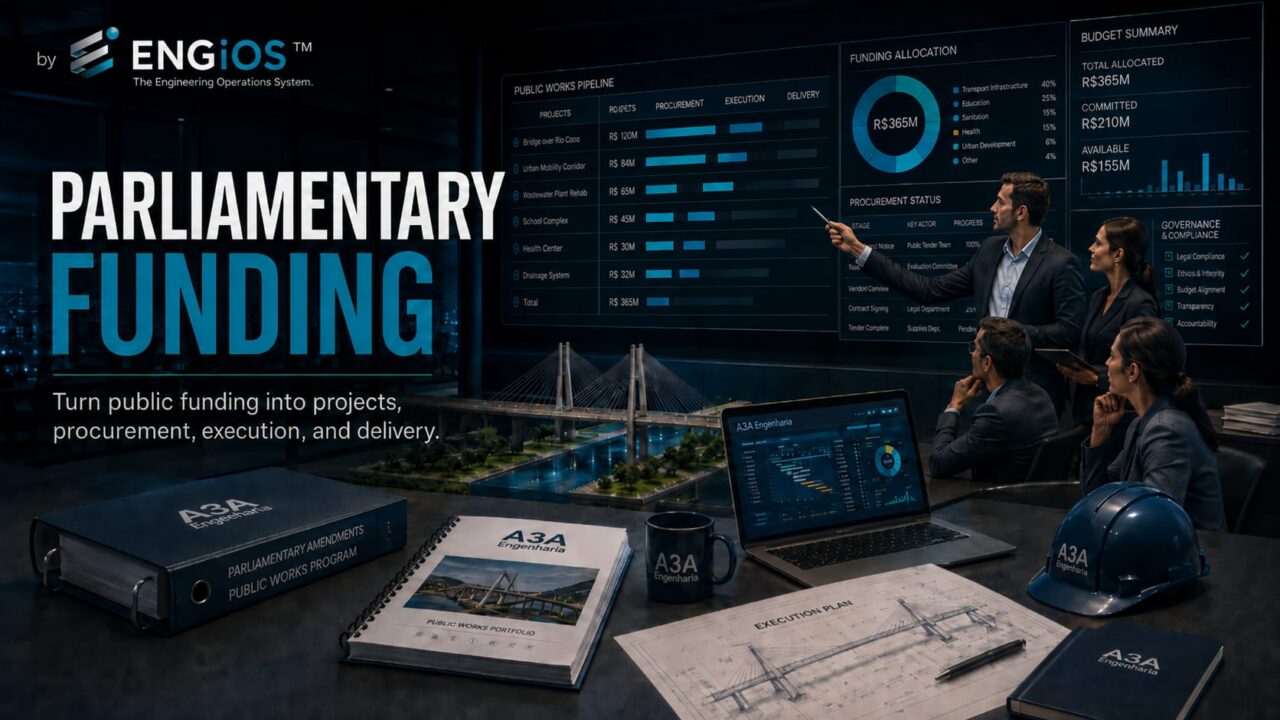
Learn how to execute parliamentary amendment funding for public works: special transfer vs. defined-purpose transfer, design, technical impediments, procurement, inspection and delivery.
Check it out!
Receiving a parliamentary amendment for a public work does not mean having a project ready for procurement. The amendment defines a budget funding source; delivering the asset depends on turning that source into a technically structured scope, a consistent work plan, sufficient design, a market-aligned budget, permits, valid procurement, inspection, traceable measurements and acceptance under real operating conditions.
In 2026, execution of federal parliamentary amendments is subject to the Constitution, Complementary Law No. 210/2024, the 2026 Budget Guidelines Law (LDO), the Annual Budget Law (LOA) and specific procedures published in Transferegov. For individual amendments, there are two distinct constitutional modalities: special transfer and defined-purpose transfer. The first transfers funds directly to a state, the Federal District or a municipality, without an agreement or equivalent instrument; the second keeps application of the funds tied to the defined purpose and follows the corresponding instrument and workflow. In both cases, when the funding finances a public work, planning, procurement, control, transparency and professional responsibility obligations continue to apply.
The main risk for the manager is confusing “funding indicated” with “an executable project.” The gap between these two conditions is precisely where technical impediments, delays, failed procurement processes, reprogramming and projects that receive funding but never deliver useful infrastructure to the public arise.
Efficient management of a parliamentary amendment for public works should therefore begin with the question: is the intended scope mature enough to become a procurement process and then an operational asset? If the answer is uncertain, the priority is not to publish a procurement notice quickly. It is to remove the technical uncertainties that may consume the budget calendar and make execution unfeasible.
A parliamentary amendment is a funding source, not a substitute for project planning
An amendment inserts or directs an appropriation in the public budget. It does not replace the project’s technical life cycle. An unsuitable site remains unsuitable; an incomplete design remains incomplete; an outdated budget remains outdated; a missing permit remains an impediment; and poorly structured procurement documents remain exposed to challenges, low competition or problematic contracting.
This distinction matters because the parliamentary-amendment calendar creates pressure for speed. In 2026, workflows published by the Federal Government establish specific windows for nomination, submission of proposals or work plans, review, supplementation and treatment of impediments. These calendars may be updated during the fiscal year. The safer strategy is not to memorize dates, but to keep the technical documentation ready to respond when each window opens.
For a public work, the minimum maturity package should include:
- clear definition of the public problem and project scope;
- study of alternatives when more than one solution is possible;
- site survey and actual site conditions;
- land-title status or availability of the site;
- required permits and authorizations, or an objective strategy for obtaining them;
- design at a level compatible with the intended procurement model;
- updated reference budget;
- plausible physical-financial schedule;
- definition of funding sources and any matching contribution;
- administrative capacity to procure and contract;
- team to manage and inspect execution;
- acceptance, commissioning and operation strategy.
The Preliminary Technical Study for public works and engineering services helps structure the need and alternatives before a solution is crystallized in the procurement documents.
Special transfer vs. defined-purpose transfer
Art. 166-A of the Constitution establishes the modalities applicable to mandatory individual amendments. In 2026, Joint Ordinance MPO/MGI/SRI-PR No. 2/2026 details the operational workflow and reaffirms that funds from individual amendments may be executed through a special transfer or a defined-purpose transfer.
Special transfer
Under a special transfer, funds are transferred directly to the beneficiary entity — state, Federal District or municipality — without execution of an agreement or equivalent instrument. This does not mean “money without rules.” The Constitution, Complementary Law No. 210/2024, oversight decisions and implementing acts have reinforced requirements for transparency, identification of the scope and a work plan within the federal environment.
For public works, management should take a conservative approach: even when there is no agreement, the beneficiary remains responsible for applying funds within the lawful purposes, complying with procurement and contract legislation, maintaining traceability, demonstrating delivery, and preserving technical, financial and asset documentation.
A special transfer is directed to the primary CNPJ of the state, Federal District or municipality. Public consortia, autonomous social services and civil-society organizations do not receive this modality; their nominations must occur through a defined-purpose transfer, pursuant to the 2026 Ordinance.
Defined-purpose transfer
Under the defined-purpose modality, funds remain tied to the program established by the amendment and to areas within the Federal Government’s constitutional competence. Execution follows the applicable instrument — for example, an agreement or transfer contract — and the proposal, work-plan, review and monitoring workflows in Transferegov.
For engineering, the practical difference is significant because the document structure and approval gates change. The manager must identify the modality before defining the checklist, rather than importing procedures from one workflow into another.
Individual, state-delegation and committee amendments: why the source matters
In 2026, operational regulations distinguish individual amendments (RP 6), state or Federal District delegation amendments (RP 7) and committee amendments (RP 8). Each group has its own rules for nomination, prioritization, minutes, workflow and treatment of impediments.
This classification is not merely an accounting detail. It defines who nominates the beneficiary, how the nomination is formalized, which documents must be made public and which stages must be completed before commitment and execution.
For those managing the project at the beneficiary entity, the recommendation is to create a funding-origin record containing:
| Field | Required control |
| Amendment type | RP 6, RP 7 or RP 8 |
| Modality | special or defined-purpose, when applicable |
| Author/body | member of Congress, delegation or committee |
| Program/action | budget classification |
| Indicated scope | description and known limits |
| Amount | indicated amount and amount effectively available |
| Matching contribution | existence, percentage and source |
| Instrument | agreement, transfer contract or other applicable workflow |
| Technical status | design, budget, permits, site |
| Critical deadline | window in force during the fiscal year |
Without this record, different departments commonly work under incompatible assumptions: engineering believes the funding is unrestricted for a certain scope; the agreements team interprets a narrower purpose; procurement structures a tender for another amount; and finance plans insufficient matching funds.
What is a technical impediment in a parliamentary amendment for public works?
Mandatory execution of amendments does not eliminate the possibility of a technical impediment. The budget system cannot compel an agency to execute an unfeasible, unlawful or materially impossible scope merely because an appropriation exists.
In public works, the most relevant impediments commonly arise from gaps such as:
- scope incompatible with the budget action or the agency’s authority;
- insufficient work plan;
- absence of design or a design too immature for review;
- budget incompatible with the scope or accepted parameters;
- lack of an available site or an impediment in land-title status;
- unresolved permitting;
- insufficient amount to deliver a functional unit;
- inability to meet the instrument’s deadlines;
- lack of operational capacity of the beneficiary;
- documentation not submitted or supplemented within the deadline of the current workflow.
The most expensive mistake is discovering the impediment at the end of the review window. Technical preparation should occur earlier: a maturity assessment can classify pending items as blockers, issues to be resolved before procurement and issues manageable during execution.
How to structure a public work before registering or accepting the amendment
An approved amendment does not correct an incomplete design. Before procurement, technical review must confirm the scope, surveys, budget, interfaces, permits and acceptance criteria so that the available funding corresponds to a genuinely executable scope.
Request a technical review of the project Terms of Reference
The recommended technical sequence starts with the problem and ends with the condition for operation.
1. Confirm the public purpose and scope
The description must be specific enough to guide design and budgeting, but it cannot be written to artificially fit a solution that has not yet been studied. “Construction of a healthcare facility,” for example, still requires a program of requirements, capacity definition, flows, building systems and interfaces with equipment.
2. Verify the site
The site must be compatible with layout, access, topography, geotechnical conditions, existing utilities, environmental restrictions, heritage constraints, expropriations and easements. Site problems frequently appear after procurement because the funding was nominated before technical due diligence.
3. Define the design level
Law No. 14,133/2021 establishes planning requirements and different procurement regimes. The required design maturity depends on the regime, but no regime eliminates the need to adequately define performance, scope, risks and acceptance criteria.
The article public works without an executive design: what Law 14,133 requires before starting explains the difference between allowing subsequent development and starting construction on a technically insufficient basis.
4. Update the budget
The amendment amount must be compared with the actual cost of the scope. In public works, the budget must consider quantities, cost compositions, social charges, BDI, logistics, base date and market items. If the funding does not close the functional scope, this must be known before procurement.
5. Build the schedule
The duration cannot be a generic division of the total amount by a number of months. It must reflect mobilization, construction stages, critical supplies, approvals, testing and acceptance. In complex public facilities, electrical systems, telecommunications, security, automation and commissioning can determine the critical path as much as civil construction.
From the work plan to procurement: where engineering prevents rework
When the modality requires a proposal and work plan, the technical documentation must converge with what will actually be procured. A work plan describing one scope and procurement documents contracting another creates a risk of incompatibility with the financed purpose.
Before procurement, there should be reconciliation among:
- registered scope and goals;
- design approved or accepted in the applicable workflow;
- instrument budget;
- procurement budget;
- disbursement schedule;
- physical-financial schedule;
- matching contribution and other sources;
- measurement criteria;
- documentation deliverables;
- acceptance criteria.
This alignment is particularly important when the proposal was registered using preliminary estimates and the design matured later. Differences must be formally addressed before they become part of the contract.
The article how to write Terms of Reference for public works that do not become change orders is a reference for turning these definitions into verifiable requirements.
Law 14,133 still applies to procurement financed by a parliamentary amendment
The parliamentary origin of the funds does not create a parallel procurement regime. When the beneficiary entity carries out procurement or administrative contracting to execute the work, it must comply with applicable law, including planning, budgeting, publicity, supplier selection, contract management and inspection.
This is especially important for special transfers. The absence of an agreement does not mean the absence of procurement, technical studies, budgeting or inspection. The funding source changes; the duty to contract correctly remains.
The administration should avoid two distortions:
- “we need to procure quickly because the amendment will expire”: a budget deadline does not justify technically weak procurement documents;
- “the member of Congress nominated it, so the scope is already defined”: political-budget nomination does not replace technical validation of the solution and its executability.
Speed without maturity usually shifts the problem to the most expensive phase: the signed contract.
How to assess whether the amendment amount is sufficient
The right question is not simply “how much funding was provided?” It is “what can this amount deliver with functionality and within the funding rules?”
A sufficiency analysis should separate:
- value of the main construction work;
- designs and surveys still required;
- permitting and authorization costs, when applicable;
- management and inspection services when allowed within the contracting structure;
- equipment and systems necessary for operation;
- interfaces to be funded by another source;
- foreseeable price adjustments over the time horizon;
- matching contribution and local availability;
- post-delivery costs that will remain with the government entity.
If the amendment covers only part of the program, it is necessary to assess whether that phase is functionally autonomous. Building 60% of a facility is not equivalent to delivering an operational first phase representing 60% of the investment.
The concept of a functional unit is essential to avoid creating new unfinished public works. The overview of unfinished public works by sector shows why different facilities stop for specific infrastructure and operating reasons.
An amendment to resume a stalled project requires diagnosis before new spending
The 2026 Ordinance provides, for special transfers, preferential allocation to certain unfinished works with related authorship, pursuant to Complementary Law No. 210/2024. This direction creates an opportunity, but also a risk: new funding should not be injected into an old project without knowing the exact condition of the asset and the contractual liabilities.
Before defining the amount required for resumption, it is necessary to survey:
- services executed and accepted;
- services executed without sufficient documentation;
- deterioration during the stoppage;
- structures and installations that need to be redone;
- remaining materials and their storage condition;
- original design and changes performed;
- permits and approvals still valid;
- contracts closed, terminated or with pending issues;
- remaining quantities;
- updated budget for the remaining scope;
- regulatory changes that occurred since the stoppage.
The methodology for technical diagnosis of a stalled public work should precede definition of the new financed scope.
How to procure without turning the funding into a future change order
Procurement is where inconsistencies among the amendment’s purpose, the design and the budget can become a challenge, low competition or a future change order. An independent review of the procurement documents verifies requirements, technical criteria and consistency with the engineering documents.
Request a technical review of the procurement notice and attachments
A parliamentary amendment generally establishes a financial limit. In engineering contracts, this increases the importance of controlling foreseeable causes of change orders.
Before procurement, review at least:
- compatibility among drawings, specifications and the cost spreadsheet;
- quantities of items with the greatest financial impact;
- preliminary services and site conditions;
- existing interferences;
- interfaces with utilities;
- specifications that may restrict competition;
- technical-equivalence criteria;
- risk allocation matrix when applicable;
- measurement method;
- price adjustment and base date;
- delivery milestones;
- documentation and testing required for acceptance.
When procurement itself begins with gaps, amendment funding is exposed to unproductive consumption: mobilization, stoppage, change, remobilization and schedule extension.
The article on technical review of Terms of Reference details the errors that most frequently migrate from procurement into execution.
Inspection: funding becomes delivery only when measurements represent physical reality
Financial execution cannot become detached from physical execution. The amount paid must correspond to services actually executed, measured, verified and documented in accordance with the contract and transfer instrument.
To achieve this, inspection should work with structured evidence:
- construction daily report;
- georeferenced photographic records when applicable;
- inspection reports;
- tests and certificates;
- measurement calculation sheets;
- field drawings and progressive as-built documentation;
- RFIs and technical decisions;
- nonconformity records;
- material and equipment approvals;
- updated schedule;
- change traceability.
The article evidence-based inspection in public works shows how to build this chain without turning inspection into low-value bureaucracy.
How to handle changes in scope during execution
Changes are part of engineering reality, but parliamentary funding increases the need to preserve the purpose of the funds. A contract change that is technically admissible does not automatically mean that the new service is compatible with the financed scope.
Before executing a change, the administration should simultaneously verify:
- admissibility under the construction contract;
- compatibility with the purpose of the amendment and instrument;
- financial availability;
- impact on matching funds or other funding sources;
- need for reprogramming or consent;
- effect on goals and indicators;
- preservation of the functionality of the final scope.
Separating technical necessity from financial eligibility prevents a correct engineering solution from creating an accountability problem because it was paid from the wrong funding source.
The role of Transferegov in transparency and monitoring
Transferegov now concentrates not only traditional agreements, but also different transfer and amendment workflows. In 2026, work plans, nominations, reviews and execution information are used as elements of transparency and control.
For the local manager, the platform should not be seen as an archive to which documents are uploaded only at the end. Ideally, the internal process should be integrated with what will be recorded in the system. Each approved revision of the design, budget, procurement, contract and measurement should have a responsible party, date, relationship to the instrument and decision trail.
This discipline reduces a common problem: the construction site works from one revision while Transferegov stores another. When this happens, accountability must retrospectively reconstruct which document authorized each service.
From physical completion to acceptance: the amendment fulfills its purpose only when the asset operates
A project that is “100% measured” is not necessarily ready for use. Installations must be tested, documents delivered, pending items resolved and operating requirements met.
The closeout phase should include:
- final inspections by discipline;
- functional and integrated testing;
- commissioning of the required systems;
- correction of nonconformities;
- consolidated as-built documentation;
- manuals and data books;
- operator training when required;
- operating permits and certificates;
- provisional and final acceptance according to the contract;
- asset capitalization;
- maintenance plan.
The commissioning plan for public works helps turn “construction completed” into “asset ready to operate.”
Maturity matrix for deciding whether a project is ready to receive amendment funding
A simple assessment can classify the project across four levels:
| Dimension | Immature | In development | Ready for procurement |
| Scope | generic | scope being defined | purpose and deliverables clear |
| Site | not verified | due diligence pending | available and validated |
| Design | nonexistent/preliminary | coordination pending | level sufficient for the regime |
| Budget | political estimate | budget being updated | current, traceable reference |
| Permits | unknown | applications in progress | strategy and conditions controlled |
| Funding | only amendment amount identified | sources being assembled | transfer, matching funds and interfaces reconciled |
| Procurement | no strategy | draft being prepared | procurement documents consistent with design and budget |
| Inspection | team undefined | appointments in progress | method, team and evidence defined |
| Operation | not analyzed | partial requirements | cost, staff and acceptance planned |
The objective is not to require perfection before any parliamentary nomination. It is to recognize early which gaps may become impediments or delays and use the period before commitment to address them.
Manager’s checklist for a parliamentary amendment intended for public works
Before considering the funding “ready for execution,” confirm:
- amendment modality and type identified;
- scope compatible with the budget program;
- beneficiary correctly identified;
- work plan consistent with the engineering;
- site and land title verified;
- design with sufficient maturity;
- updated and traceable budget;
- total amount and funding sources reconciled;
- matching contribution provided for when applicable;
- permits and authorizations mapped;
- procurement strategy defined;
- procurement documents compatible with the instrument;
- technical risks classified;
- schedule aligned with the budget cycle and construction reality;
- inspection team available;
- measurement and payment workflow defined;
- document management prepared for Transferegov;
- acceptance and operation criteria established.
If most of these items depend on future actions, the funding is still in the structuring phase, not the execution phase.
Final considerations
A parliamentary amendment can accelerate important investments, recover unfinished works and enable infrastructure that would not fit within the local budget alone. But public value materializes only when the funding passes through a complete chain: nomination, eligibility, technical maturity, procurement, execution, control and operational delivery.
Engineering consulting has a particularly relevant role at the interfaces of this chain. It does not replace the manager, granting authority, legal counsel or institutional inspectors. Its role is to reduce technical uncertainty, connect design and budget, anticipate impediments, review procurement documents, support decisions and build evidence so that funding is converted into a functional asset.
The management rule is simple: do not measure success by the amount of amendment funding committed, but by infrastructure delivered, accepted, operational and traceable. This is the criterion that prevents budget availability from becoming yet another unfinished public work.
After contracting, protecting the funding depends on evidence: physical progress, measurement, testing, decisions, changes and payments must form a coherent trail. Technical support for inspection strengthens this governance during execution.
Technical references
[1] BRAZIL. Constitution of the Federative Republic of Brazil of 1988, especially arts. 166 and 166-A. Available at: [https://www.planalto.gov.br/ccivil_03/constituicao/constituicao.htm](https://www.planalto.gov.br/ccivil_03/constituicao/constituicao.htm)
[2] BRAZIL. Complementary Law No. 210, of November 25, 2024. Provides for the proposal and execution of parliamentary amendments in the annual budget law. Available at: [https://www.planalto.gov.br/ccivil_03/leis/lcp/lcp210.htm](https://www.planalto.gov.br/ccivil_03/leis/lcp/lcp210.htm)
[3] BRAZIL. Joint Ordinance MPO/MGI/SRI-PR No. 2, of January 15, 2026. Provides for procedures for operating parliamentary amendments in 2026. Available at: [https://www.gov.br/transferegov/pt-br/legislacao/portarias/portaria-conjunta-mpo-mgi-sri-pr-no-2-de-15-de-janeiro-de-2026](https://www.gov.br/transferegov/pt-br/legislacao/portarias/portaria-conjunta-mpo-mgi-sri-pr-no-2-de-15-de-janeiro-de-2026)
[4] BRAZIL. Law No. 15,321, of December 31, 2025. 2026 Budget Guidelines Law. Available at: [https://www.planalto.gov.br/ccivil_03/_ato2023-2026/2025/lei/l15321.htm](https://www.planalto.gov.br/ccivil_03/_ato2023-2026/2025/lei/l15321.htm)
[5] BRAZIL. Ministry of Management and Innovation in Public Services. Transferegov — Public Works Module. Available at: [https://www.gov.br/transferegov/pt-br/manuais/transferegov/obras](https://www.gov.br/transferegov/pt-br/manuais/transferegov/obras)
[6] BRAZIL. Law No. 14,133, of April 1, 2021. Public Procurement and Administrative Contracts Law. Available at: [https://www.planalto.gov.br/ccivil_03/_ato2019-2022/2021/lei/l14133.htm](https://www.planalto.gov.br/ccivil_03/_ato2019-2022/2021/lei/l14133.htm)
Frequently asked questions
Yes, provided that the budget program, transfer modality, scope and instrument rules allow the investment. The project must still comply with applicable technical, budget, environmental, procurement, inspection and accountability requirements.
In a special transfer, funds from individual amendments are transferred directly to states, the Federal District or municipalities without an agreement or equivalent instrument, subject to constitutional and transparency rules. Under a defined-purpose transfer, funds remain tied to the amendment program and follow the corresponding instrument and workflow.
No. The absence of an agreement does not exempt the beneficiary entity from complying with the law applicable to its contracting, including Law No. 14,133/2021 when applicable, nor does it eliminate planning, control and inspection duties.
Key factors include an insufficient work plan, inadequate design, incompatible budget, lack of an available site or permit, scope incompatible with the budget program, an amount incapable of delivering a functional unit, and lack of operational capacity of the beneficiary.
Yes, subject to the modality, budget program and current rules. In 2026, there is regulatory guidance giving preference, in certain special-transfer workflows, to unfinished public works. Before adding new funding, it is essential to diagnose the physical, documentary, contractual and budget condition of the remaining scope.
Not necessarily, but the beneficiary must demonstrate how the complete scope will be financed and delivered. If there are other sources, matching funds or phases, they must be compatible and the financed scope must form a functional solution, avoiding a phase that cannot operate independently.
Ensure consistency among the indicated scope, work plan, design, budget, funding source, schedule, procurement documents, and measurement and acceptance criteria. Procuring before this reconciliation transfers uncertainty into the contract and increases the risk of change orders and stoppages.
Complementary technical materials
Related services
- Technical Review of Terms of Reference for Public Works and Engineering Services
- Technical Review of Procurement Notices and Attachments for Engineering Procurement
- Technical Support for Oversight of Engineering Works and Contracts
Key content on the topic
- Technical diagnosis of stalled public works
- Public works without an executive design? What Law 14,133 requires before starting
