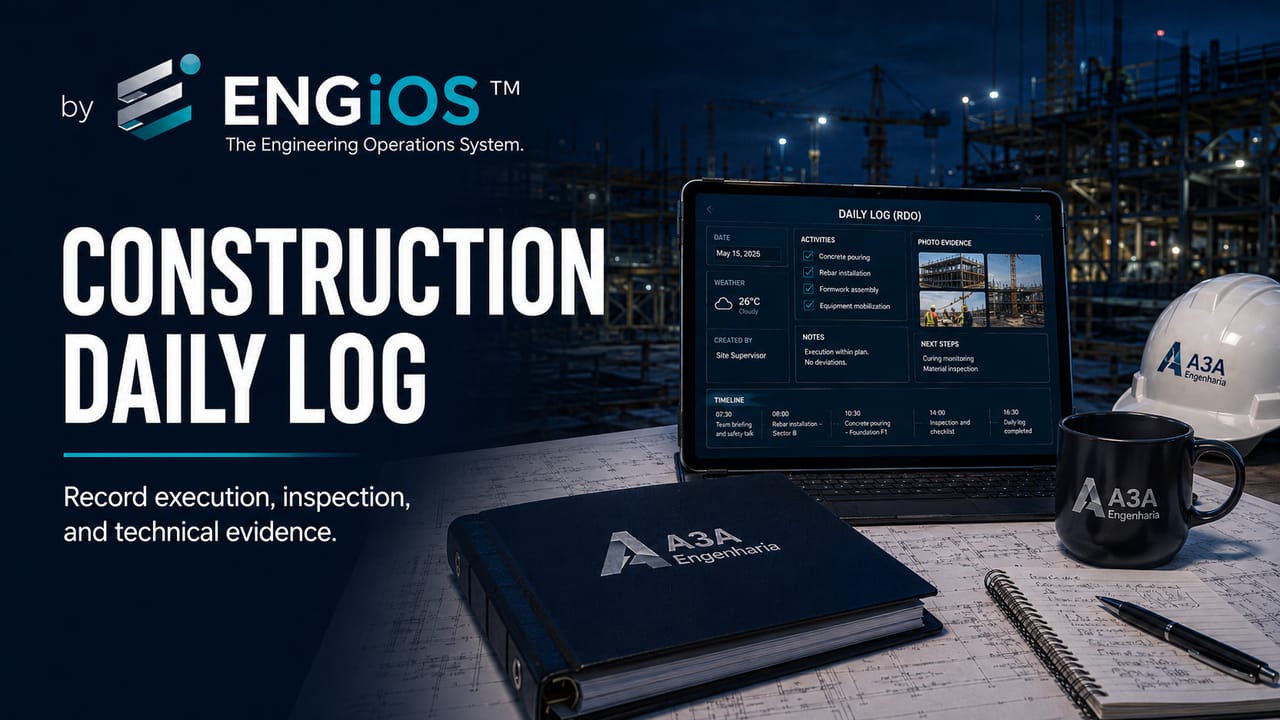
Learn how to structure a Construction Daily Report or RDO, record occurrences, produce evidence, and support inspection, measurement, schedule control, and contractual decisions.
Check it out!
The Construction Daily Report, also referred to in many contracts by the Brazilian acronym RDO (Relatório Diário de Obra), is the chronological record of project execution. It documents what occurred in each work period: services performed, workforce mobilized, equipment, weather conditions, interferences, safety occurrences, inspections, instructions from the inspection team, nonconformities, stoppages, decisions, pending items, and facts capable of affecting schedule, cost, quality, or contractual responsibility.
In engineering contracts, the Construction Daily Report should not be treated as an administrative form filled out at the end of the day merely to “check a box.” Its value lies in producing a verifiable technical timeline of execution. A well-structured RDO makes it possible to reconstruct facts, verify measurements, analyze delays, demonstrate mobilization, assess productivity, support notices, evaluate claims, record instructions, and support acceptance of the contracted object.
In public procurement, this function is directly connected to the inspection duty established by Brazilian Law No. 14,133/2021. Article 117 determines that contract execution must be monitored and inspected by representatives of the Public Administration and that occurrences related to execution must be recorded. Therefore, more important than the document’s name is the existence of a dedicated, contemporaneous, traceable, and technically consistent record of contract occurrences.
What Is a Construction Daily Report and What Is Its Role in Engineering?
The Construction Daily Report is an operational and contractual record produced during execution. Unlike a monthly report, which consolidates information after the period has already occurred, the daily report records events close enough to the time they happened to preserve context, authorship, and evidence.
In a construction project or systems implementation, many apparently minor facts can become relevant weeks or months later. An area that was not released, an unforeseen interference, lack of power availability, heavy rain, a design change, delayed equipment delivery, a field instruction, or rejection of a service can affect the schedule and measurement. Without a contemporaneous record, later analysis becomes dependent on memory, isolated emails, or conflicting versions.
This is why the RDO should be treated as part of the document governance of execution, not merely as a site document.
A3A addresses this logic within its Technical Support for Inspection of Engineering Works and Contracts, connecting field records, contractual criteria, evidence, and technical decisions.
Are Construction Daily Report, RDO, and Occurrence Log the Same Thing?
The terms appear in different forms among companies, public agencies, and contracts. “Construction Daily Report” generally designates the chronological log or system of project occurrences. “RDO” can mean Relatório Diário de Obra and usually takes a structured format by date, shift, work front, or contract.
From a control standpoint, the essential element is that the instrument can answer, traceably, questions such as:
- what was scheduled for the day;
- what was actually performed;
- where the service was carried out;
- by which crew;
- with which equipment;
- which materials were used or received;
- which inspections and tests occurred;
- which constraints affected production;
- which instructions were issued by the inspection team;
- which deviations or pending items were identified;
- which documents, drawings, or revisions were valid;
- which facts may affect schedule, cost, or quality.
The document name may vary. What cannot vary is its ability to constitute a reliable record of execution.
What Should Be Included in a Construction Daily Report?
There is no single universal form applicable to every project. The content must be proportional to the object, complexity, and contractual regime. However, certain fields recur in mature inspection systems.
| Information group | Examples of records | Why it matters |
| Identification | contract, project, work front, date, shift | ensures traceability |
| Field conditions | weather, access, released areas | explains production constraints |
| Workforce | crews, trades, quantities | demonstrates mobilization and execution capacity |
| Equipment | machines, tools, vehicles, unavailability | supports productivity and resource analysis |
| Services | activity, location, approximate quantity, stage | connects execution to scope |
| Materials | receipts, lots, rejections, storage | supports quality control |
| Inspections and tests | tests, checklists, inspections released or rejected | demonstrates conformity |
| Occurrences | interferences, accidents, stoppages, failures | preserves contractual history |
| Instructions | inspection-team guidance and contractor responses | records decisions |
| Documents | drawings, revisions, RFIs, releases | identifies the technical basis used |
| Evidence | photographs, attachments, protocols | enables later verification |
The quality of the Construction Daily Report is not determined by the number of fields completed, but by its ability to relate event, location, responsible party, impact, and evidence.
Should the Construction Daily Report Record Only Services Performed?
No. One of the most frequent mistakes is filling out the RDO as if it were only a production list. Days of low productivity, stoppages, waiting, and constraints must also be recorded because they are part of the reality of execution.
If the crew spent four hours waiting for a room to be released, that fact may affect the schedule. If equipment could not be installed because a preceding infrastructure item was incomplete, that interface should appear. If a work front was suspended due to a safety risk, the reason and the measures taken must be documented.
Documentary silence is often interpreted later as absence of an event. Therefore, a technically useful daily report records both production and constraints on production.
How Does the RDO Relate to Contract Inspection?
The Construction Daily Report gains value when it stops being an isolated form and becomes integrated with inspection, pending items, measurements, and contractual decisions.
Learn about Technical Support for Inspection of Engineering Works and Contracts
Brazilian Law No. 14,133/2021 establishes that execution must be monitored and inspected by one or more contract inspectors. A dedicated record of occurrences is a central part of this monitoring.
In practice, the inspector does not need to turn the Construction Daily Report into a lengthy daily technical opinion. The inspector needs to ensure that relevant facts are recorded and that instructions, irregularities, and corrective measures can be traced.
This record is especially important when inspection identifies:
- execution differing from the design;
- unapproved material;
- service performed without the required inspection;
- delay on a critical work front;
- improper reduction of workforce;
- unavailability of contractually required equipment;
- failure to comply with a safety requirement;
- execution before document release;
- damage to an existing installation;
- need for correction or rework.
Based on the record, the inspection team can open a pending item, issue a notice, request correction, register a nonconformity, or escalate the decision to the contract manager.
Should the RDO Be Completed by the Contractor or by the Inspection Team?
The answer depends on the contractual model and the adopted procedure. In many projects, the contractor produces the initial record and the inspection team reviews, comments on, or validates it. In others, there are separate records: the contractor’s daily report and the inspection record.
The risk arises when the document produced by the executing contractor is automatically treated as the official version of events without review by the owner.
The contractor naturally records events from its operational perspective. The inspection team must verify points that affect the owner’s interests: quantity performed, conformity, pending items, causes of delay, resource availability, and relevant occurrences.
In complex contracts, it is advisable to separate three layers:
- execution record, produced by the contractor;
- inspection record, produced or validated by the owner’s representative;
- deviation handling, performed through the appropriate formal instruments, such as NCR, RFI, notice, meeting minutes, or technical opinion.
The Construction Daily Report Does Not Replace a Notice, RFI, or Nonconformity
The RDO is a record of facts. It should not concentrate all contractual communication.
A relevant scope change, for example, does not become valid merely because it was mentioned in the daily report. Likewise, an instruction with cost or schedule impact may require specific formalization under the contract. The same applies to nonconformities that require cause, disposition, corrective action, and reinspection.
Therefore, proper governance uses the RDO as source evidence and routes each occurrence to the corresponding document workflow.
This principle also appears in Contract, Scope, and Deliverables Management: operational records must feed formal decision and control processes.
Photographs in the Construction Daily Report: Quantity Does Not Replace Context
Attaching dozens of unidentified photographs does not create good evidence. A technically useful photograph must make it possible to understand what is being demonstrated.
Whenever possible, photographic evidence should be associated with:
- date and time;
- location or work front;
- recorded element;
- service performed or deviation observed;
- drawing or room reference;
- identification of the problem, when applicable.
Before-and-after photographs can be particularly useful for services that will later be concealed by ceilings, floors, walls, trenches, insulation, or equipment.
Construction Daily Report and Design/Revision Control
A recurring field problem is execution using outdated documentation. The RDO can help preserve which revision was current for a given activity.
In projects with strong document control, the daily record may indicate:
- drawing used;
- current revision;
- applicable execution procedure;
- field instruction issued;
- related RFI;
- release for execution.
This information is especially valuable when a change is incorporated during construction and must later be reflected in the As Built documentation.
How the Construction Daily Report Supports Measurement
Measurement must be based on what was actually performed and meets contractual criteria. The Construction Daily Report is one of the evidence sources that helps verify whether the quantity presented in the measurement statement is consistent with the progress recorded in the field.
This does not mean that the RDO replaces the measurement calculation sheet. It functions as a consistency layer.
If the measurement statement reports installation of fifty pieces of equipment in a given period, but the daily reports show mobilization, access, and execution incompatible with that volume, the inspection team has a signal to deepen verification.
A robust path relates:
RDO → execution evidence → calculation sheet → measurement statement → certification → payment.
Construction Daily Report and Physical-Financial Schedule
Comparison between planned and actual performance becomes more reliable when a daily history exists.
The physical-financial schedule shows expected progress. The RDO helps explain why reality diverged from that expectation.
Over several weeks, the records make it possible to identify patterns:
- productivity below plan;
- recurring access constraints;
- lack of specialized labor;
- equipment unavailability;
- supply delays;
- rework;
- late releases;
- interferences between disciplines.
Thus, the daily report stops being only a historical record and begins to feed Project Controls.
Can the RDO Be Used in Delay Analysis and Claims?
Consistent field records reduce uncertainty in the analysis of delays, scope changes, and claims because they preserve the chronology of events.
Yes, provided that it is contemporaneous, consistent, and supported by other evidence. In delay, economic rebalancing, or claim analyses, the problem is rarely proving that an event occurred; the challenge is proving when it occurred, how long it lasted, which activity it affected, and what consequence it produced.
Daily records help build this causal chain. They can demonstrate, for example, that a given area remained unavailable during a critical window or that a field condition interrupted the planned sequence.
But the daily report alone does not prove the entire impact. The analysis must be cross-checked against the schedule, critical path, communications, measurements, resources, and contractual documents.
This approach is explored in greater depth in the content on Claim Management in Engineering Projects.
Which Errors Make the Construction Daily Report Weak as Evidence?
An RDO loses value when it is generic, retrospective, or contradictory.
Among the most frequent problems are:
- completion several days after the occurrence;
- automatic repetition of the same text;
- services described without location;
- absence of quantification when relevant;
- photographs without context;
- failure to record known constraints;
- divergence between the daily report and measurement statement;
- lack of identification of who recorded or validated it;
- absence of an inspection-team response;
- later changes without an audit trail;
- excessively subjective records.
A daily report that merely states “services performed normally” provides almost no management information.
How to Record Delays and Interferences Without Turning the Daily Report Into a Dispute
The record should prioritize observable facts. Instead of writing “the contractor delayed the project because of incompetence,” the technical record can state that work front X was scheduled to start on a given date, that the required crew or material was unavailable, and which activity did not occur.
Likewise, if the constraint is attributable to the owner, the document should objectively record the area’s unavailability, the date on which release was requested, and the affected activity.
Separating fact from interpretation improves evidence quality and reduces unproductive disputes.
Electronic Construction Daily Report: What Changes?
Digitalization improves traceability when the system preserves authorship, date, revision, and change history. An electronic RDO should not merely be a web form that can be rewritten without control.
Desirable features include:
- author and timestamp recording;
- georeferencing when relevant;
- photographic attachments;
- inspection-team comments;
- approval or acknowledgement;
- revision history;
- search by date, work front, contract, or occurrence;
- export to the document management system (DMS/GED);
- integration with pending items, measurements, and documents.
Technology is useful when it reinforces the process. If the governance workflow is not defined, the system merely digitizes disorder.
How to Use the RDO in Public Works Governed by Law 14.133
In public works, the Construction Daily Report gains an additional function: besides recording execution, it becomes part of the documentary trail that allows the Public Administration to demonstrate how it monitored the contract. Article 117 of Brazilian Law No. 14,133/2021 requires monitoring and inspection of execution, with recording of occurrences and adoption of the measures necessary to correct observed deficiencies or defects.
This does not turn the RDO into a self-sufficient legal document. The daily record remains a technical instrument. Its value lies in connecting the fact observed in the field to the formal instruments of inspection, measurement, and contract management. The most robust logic is occurrence → contemporaneous record → evidence → inspector analysis → corrective measure → verification → effect on measurement, schedule, or acceptance.
This chain is explored in greater depth in the article How to Inspect a Public Work: Method, Responsibilities, and Evidence Under Law 14.133, which treats the RDO as one of the evidence sources in the inspection system rather than as a substitute for inspections, reports, notices, or formal decisions.
It is also important to separate responsibilities. The contract manager and contract inspector perform different functions. The inspector technically monitors execution, records occurrences, and verifies conformity; the manager coordinates contract management, consolidates information, and routes decisions that exceed the authority of field inspection. A well-structured RDO facilitates this interface because it provides traceable facts instead of narratives reconstructed later.
In measurements for public works, the RDO should function as consistency evidence, never as the sole basis for payment. Quantities must be checked through calculation sheets, inspections, surveys, and contractual criteria. The article on the Construction Measurement Statement explains how to relate performed service, evidence, certification, and payment release.
For more complex public contracts, inspection should also ensure that the daily report preserves events capable of changing the interpretation of the schedule and contractual responsibility: unavailable work front, unreleased design, interference, weather preventing work, supply delay, rework, field instruction, nonconformity, partial stoppage, and formally authorized change. These records feed evidence-based inspection and technical traceability of execution.
In public works, the RDO is most useful when it is part of an inspection system that relates contractual requirement, inspection, evidence, measurement, pending item, and acceptance.
Learn about Technical Support for Inspection of Engineering Works and Contracts
What Should the Inspection Team Review Before Accepting the RDO for the Period?
Daily or periodic review should verify consistency between the record and the other available sources.
A practical checklist includes:
- confirm the work fronts actually open;
- verify relevant workforce and resources;
- check declared critical services;
- compare records with inspections and photographs;
- record discrepancies;
- identify events with possible schedule or cost impact;
- open pending items when necessary;
- relate documents issued during the period;
- preserve evidence of services that will be concealed;
- ensure that inspection-team instructions are traceable.
RDO in Installation and Technology-System Contracts
In electrical, telecommunications, automation, electronic security, and critical-system projects, the Construction Daily Report has important particularities. Production is not always expressed in square meters completed. Many activities involve assembly, parameterization, certification, integration, and testing.
In these cases, the record may include:
- cable installation and identification;
- equipment installation by room or area;
- panel energization;
- continuity testing or certification;
- device configuration;
- firmware and software versions when relevant;
- integration between subsystems;
- functional tests;
- pending preceding infrastructure;
- network, power, or access releases.
This level of detail allows execution to be related later to commissioning and technical acceptance.
How the Construction Daily Report Connects to the Inspection Report
The daily report records temporal detail. The inspection report consolidates the technical interpretation of the period.
A Technical Inspection Report can use RDOs as a source to demonstrate progress, pending items, risks, and recommendations. This reduces dependence on narratives prepared only at month-end.
The appropriate combination is:
- RDO for daily facts;
- checklists for specific verifications;
- inspection records for quality;
- statements for measurement;
- periodic reports for management analysis;
- notices and technical opinions for formal decisions.
When Does the Owner Need Independent Technical Support?
In more complex contracts, the designated inspector may not have sufficient availability or specialization to monitor every discipline. Brazilian Law No. 14,133 itself permits hiring third parties to assist and support inspection with relevant information.
Independent technical support can structure records, verify documentation, monitor critical work fronts, review measurements, consolidate evidence, and identify risks without replacing the formal authority of public officials.
This model is particularly useful in multidisciplinary implementations, brownfield retrofits, and contracts with a high density of interfaces.
Final Considerations
The Construction Daily Report is a central component of the contract’s technical memory. When properly structured, it connects what occurred in the field to inspection, measurement, schedule, quality, claims, and acceptance processes.
The main benefit is not increased bureaucracy, but reduced uncertainty. An objective daily record allows future decisions to be based on contemporaneous facts rather than incomplete reconstructions made months later.
For managers and inspectors, the right question is not only “was the daily report completed?” but “does the record reliably demonstrate what happened, where, when, by whom, and with what consequence?”
In complex contracts, independent structuring of execution evidence can support the inspector without transferring the inspector’s formal authority.
Technical references
[1] BRAZIL. Law No. 14,133, of April 1, 2021. Public Procurement and Administrative Contracts Law. Article 117. Available at: https://www.planalto.gov.br/ccivil_03/_ato2019-2022/2021/lei/l14133.htm
[2] BRAZILIAN FEDERAL COURT OF ACCOUNTS (TCU). Decision 592/2022-Plenary. Inspection of works and records in the Construction Daily Report. Available at: https://pesquisa.apps.tcu.gov.br/doc/acordao-completo/592/2022/Plen%C3%A1rio
[3] BRAZILIAN FEDERAL COURT OF ACCOUNTS (TCU). Decision 2749/2017-Plenary. Construction daily reports as contemporaneous evidence in delay analysis. Available at: https://pesquisa.apps.tcu.gov.br/doc/acordao-completo/2749/2017/Plen%C3%A1rio
Frequently asked questions
It is the chronological record of occurrences during execution of a construction project or service, including activities performed, resources, field conditions, instructions, constraints, inspections, deviations, and relevant evidence.
In many contracts, yes. RDO usually means Relatório Diário de Obra, or Construction Daily Report. The name may vary, but the technical requirement is to maintain a contemporaneous and traceable record of execution occurrences.
The procedure depends on the contract. The contractor may prepare the operational record and the inspection team may review, comment on, or validate it. The important point is that the Public Administration maintains its own record or effective control of relevant occurrences.
It can be relevant evidence, but it should be analyzed together with the schedule, communications, contractual documents, measurements, and other evidence to demonstrate cause, duration, and impact.
No. It records facts and occurrences. Matters requiring a contractual decision, scope change, penalty, or formal communication must follow the instruments provided for in the contract.
The requirement depends on the contract and inspection procedure, but contextualized photographs significantly improve evidence quality, especially for services that will later be concealed.
Complementary technical materials
Related solutions
- Contract, Scope, and Deliverables Management
- Project, Program, and Portfolio Governance
- Requirements, Evidence, and Acceptance Criteria Management
Related services
- Technical Support for Inspection of Engineering Works and Contracts
- Technical Acceptance of Engineering Works and Services
- Technical Analysis of Amendments, Scope Changes, and Claims
Key content on the topic
- Technical Inspection Report in Engineering
- Contract Management in Engineering
- Physical-Financial Schedule in Projects and Construction