
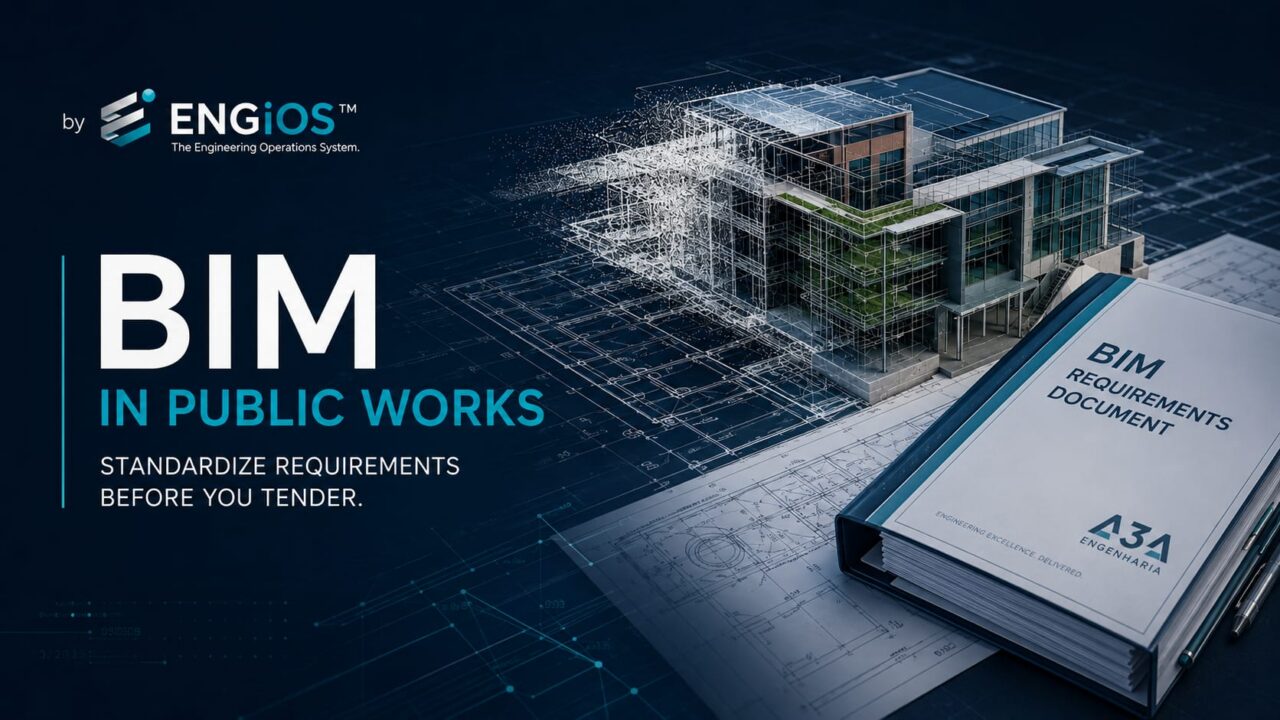
Understand why public agencies need to standardize BIM requirements before tendering: Law 14.133, ISO 19650, CDE, EIR, BEP, inspection, and acceptance criteria.
Check it out!
The discussion about BIM in public works can no longer be restricted to software selection or to a generic requirement to “deliver the design in BIM.” The decisive issue for the Public Administration is different: if BIM will be used to procure, coordinate, measure, inspect, or operate a public asset, information requirements must be standardized before procurement.
Law No. 14.133/2021 establishes that, in procurements for engineering and architectural works and services, whenever appropriate to the object, BIM or similar or more advanced integrated technologies and processes should preferably be adopted. Within the federal scope covered by Decree No. 10.306/2020, implementation was structured in phases, and the second phase, which began on January 1, 2024, expanded BIM uses to construction management in selected projects. The New BIM BR Strategy, established by Decree No. 11.888/2024, reinforces the structuring of the Public Administration and the creation of parameters for BIM-based procurement and contracting.
This does not mean there is a single national rule making BIM mandatory for every public work regardless of government level, object, and context. It means something more important for those preparing a procurement: public adoption of BIM is no longer experimental, and requiring BIM without standardizing information, responsibilities, and acceptance criteria creates a predictable contractual risk.
An agency that merely writes “the design shall be developed in BIM” has still not defined what it wants to receive. It must establish uses, formats, model structure, common data environment, classification rules, information requirements, naming conventions, responsibilities, deliverables, revisions, information levels, and objective validation criteria. Without this, each bidder interprets BIM differently, proposals cease to be technically comparable, and inspection receives a digital object it does not know how to verify.
The problem is not adopting BIM; it is adopting BIM without a standard
BIM is an information-management process applied to the asset life cycle. Three-dimensional models are an important part of that process, but by themselves they do not represent the governance required to procure and receive structured information.
When a Public Administration requires BIM without establishing a minimum standard, familiar problems appear:
- each discipline uses different conventions;
- files are delivered without naming rules;
- models do not have common coordinates or references;
- objects contain inconsistent properties;
- classifications are incompatible;
- required parameters are undefined;
- levels of detail and information vary among suppliers;
- clashes are handled without a formal process;
- revisions circulate by email without status control;
- there is no single source of approved information;
- the contractor delivers visually complete models without the data required for the intended use;
- the inspector has no objective matrix for accepting or rejecting deliverables.
The result is paradoxical: procurement asks for advanced technology, but execution falls back on informal communication, parallel spreadsheets, and subjective interpretation.
BIM Information Management according to ISO 19650 helps explain why the central issue is organizing information rather than merely authoring models.
What Law 14.133 actually says about BIM
Article 19, paragraph 3, of Law No. 14.133/2021 establishes preferential adoption of BIM, or similar or more advanced integrated technologies and processes, in procurements for engineering and architectural works and services whenever the technology is appropriate to the object.
The expression preferably adopted must be interpreted precisely. It does not amount to an automatic, undifferentiated obligation for every project. The Public Administration must assess suitability, institutional capacity, purpose, costs, procurement maturity, and expected benefits.
On the other hand, the legal provision eliminates the idea that BIM is merely an optional innovation unrelated to the preparatory phase. If the object supports BIM and the Public Administration decides to use it, the procurement artifacts must reflect that decision.
This includes answering before the bidding documents are issued:
- what BIM will be used for;
- which deliverables will be required;
- which information must be included in the models;
- who will be responsible for coordinating models and information;
- how submission, review, approval, and archiving will occur;
- which open and native formats will be accepted;
- which criteria will be used for inspection and acceptance;
- how final information will reach the As-Built documentation and operations.
Deciding to use BIM without these answers transfers uncertainty from the preparatory phase to contract execution.
Decree 10.306/2020: why the Federal Administration already needed to structure BIM uses
Decree No. 10.306/2020 established the use of BIM in the direct or indirect execution of engineering works and services by federal agencies and entities covered by the regulation, according to dissemination phases.
The first phase covered uses such as authoring architectural and engineering models, clash detection, quantity extraction, and generation of graphic documentation. The second phase, starting on January 1, 2024, expanded use to construction management in new construction, renovation, expansion, or rehabilitation projects considered relevant to BIM dissemination.
The management point is relevant even for entities not directly subject to the decree. A use such as “quantity extraction” does not work reliably if objects, classifications, units, properties, and modeling rules are inconsistent. “Construction management” does not occur merely because a 3D model exists: it requires updating, accountability, versioning, validation, and linkage to actual execution.
Therefore, the broader the contracted use, the greater the need for standardization.
The New BIM BR Strategy increases the urgency of structuring the Public Administration
Decree No. 11.888/2024 established the new BIM BR Strategy with objectives that include coordinating and supporting the structuring of the Federal Public Administration for BIM adoption, supporting states and municipalities, proposing regulatory acts for procurement and contracting, guiding the development of standards, and encouraging open technical specifications for interoperability.
The direction is clear: BIM dissemination in the public sector depends on institutional capacity and procurement parameters.
This changes the question public agencies should ask. Instead of “when will we be required to use BIM?”, the more productive question is:
“if we need to procure in BIM tomorrow, are our standards, templates, requirements, and acceptance criteria ready?”
For many organizations, the answer is still no.
And this gap should not be filled by the company that wins the tender. The contractor may propose its BIM Execution Plan, tools, and processes, but the appointing party’s requirements must already exist. Otherwise, the supplier ends up unilaterally defining the information structure used to inspect its own contract.
BIM without standardization transfers definition power to the supplier
Requiring BIM without corporate requirements allows the winning supplier to define the information structure used by the owner itself. Before tendering, uses, requirements, CDE, standards, and acceptance criteria must be established.
This is one of the most underestimated risks.
If the bidding documents do not define data structure, uses, standards, and deliverables, the first contractor may implement its own method. A second contractor creates another. A third uses different naming conventions and classifications. After several contracts, the agency owns dozens of models but does not have an interoperable corporate information repository.
The consequence appears at four levels.
Procurement
Proposals are difficult to compare because bidders estimate different efforts for what everyone calls “BIM.”
Inspection
The inspector lacks an objective matrix for verifying completeness, quality, coordination, and required data.
Integration
Models from different projects do not use the same structure, preventing consolidation of institutional information.
Operations
The maintenance team receives models with incompatible properties, different naming conventions, and insufficient data for asset management.
Standardizing before procurement does not restrict innovation. It defines the corporate minimum upon which suppliers can propose more efficient methods.
What must be standardized before tendering a BIM procurement
Information standards do not replace engineering. They create the common foundation on which multidisciplinary systems can be modeled, coordinated, checked, and delivered using verifiable criteria.
Standardization should be proportional to the complexity of the object. A municipality does not need a hundreds-page manual for a simple procurement. But it does need to control the elements that affect scope, price, inspection, and acceptance.
1. BIM objectives and uses
The agency must establish why it is requiring BIM.
Uses may include:
- discipline authoring;
- multidisciplinary coordination;
- clash detection;
- quantity extraction;
- 4D planning;
- 5D estimating;
- construction progress monitoring;
- measurement validation;
- As-Built documentation;
- commissioning;
- delivery of data for operations and maintenance.
Requiring every use indiscriminately increases cost and may not create value. The use must address a real project need.
2. Information requirements
The Public Administration must state which information must be produced, at what stage, and for what purpose.
The ISO 19650 series structures concepts of information requirements that help separate organizational, asset, project, and appointment needs. The article on OIR, AIR, PIR, and EIR explores this architecture in greater depth.
In practice, a requirement should answer:
- which data is required;
- for which object or system;
- at which stage;
- in which format;
- under whose responsibility;
- for which decision;
- how it will be validated.
3. Model structure
Where applicable, it is necessary to define:
- disciplines and federation;
- segregation strategy;
- coordinates and origin;
- units;
- zones, levels, and locations;
- modeling rules;
- tolerances;
- shared references;
- classification system.
Without a common reference, coordination loses reliability.
4. Naming and coding
Files, models, documents, revisions, and statuses need rules.
A public organization that procures dozens of designs must be able to locate information without depending on the memory of those who participated in each contract.
Naming should be simple enough to apply and structured enough to enable search, automation, and auditing.
5. Common Data Environment — CDE
The CDE organizes states, revisions, approvals, and information sharing. It is not merely a cloud folder.
The article BIM CDE: Common Data Environment under ISO 19650 details the role of the environment in information control.
Procurement should establish:
- platform or functional requirements;
- administration responsibilities;
- access profiles;
- information states;
- review workflow;
- audit trail;
- retention;
- export and portability;
- final delivery of the repository.
6. Formats and interoperability
The owner must decide which native and open formats it needs to receive.
The BIM BR Strategy encourages open technical specifications for interoperability. The objective is not to prohibit proprietary tools but to avoid unnecessary lock-in of public information.
The requirement may combine native format, IFC where appropriate, PDFs, structured spreadsheets, BCF, or other artifacts according to the use.
7. Required level of information
“LOD 300” by itself rarely solves a procurement requirement. The acronym can be interpreted in different ways and does not necessarily define all required alphanumeric properties.
The agency should specify the geometric and non-geometric information needed for each stage and relevant object, always aligned with the intended use.
8. Coordination and clash rules
Clash detection needs a process, not just software.
It is necessary to define:
- types of conflicts;
- tolerances;
- coordination responsibility;
- frequency;
- prioritization;
- recording;
- resolution deadline;
- closure criteria.
The article on BIM Design Coordination shows how coordination differs from simply generating a clash list.
9. Submission and approval rules
The owner needs to establish the information cycle.
An issue may be work in progress, shared for coordination, submitted for approval, or published for use. Mixing these states creates the risk of construction using unapproved information.
10. Final delivery and As-Built
The specification must state what happens at closeout.
It is necessary to define:
- which models will be updated;
- who incorporates field changes;
- which equipment data will be mandatory;
- how testing and commissioning evidence relates to assets;
- which formats will be archived;
- how information will be transferred to operations.
Without a closeout requirement, the As-Built model often becomes a late and poorly verifiable update.
The BEP does not replace the appointing party’s requirements
The BIM Execution Plan — BEP — describes how the appointed team intends to meet the requirements and organize information production.
It is essential, but it cannot be the document that independently invents what the owner should have specified.
The BIM BEP should respond to previously established requirements.
A healthy relationship is:
owner defines what it needs → bidder demonstrates capability → contractor presents how it will execute → Public Administration reviews and approves → inspection verifies compliance.
When the first link does not exist, the BEP risks becoming a unilateral methodology proposal without a corporate reference for evaluation.
How BIM standardization improves tendering
Standardization improves comparability among proposals.
If the bidding documents define specific uses, deliverables, formats, coordination meetings, review cycles, and information levels, all bidders price a similar baseline.
This reduces two opposite risks:
Undersizing
A bidder offers a low price because it interpreted “BIM” as simple three-dimensional modeling.
Oversizing
Another bidder includes a sophisticated coordination and information-management structure that was not necessary for the object.
Without a standard, the lowest price may be associated with the weakest understanding of scope.
With a standard, competition takes place on a clearer technical basis.
How BIM should appear in the ETP, Terms of Reference, design, and bidding documents
The requirement should not be added at the end of the Terms of Reference as a generic sentence.
In the ETP
The Public Administration should justify suitability and expected benefits. It should assess its capacity to use and inspect the deliverables.
In the Terms of Reference or equivalent document
This is where scope, requirements, deliverables, acceptance criteria, responsibilities, and measurement conditions are defined.
In the technical appendices
These may contain the BIM manual, information requirements, templates, use matrix, CDE requirements, naming structure, and reference models.
In the bidding documents
Requirements must be consistent with qualification, proposals, obligations, and evaluation criteria without creating unnecessary barriers to competition.
In the contract
There must be verifiable obligations, deadlines, deliveries, approval flows, ownership, and information portability.
Technical Review of Bidding Documents and Attachments for Engineering Procurement is particularly relevant when BIM requirements span multiple procurement documents.
The Public Administration must standardize before its first major BIM procurement
Waiting for the first contract to discover the standard is expensive.
The initial contract tends to establish informal precedents. If the structure is poor, the problems will be replicated. If each administrative unit procures differently, the organization creates information islands.
A minimum institutional preparation program can be carried out before tendering and include:
- maturity and use-case assessment;
- definition of institutional objectives;
- information standards;
- requirement templates;
- naming and coding rules;
- CDE criteria;
- responsibility matrix;
- minimum interoperability requirements;
- acceptance criteria;
- BEP template;
- inspection checklist;
- delivery strategy for operations.
The complexity of these artifacts should grow with the portfolio.
How to create urgency without overstating the legal obligation
A common mistake in commercial and institutional communication is to state that “Law 14.133 made BIM mandatory for all public works.” This statement is stronger than the legal text and can undermine technical credibility.
The real urgency is better grounded.
The law created an explicit preference
BIM entered the legal framework for engineering procurement.
The Federal Government already has phased implementation
Decree 10.306/2020 shows that concrete uses have already been incorporated in covered federal agencies and projects.
The BIM BR Strategy seeks to expand public-sector capability
Decree 11.888/2024 provides support to states and municipalities and parameters for procurement and contracting.
Standards take time to mature
Manuals, CDE, requirements, templates, and criteria should not be improvised during tendering.
The cost of correcting later is higher
An incomplete specification can generate incomparable proposals, contract amendments, scope disputes, and models with no future utility.
Therefore, the correct message is:
the Public Administration does not need to wait for a universal obligation to prepare. If BIM is likely to be used, standardization must precede procurement.
What happens when every public work uses a different BIM standard
Imagine an agency with ten public buildings procured over four years.
In the first contract, the company uses its own parameters. In the second, another company models using a different classification. In the third, the CDE platform is closed at the end of construction without structured export. In the fourth, the As-Built contains geometry only. In the fifth, room codes do not match the asset register.
Individually, each project may appear delivered. As a portfolio, the agency cannot consolidate assets, compare information, integrate maintenance, or build a reliable corporate library.
Standardization is what transforms BIM from a design tool into an institutional asset.
Standardization does not mean locking down tools
A corporate standard should define outcomes, structures, and interfaces rather than necessarily impose a single software package on every participant.
An interoperability-oriented procurement can establish:
- delivery formats;
- mandatory properties;
- classification;
- coordinates;
- naming;
- workflows;
- security requirements;
- validation criteria.
Within this envelope, suppliers can use tools compatible with their methods.
This preserves competition and reduces technology dependence.
How to inspect BIM deliverables
Inspecting BIM is not about opening the model and checking whether it “looks right.”
Inspection needs verifiable criteria.
A control matrix may include:
| Dimension | Verification |
| file | name, format, revision, status |
| structure | discipline, model, levels, coordinates |
| geometry | completeness and applicable tolerances |
| properties | mandatory parameters completed |
| classification | codes and rules compliant with the standard |
| coordination | conflicts addressed and recorded |
| documentation | drawings and schedules consistent with the model |
| CDE | submission through the correct workflow |
| approval | comments addressed and evidenced |
| delivery | formats and final package complete |
Inspection can use automated checks, but the technical result still depends on the requirement.
Model-checking software does not know, by itself, what the owner needed to receive.
BIM and evidence-based inspection
BIM can strengthen traceability when every decision and deliverable is linked to controlled information.
Evidence-based inspection in public works can incorporate models as another evidence layer, provided governance exists.
Examples:
- quantity extracted from a validated model;
- inspection linked to an element or location;
- NCR associated with the corresponding system;
- field photograph associated with the room or area;
- test linked to the installed asset;
- approved revision recorded in the CDE;
- change incorporated into the As-Built model.
The gain is not merely visualization. It is reduced ambiguity between requirement, object, location, and evidence.
Can BIM support measurement of public works?
Yes, but not automatically.
Quantities extracted from models depend on consistent modeling rules, units, classification, and completeness. Contractual measurement also depends on payment criteria, acceptance, and evidence.
Therefore:
model quantity ≠ automatically payable quantity.
Modeling can support checking, traceability, and planning, but inspection must ensure correspondence among:
- contract item;
- modeled object;
- quantity;
- physical execution;
- inspection;
- evidence;
- measurement criterion.
When this structure is planned, BIM can reduce manual work and inconsistencies. When it is not, the model becomes just another divergent source.
4D BIM and schedule monitoring
Models linked to the schedule can make the construction sequence easier to understand spatially.
The use can support:
- work-front planning;
- assessment of temporal conflicts;
- phase communication;
- access analysis;
- visual comparison of planned vs. actual;
- planning of shutdowns and critical windows.
But 4D does not correct a poorly structured schedule. Activity logic, dates, milestones, and dependencies remain the foundation.
5D BIM and cost estimating
Cost integration requires a classification structure and mapping between objects, quantities, and budget items.
If each object uses different properties, the association becomes fragile. If the estimate has a structure incompatible with the WBS and the model, automation only creates the appearance of integration.
For this reason, 5D is a strong argument for prior standardization.
BIM for As-Built and public-asset operations
One of the greatest sources of waste occurs when BIM is contracted only for design and loses value at closeout.
To deliver useful information to operations, the Public Administration must define in advance which data it wants to preserve.
Examples:
- manufacturer;
- model;
- asset number;
- capacity;
- location;
- installation date;
- warranty;
- manual;
- maintenance plan;
- circuit identification;
- related system;
- test date;
- commissioning status.
It makes no sense to require hundreds of properties with no use. It also makes no sense to discover at final delivery that the required data was never requested.
Should the CDE belong to the supplier or the owner?
The answer depends on the strategy, but the Public Administration must guarantee control, access, portability, and continuity of information.
If the CDE belongs to the contractor, the contract must provide for export and structured delivery. If the owner has a corporate platform, it must establish access and usage rules.
The risk is completing the work with knowledge locked into a license that will be terminated or an environment the agency does not administer.
This issue must be addressed in the preparatory phase.
How to assess bidder BIM maturity without unduly restricting competition
Qualification should be tied to the complexity and relevant portions of the object.
Possible evidence may include:
- compatible experience;
- team with defined roles;
- information-management methodology;
- coordination capability;
- quality-control processes;
- interoperability demonstration;
- proposed BEP where appropriate.
The requirement should not be an arbitrary list of certificates or software unrelated to the capacity to deliver the object.
Standardizing scope helps define precisely which capability is necessary.
How to structure a BIM standardization program for a public agency
A practical strategy can be divided into six blocks.
Block 1 — assessment
Map types of works, current processes, systems, capabilities, contracts, assets, and pain points.
Block 2 — corporate requirements
Define what the organization needs to know about its projects and assets.
Block 3 — standards and templates
Create reusable naming conventions, structures, templates, requirements, and checklists.
Block 4 — information environment
Define CDE, workflows, permissions, and archiving.
Block 5 — procurement
Incorporate BIM into the ETP, Terms of Reference, bidding documents, appendices, and acceptance criteria.
Block 6 — pilot implementation and improvement
Apply the standard to a controlled project, measure problems, and adjust before scaling.
This roadmap reduces the risk of writing a theoretical manual that is never used.
When to hire independent BIM consulting
External support is particularly useful when the agency needs to define requirements independently of the future executor.
Consulting can support:
- maturity assessment;
- adoption strategy;
- BIM manual;
- information requirements;
- EIR templates;
- BEP templates;
- CDE strategy;
- classification and naming;
- BIM use matrix;
- audit criteria;
- technical review of bidding documents;
- proposal-analysis support;
- inspection of deliverables;
- As-Built governance.
BIM and Engineering Information Management concentrates this layer of requirements, models, CDE, and governance, while BIM Designs covers multidisciplinary development of the designs themselves.
This separation is important: the party defining the owner’s standard does not need to be the same party that will execute every future model.
Checklist before publishing BIM bidding documents
Before issuing the procurement, the Public Administration should be able to answer “yes” to the following questions:
- are BIM uses defined?
- are clear information requirements available?
- are deliverables listed?
- is there a naming and revision rule?
- is the CDE functionally defined?
- are delivery formats and interoperability specified?
- are responsibilities assigned?
- are coordination criteria described?
- does the BEP have minimum requirements?
- does inspection know what it will verify?
- are acceptance criteria objective?
- is measurement consistent with deliverables?
- does the As-Built have specific requirements?
- has the data required for operations been identified?
- does the contract guarantee information portability?
If several answers are negative, the procurement is not yet mature enough to require BIM safely.
The cost of standardizing beforehand is lower than the cost of correcting contracts
Standardization requires initial effort. However, the cost should be compared with the rework avoided across multiple procurements.
A corporate standard can be reused. Requirements and templates can be adapted by project. The object and data library can mature. Inspectors learn a common structure. Suppliers know what to expect.
Without a standard, every tender starts from zero and every contract pays again for ambiguity.
The minimum BIM standardization package before the first tender
A Public Administration intending to procure in BIM does not need to begin with a long, abstract manual. It needs to begin with a minimum package capable of making scope, price, inspection, and acceptance comparable. This package should be institutional enough to survive supplier changes and simple enough to be applied in the first contracts.
| Artifact | Function | Risk avoided |
| BIM use matrix | defines what the model will be used for in each phase | generic requirements and oversizing |
| information requirements | establishes which data must be delivered, when, and for which decision | visually complete models without useful information |
| naming and classification standard | standardizes files, objects, disciplines, revisions, and statuses | fragmented repository and low traceability |
| CDE requirements | defines states, workflows, access, retention, and portability | loss of history and dependence on the supplier’s platform |
| deliverables matrix | relates phase, responsible party, format, content, and acceptance criterion | scope and measurement disputes |
| BEP template | requires the contractor to demonstrate how requirements will be met | generic BEP unrelated to the contract |
| BIM inspection checklist | turns requirements into repeatable checks | subjective acceptance |
| As-Built and operations requirements | defines final data that must remain with the owner | final model with no asset-management or operational utility |
The value of this package is cumulative. After the first project, the agency can revise naming, tolerances, libraries, workflows, and templates based on real issues. What must be avoided is the reverse path: allowing each supplier to create its own structure and trying to standardize only after dozens of incompatible models have already been received.
Owner requirements must be separated from contractor methodology
A mature procurement clearly separates two layers. The first belongs to the owner: objectives, uses, information requirements, standards, interfaces, deliverables, and acceptance criteria. The second belongs to the contractor: team, software, automation, federation strategy, internal routines, production sequence, and other means used to fulfill the contract.
This separation protects competition. The agency does not need to impose the same tool on everyone, but it does need to require the same verifiable result. It also protects inspection: when a requirement is institutional, the inspector compares the delivery against a reference defined before the procurement, not against the method proposed by the executing company itself.
In practice, this allows the BEP to be evaluated as a response to the bidding documents. A good BEP demonstrates compliance, identifies responsibilities, describes processes, records exceptions, and explains how the team intends to meet the deliverables. It should not function as the document used to fill scope gaps left open in the Terms of Reference.
The greatest risk of not standardizing appears after the first project
In an isolated procurement, lack of standardization may look like an operational issue. In a public portfolio, it becomes an asset-management problem. The agency begins to own models that do not communicate with one another, different asset codes, divergent classification criteria, and information that cannot be consolidated across buildings, campuses, units, or departments.
This compromises future uses such as asset inventory, maintenance planning, renovation estimating, space management, CAPEX planning, energy management, and performance comparison among facilities. The cost of non-standardization does not appear only in the current project; it appears throughout the life cycle of the portfolio.
This is why the correct urgency is not “adopt BIM because everyone will be required to.” The urgency is to prevent upcoming contracts from creating incompatible digital liabilities. When there is a real prospect of adoption, standardization must precede scale.
Final considerations
BIM in public works should not be treated as a technology clause added to the bidding documents. It is an information-management decision that affects planning, design, procurement, inspection, measurement, As-Built documentation, and operations.
Law 14.133 consolidated the preference for BIM when appropriate to the object; Decree 10.306 structured uses within the covered Federal Administration; and the new BIM BR Strategy seeks to expand institutional capacity and procurement parameters. This movement is enough to create real urgency without claiming a universal obligation that the legislation does not establish.
The most valuable preparation is to standardize before tendering. The agency needs to define what it wants to receive, how information will be organized, which process will be used to approve deliverables, and which evidence will allow the inspector to accept or reject the object.
When this exists, BIM can reduce ambiguity, increase comparability, and build a reusable digital repository. When it does not, technology merely digitizes the contract’s lack of definition.
When BIM spans the ETP, Terms of Reference, technical appendices, qualification criteria, and contractual obligations, inconsistencies among documents can generate challenges, incomparable proposals, and scope disputes.
Request a Technical Review of Bidding Documents and Attachments
Technical references
[1] BRASIL. Lei nº 14.133, de 1º de abril de 2021 — Lei de Licitações e Contratos Administrativos. 2021. Available at: https://www.planalto.gov.br/ccivil_03/_ato2019-2022/2021/lei/l14133.htm.
[2] BRASIL. Decreto nº 10.306, de 2 de abril de 2020 — utilização do BIM em obras e serviços de engenharia da Administração Pública Federal. 2020. Available at: https://www.planalto.gov.br/ccivil_03/_ato2019-2022/2020/decreto/d10306.htm.
[3] BRASIL. Decreto nº 11.888, de 22 de janeiro de 2024 — Estratégia BIM BR. 2024. Available at: https://www.planalto.gov.br/ccivil_03/_ato2023-2026/2024/decreto/d11888.htm.
[4] MINISTÉRIO DA GESTÃO E DA INOVAÇÃO EM SERVIÇOS PÚBLICOS. BIM em Obras Públicas. 2026. Available at: https://www.gov.br/obrasgov/pt-br/bim-obras-publicas.
[5] INTERNATIONAL ORGANIZATION FOR STANDARDIZATION. ISO 19650-1:2018 — Information management using building information modelling — Concepts and principles. 2018. Available at: https://www.iso.org/standard/68078.html.
[6] INTERNATIONAL ORGANIZATION FOR STANDARDIZATION. ISO 19650-2:2018 — Information management using building information modelling — Delivery phase of the assets. 2018. Available at: https://www.iso.org/standard/68080.html.
Frequently asked questions
No. Law 14.133 establishes preferential adoption of BIM, or similar or more advanced integrated technologies, when appropriate to the object. There are also specific federal-use rules for agencies and projects covered by Decree 10.306/2020.
Because uses, information requirements, formats, CDE, naming conventions, responsibilities, and acceptance criteria affect scope, price, and inspection. Without a standard, each bidder may interpret BIM differently.
At a minimum: objectives and uses, information requirements, model structure, naming conventions, formats, interoperability, CDE, information levels, coordination, submissions, responsibilities, acceptance criteria, and As-Built delivery.
No. The BEP should explain how the team will meet the appointing party’s requirements. When requirements do not exist, the supplier ends up unilaterally defining the methodology and part of the scope itself.
It can support quantities, checking, and traceability, but a quantity extracted from the model is not automatically payable. Measurement remains subject to the contract, demonstrated execution, inspection, and acceptance criteria.
Because it organizes states, revisions, submissions, approvals, access, and audit trails. It also reduces the risk of construction using outdated information and facilitates preservation of the public information repository.
When it needs to structure strategy, a BIM manual, information requirements, CDE, templates, audit criteria, bidding-document review, or independent inspection before scaling BIM procurements.
Supplementary technical materials
Related solutions
Related services
- BIM and Engineering Information Management
- BIM Designs
- Technical Review of Bidding Documents and Attachments for Engineering Procurement
Main content on this topic
- BIM Information Management: How to Apply ISO 19650
- BIM Information Requirements: OIR, AIR, PIR, and EIR
