
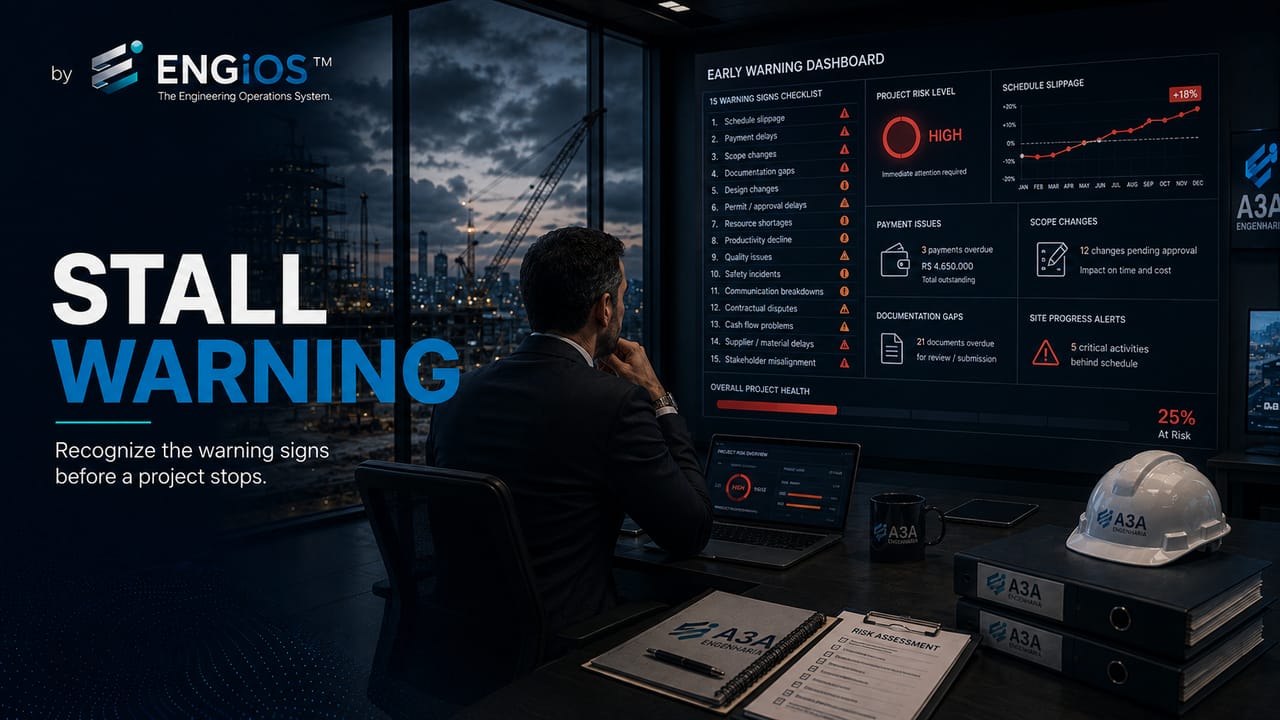
See 15 warning signs that a public works project may be heading toward a stoppage and how to structure indicators, recovery, oversight, and governance before the site comes to a halt.
Check it out!
A public works project rarely comes to a halt overnight. Before a formal stoppage, signs of loss of control usually emerge: schedules no longer reflect reality, technical decisions accumulate, design information reaches the field late, progress measurements no longer track physical advancement, licensing issues remain unresolved, productivity declines, and management becomes increasingly reactive.
The problem is that each sign, viewed in isolation, may appear manageable. A stoppage occurs when several of them begin to reinforce one another. Therefore, the best time to act is not after the site has already stopped, but when leading indicators show that schedule, scope, resources, engineering, and governance are losing alignment.
This checklist brings together 15 warning signs that help identify a project heading toward a stoppage and, more importantly, organize the response before the problem turns into contractual interruption, asset deterioration, and the need for a future recovery effort.
What it means for a project to be heading toward a work stoppage
When the schedule, RFIs, nonconformities, progress measurements, and decisions begin to deteriorate at the same time, reactive oversight is no longer sufficient. Technical Support for Construction Oversight organizes evidence, open issues, measurements, and corrective actions so the manager can intervene before the trend turns into a work stoppage.
Heading toward a work stoppage does not mean that the project will necessarily be interrupted. It means execution has accumulated conditions that increase the probability of losing continuity and can no longer be treated as isolated deviations.
The assessment must be systemic. A seven-day delay in one activity is not, by itself, evidence of a crisis. But a critical-path delay combined with a pending design, material not yet purchased, an unanswered RFI, and a blocked progress measurement creates a very different risk chain.
Brazilian Law 14,133/2021 assigns senior management responsibility for procurement governance and requires the preparatory phase to address risks capable of compromising the success of the procurement process and proper contract execution. During construction, the same logic must continue: risk must be monitored as a living variable, not as a matrix completed only during procurement.
The Brazilian Federal Court of Accounts (TCU) also treats stalled public works as a chronic problem and associates their occurrence with factors such as deficient designs, insufficient resources, and low institutional capacity. The preventive point is important: many of these factors can be observed before a formal stoppage, provided there are indicators, evidence, and a decision-making routine.
How to use the checklist: an isolated sign is not a diagnosis
The checklist should function as a management screening tool. For each sign, the team should assess at least four dimensions:
- trend: is it improving, stable, or worsening?
- criticality: does it affect a routine activity or the critical path?
- interdependence: does it depend on other open issues?
- response capacity: is there an owner, deadline, and recovery action?
A simple classification is recommended.
| Status | Interpretation | Action |
| Green | isolated deviation, contained and with an effective plan | monitor |
| Yellow | negative trend or multiple correlated deviations | intervene |
| Red | material risk to continuity, without an adequate response | escalate and recover |
The mistake is to turn the classification into a decorative traffic light. Every change of level must be tied to a concrete action, an accountable person, and a verification date.
Project, Program and Portfolio Governance helps structure this type of escalation, especially when the project involves multiple internal areas, designers, inspectors, suppliers, and contractors.
Warning sign 1 — the official schedule no longer reflects reality
The first warning sign appears when everyone knows the schedule dates will not be met, but the document remains formally unchanged.
This usually happens when updates are made only to produce reports, without rebuilding logical relationships, actual productivity, constraints, and the critical path. The schedule begins to record a desired narrative rather than the executable condition.
Some practical indications include:
- overdue activities remain open across several measurement cycles;
- progress percentages are adjusted without compatible physical evidence;
- contractual milestones appear achievable despite known constraints;
- predecessor and successor relationships do not reflect the field sequence;
- artificial float hides critical-path delay;
- updates do not incorporate scope or design changes;
- short-term planning diverges from the master schedule.
When this occurs, the Administration loses its main tool for anticipating the time impact of decisions.
The response is not simply to request a “new schedule.” It is to require a technically supported rebaseline, with a status date, observed productivity, constraints, critical path, milestones, and a recovery plan.
Warning sign 2 — critical milestones are repeatedly missed without a recovery plan
Every project can experience delays. The warning sign appears when milestones are missed in sequence and each occurrence is treated as an independent event.
A project that misses mobilization, area release, completion of the structure, building enclosure, energization, and start of commissioning is showing a trend, not a collection of coincidences.
The recovery plan must answer:
- what is causing the delay;
- which activities have been affected;
- which resources will be added or reallocated;
- which sequences can be safely changed;
- what is the new date for each milestone;
- which decisions are required from the Administration;
- how recovery will be demonstrated.
Without this level of response, the schedule is successively pushed forward until execution loses a financial window, permit, third-party contract, or team availability.
Warning sign 3 — physical progress and financial progress begin to diverge
Divergence between physical execution, progress measurement, and disbursement is one of the most important warning signs because it may indicate different problems.
If financial progress is far ahead of physical progress, the team must verify measurement criteria, paid materials, temporary works, permitted advances, and the correspondence between billed quantities and quantities incorporated into the project.
If physical progress is ahead of financial progress, there may be backlogged measurements, insufficient documentation, deductions, disputes over quantities, analysis delays, or a compromised payment flow.
Neither situation should automatically be interpreted as an irregularity. The warning sign is the persistent divergence without a technical explanation and without a correction plan.
Effective oversight tracks three separate curves:
- validated physical progress;
- amount measured and approved;
- amount actually paid.
When the three remain separated for prolonged periods, contract continuity may be affected.
Warning sign 4 — measurements, payments, or funding begin to create a bottleneck
A project depends on predictable financial flow. This applies both to the Administration’s budget resources and to the contractor’s financial capacity to sustain mobilization, suppliers, labor, and equipment.
Warning signs include:
- progress statements repeatedly submitted with incomplete documentation;
- measurements returned several times for the same reason;
- significant deductions without resolution;
- late or unpredictable payments;
- suppliers reducing deliveries because of contractor default;
- subcontractors demobilizing;
- critical materials conditioned on overdue payments;
- planned disbursement incompatible with the available budget balance or financial schedule.
Management must focus on the cause. If a measurement is blocked because the work lacks evidence, the problem is technical and documentary. If evidence exists but the Administration’s internal process takes longer than planned, the bottleneck is procedural. If the contractor receives payment and still loses purchasing capacity, there may be economic and financial weakness.
Contract, Scope and Deliverables Management makes it possible to link each measurement to an obligation, evidence, and acceptance criterion, reducing disputes that accumulate during monthly closing.
Warning sign 5 — RFIs and technical decisions age without resolution
An open RFI is an uncertainty. Ten open RFIs may simply be normal volume. The critical warning sign is the aging of issues that block execution.
The team should know, for example:
- number of open RFIs;
- average age;
- overdue RFIs;
- RFIs linked to the critical path;
- average response time by discipline;
- how many resulted in scope changes;
- how many reappear because the previous answer was inconclusive.
A technical issue without an owner or deadline tends to migrate to the field as improvisation. The contractor must continue producing and tends to decide based on the information available. Later, the solution may be rejected, generating rework, a claim, and delay.
Open Issues, RFIs and Nonconformities Management is particularly relevant to this indicator because it distinguishes the volume of open issues from an issue that actually threatens a milestone.
Warning sign 6 — designs and revisions reach the field after they are needed for execution
When engineering is no longer ahead of construction, the site either waits for information or proceeds with incomplete documentation.
The warning sign appears when:
- drawings are released after the planned start date of the work;
- revisions replace documents that are already under execution;
- teams work from obsolete copies;
- coordination takes place during installation;
- constructability is discussed after mobilization;
- suppliers fabricate using information that is still under review;
- design changes do not reach all stakeholders at the same time.
This problem often creates an impact cycle: information delay → partial execution → revision → rework → new measurement → claim → rescheduling.
Control should use an engineering look-ahead, comparing the required date of each document with its actual release date. The question changes from “how many drawings are pending?” to “which documents will be needed in the next four, eight, or twelve weeks and are still not released?”.
Warning sign 7 — nonconformities and rework stop being exceptions
An isolated nonconformity does not indicate a risk of work stoppage. Repetition of similar failures reveals a loss of quality control, design understanding, or execution capacity.
It is important to monitor:
- recurrence rate by cause;
- NCs that have remained open for a long time;
- rework on services already measured;
- failures concentrated in one team or subcontractor;
- successive rejections in inspections and tests;
- corrections that prevent subsequent work fronts from closing;
- cost and schedule consumed by rework.
The analysis must go beyond counting NCs. One project may have many minor NCs and still be under control, while another has few NCs but all of them affect critical systems.
When the root cause is not addressed, the problem moves to later stages. A waterproofing failure may only become visible after enclosure. An untested installation may block commissioning months later. A structural incompatibility may prevent equipment installation.
Warning sign 8 — scope changes begin to occur through informal instructions
The project enters dangerous territory when field decisions begin to change the object, quantity, solution, or sequence without a formal change-control process.
Statements such as “execute now and we will formalize it later” may seem practical, but they accumulate uncertainty regarding cost, schedule, responsibility, and measurement.
Warning signs include:
- recurring verbal orders;
- emails replacing formal change documents;
- additional services without an agreed price;
- execution before approval of the change;
- divergence between design, bill of quantities, and as-built condition;
- quantities increasing without a revised baseline;
- technical decisions without a record of who authorized them.
Change management should assess impact before authorization whenever possible. When an emergency action requires immediate execution, traceability remains necessary.
The risk of a work stoppage emerges when the contract accumulates a significant volume of work without agreement on payment, schedule, or responsibility.
Warning sign 9 — amendments and claims become the normal way of managing the contract
A contract amendment is not synonymous with a problem. Projects may legitimately require changes due to supervening events, technical adjustments, or duly justified modifications.
The warning sign appears when management stops working from a stable baseline and becomes continuously dependent on discussions about economic rebalancing, schedule, quantities, and scope.
Typical symptoms include:
- multiple simultaneous claims awaiting decision;
- successive time extensions without schedule recovery;
- changes that are not fully incorporated into the documents;
- known financial impact that has not yet been formalized;
- work performed under reservation;
- contradictory technical and legal positions;
- remaining contract balance unable to support the strategy in progress.
In this situation, the project may remain physically active while its contractual basis is already weakened.
Warning sign 10 — critical-path materials and equipment miss their required dates
A delay in a long-lead item can immobilize several work fronts that are otherwise ready.
Management should track not only the planned delivery date, but the entire chain:
- specification released;
- supplier approved;
- purchase order issued;
- manufacturing design approved;
- manufacturing started;
- inspection or FAT performed, when applicable;
- transport contracted;
- delivery to site;
- proper storage;
- installation and testing.
A transformer, elevator, electrical panel, chiller, generator, medical equipment, pumping system, or imported item may determine the energization, testing, or operation milestone.
Procurement delays are especially dangerous when they only appear in the schedule at the “delivery” date. By then, recovery capacity is already minimal.
Warning sign 11 — permits, areas, and interferences remain unresolved close to execution
Permitting, expropriation, area release, utility relocation, utility-company authorization, and external interferences must be treated as schedule activities, with owners and logical predecessors.
The warning sign occurs when physical execution approaches a work front that still depends on an unresolved external condition.
Examples:
- earthworks completed, but the next section is still awaiting expropriation;
- electrical installation completed without confirmation of utility energization;
- fire protection system advanced without the required approval;
- drainage planned in an area with an unmapped interference;
- equipment ready for installation without licensed supporting infrastructure;
- mobilization planned before the corresponding environmental release.
The problem is not limited to delaying that work front. Teams and equipment may become idle, sequences must be changed, and indirect costs increase.
Warning sign 12 — contractor productivity, mobilization, or capacity enters a downward trend
Work stoppages rarely begin with an empty construction site. In many cases there is a progressive demobilization.
The oversight team should monitor trends such as:
- persistent reduction in workforce;
- departure of key professionals without equivalent replacement;
- reduction in available productive equipment;
- fewer shifts;
- subcontractors leaving the site;
- productivity below plan for several weeks;
- site without materials for released work fronts;
- inadequate equipment maintenance;
- workforce concentrated on low-relevance activities while the critical path remains uncovered.
Gross headcount alone is not enough. One hundred workers do not represent adequate mobilization if the professional composition does not match the activities that need to be performed.
A productivity analysis must relate mobilized resources, quantity executed, and the constraints affecting each work front.
Warning sign 13 — oversight loses evidence quality and begins to manage from memory
When a project enters a crisis, documentation becomes even more important. Paradoxically, it is common for daily reports, records, inspections, and meeting minutes to become incomplete precisely at that moment because the team is absorbed by urgent issues.
Signs of weakened oversight include:
- construction daily reports with generic entries;
- photographs without date or location;
- relevant decisions not formally recorded;
- measurements without a traceable calculation record;
- inspections without recorded acceptance criteria;
- open issues discussed in meetings but not controlled afterward;
- lack of evidence regarding mobilized resources;
- document versions without control.
Lack of evidence aggravates disputes and makes root-cause diagnosis more difficult. If the project actually stops, reconstructing the situation later will be much more costly.
Technical Support for Construction and Contract Oversight can reinforce inspection, measurement, recordkeeping, and control capacity without replacing the duties of the public inspector and contract manager.
Warning sign 14 — the risk matrix is no longer updated and the same problems reappear
A risk that has materialized without changing the strategy continues to be treated as a surprise.
The matrix must evolve during execution. Each relevant risk should include:
- defined event;
- cause;
- consequence;
- probability or qualitative assessment;
- impact;
- planned response;
- owner;
- deadline;
- escalation trigger;
- residual risk.
The warning sign of loss of control appears when meetings repeat the same topics for weeks without closing actions.
Risk must also be connected to the schedule. A critical permit with an uncertain date is not merely one line in the matrix; it is a condition that threatens a specific activity and milestone.
Warning sign 15 — interfaces lose ownership and decision governance breaks down
The final warning sign is also one of the most dangerous. In complex projects, many problems do not belong entirely to a single discipline or company.
An interference involving architecture, structure, and building systems may require a joint decision. Energization may depend on the utility, designer, contractor, panel supplier, and operations team. Commissioning may require multiple systems to be completed in sequence.
When no one owns the interface, the issue circulates among participants.
Typical symptoms include:
- meetings end without an owner and deadline;
- decisions depend on people who are not participating in the correct forum;
- internal areas of the Administration issue conflicting directions;
- designers and contractors debate responsibility without producing a solution;
- approvals move through informal chains;
- technical issues are escalated to executive levels without a consolidated technical opinion;
- the manager discovers problems only after the milestone is already compromised.
At this stage, increasing pressure on the contractor may not solve the problem. The project’s own governance structure must be reviewed.
The 15 warning signs in a single monitoring matrix
For practical use, the warning signs can be consolidated into a weekly or biweekly matrix.
| No. | Warning sign | Possible indicator | Control question |
| 1 | unrealistic schedule | overdue activities / critical path | does the baseline still represent execution? |
| 2 | missed milestones | delayed milestones | is there a verifiable recovery plan? |
| 3 | physical vs. financial progress | accumulated divergence | is the difference explained? |
| 4 | financial bottleneck | measurement/payment age | does the flow threaten mobilization? |
| 5 | aging RFIs | critical overdue RFIs | is any work front waiting for a response? |
| 6 | late engineering | documents released after need date | does the field receive information before it is needed? |
| 7 | rework | recurring NC / rework hours | has the root cause been eliminated? |
| 8 | informal changes | unrecorded instructions | is scope changing outside the process? |
| 9 | amendments and claims | pending items / potential impact | does the contract maintain a stable baseline? |
| 10 | critical procurement | items outside need date | is there an item that will block a milestone? |
| 11 | permits and areas | unreleased constraints | is the next work front actually released? |
| 12 | execution capacity | productivity / mobilization | do resources support the plan? |
| 13 | weak evidence | incomplete records | can the situation be audited? |
| 14 | untreated risk | overdue actions | do recurring risks have an owner? |
| 15 | ownerless interfaces | multidisciplinary open issues | who decides, and by when? |
The matrix does not replace analysis. Its value is to force a recurring assessment of trends and allow escalation before the crisis becomes invisible within the volume of daily tasks.
How many warning signs are enough to consider the project at risk?
There is no universal number. A single critical warning sign may be enough to require immediate intervention. A structural-stability concern, loss of an indispensable permit, or interruption of an essential resource can compromise continuity regardless of the other indicators.
Likewise, five interdependent yellow warning signs may represent greater risk than two isolated red warning signs that are already contained.
The assessment must consider the chain effect. A delayed design can delay procurement; delayed procurement compromises installation; installation affects energization; energization blocks commissioning; missed commissioning prevents handover. The first deviation may look small, but the chain reveals its criticality.
Therefore, the correct question is not “how many warning signs are red?” but “which combinations can interrupt the critical path or make the contract unviable?”.
Leading and lagging indicators
Effective governance distinguishes indicators that allow action before impact from those that only confirm damage that has already occurred.
Leading indicators
Examples include:
- RFI age;
- document approaching its need date without approval;
- long-lead item still without a purchase order;
- critical risk without a response plan;
- declining workforce on a future work front;
- permit not yet submitted within the required window;
- look-ahead activity without release.
These indicators enable intervention.
Lagging indicators
Examples include:
- milestone already missed;
- rework cost already incurred;
- accumulated delay;
- payment already overdue;
- equipment that did not arrive on the required date;
- partial stoppage already materialized.
They remain important, but have less preventive capacity.
A well-managed project does not stop measuring delay; it simply does not depend on delay to discover that a problem exists.
How to build a work-stoppage risk dashboard
The dashboard should be concise enough to support decisions and detailed enough to provide traceability.
A practical architecture has five layers:
- milestones: schedule and critical path;
- engineering: designs, RFIs, approvals, and changes;
- execution: productivity, quality, and mobilization;
- contract: measurements, claims, resources, and obligations;
- interfaces: permits, third parties, utilities, and future operations.
Each indicator must have a known data source. Avoid subjective ratings such as “poor condition” without criteria. When a warning sign is qualitative, define what green, yellow, and red mean.
Example: for a critical RFI, green may mean a response within the governance deadline; yellow, overdue without immediate impact; red, overdue and blocking the critical path. The exact deadlines depend on the project and should not be invented as a universal rule.
Look-ahead planning as a preventive tool
The master schedule shows the whole project, but short-term look-ahead planning reveals constraints that can still be resolved while there is time.
For each activity planned for the coming weeks, the team should verify:
- design released;
- area available;
- material available;
- team mobilized;
- equipment available;
- predecessor completed;
- permit or authorization obtained;
- method approved;
- inspection planned;
- pending decision.
An activity should not enter the weekly plan simply because it appears on the schedule. It must be ready to execute.
When the percentage of planned but unreleased activities rises continuously, there is a strong warning sign that the project is consuming its sequencing options and approaching bottlenecks.
The role of oversight: detect trends without taking over the contractor’s management
Public-sector oversight should not replace the contractor’s internal planning or manage its means and methods of execution. However, it must verify whether the contract is producing the expected results and whether deviations threaten schedule, quality, cost, or safety.
This requires evidence and analytical capability.
Oversight can monitor:
- compliance with milestones;
- contractually required mobilization;
- quality and testing;
- documents and approvals;
- progress measurements;
- changes and risks;
- responses to formal notices;
- recovery plans submitted by the contractor.
Role separation is important. The Administration defines requirements, controls, and decides within its authority; the contractor remains responsible for organizing the means under its responsibility.
When to issue a notice, require a recovery plan, or escalate to executive level
Not every deviation requires an immediate formal notice. But a pattern of deterioration should not remain only in meeting minutes.
Effective governance establishes escalation triggers, for example:
- contractual milestone under threat;
- recovery plan not fulfilled;
- critical open issue overdue;
- safety nonconformity;
- reduction in execution capacity;
- risk of losing a permit;
- work performed without the required documentation;
- scope change without authorization.
The legal and administrative form of the action depends on the contract and applicable regime. Technically, the essential requirement is for the communication to describe the fact, requirement, evidence, expected impact, required action, and deadline.
How to prevent the “recovery plan” from becoming just another schedule
A recovery plan must address constraints and resources, not merely redraw dates.
Depending on the situation, it should show:
- root cause;
- impact on the critical path;
- productivity required for recovery;
- additional crews;
- shifts or parallel work fronts;
- required materials;
- decisions required from the Administration;
- pending designs;
- intermediate control milestones;
- risks introduced by acceleration;
- criteria for measuring effectiveness.
Accelerating without assessing quality and safety can create rework. Overlapping activities without analyzing interference may simply move the problem. Real recovery means restoring an executable sequence.
When the project needs an independent review
There is a point at which the team directly involved may be so absorbed by execution that it loses the ability to reconstruct the situation in an integrated manner.
An independent review makes sense when signs such as the following coexist:
- schedule lacking credibility;
- multiple claims;
- design under continuous revision;
- physical-financial divergence;
- critical nonconformities;
- permit issues;
- declining mobilization;
- completion date without technical support.
The review may take the form of due diligence, project assurance, risk diagnosis, or Owner’s Engineering, depending on the problem. The objective is to establish a reliable baseline and recovery plan, not simply to produce another report.
The article on technical diagnosis of a stalled project shows the depth required once the interruption has already occurred. Preventively, the goal is to act before reaching that stage.
A partially stopped project is also a critical warning sign
A work stoppage does not have to affect the entire project. Many projects enter a condition of “apparent activity”: some teams remain mobilized, but the work fronts that determine completion are stopped.
Examples:
- finishing work continues, but critical infrastructure does not advance;
- external works proceed, but the electrical system is blocked;
- the team executes secondary items while the main design awaits a decision;
- site maintenance continues, but effective production falls sharply.
Therefore, indicators based only on “active project” or “stalled project” may be too late for management. Monitoring should track unavailable critical work fronts, constraints, and actual productivity.
The cost of ignoring the warning signs
When intervention is late, the Administration faces more than additional schedule days.
Loss of continuity can generate:
- demobilization and remobilization;
- deterioration of completed work;
- need for preservation and security;
- design review;
- budget update;
- loss of warranties;
- equipment obsolescence;
- site and administration costs;
- new tests;
- contractual disputes;
- reprocurement of the remaining scope;
- delay in delivering the public service associated with the project.
The real cost of leaving a project stalled must be understood as the sum of several components, not as a fixed percentage of the contract.
A five-level intervention protocol
The response can be organized by intensity.
Level 1 — monitoring
Isolated deviation, with a clear plan and no material impact. Record and verify.
Level 2 — corrective action
Localized negative trend. Define owner, deadline, and evidence of recovery.
Level 3 — integrated recovery plan
Multiple interdependent warning signs. Review schedule, resources, engineering, procurement, and decisions.
Level 4 — executive review
Concrete risk of loss of continuity. Involve decision-making levels and technical, legal, and contractual support as required.
Level 5 — stoppage or transition contingency
When continuity cannot be assured, prepare protection, documentation, inventory, safety, and preservation measures. If a stoppage occurs, the Administration should avoid losing evidence and the physical condition of the asset.
This graduated approach avoids both trivializing the warning sign and overreacting to ordinary construction deviations.
How Owner’s Engineering acts before a work stoppage
When risk warning signs cut across multiple disciplines, suppliers, and contractual decisions, the problem is no longer merely one of monitoring; it becomes a matter of project governance. Owner’s Engineering integrates risks, interfaces, changes, and acceptance criteria from the owner’s side.
In more complex projects, Owner’s Engineering can function as an independent layer integrating design, execution, procurement, quality, documentation, and acceptance.
This does not mean replacing the public inspector or directing the contractor. It means providing the owner with technical capacity to identify trends, assess consequences, and close interfaces that cross multiple disciplines.
Preventive action is especially valuable because many warning signs in this checklist originate at interfaces: a design revision changes procurement; procurement affects the schedule; the schedule affects cost; cost creates a claim; the claim affects a contractual decision.
When these relationships are handled only by isolated areas, systemic risk remains invisible.
Monthly work-stoppage risk meeting checklist
A dedicated meeting can be short if the data is prepared. The agenda should answer:
- which milestones have changed since the last review?
- what is the current critical path?
- which five constraints most threaten the coming weeks?
- which RFIs and decisions are overdue, and why?
- which engineering documents are approaching their need date?
- which long-lead items are outside the required curve?
- which permits or areas threaten future work fronts?
- is mobilization compatible with the recovery plan?
- which NCs affect sequence or acceptance?
- which changes have not yet been incorporated into the baseline?
- what is the physical-financial divergence and its cause?
- which claims or amendments may block continuity?
- which risks have changed level?
- who is responsible for each critical action?
- which decisions need to be escalated this week?
The objective is not to produce lengthy minutes. It is to leave the meeting with closed actions and enough evidence to assess, at the next meeting, whether the trajectory has improved.
Final considerations
A project heading toward a work stoppage almost always emits warning signs before it stops. The challenge is not merely to detect them, but to distinguish them from normal execution noise and understand when they begin to form a risk chain.
An unrealistic schedule, aging decisions, delayed designs, recurring nonconformities, informal changes, critical procurement, pending permits, declining mobilization, and fragmented governance should not be managed as independent problems when they affect the same critical path.
Prevention requires a reliable baseline, leading indicators, clear owners, verifiable recovery plans, and proportional escalation. The earlier the Administration acts, the more options remain available — reschedule, correct, mobilize, decide, procure, obtain permits, or review. After a stoppage, these options diminish and the cost of recovering the project increases.
When several warning signs in this checklist affect the same critical path, the problem is no longer a set of local deviations. Schedule, engineering, contract, risks, quality, and decisions must be integrated into a single recovery strategy.
Technical references
[1] BRAZIL. Law No. 14,133, of April 1, 2021. Public Procurement and Administrative Contracts Law. Available at: [https://www.planalto.gov.br/ccivil_03/_ato2019-2022/2021/lei/l14133.htm](https://www.planalto.gov.br/ccivil_03/_ato2019-2022/2021/lei/l14133.htm)
[2] BRAZILIAN FEDERAL COURT OF ACCOUNTS. Management of stalled public works — High-Risk List of the Public Administration. Available at: [https://sites.tcu.gov.br/listadealtorisco/gestao_das_obras_paralisadas.html](https://sites.tcu.gov.br/listadealtorisco/gestao_das_obras_paralisadas.html)
[3] BRAZILIAN FEDERAL COURT OF ACCOUNTS. Decision 1,079/2019 — Plenary. Diagnosis of stalled public works financed with federal resources. Available at: [https://portal.tcu.gov.br/data/files/91/C2/A5/44/5E9628102DFE0FF7F18818A8/Acordao%201079_2019%20%20Plenario.pdf](https://portal.tcu.gov.br/data/files/91/C2/A5/44/5E9628102DFE0FF7F18818A8/Acordao%201079_2019%20%20Plenario.pdf)
[4] BRAZILIAN CHAMBER OF THE CONSTRUCTION INDUSTRY. Stalled Public Works in Brazil: diagnosis and proposals. Available at: [https://brasil.cbic.org.br/acervo-coinfra-publicacao-obras-publicas-paralisadas-no-brasil-diagnostico-e-propostas](https://brasil.cbic.org.br/acervo-coinfra-publicacao-obras-publicas-paralisadas-no-brasil-diagnostico-e-propostas)
[5] BRAZILIAN FEDERAL COURT OF ACCOUNTS. Half of public works financed with federal resources are stalled. Jul. 30, 2025. Available at: [https://portal.tcu.gov.br/imprensa/noticias/metade-das-obras-financiadas-com-recursos-federais-estao-paradas](https://portal.tcu.gov.br/imprensa/noticias/metade-das-obras-financiadas-com-recursos-federais-estao-paradas)
Frequently asked questions
The most relevant warning signs include a schedule that no longer reflects reality, repeatedly missed milestones, physical-financial divergence, aging RFIs, delayed designs, rework, informal changes, accumulated claims, delayed critical procurement, pending permits, declining mobilization, and governance failures.
There is no universal number. One critical risk may threaten continuity, while several interdependent moderate warning signs may create a chain effect. The assessment should consider criticality, trend, critical path, and response capacity.
No. Delays may be recoverable. The concerning warning sign is repeated milestone loss without a technically supported recovery plan, especially when the official schedule no longer reflects reality and constraints are not addressed.
When required technical decisions remain unanswered, work fronts become blocked or proceed based on assumptions. This can generate waiting, improvisation, rework, scope changes, claims, and critical-path impacts.
Leading indicators show risk before impact, such as a design approaching its required date without approval. Lagging indicators confirm consequences that have already materialized, such as a missed milestone or equipment that did not arrive.
No. Mobilization changes according to the project phase. The warning sign exists when the reduction is incompatible with planned activities, key professionals are not replaced, or productivity and critical-path coverage enter a negative trend.
Oversight should verify requirements, progress, quality, evidence, measurements, contractually required mobilization, open issues, and recovery plans without replacing the contractor’s responsibility for organizing its means of execution.
When multiple relevant warning signs coexist, such as a schedule lacking credibility, accumulated claims, continuous design revision, physical-financial divergence, declining mobilization, and a completion date without technical support.
Complementary technical materials
Related solutions
- Contract, Scope and Deliverables Management
- Open Issues, RFIs and Nonconformities Management
- Project, Program and Portfolio Governance
Related services
- Owner’s Engineering
- Technical Support for Construction and Contract Oversight
- Technical Engineering Due Diligence
Main content on this topic
- Technical diagnosis of a stalled project
- Stalled public works in Brazil: updated TCU map
- How much does it cost to leave a project stalled for 12 months?
