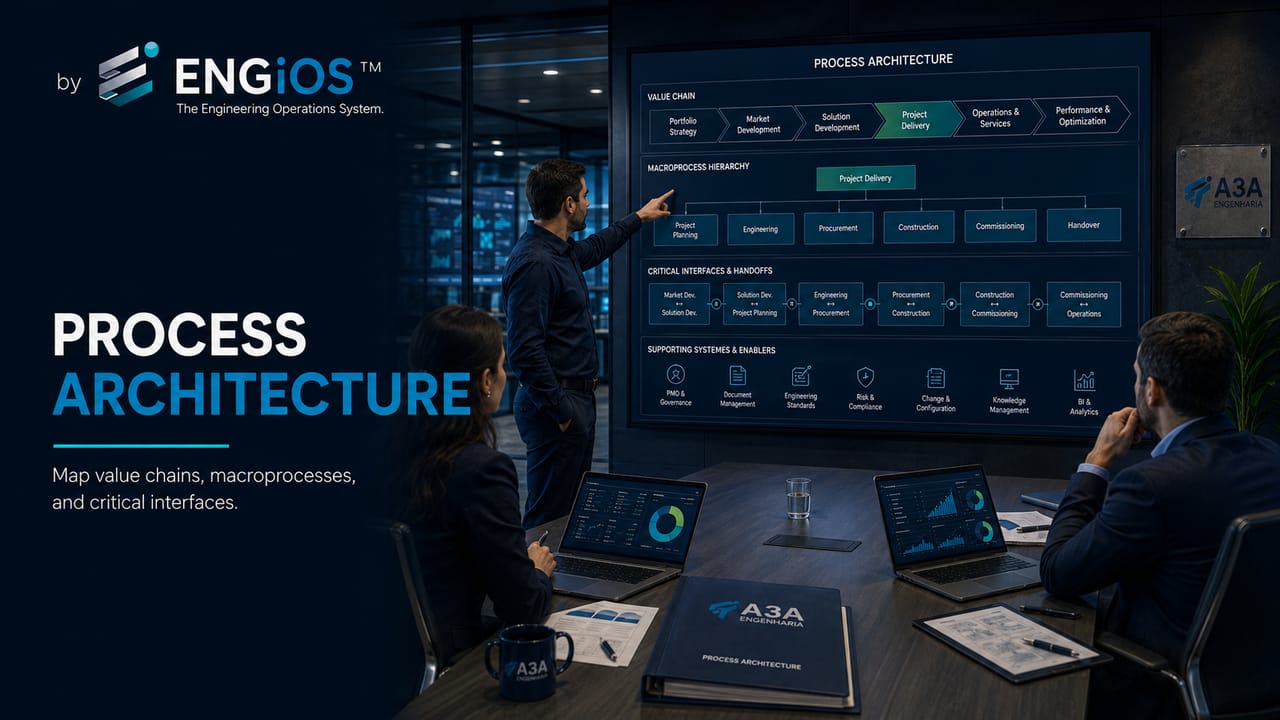
Understand how to structure Engineering process architecture, organize value chains and macroprocesses, map interfaces, and prioritize improvements without reproducing the organization chart.
Check it out!
Process architecture organizes a company’s processes as a system, showing how strategy unfolds into value chains, macroprocesses, processes, and subprocesses that connect to produce results. In Engineering, this view prevents each area from mapping routines in isolation without understanding the dependencies among design, procurement, quality, contracts, documents, suppliers, and operations.
Its purpose is not to create an organization chart of activities or a bureaucratic catalog. The architecture establishes boundaries, relationships, responsibilities, and levels of detail so the organization knows which processes exist, how they relate, which are critical, and where to concentrate governance and improvement.
When this structure does not exist, the company tends to optimize parts of the work while delays and rework remain at the interfaces. Process architecture therefore works as a layer before detailed AS-IS/TO-BE mapping: first the system is understood; then the priority processes that deserve deeper analysis are selected.
What Is Process Architecture?
A process architecture should not reproduce the organization chart. It needs to show how results cross areas, projects, and suppliers and where interfaces condition schedule, quality, and decisions.
Process architecture is the structured representation of an organization’s set of processes and the relationships among them. It creates a high-level view that makes it possible to understand how different flows contribute to common objectives and how management, operational, and support processes depend on one another.
ISO 9001’s process approach treats the organization as an integrated system of processes. This requires identifying processes, understanding their sequence and interaction, defining inputs and outputs, considering interfaces and risks, and assigning responsibilities. The central point is systemic: a process should not be analyzed only within the area that executes it, because its performance depends on inputs produced by other processes and affects subsequent results.
In an Engineering company, for example, design development depends on requirements, planning, document management, interfaces, procurement, change control, quality, and customer decisions. If each flow is managed as an island, the project may show good local performance and still accumulate delays in the end-to-end result.
A well-built architecture makes it possible to answer questions such as:
- which processes are needed to deliver value to the customer and the project;
- where each high-level flow begins and ends;
- which processes are core, management, and support processes;
- which processes cross several functional areas;
- which interfaces concentrate the greatest risk of information loss or waiting;
- which processes need an owner, indicators, and more robust governance;
- which processes should be prioritized for diagnosis, standardization, or improvement.
Process Architecture Is Not Process Mapping
The two concepts complement each other, but they answer different questions.
Architecture works at the systemic level. It identifies and organizes the organization’s process portfolio and shows its relationships. Mapping works at the operational or analytical level of a selected process, identifying activities, decisions, responsible parties, documents, systems, times, and exceptions.
| Dimension | Process architecture | Process mapping |
| Main question | Which processes exist and how do they relate? | How does this process work today and how should it work? |
| Scale | Organization, unit, or value chain | Specific process or flow |
| Result | Hierarchical structure and process network | AS-IS, analysis, and TO-BE |
| Focus | System, boundaries, dependencies, and priorities | Activities, decisions, rules, and controls |
| Typical use | Governance and prioritization | Diagnosis and redesign |
This prevents a common mistake: starting dozens of mapping workshops without knowing which processes are actually critical. AS-IS and TO-BE process mapping generates more value when supported by an architecture view that defines scope and priority.
Value Chain, Macroprocess, Process, and Subprocess: What Is the Hierarchy?
There is no single mandatory terminology for every industry, but the organization needs to adopt a consistent hierarchy. The purpose is to allow managers to move from an executive view to progressively more detailed levels without losing the relationship between the work and the expected result.
Value Chain
The value chain represents a broad set of capabilities and processes that, in combination, produce value for a stakeholder. In an Engineering organization, a chain may range from identifying a demand through design, contracting, implementation, commissioning, and acceptance.
It should not be confused with a rigid chronological sequence. Some activities occur in parallel, return to previous stages, or are shared by different chains. The value of the structure lies in making the logic of result generation visible.
Macroprocess
Macroprocesses group related processes at a higher management level. They facilitate executive reading and help distribute responsibilities without turning the corporate map into an unreadable diagram.
Possible Engineering examples include:
- demand and portfolio management;
- Engineering development;
- technical procurement and contracting;
- implementation management;
- quality and assurance;
- document and information management;
- operations, assets, and improvement.
Process
A process has an identifiable result, inputs, outputs, customers or stakeholders, responsibilities, and performance criteria. It may cross several organizational functions.
Engineering change management, technical document approval, RFI treatment, supplier qualification, and technical acceptance are examples of processes that normally require an end-to-end view.
Subprocess and Activity
When a process is complex, coherent parts of the flow may be treated as subprocesses. An activity is a more operational level and represents work performed within the flow.
Detailing should stop when it no longer supports decision-making, control, or execution. Process architecture should not become an infinite decomposition of tasks.
How to Build an Engineering Process Architecture
The work should begin with results and strategy, not with existing departments. If the structure merely reproduces the organization chart, it will tend to preserve the same silos that process management is intended to overcome.
1. Define Purpose and Scope
First, it is necessary to clarify what the architecture needs to solve. The work may cover the entire company, a project office, an Engineering unit, a CAPEX program, or a specific function.
Common objectives include standardizing processes across projects, implementing governance, preparing a PMO, reducing rework, improving integration between Engineering and Procurement, or creating a basis for digital transformation.
2. Identify Results and Stakeholders
The architecture needs to be built around expected results. Customers, operations, managers, contracting parties, inspection teams, and suppliers may receive or produce relevant outputs.
The question is not only “what does each department do?” but “what result needs to be produced and which processes participate in that delivery?” This shift in perspective reveals flows that cross functional boundaries.
3. Identify Essential Processes
The organization should identify the processes needed to achieve its objectives. ISO recommends considering management, resource, operation, measurement, analysis, and improvement processes. Frameworks such as the APQC Process Classification Framework can serve as taxonomy references, but they must be adapted to the company’s actual context.
An external framework is a starting point, not a ready-made answer. An industrial project company, a utility, and an Engineering Consulting firm have different interfaces, risks, and requirements.
4. Organize the Hierarchy
After identifying processes, they need to be grouped coherently into chains, macroprocesses, and processes. The hierarchy should allow navigation from the executive to the operational level without creating artificial categories merely to fill levels.
A useful rule is to require each element to have a clear result or purpose. If two items differ only by the department that executes them, they may be representing functions rather than distinct processes.
5. Map Interactions and Interfaces
The architecture gains value when it shows dependencies. Inputs and outputs need to be connected, especially where transfer occurs between areas, systems, companies, or disciplines.
In Engineering, critical interfaces frequently appear between:
- requirements and design development;
- Engineering and document control;
- design and procurement;
- supplier and inspection;
- design and construction;
- quality and commissioning;
- implementation and operations;
- technical management and contract management.
These transitions are important because a delay may not be inside any isolated process. It may arise precisely when an incomplete output reaches the next process.
Core, Management, and Support Processes
A simple classification helps make the architecture readable, provided it is not used as an end in itself.
Core Processes
They directly produce the results that justify the existence of the organization or unit being analyzed. In Engineering Consulting, they may involve diagnosis, studies, design development, management, inspection, commissioning, and acceptance.
Management and Governance Processes
They direct, prioritize, supervise, and control the system. They include portfolio, risk, performance, quality, decision, change, and management review processes.
Support Processes
They provide resources and capabilities to the others. Document management, technology, competencies, internal procurement, and knowledge are possible examples.
The classification does not eliminate the need to observe the end-to-end flow. A support process can be decisive for the final schedule of a project when it lies on the critical path of information.
How Process Architecture Reduces Silos in Engineering
Functional structures are necessary because they concentrate specialties. The problem arises when each function begins optimizing only its own indicators without considering the complete delivery.
A technical document, for example, may be prepared on time by the responsible discipline and still reach the customer late because it spent days in verification, document control, consolidation, and approval queues. Each area may declare local compliance while the end-to-end process fails.
Architecture makes this problem visible by shifting the unit of analysis from the department to the result. It shows that Engineering, Quality, Document Control, Contracts, and Procurement may participate in the same flow and need to share performance criteria.
This view connects to process management and BPM: architecture defines the system; process management keeps flows under control and continuous improvement.
How to Prioritize Processes for Diagnosis and Improvement
Mapping every process with the same level of depth consumes effort without necessarily solving the most important problems. Criticality, interfaces, risk, volume, and impact should guide priority.
Not every process deserves the same level of documentation or improvement effort. ISO guidance itself associates the degree of formalization with context, complexity, criticality, and the need for accountability.
A prioritization matrix may consider, for example:
| Criterion | Diagnostic question |
| Customer impact | Does the process directly affect delivery or acceptance? |
| Technical criticality | Can a failure compromise safety, performance, or conformity? |
| Schedule impact | Does the flow create queues or block critical deliverables? |
| Rework | Are there recurring returns or corrections? |
| Interfaces | How many areas, disciplines, or suppliers participate? |
| Traceability | Do decisions and approvals need to be demonstrable? |
| Variability | Do projects or units execute the same process in incompatible ways? |
| Improvement potential | Is there a relevant opportunity for simplification or standardization? |
Prioritization prevents “mapping by inventory,” in which the organization documents hundreds of routines without solving the pain points that motivated the program.
Relationship with BPMN, SIPOC, VSM, and Workflows
Process architecture does not compete with modeling techniques; it defines where and why those techniques will be used.
SIPOC can help delimit suppliers, inputs, process, outputs, and customers. BPMN is useful when a process needs to be modeled with events, decisions, participants, and exceptions. Value Stream Mapping helps analyze value flow, information, waiting, and waste.
A workflow is the operationalization of a flow, often in a digital environment. The correct sequence is to understand the architecture, select the process, diagnose the current state, design the future state, and only then decide what level of standardization or automation is appropriate.
Process Architecture and the Project Management Office
PMOs and Project Management Offices often standardize templates, meetings, and indicators before stabilizing the processes that connect strategy and execution. This can create an additional layer of control without addressing the causes of delay.
A process architecture applied to the PMO helps define how demands enter, how projects are authorized, how requirements and changes are handled, how information is approved, how risks are escalated, and how closeout and lessons learned return to the system.
It also helps separate permanent corporate processes from activities specific to each project. The Engineering Project Management Office can govern a set of processes shared by many projects without trying to turn all technical execution into a standardized routine.
Process Architecture and Engineering Consulting
In Engineering Consulting, process architecture can be used as an organizational diagnostic instrument. It makes it possible to locate problems that are not purely technical but directly affect schedule, quality, cost, and traceability.
It is particularly useful when the contracting organization presents symptoms such as:
- heavy dependence on specific people;
- slow approvals or approvals without uniform criteria;
- multiple projects using different flows for the same purpose;
- information loss between Engineering, Procurement, and implementation;
- recurring document rework;
- informal processes that grew without governance;
- system implementation without a clear definition of the future process.
In these cases, architecture is not the final deliverable. It is the basis for deciding where to deepen the diagnosis and which sequence of improvements generates the greatest return.
The Engineering Process Diagnosis and Optimization service transforms this systemic view into structured AS-IS work, bottleneck and interface analysis, TO-BE design, indicators, and an implementation roadmap.
Common Mistakes When Structuring a Process Architecture
Reproducing the Organization Chart
Department and process are different concepts. The architecture should show result flows, including when they cross several areas.
Creating Too Many Levels
An excessively detailed taxonomy becomes difficult to maintain. The number of levels should follow management needs, not an abstract standard.
Copying an External Framework in Full
Frameworks provide useful language and references, but they do not know the organization’s specific contracts, systems, culture, risks, and interfaces.
Trying to Map Everything at Once
The architecture should enable prioritization. Critical, high-volume processes or those with strong customer and schedule impact should receive attention first.
Ignoring Interfaces
A hierarchical list without relationships among processes is only an inventory. Dependencies are essential to understanding end-to-end performance.
Starting with the Tool
Modeling or workflow software can support the work, but it does not define which processes the organization needs or resolve responsibility conflicts.
When Is It Worth Procuring a Process Architecture Diagnosis?
The engagement makes sense when the organization already recognizes that the problems go beyond an isolated flow. If several projects repeat similar delays, if interfaces between areas generate recurring conflicts, or if a PMO, quality, or digital-transformation initiative needs a common foundation, systemic analysis tends to generate more value than mapping a single procedure.
A well-structured diagnosis should deliver at least a coherent view of the process portfolio, priority criteria, critical interfaces, high-level responsibilities, and a roadmap for deeper work. The objective is to indicate where the organization should act first and why.
How to Define the Right Granularity for Process Architecture
One of the most important decisions when structuring a process architecture is choosing the appropriate level of detail. If the view is too generic, it does little to help locate bottlenecks, responsibilities, and interfaces. If it is too detailed, it ceases to be architecture and becomes a difficult-to-maintain inventory with hundreds of elements that do not support decision-making.
In Engineering, granularity needs to match the type of decision the architecture must support. For an executive board or a corporate PMO, it may be sufficient to see macroprocesses such as design development, change management, procurement, document management, quality, and commissioning. To diagnose recurring delays, however, the macroprocess must be decomposed to the point where interfaces and results can be assigned and measured.
A useful rule is that every process represented in the architecture should have an identifiable result, understandable boundary, customers or users, relevant inputs, and the possibility of assigning responsibility. When an element has no distinguishable output or cannot be managed separately, it is probably at an excessively detailed level. When it groups very different results under a single name, it probably needs to be decomposed.
| Level | Management question | Engineering example | Main use |
| Value chain | How does the organization transform demand into value? | From project need to delivery and operations | Strategic view |
| Macroprocess | Which major capabilities produce this result? | Design development, procurement, implementation | Governance and prioritization |
| Process | Which recurring flow needs an owner and measured performance? | Change control, technical review, document approval | Management and improvement |
| Subprocess | Which part of the flow deserves separate treatment? | Impact analysis, technical approval, controlled issuance | Diagnosis and TO-BE design |
| Activity | What does a person or system execute? | Register request, verify document, issue technical opinion | Procedure and workflow |
This distinction also prevents a common mistake: using the same architecture for every purpose. The view used for strategic planning does not need the same level of detail used to configure a workflow. The architecture should remain relatively stable; operational maps and procedures can evolve more frequently.
Another criterion is managerial autonomy. If two parts of a flow have different owners, their own indicators, distinct risks, or independent improvement cycles, there is an argument for treating them as separate processes or subprocesses. If the division merely reproduces departments, job titles, or system screens, it probably does not improve management capability.
At interfaces with suppliers and contractors, granularity needs to make visible where responsibility for information, decisions, or acceptance changes. A process can cross organizational boundaries without losing its end-to-end view. This is particularly important in Engineering procurement, document management, inspections, and commissioning, where a technically incomplete output at one stage often reappears as delay or rework several stages later.
The architecture should also distinguish permanent processes from project-specific routines. A corporate change-management process may be executed across dozens of projects, while an exceptional sequence created for a specific implementation does not necessarily deserve a place in the corporate architecture. This separation preserves standardization without eliminating adaptations justified by context.
How Do You Know If the Architecture Is Too Detailed?
Some signs are recurrent: the map requires updating with every small operational change; different names represent equivalent activities; discussion focuses on symbols and terminology rather than results; or managers cannot use the structure to prioritize improvements. In these cases, it is advisable to raise the level of abstraction and keep the detail in AS-IS/TO-BE maps.
How Do You Know If It Is Too Generic?
The opposite problem occurs when broad blocks such as “Engineering,” “Procurement,” or “Quality” replace real processes. If it is not possible to identify what result is produced, who receives the output, where the interfaces are, and what performance should be monitored, the architecture is still too close to the organization chart.
The correct level is the one that allows the organization to see where value flows, where responsibility changes, and where it is worth deepening the diagnosis. From this view, detailed mapping becomes selective and criticality-driven instead of an indiscriminate documentation exercise.
Final Considerations
Process architecture is the layer that transforms a collection of routines into an understandable management system. In Engineering companies, it makes visible how demands, requirements, documents, decisions, contracts, suppliers, and deliverables connect and where interfaces can compromise the result.
Its value does not lie in producing a large corporate map, but in guiding governance and priorities. When combined with process management, AS-IS/TO-BE mapping, indicators, and continuous improvement, it makes it possible to direct resources toward the flows that actually determine performance and value generation.
Technology should execute a process that is already understood. When workflow or automation is introduced before diagnosis, the organization risks digitizing queues, redundant approvals, and rules that should have been reviewed.
Technical references
[1] INTERNATIONAL ORGANIZATION FOR STANDARDIZATION (ISO). The process approach in ISO 9001:2015. Geneva: ISO, 2015. Available at: ISO — The process approach in ISO 9001:2015.
[2] APQC. Process Frameworks. Houston: APQC. Available at: APQC — Process Frameworks.
[3] APQC. Leveraging APQC’s Process Classification Framework (PCF) for More Effective Processes. Houston: APQC, 2024. Available at: APQC — Leveraging the Process Classification Framework.
Frequently asked questions
It is the structure that organizes an organization’s processes into levels and shows how they relate to produce results. It provides a systemic view before the operational detailing of each process.
Architecture identifies the set of processes, their hierarchy, and their interactions. Mapping examines a specific process in greater depth, showing activities, decisions, responsible parties, documents, systems, and improvement opportunities.
Macroprocesses are groupings of related processes at a higher management level. They make it possible to visualize major capabilities or flows without entering into the detail of operational activities.
No. BPMN can be used to model selected processes, but architecture first addresses the process system, its boundaries, hierarchy, and relationships. The notation is a subsequent tool and should be proportional to the required level of detail.
It helps the PMO define common processes for demand intake, authorization, requirements, changes, risks, documents, decisions, and closeout, reducing unnecessary variation between projects without eliminating technical autonomy.
When delays, rework, information loss, or conflicts recur across different areas and projects and the problem appears to go beyond a single flow. The diagnosis identifies critical interfaces, priorities, and an improvement roadmap.
Additional technical materials
Main content on the topic
- Process Management and BPM: What It Is, Stages, and Application in Engineering
- Process Mapping: How to Develop AS-IS and TO-BE in Engineering Companies
Related technical content
- BPMN: What It Is, Symbols, and How to Model Engineering Processes
- Value Stream Mapping in Engineering: How to Map Value, Information, and Decision Flows