
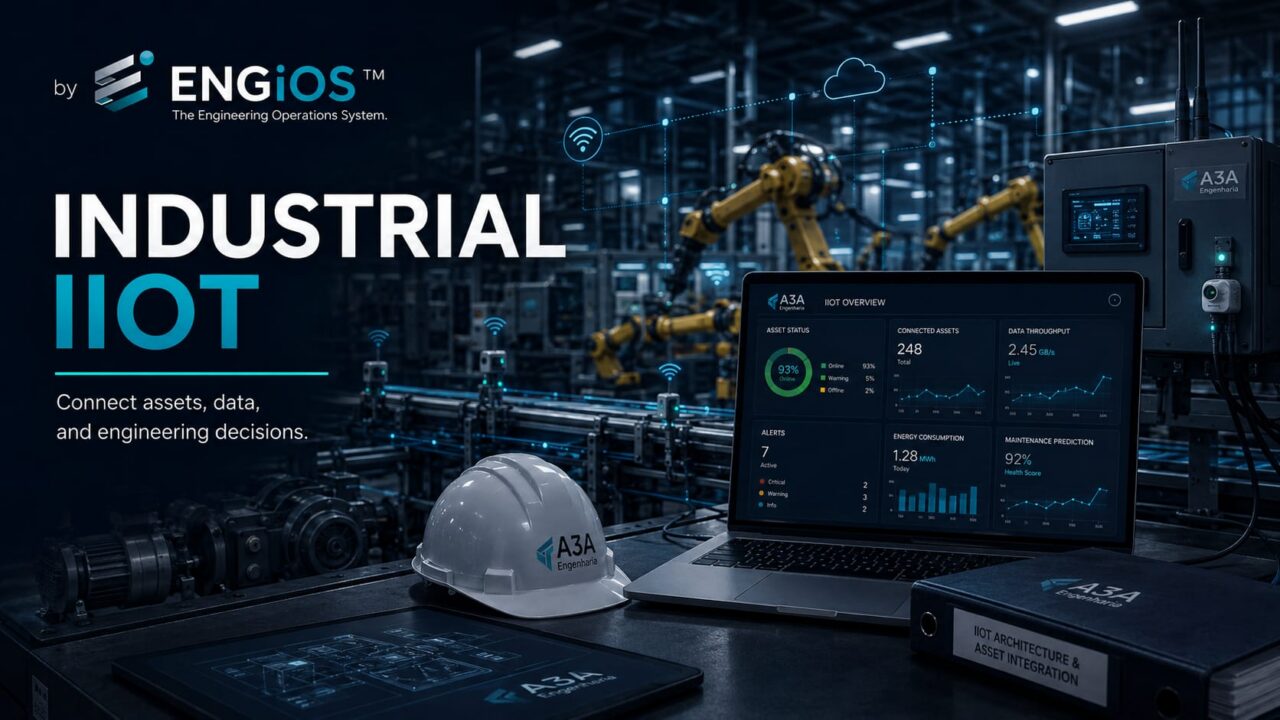
Understand IIoT, Industrial Internet of Things architecture, edge computing, gateways, OPC UA, MQTT, cybersecurity, analytics, maintenance, and deployment at scale.
Check it out!
IIoT, or Industrial Internet of Things, is the use of sensors, devices, gateways, networks, edge computing, and data platforms to connect industrial assets and processes and transform operational data into monitoring, diagnostics, analysis, and decision-making. Unlike consumer IoT, IIoT operates in environments where availability, security, asset lifecycle, interoperability with legacy systems, and the physical impact of failures are engineering requirements. A consistent IIoT project starts with the use case and process requirements, defines where data will be collected and processed, establishes integration with automation and enterprise systems, and addresses cybersecurity, governance, and operations from the architecture stage.
What Is IIoT
Industrial Internet of Things is the application of Internet of Things principles to industrial environments. The objective is not simply to “put equipment on the internet,” but to obtain asset and process data in a controlled manner to increase visibility, support maintenance, improve performance, reduce waste, automate analyses, or enable new operating models.
A solution may use dedicated sensors, variables already available in PLCs and SCADA systems, industrial gateways, edge servers, message brokers, historians, databases, analytics platforms, and local or cloud applications. The appropriate combination depends on the use case and the constraints of the facility.
IIoT is directly connected to the world of industrial automation, but it does not replace it. Process control, protection, and deterministic functions still require appropriate architectures; IIoT usually adds capabilities for observation, contextualization, integration, and analysis.
What Is the Difference Between IoT and IIoT
IoT and IIoT use similar connectivity, processing, and data technologies, but the application context significantly changes the requirements.
In consumer IoT, temporary loss of a device may be inconvenient. In IIoT, a communication failure or improper command may affect production, quality, equipment integrity, or personnel safety. Architecture decisions therefore need to consider physical consequences and operational continuity.
Availability and Determinism
Not every IIoT application requires deterministic communication. Monitoring vibration once per minute is different from closing a control loop in milliseconds. The mistake is to place critical functions on a data architecture that was not designed for them.
A sound separation of responsibilities keeps critical control close to the process and uses IIoT for collection, analysis, optimization, and integration when latency and availability allow.
Lifecycle
Industrial equipment may remain in operation for decades. This contrasts with the short cycles of consumer devices and software services. An IIoT project needs to consider updates, support, certificates, protocol compatibility, and gateway replacement throughout its service life.
Physical Environment
Temperature, dust, vibration, electromagnetic interference, power supply, grounding, and network availability influence hardware selection. A sensor suitable for a laboratory may be unsuitable for an MCC, a substation yard, or a process area.
Cybersecurity
IIoT introduces new communication channels among assets, edge systems, local platforms, cloud services, and remote users. This expands the attack surface and requires a security architecture compatible with operational risk.
IIoT Starts with the Use Case, Not the Platform
IIoT needs to start with the engineering problem and the decision that will be improved by the data. Selecting a platform before defining the use case often produces technically interesting pilots without clear criteria for value or scale.
Projects often begin by selecting an IoT platform and only afterward look for problems that might justify it. This path tends to produce interesting pilots that are difficult to scale or sustain.
Engineering should begin with the question: which decision or action will improve with these data?
A use case needs to identify the asset or process, variable, frequency, data quality, desired analysis, information user, associated decision, and expected benefit.
Well-Defined Use Cases
Examples include:
- condition monitoring of motors, pumps, and fans;
- vibration and temperature analysis;
- energy-consumption monitoring;
- detection of battery and UPS degradation;
- remote monitoring of distributed assets;
- availability and utilization indicators;
- process-quality monitoring;
- trend-based analytical alarms;
- feeding maintenance systems;
- supporting Digital Twin models.
Each case has different requirements. A monthly energy dashboard does not require the same architecture as near-real-time detection of a failure condition.
IIoT Architecture: From the Field to Data Use
The architecture must preserve the origin and context of data. Between the sensor and the final application, several transformations may occur: collection, normalization, storage, aggregation, enrichment, and analysis.
If these stages are not governed, the end user receives a number without knowing its origin, unit, quality, or timestamp.
Sensors and Existing Data
Not every project requires new sensors. Many variables are already available in PLCs, IEDs, drives, meters, SCADA systems, or historians. The first analysis should verify whether existing data is suitable for the use case.
Additional sensors may be necessary when the variable does not exist, when resolution is insufficient, or when accessing the control system would create unnecessary risk or complexity.
Industrial Gateways
Gateways bridge devices and platforms. They may convert protocols, aggregate data, apply filters, execute local logic, temporarily store information, and establish secure communication with upper layers.
Selection should consider protocols, capacity, operating system, updates, certificates, local storage, redundancy, environmental conditions, and support lifecycle.
Edge Computing
Edge computing processes data close to the source. This reduces dependence on external connectivity, limits traffic, enables local response, and can keep sensitive data within the facility.
There is no rule that “edge is better than cloud.” The decision should be based on latency, volume, criticality, connectivity, cost, and governance.
Data Platform
The platform may include a broker, historian, time-series database, data lake, analytics services, and APIs. The architecture should define which component is the source of truth for each type of information and how data is versioned or contextualized.
Edge, On-Premises, or Cloud
An IIoT architecture may operate entirely locally, entirely in the cloud, or in a hybrid model. The correct design depends on operational needs.
When Local Processing Matters
Edge or on-premises processing is often appropriate when:
- the decision must occur even without external connectivity;
- low latency is required;
- raw data volume is high;
- confidentiality restrictions exist;
- the application integrates directly with OT systems;
- external connectivity availability is incompatible with process requirements.
When the Cloud Adds Value
Cloud services can facilitate scalability, multisite consolidation, advanced analytics, collaboration, and platform maintenance. However, application availability should not be confused with process availability.
A critical function should not fail unsafely merely because an external service becomes unavailable.
Hybrid Architecture
Many industrial projects benefit from a hybrid approach: control and essential functions remain local, while selected data is sent to central or cloud services for analysis, benchmarking, and enterprise management.
Integration with Existing Automation Systems
OPC UA can structure interoperability and context among industrial systems, while MQTT can distribute data through a publish/subscribe architecture. Protocol selection should arise from requirements, not from the latest technology trend.
IIoT rarely starts in an empty plant. The project needs to coexist with controllers, SCADA, historians, industrial networks, CMMS, energy systems, and enterprise applications.
Integration should minimize unnecessary changes to stable systems and avoid creating dependencies between functions that were previously independent.
OPC UA
OPC UA provides interoperability and information-modeling mechanisms that can connect industrial data to upper-level systems. The OPC Foundation itself positions the architecture across a spectrum from sensors and controllers to MES, ERP, M2M, IIoT, and cloud environments.
This does not mean OPC UA is mandatory. The protocol should be selected according to endpoints, communication model, security requirements, and the existing ecosystem.
MQTT
MQTT is a lightweight publish/subscribe protocol widely used in IoT and M2M. In this model, clients publish messages to topics and other clients receive data through a broker.
For IIoT, this decoupling can facilitate data distribution to multiple applications. However, topics, quality of service, retention, authentication, authorization, and broker availability need to be designed.
MQTT 5.0 is an OASIS standard. Its use in industrial infrastructure should include security features and a network architecture appropriate to the criticality of the environment.
Legacy Protocols
Modbus and other existing protocols may continue to serve as data sources. The gateway or connector should map address, scale, type, unit, and quality in a documented manner.
Turning an anonymous register into reliable data requires engineering context.
IIoT and SCADA Are Not the Same Thing
SCADA was designed for operational supervision and control. IIoT expands connectivity and data use, often connecting assets and information to analytics, maintenance, energy, and enterprise-management applications.
There is overlap, but the objectives are different. A SCADA system may be a data source for IIoT; an IIoT platform may provide dashboards; even so, automatically replacing supervision and control functions without analyzing requirements is not prudent.
Avoid Duplicate Sources of Truth
If SCADA, the historian, the IIoT platform, and the data lake store the same variable, the architecture needs to define which record is authoritative for each purpose. Differences in timestamps, interpolation, or quality treatment may produce different results.
IIoT and Predictive Maintenance
Predictive maintenance is one of the use cases most commonly associated with IIoT, but collecting data does not automatically create a predictive strategy.
Relevant failure modes, variables capable of indicating degradation, collection frequency, baseline, limits, and response procedures need to be selected.
From Sensor to Maintenance Work Order
Value appears when detection produces an action. A workflow may be: a sensor identifies a trend, an algorithm or rule generates a condition, a specialist validates it, the maintenance system receives a recommendation, and the intervention is planned.
Without this closure, the organization merely accumulates alerts.
False Positives and Trust
Excessive alerts reduce user confidence. Models should be validated with sufficient historical data, operational context, and treatment of changes in equipment operating regimes.
IIoT does not eliminate maintenance engineering; it provides new evidence for it.
Energy Monitoring and Operational Efficiency
Connected meters can provide demand, energy, power factor, harmonics, and other quantities. Their usefulness depends on the objective: allocation, demand management, diagnostics, efficiency, or correlation with production.
The metering architecture should consider instrument class, synchronization, sampling interval, and measurement-point location. Aggregating data without understanding the electrical topology can lead to incorrect conclusions.
Remote Assets and Telemetry
IIoT is especially useful for distributed assets: pumping stations, substations, remote units, telecommunications infrastructure, and distributed equipment.
Connectivity may use private networks, cellular, radio, fiber, or other technologies. Selection should consider coverage, availability, latency, cost, redundancy, and security.
Telemetry should provide local buffering during temporary communication loss when historical continuity is relevant.
Data Quality Is an Engineering Requirement
An analytical model cannot silently correct a poorly installed sensor, an incorrect unit, or an inconsistent timestamp. Before analytics, sufficient data quality must be ensured.
Important dimensions include accuracy, completeness, timeliness, consistency, unit, resolution, and traceability.
Contextualization
A temperature value gains meaning when it is associated with equipment, TAG, location, operating condition, unit, and limit. IIoT systems need to preserve these relationships.
Asset hierarchies and semantic models help avoid databases full of tags without context.
Synchronization
Correlation among events from different systems depends on coherent clocks. In cause analysis, differences of seconds can change interpretation of the sequence.
The project should define time sources and behavior during loss of synchronization whenever relevant.
Cybersecurity in IIoT
IIoT introduces channels, components, and flows that may cross traditional OT boundaries. Cybersecurity therefore needs to be part of the architecture from the beginning.
In 2025, IEC published IEC PAS 62443-1-6, dedicated to applying the IEC 62443 series to IIoT. The document recognizes that IIoT creates new communication channels, reorganizes functions, and introduces new security concerns, guiding asset owners and service providers in applying the 62443 series in this context.
Device Identity
Each device or gateway should have a controllable identity. Shared credentials make revocation and auditing difficult. Certificates may be appropriate in certain scenarios, provided there is a process for issuance, renewal, and replacement.
Firmware and Vulnerabilities
IIoT devices add software to the operational environment. Version inventory, update policy, and vulnerability assessment need to be defined.
Automatic updates may be inappropriate in production; never updating is also inappropriate. Governance should establish testing, approval, and maintenance windows.
Remote Access
Remote support should include authentication, authorization, logging, and revocation. Permanent connections configured solely for convenience increase exposure.
Flow Minimization
Bidirectional communication is not necessary when the use case is collection only. Unidirectional architectures or restrictive rules may reduce risk in certain scenarios.
Governance of IIoT Assets
A project may start with ten gateways and grow to hundreds. Without inventory and standards, each pilot becomes an operational exception.
The organization needs to know the location, model, firmware, owner, address, certificates, protocols, dependencies, application, and criticality of each device.
Architecture Standards
Defining approved models for gateways, operating systems, protocols, naming, connectivity, and security reduces variety and simplifies support.
Standardization should preserve the flexibility required for legitimate cases, but exceptions need to be deliberate.
Integration with Maintenance and Asset Management
IIoT generates greater value when data reaches the management process that can act on it. For maintenance, this means integrating condition data with the asset register, criticality, history, and work-order planning.
The architecture does not necessarily need a direct real-time integration with the CMMS. An analytics or workflow layer may exist, provided ownership and process closure are clear.
Digital Twin
Digital Twin can use IIoT data as one of the sources for representing the state and performance of an asset. However, a digital twin is a broader concept than telemetry acquisition.
A set of sensors connected to a dashboard does not automatically become a Digital Twin. A model, context, and a consistent relationship with the physical asset are required.
Integration with MES and Enterprise Systems
ISA-95/IEC 62264 provides useful models for discussing boundaries and information flows among control, manufacturing operations, and enterprise functions. The 2025 edition of Part 1 updates this reference for a context of more modular and data-oriented architectures.
IIoT can create additional information paths. These flows need to respect ownership, semantics, and security rather than silently bypass official systems.
Avoid Excessive Point-to-Point Integration
When each application creates its own connector directly to each PLC, the architecture becomes difficult to maintain. Interoperability layers, brokers, and APIs can reduce coupling, provided they do not create an untreated new single point of failure.
How to Design an IIoT Use Case
A structured process helps prevent technology without a clear objective.
- Define the problem and desired decision.
- Identify relevant assets and variables.
- Verify whether the data already exists.
- Define required quality, frequency, and latency.
- Select the collection and processing architecture.
- Assess cybersecurity and interfaces.
- Define the KPI and success criterion.
- Implement a controlled pilot.
- Validate benefit and operation.
- Standardize before scaling.
This sequence prevents a pilot from being considered successful merely because the technology worked.
PoC, Pilot, and Production Are Different Stages
A Proof of Concept demonstrates the technical feasibility of a hypothesis. A pilot tests the solution in a context closer to reality. Production requires scalability, support, security, asset management, monitoring, and operational processes.
Many initiatives remain stuck between pilot and production because operational requirements were not considered from the beginning.
The Pilot Purgatory Problem
A pilot may use a shared account, improvised gateway, database without backup, and temporary connection. That may be acceptable for proving a concept, but not for scaling it.
Before production, temporary decisions need to be replaced with a supportable architecture.
How to Measure the Results of an IIoT Project
KPIs should be linked to the use case. The number of sensors installed or the amount of data collected are implementation indicators, not value indicators.
Depending on the objective, metrics may include reduced failures, diagnostic time, consumption, availability, response time, fewer manual inspections, or forecasting accuracy.
Baseline
Without a reference condition, demonstrating improvement is difficult. The project needs to record performance before the intervention or establish a comparable group whenever possible.
Technical Benefit and Economic Benefit
Not every use case produces immediate direct savings. Some increase safety, traceability, or operational knowledge. The business case should make explicit which type of value is being pursued.
How to Scale IIoT Without Multiplying Technical Debt
Scaling means repeating a governed architecture, not copying pilots indefinitely.
Before expanding, the organization should define a device catalog, connectivity standards, naming, onboarding, certificates, observability, updates, backup, support, and decommissioning.
Multisite
Across multiple facilities, the architecture should balance enterprise standardization with local particularities. A common gateway can simplify support; field protocols and networks may vary by plant.
The central platform needs to clearly distinguish assets, sites, permissions, and contexts.
Brownfield: How to Connect Legacy Assets
Older assets may not support modern protocols. That does not mean they need to be replaced solely to participate in IIoT.
Gateways can collect data from existing interfaces, but engineering needs to verify whether access affects controller performance and whether the network can support the new traffic.
The article on Brownfield Projects addresses surveying, validation of existing conditions, and intervention strategy.
Do Not Turn Monitoring into Operational Risk
An analytics initiative should not increase the likelihood of process unavailability. Changes to controllers, switches, and firewalls need to follow change-management and testing procedures.
In some scenarios, it is preferable to collect data through an existing interface or segregated infrastructure.
Commissioning an IIoT Solution
An IIoT solution is only delivered when devices, data, security, integrations, backups, and documentation can be verified. Commissioning the complete data path reduces the gap between a working dashboard and an operationally reliable solution.
IIoT also needs to be commissioned. The fact that a sensor appears on a dashboard does not demonstrate data quality, security, or integration.
Tests may verify:
- device identification and TAG;
- scale and unit;
- timestamp;
- communication loss and recovery;
- local buffering;
- authentication;
- certificate renewal or validity;
- gateway behavior after reboot;
- broker availability;
- data quality;
- alarms and rules;
- integration with destination applications;
- backup and restore;
- logs and auditing.
Industrial commissioning provides a governance framework that can be adapted to digital and OT environments.
Documentation and Handover
The final package should enable the Owner to understand and administer the architecture. Diagrams, inventory, addressing, firewall rules, certificates, credentials, versions, backups, data models, MQTT topics, OPC UA endpoints, APIs, and support procedures are examples of relevant information.
Documentation is especially important because IIoT combines field engineering, networks, software, and data. Without an integrated view, the solution may depend on the tacit knowledge of the implementation team.
When IIoT Is Not the Best Solution
Not every industrial problem requires IIoT. If the objective can be achieved with the existing SCADA system, improved instrumentation, or a simple integration, adding a distributed platform may increase complexity without proportional benefit.
It is also inappropriate to start an IIoT initiative when there is no process for acting on the information generated. Detecting a condition without an owner or workflow merely transfers the problem to an alert queue.
The decision should compare technical alternatives and lifecycle cost.
How to Procure an IIoT Project
The procurement package needs to describe the use case, assets, variables, integrations, minimum architecture, responsibilities, cybersecurity, documentation, testing, operation, and success criteria.
When the scope is too open, each bidder may offer different combinations of gateways, platforms, and services, making comparison difficult.
The article on how to evaluate industrial automation companies goes deeper into integrator qualification, RFP, TBE, licensing, and acceptance criteria.
Recommended Journey for Implementing IIoT
A scalable approach separates discovery, proof, pilot, and industrialization.
Gate Before Scaling
The project should verify whether the pilot demonstrated data quality, security, integration, support, and value. Scaling a solution that still depends on constant manual intervention only expands the problem.
Continuous Operation
Once deployed, IIoT enters the digital-asset management lifecycle: monitoring devices, firmware, certificates, capacity, logs, cloud costs, and application evolution.
Final Considerations
IIoT creates a bridge between industrial assets and data applications, but its value depends on disciplined engineering. The use case needs to come before the platform; critical functions must remain in appropriate architectures; data needs context and quality; and cybersecurity, operations, and lifecycle must be addressed from the design stage.
When properly structured, IIoT can increase process visibility, support condition-based maintenance, connect remote assets, improve energy management, and feed analytics and Digital Twin applications. When implemented merely as a collection of sensors and dashboards, it tends to create new technology silos.
The difference lies in the architecture, governance, and ability to transform data into verifiable operational decisions.
Technical references
[1] 1. INTERNATIONAL ELECTROTECHNICAL COMMISSION. IEC PAS 62443-1-6:2025 — Security for industrial automation and control systems — Part 1-6: Application of the 62443 series to the Industrial Internet of Things (IIoT). Geneva: IEC, 2025. Available at: [https://webstore.iec.ch/en/publication/102885](https://webstore.iec.ch/en/publication/102885)
[2] 2. NATIONAL INSTITUTE OF STANDARDS AND TECHNOLOGY. Guide to Operational Technology (OT) Security. NIST SP 800-82 Rev. 3. Gaithersburg: NIST, 2023. Available at: [https://csrc.nist.gov/pubs/sp/800/82/r3/final](https://csrc.nist.gov/pubs/sp/800/82/r3/final)
[3] 3. OASIS OPEN. MQTT Version 5.0. OASIS Standard, 7 Mar. 2019. Available at: [https://docs.oasis-open.org/mqtt/mqtt/v5.0/mqtt-v5.0.html](https://docs.oasis-open.org/mqtt/mqtt/v5.0/mqtt-v5.0.html)
[4] 4. OPC FOUNDATION. OPC Unified Architecture — Part 1: Overview and Concepts. Available at: [https://reference.opcfoundation.org/Core/Part1/v105/](https://reference.opcfoundation.org/Core/Part1/v105/)
[5] 5. INTERNATIONAL SOCIETY OF AUTOMATION. ANSI/ISA-95.00.01-2025 (IEC 62264-1 Mod), Enterprise-Control System Integration — Part 1: Models and Terminology. Research Triangle Park: ISA, 2025. Available at: [https://www.isa.org/products/ansi-isa-95-00-01-2025-iec-62264-1-mod-enterprise](https://www.isa.org/products/ansi-isa-95-00-01-2025-iec-62264-1-mod-enterprise)
Frequently asked questions
IIoT means Industrial Internet of Things. It is the connection of industrial assets, sensors, and systems to a data architecture for monitoring, analysis, integration, and decision-making.
IIoT operates in industrial environments, where failures can affect physical processes, availability, and safety. Lifecycle, legacy interoperability, cybersecurity, and operational continuity therefore carry greater weight than in many consumer IoT applications.
Not necessarily. SCADA is focused on operational supervision and control; IIoT expands data utilization and integration. A SCADA system can be a data source for an IIoT architecture.
Edge computing processes data close to the asset, reduces dependence on external connectivity, lowers traffic, and enables local decisions when latency, privacy, or availability require it.
No. MQTT is a widely used publish/subscribe protocol, but selection should consider architecture, endpoints, security, and integrations. OPC UA and other protocols may also be part of the solution.
The architecture should address zones, flows, device identity, authentication, authorization, firmware, certificates, remote access, inventory, and monitoring. IEC PAS 62443-1-6:2025 guides application of the IEC 62443 series to IIoT.
Define the use case, KPI, security and operational requirements, device standards, integration, support, and scaling criteria from the start. PoC, pilot, and production should be treated as different stages.
Identification, scale, unit, timestamp, communication, buffering, authentication, certificates, gateway behavior, broker availability, data quality, integration, backup, logs, and failure recovery.
Complementary technical materials
Related solutions
- SCADA Systems: supervision, control, alarms, and operational data
- Digital Supervision and Control Systems (SDSC): automation and integrated operation
Related services
- Industrial Automation Design: control, supervision, OT networks, and integration
- Systems Integration: APIs, protocols, data, and interoperability
Main content on the topic
- Industrial Automation: what it is, architecture, systems, and Engineering applications
- Industrial Automation Company: how to evaluate, compare, and hire an integrator
- OPC UA: what it is, how it works, security, and integration with SCADA, Modbus, and MQTT
Related technical content
- Industrial networks: what they are, protocols, architecture, security, and integration with SCADA
- Industrial Ethernet: what it is, how it works, protocols, topologies, and security
- Digital Twin: what it is, architecture, BIM, IoT, and asset management
- Industrial Commissioning: pre-commissioning, start-up, cold and hot tests
- Brownfield Projects: engineering in existing facilities, surveying, As-Built, and retrofit
