
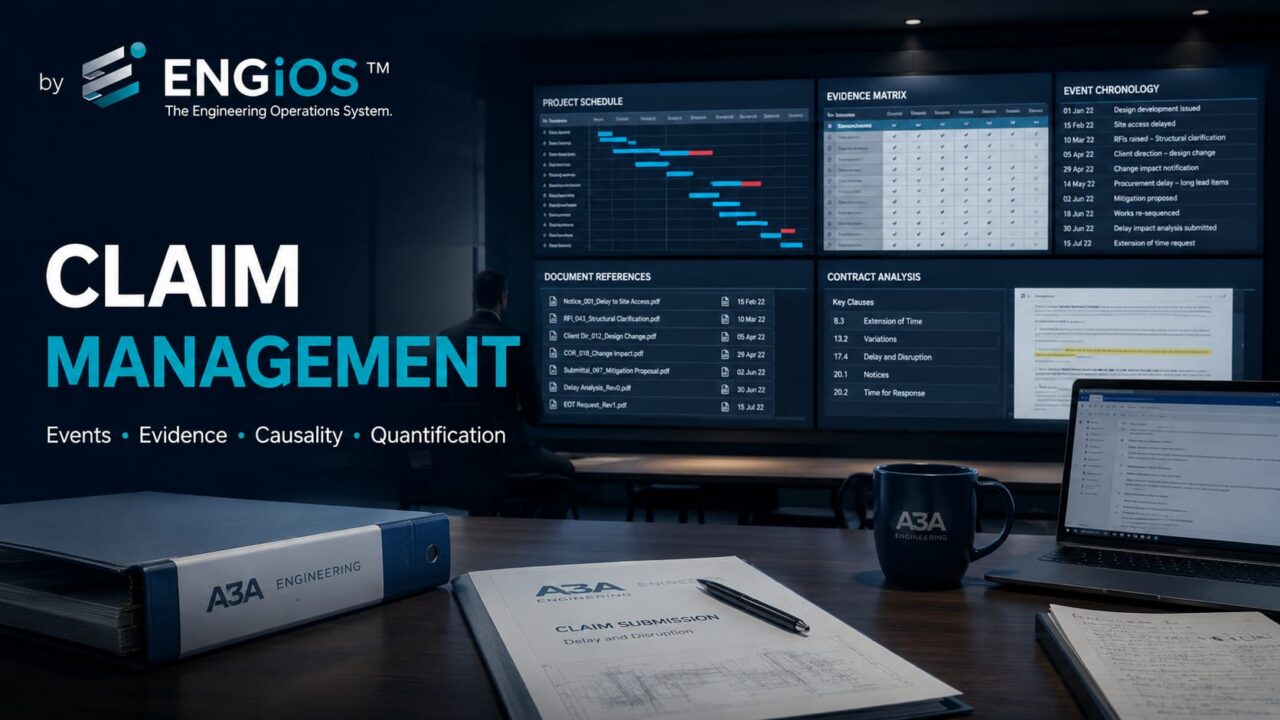
Understand how to structure Claim Management in engineering projects: events, notices, entitlement, evidence, causation, schedule, costs, mitigation, and governance.
Check it out!
Claim Management is the structured management of contractual events that may affect scope, schedule, cost, productivity, responsibility, or the rights of the parties. In engineering projects, the objective is not to “create claims,” but to identify facts with contractual potential early, preserve evidence, comply with notice requirements, analyze causation, and decide whether an event should be absorbed, formalized as a change, negotiated, or converted into a claim.
The difference between mature management and reactive action is timing. When an event is recorded as it occurs, the baseline, documents, resources, communications, and impacts can still be verified. When the issue is reconstructed months later, the team depends on memory, dispersed files, and conflicting interpretations. Therefore, Claim Management should operate during execution, integrated with planning, costs, document management, changes, and contract governance.
An effective system connects seven elements: triggering fact, contractual obligation, notice, contemporaneous evidence, causal link, demonstrable impact, and decision. The absence of one of these elements does not automatically eliminate a claim, but it increases uncertainty and weakens the technical analysis.
Claim Management is not synonymous with preparing a Claim
An engineering contractual claim is a structured assertion regarding a specific right or contractual consequence. Claim Management is broader: it organizes the process through which potential events are identified, analyzed, documented, decided, and closed.
| Dimension | Individual Claim | Claim Management |
| focus | a specific request | portfolio of events, changes, and claims |
| horizon | normally after impact materializes | from the emergence of the event |
| evidence | case dossier | continuous record system |
| responsibility | team preparing or analyzing the claim | engineering, planning, costs, contracts, Document Control, and management |
| objective | demonstrate or contest a right | control contractual exposure and avoid unnecessary escalation |
This distinction prevents the organization from treating claims only as a legal or closeout activity. In complex projects, the process begins in the field, engineering, schedule, Procurement, and interfaces between contracts.
From event to closeout: the Claim Management cycle
AACE International treats Contract Change Management as a management process applicable to different contracting strategies and delivery methods. The principle is consistent with an essential engineering practice: events need to enter a control flow before they become accumulated disputes.
The flow does not mean that every event will result in a financial request or extension of time. Screening may conclude that the risk was assumed, that there was no impact, that the change was already compensated through another mechanism, or that the evidence is insufficient. The value of the process lies precisely in producing a traceable decision.
Event register: the layer that prevents late reconstruction
The first operational tool is a contractual event register. It should be simple enough to be used during execution and complete enough to support later analysis.
A useful register links each event to date, origin, factual description, affected contract or package, related requirement, owner, applicable notice, documents, potential impact, and analysis status. It is not necessary to quantify everything on the first day. It is necessary to prevent the fact from disappearing from the system.
Typical events include design changes, delayed information, unreleased access, physical interference, operational restrictions, sequence changes, field instructions, suspension, unavailable work fronts, supplier delay, unforeseen conditions, regulatory change, or interface conflicts.
Contracts, Scope, and Deliverables Management reduces dispersion by connecting these events to scope, responsibilities, and formal project decisions.
When contractual events are scattered across emails, minutes, schedules, and field reports, the organization loses time precisely when it needs to decide. Structuring a single flow for registration, notice, evidence, and analysis reduces this exposure and improves negotiation quality.
Structure the technical analysis of amendments, scope changes, and claims
Notice: notifying at the right time is part of management
Many contracts establish deadlines, form, recipient, and minimum content for notifications. The function of a notice is not to prove the merits of a claim by itself. It preserves communication that a particular event may have contractual consequences and allows the other party to monitor, mitigate, instruct, or contest the fact while it is occurring.
Management needs to distinguish operational communication from contractual notice. An email between engineers may technically record the problem but not necessarily comply with the notice clause. The reverse is also true: a formal letter without factual content and evidence may satisfy a procedure and still be technically weak.
A good routine connects the event register to a notice calendar with owners and deadlines. This reduces dependence on memory and prevents contractual control from starting only after the impact has materialized.
Entitlement: before calculating, identify the contractual basis
Entitlement analysis asks whether the contract and risk allocation support the proposed treatment. AACE RP 120R-21 is a specific reference for demonstrating entitlement in change orders and claims in an EPC context.
In practical terms, the team should locate the original obligation, identify the fact that changed the expected condition, verify who assumed the risk, and determine which contractual mechanism applies. The same financial effect may arise from a scope change, contractor risk, compensable event, force majeure, third-party delay, or a condition already covered by price adjustment.
Therefore, contractual and supplier risks and the risk matrix need to be part of event analysis, not merely initial planning.
Contemporaneous evidence: the claim begins in execution records
Contemporaneous evidence is produced during the normal course of the work, close to the time of the event. It tends to be more reliable than reconstructions prepared after the parties’ positions are already established.
Relevant records vary with the event: site logs, reports, meeting minutes, RFIs, instructions, design revisions, photographic records, measurements, timesheets, equipment logs, supplier deliveries, histograms, updated schedules, productivity reports, correspondence, and approval documents.
The point is not to accumulate files. It is to build traceability. Each piece of evidence should help answer what happened, when, where, who was affected, which obligation was in force, how long it lasted, which resources were impacted, and which mitigation measures were adopted.
Baseline: without a reference, impact becomes a subjective comparison
Claim Management needs to preserve the project’s reference condition. For schedule, this includes the contractual schedule or approved baseline, logic, milestones, and assumptions. For cost, budget, cost build-ups, planned productivity, resources, and commercial conditions. For scope, procurement documents, SOW, specifications, and interface matrix.
Scope of Work in Engineering and Contractual Scope are fundamental references because they allow comparison between the original obligation and the modified condition.
Without a reliable baseline, the analysis tends to confuse poor original conditions, the contractor’s own low productivity, and the real effect of an external event.
Causal link: connecting event, mechanism, and consequence
Causation is the bridge between the triggering fact and the claimed impact. It is not enough to show that an event occurred and that the project ended up more expensive or later. It is necessary to explain how that event changed a particular activity, resource, sequence, productivity level, or execution path.
The analysis can be structured as a chain: event → affected obligation → impact mechanism → affected activity or resource → measurable effect → contractual consequence. The longer this chain, the greater the need for intermediate evidence.
For schedule events, this logic leads to criticality and delay analysis. For cost events, it leads to segregation of additional costs, loss of productivity, prolongation, acceleration, or other demonstrable effects. In both cases, temporal correlation should not automatically be treated as causation.
Schedule quantification: Claim Management must connect to the schedule
Schedule analysis should verify whether the event affected critical activities, consumed float, changed sequence, prevented a work front, or required replanning. The method depends on the timing of the analysis, schedule quality, and the purpose of the decision.
A Time Impact Analysis may be appropriate for prospective analysis of a specific event when a reliable schedule and updated logic exist. Retrospective analyses may require other methods, especially when the project is already complete or schedule updates are low quality.
Claim Management should not choose the result first and then search for a method. The methodology must be compatible with the available data and the contractual question.
Cost quantification: separate actual cost, causal effect, and duplication
For cost, the main discipline is to avoid attributing an overall variance entirely to a specific event. The calculation should distinguish additional direct cost, prolongation, loss of productivity, mobilization, acceleration, third parties, equipment, and other components as applicable.
Duplication must also be checked. A cost already compensated through a change order, price adjustment, unit rate, contractually assumed contingency, or another mechanism should not reappear without justification.
The article on economic-financial rebalancing develops reconstruction of the economic equation, while Claim Management organizes the continuous process that allows this analysis to be reached with reliable records.
In contracts with multiple suppliers and frequent changes, preventing claims depends less on a well-written letter at the end and more on continuous governance over scope, deliverables, interfaces, decisions, and evidence during execution.
Learn about the Contracts, Scope, and Deliverables Management solution
Mitigation: controlling the impact is also part of the claim
A mature organization does not use event registration as justification for allowing the impact to grow. Management should document which measures were assessed and adopted to reduce schedule, cost, or lost productivity.
Mitigation may involve resequencing, partial work-front release, method changes, additional resources, engineering prioritization, temporary solutions, alternative purchasing, or accelerated decisions. Each measure may create new costs or risks and needs to be recorded.
The later analysis becomes more robust when it can show not only the problem, but also the alternatives considered and why a particular response was technically and economically reasonable.
Integration between change, amendment, and claim
Change Management and Claim Management should interact, but they are not identical. A change identified and agreed early may be formalized through a change order or amendment without becoming a dispute. A claim may arise when there is disagreement about entitlement, schedule, cost, responsibility, or quantification.
The article on Engineering Change Management addresses technical-change governance; the Contract Amendment addresses contractual formalization. Claim Management occupies the interface where events and changes need to be analyzed before their economic and contractual resolution.
Governance: who records, who analyzes, and who decides
A recurring mistake is concentrating the entire process in a contract manager without integrating the disciplines that produce evidence. Claims arise at technical interfaces; therefore, the system needs to define roles.
Engineering characterizes requirements and changes. Planning assesses schedule effects. Cost Control analyzes quantum. Document Control preserves the documentary trail. Procurement and technical supervision record supplier and field events. Contract management interprets clauses and notices. Legal assesses legal implications when necessary. The decision authority approves the organization’s final position.
A RACI matrix can formalize this governance, but the essential requirement is ownership for each event and a decision deadline. Events without an owner tend to age until they become disputes that are difficult to reconstruct.
Claim register: turning a collection of cases into a manageable portfolio
In addition to the event register, more complex projects may maintain a claim register for cases that have passed initial screening. It should provide an executive view without replacing technical dossiers.
Useful fields include value or exposure range, potential schedule impact, entitlement status, evidence quality, probability of resolution, owner, next action, contractual deadline, and decision dependency.
This view helps management prioritize higher-exposure cases and prevents the number of claims from being used as the only indicator. A project may have a few extremely high-impact claims or many low-relevance events.
Claim Management indicators
The function should measure process quality and speed, not the “number of claims generated”. Useful indicators include time between event and registration, notices issued on time, events without an owner, average case age, financial exposure, schedule exposure, percentage resolved through negotiated change, and percentage that evolved into dispute.
Another important indicator is evidence quality. Cases classified as “high impact and low evidence” deserve immediate attention because they combine significant exposure with low decision capability.
Substantiation matrix: linking obligation, fact, evidence, and impact
One of the most efficient ways to improve claim quality is to structure a substantiation matrix before consolidating the narrative. It works as an evidence map: for each relevant assertion, it identifies the related contractual obligation, triggering fact, contemporaneous evidence, causal mechanism, schedule or cost effect, and intended conclusion.
This method reduces two recurring problems. The first is an excess of documents with no clear function: hundreds of attachments can make a claim more voluminous without making it more demonstrable. The second is the existence of conclusions without an evidentiary bridge, such as presenting an additional amount without explaining which resources were affected, during which period, and through which mechanism.
| Element | Control question | Expected evidence |
| obligation | what did the contract provide? | clause, SOW, requirement, drawing, or risk matrix |
| event | what changed or failed to occur? | notice, RFI, instruction, minutes, site log, or correspondence |
| causation | how did the event affect execution? | sequence, work-front record, resource, productivity, or schedule |
| impact | what consequence was measured? | calculation, TIA, measurement, actual cost, or statement |
| treatment | what contractual consequence is being defended? | extension of time, compensation, change, or substantiated rejection |
The matrix is also useful for independent review. A third party can quickly identify where support is strong and where gaps exist. Instead of discussing the claim as an indivisible document, the team examines specific elements and can request additional evidence before submission.
Event maturity: not every case is ready to be quantified
Contractual events evolve. At first there may be only a potentially relevant fact; later, impact evidence emerges, the contractual basis becomes clearer, duration becomes known, and sufficient data becomes available for quantification. Treating every case as if it were at the same maturity level leads to premature decisions.
A simple classification can distinguish identified event, event under analysis, potential change, claim in preparation, submitted claim, negotiation, and closeout. Each stage requires different information. A newly identified event needs an owner, notice, and evidence preservation; a claim in preparation requires causation and quantum; a negotiation requires a consolidated technical position, concession limits, and records of the assumptions discussed.
This maturity should appear in the claim register. It is not appropriate to assign artificial financial precision to a case that still lacks data. In early phases, exposure ranges and confidence levels are more honest than a fixed value. As evidence matures, the estimate can be replaced by a detailed calculation.
Governance improves when management can distinguish “possible exposure” from a “technically substantiated claim”. This prevents preliminary amounts from being treated as certain assets or unavoidable liabilities.
Defensive analysis: Claim Management also applies to claims received
Claim Management should not exist only for the party making the request. Owners, EPC contractors, management contractors, and clients also need a structured process to analyze claims received. The logic is symmetrical: verify entitlement, notice, baseline, causation, mitigation, and quantification before accepting, rejecting, or negotiating.
A technically robust response avoids two extremes. Quickly accepting an amount under schedule pressure may incorporate costs without sufficient demonstration. Completely rejecting a plausible claim, on the other hand, may escalate the dispute and postpone a solution that would have been more economical during execution.
Defensive analysis should test the narrative against the project’s own records. If a contractor states that a work front was unavailable, for example, the team needs to compare site logs, releases, alternative activities, mobilized resources, and the contemporaneous schedule. If the allegation involves productivity, it is necessary to distinguish the event effect from the contractor’s own performance, learning curve, insufficient resources, rework, or an already anticipated condition.
The result does not have to be binary. A claim may have recognized entitlement but contested quantum; it may demonstrate schedule impact without compensable cost; or it may contain valid and duplicated portions. The response should decompose these conclusions to support negotiation and decision-making.
Technical negotiation and settlement: resolving without losing traceability
Not every claim needs to proceed to formal dispute. In many projects, the best economic decision is to negotiate during execution, while mitigation alternatives still exist and both parties share an interest in project continuity. For this to work, negotiation must start from an organized technical basis.
The team should separate undisputed facts, points of disagreement, exposure range, schedule risks, the cost of prolonging the discussion, and future dependencies. This structure helps negotiate based on verifiable elements rather than only on overall positions.
It is also important to record exactly what was resolved. A settlement or agreement on a change order should define the period, covered events, amounts, schedule effects, excluded items, and consequences for related claims. Without this boundary, an apparently final solution may reappear in another request under different terminology.
Negotiation traceability protects both parties. It makes it possible to understand which assumptions supported the decision and prevents commercial concessions from later being interpreted as broad recognition of technical or contractual responsibility.
Preventive Claim Management reduces the need for late forensic analysis
The earlier the organization connects event, contract, and evidence, the lower the need for forensic reconstruction at closeout. This does not eliminate legitimate disputes, but it improves the quality of the discussion.
Prevention depends on clear scope, traceable requirements, a reliable schedule, change management, contemporaneous records, and formal decisions. Therefore, Claim Management is not an isolated process: it is a governance layer that integrates functions already present in the project.
Final considerations
Claim Management in engineering projects should operate as a continuous system for identification, documentation, analysis, and decision-making. Its value lies in transforming dispersed events into a verifiable chain connecting contract, baseline, evidence, causation, schedule, cost, and resolution.
When this process works during execution, the organization can quickly distinguish an absorbable event, a negotiable change, and a claim that requires deeper analysis. It also reduces dependence on late reconstruction and improves negotiation capability because positions are supported by contemporaneous facts.
The discipline does not replace scope management, planning, cost control, or legal analysis. It connects these functions when a fact may change contractual rights and obligations.
Technical references
[1] AACE INTERNATIONAL. Recommended Practice 100R-19 — Contract Change Management: As Applied in Engineering, Procurement, and Construction. Morgantown: AACE International. Available at: https://web.aacei.org/resources/recommended-practices
[2] AACE INTERNATIONAL. A Primer for Claims and Disputes (Claims 101). Source Extra, Aug. 24, 2022. Available at: https://source.aacei.org/2022/08/24/a-primer-for-claims-and-disputes-claims-101/
[3] AACE INTERNATIONAL. Spotlight on Recommended Practice 100R-19: Contract Change Management. Feb. 24, 2021. Available at: https://communities.aacei.org/events/event-description?CalendarEventKey=63a7cb54-e138-40b6-974f-2da402a8c0c5&hlmlt=ED
Frequently asked questions
It is the continuous management of contractual events with the potential to change scope, schedule, cost, productivity, or responsibilities, from registration and notice through analysis, negotiation, formalization, and closeout.
No. A claim is a specific contractual request. Claim Management is the broader process that identifies, documents, analyzes, and governs a portfolio of events, changes, and claims during execution.
No. Screening may conclude that the risk was assumed, there was no impact, the change was negotiated through another mechanism, or there is insufficient entitlement.
It depends on the event, but contemporaneous records such as site logs, minutes, RFIs, revisions, schedules, measurements, productivity reports, correspondence, photos, and resource logs are especially valuable.
Change Management governs technical and contractual changes. Claim Management addresses events and disagreements that may generate rights, impacts, and claims. A change resolved early may never become a claim.
Governance should be multidisciplinary. Contract management coordinates, while Engineering, Planning, Cost Control, Document Control, Procurement, technical supervision, and Legal contribute according to the event and decision.
Complementary technical materials
Main content on the topic
- Contractual Claim in Engineering: how to technically structure a Claim
- Economic-Financial Rebalancing in Engineering Contracts
- Contract Review, Price Adjustment, and Repactuation in Engineering
Related technical content
- Contractual Scope in Engineering
- Contractual and Supplier Risks in Engineering Projects
- Engineering Change Management (ECM) in Engineering Projects
