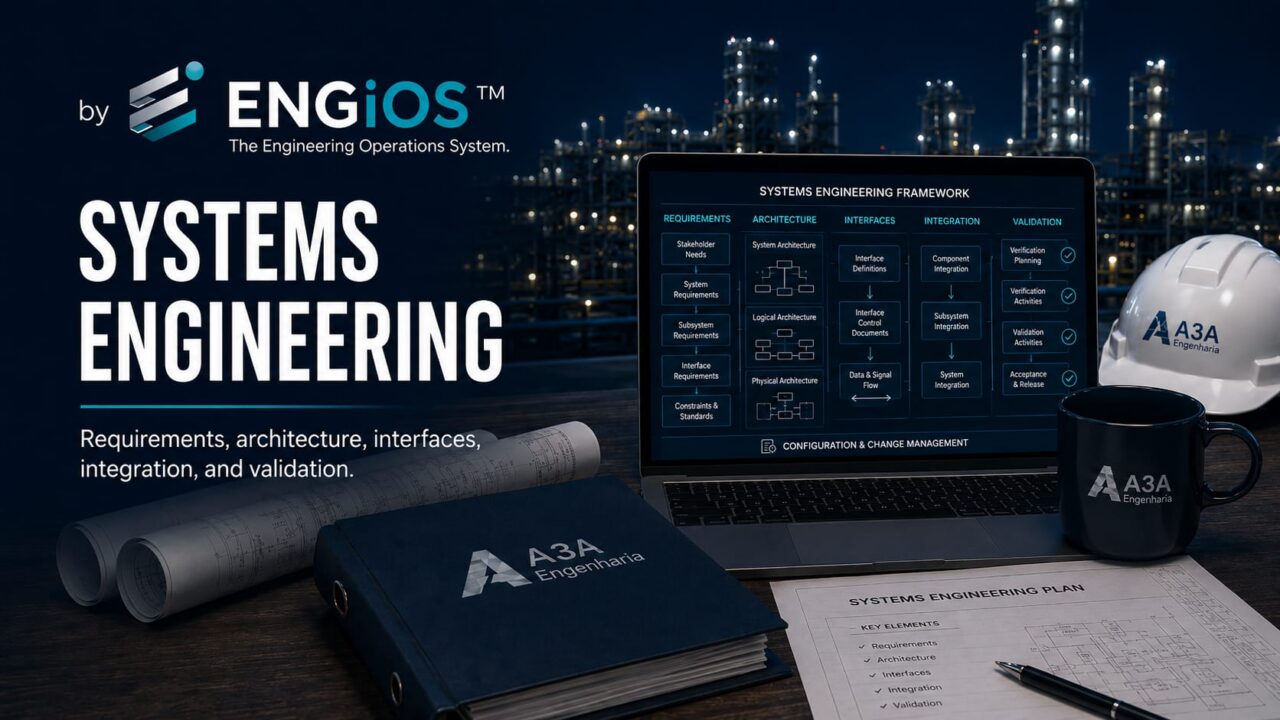
Understand Systems Engineering applied to complex projects: stakeholders, requirements, architecture, interfaces, integration, verification, validation, MBSE, and life cycle.
Check it out!
Systems Engineering is the discipline that structures the development of complex systems from stakeholder needs, transforming them into requirements, architecture, interfaces, integrated solutions, and verification and validation evidence throughout the life cycle. In multidisciplinary projects, its primary role is to reduce integration failures that arise when each discipline or supplier optimizes only its own part without controlling the behavior of the whole.
The approach is especially useful in critical systems, technology infrastructure, automation, energy, telecommunications, electronic security, data centers, transportation, and projects that combine hardware, software, networks, people, procedures, facilities, and operations. In these cases, the problem is rarely located in a single component: it appears at interfaces, in incompatible assumptions, poorly allocated requirements, or late validation of the complete system.
ISO/IEC/IEEE 15288:2023 establishes a life-cycle process framework applicable to systems and systems of systems, from conception through development, production, utilization, support, and retirement. The standard does not prescribe a specific method; it provides a structure for organizing technical and management processes coherently throughout the life cycle.
Systems Engineering is not just integration at the end
Integration is an important stage, but Systems Engineering begins before detailed design. It defines the problem, identifies stakeholders, structures requirements, establishes architecture, allocates functions, and controls interfaces before components are procured or installed.
| Fragmented view | Systems Engineering |
| each discipline receives its scope in isolation | requirements are derived from the system and allocated to disciplines |
| interfaces emerge during implementation | interfaces are identified and controlled from the architecture stage |
| tests verify components individually | verification and validation connect component, subsystem, and mission |
| changes are handled locally | impact is analyzed across the system and its dependencies |
| operations receives the completed assembly | operational requirements influence the design from the outset |
This change in perspective matters because a system may have every component individually “compliant” and still fail as a whole. Local compliance does not guarantee system-level integration.
System of interest, environment, and boundaries
The first step is to define the system of interest: which set of elements must produce a given outcome and where its boundaries lie. This definition prevents important requirements from falling outside the scope simply because they appear to belong to another discipline or supplier.
An access control system, for example, is not just a reader, controller, and software. It may depend on the IP network, authentication, corporate directory, VMS integration, power supply, UPS, doors, locks, fire-system interfaces, operating procedures, data protection, and server availability.
Defining boundaries also requires mapping external systems, users, operators, maintenance, the physical environment, and organizational interfaces. Architecture is born from this view, not from an equipment catalog.
Stakeholder needs and concept of operations
Before writing technical requirements, it is necessary to understand the outcome expected by stakeholders. Users, operations, maintenance, security, IT, engineering, compliance, and business functions may have different and even conflicting needs.
The concept of operations describes how the system will be used under normal, degraded, maintenance, contingency, and emergency conditions. It helps transform generic statements such as “the system must be reliable” into verifiable scenarios: which service must remain available, for how long, with what recovery capability, and which functions may degrade.
Stakeholder analysis helps identify interests and decision authority, but Systems Engineering must convert those needs into traceable technical criteria.
Requirements: turning needs into verifiable conditions
A system requirement must express a necessary condition in a clear, verifiable, and traceable manner. Vague requirements transfer uncertainty to design, procurement, and acceptance.
Engineering Requirements Management explores this process in greater depth. In Systems Engineering, management includes derivation and allocation across levels: stakeholder need → system requirement → subsystem requirement → component or interface requirement.
This decomposition must preserve the rationale for each requirement. When a subsystem specification loses its link to the original need, local changes may appear acceptable even while compromising the system outcome.
Types of requirements that must coexist
Complex projects cannot be limited to functional requirements. They must also address performance, availability, safety, cybersecurity, interfaces, environment, maintenance, operations, reliability, expandability, data, documentation, and implementation constraints.
A traceability table can show how these requirements are distributed:
| System requirement | Responsible subsystem | Affected interface | Verification method | Expected evidence |
| availability | servers/network/application | power and communications | test and analysis | availability report |
| performance | application + infrastructure | network and database | test | load-test results |
| interoperability | systems A and B | API/protocol | demonstration | log and functional report |
| degraded operation | multiple subsystems | contingency logic | integrated test | test script and evidence |
Traceability is the mechanism that prevents system-level requirements from disappearing between contracts.
When critical requirements are spread across disciplines and suppliers, technical decisions require an independent view of the complete system. Before specifying components, it is worth structuring needs, functions, interfaces, and verification criteria.
Structure requirements and architecture with Engineering Technical Consulting
Systems Architecture: organizing functions, elements, and relationships
Architecture describes the fundamental organization of the system, its elements, relationships, responsibilities, and principles of evolution. ISO/IEC/IEEE 42010:2022 establishes requirements for architecture descriptions and distinguishes the architecture itself from its documentary representation.
A useful architecture is not merely a diagram. It needs to answer which functions exist, where they will be performed, how elements communicate, which dependencies are critical, which decisions have been made, and which quality attributes need to be preserved.
Architecture provides a structure for technical decisions and change management. When a change occurs, the team can identify which elements, requirements, and interfaces will be affected.
Functional architecture and physical architecture
Functional architecture describes what the system needs to do and how functions relate to one another. Physical architecture describes where those functions will be performed: equipment, software, networks, facilities, services, and components.
Separating function from implementation at the outset helps avoid premature solution specification. The team can discuss redundancy, segregation, processing, communications, or security before selecting specific products.
This logic is consistent with Consulting Engineering: first structure requirements and alternatives; then materialize the technical solution.
Interfaces are engineering objects, not lines on a drawing
Interfaces define relationships between elements: signal, power, data, mechanical, space, protocol, responsibility, sequence, or information. A large share of system failures arises because an interface is assumed by both parties and specified by neither.
An interface must have an owner, requirements, origin/destination, conditions, protocol or physical characteristic, supply responsibility, tests, and validation evidence. In environments with multiple contracts, it must also identify who coordinates the boundary point.
Contract, scope, and deliverables management is particularly relevant because technical interfaces often coincide with contractual boundaries.
Interface Control Document and interface matrix
Depending on complexity, critical interfaces can be controlled through ICDs — Interface Control Documents — or equivalent matrices. The format matters less than traceability.
The document must make it possible to identify the interface requirement, responsible parties, revision, approval status, tests, dependencies, and changes. Interfaces that are not yet defined should appear as controlled open items, not as documentary silence.
In projects with dozens of suppliers, an interface register helps prioritize high-risk points and avoid late discovery during SAT or commissioning.
Allocation of requirements and responsibilities
Once the architecture defines the system elements, requirements need to be allocated. An availability requirement, for example, may generate requirements for power supply, network redundancy, servers, software, databases, and operations.
Allocation must avoid two opposite failures: a requirement with no responsible party, and multiple suppliers each assuming the other will address it. The matrix must make clear who supplies, who integrates, who verifies, and who accepts.
The Scope of Work in Engineering turns this architecture into contractual obligations when packages are procured separately.
Design Review as a control of system coherence
A Design Review should not assess only whether each discipline has completed its documents. The review must test coherence among requirements, architecture, interfaces, risks, and verification criteria.
Typical questions include: have all requirements been allocated? Are there interfaces without an owner? Does a component change affect overall performance? Are there unplanned single points of failure? Do test criteria cover degraded modes? Is the solution operable and maintainable?
This system-level review reduces the likelihood of discovering incompatibilities only during integration.
In projects with multiple packages, system-level risk usually appears at the boundaries: a requirement without an owner, an unspecified interface, a local change with a global effect, or integrated testing planned too late. The Owner needs to preserve this cross-cutting view throughout design, procurement, and implementation.
Learn about Owner’s Engineering for technical coordination and multidisciplinary integration
Integration is built in layers
Integration progressively combines elements until they form the system. Doing everything at once at the end makes diagnosis more difficult because any failure may involve multiple interfaces.
A common strategy progresses from component to subsystem, system, and integration with external systems. At each level, prerequisites and criteria need to be defined.
Sequence also matters. Integrating without evidence that components have been verified increases noise: the team attempts to diagnose a local defect and an interface problem simultaneously.
Integration strategy
The strategy must consider dependencies, environment availability, simulators, mockups, FAT, SAT, temporary infrastructure, test data, and access to external systems.
In digital systems, laboratory environments can bring forward API, authentication, and network integrations before physical implementation. In electromechanical systems, prototypes and factory tests can reduce field risk.
The strategy needs to be defined early because it may generate requirements for tools, test points, diagnostic interfaces, and supplier deliverables.
Verification and validation are not the same thing
Verification answers whether the system or element meets the specified requirements. Validation answers whether the system meets the need and intended use in the operational environment.
A system can be verified without being validated. For example, every piece of equipment may comply with datasheets and unit tests, while integrated operation still fails to support the users’ actual workflow or the required response time.
| Process | Question | Typical evidence |
| verification | did we build it according to the requirement? | inspection, analysis, demonstration, test |
| validation | does the system solve the need in actual use? | operational scenarios, integrated tests, assisted operation |
The distinction influences acceptance criteria. Verification should be planned from the requirements stage, not invented when the system is already complete.
Verification matrix and evidence
Each requirement should have a verification method and planned evidence. Common methods include analysis, inspection, demonstration, and testing, selected according to the nature of the requirement.
Requirements, Evidence, and Acceptance Criteria Management connects requirements to evidence so that acceptance does not depend on a subjective assessment at the end.
The matrix also helps identify requirements that cannot be verified with the current architecture. This must be resolved during design, not during commissioning.
Commissioning and Systems Engineering
Commissioning verifies readiness, functionality, and integration before transfer to operations. In complex systems, it is a natural extension of Systems Engineering logic because it works with requirements, interfaces, tests, and evidence.
However, commissioning should not be the first time the system is analyzed as a whole. If requirements and interfaces were not controlled earlier, integrated tests begin discovering basic engineering problems at a stage where correction is expensive.
Configuration and changes
The architecture and requirements form a technical baseline. Changes must identify the version, rationale, impact, affected elements, and evidence that needs to be repeated.
Engineering Change Management provides the governance needed to prevent changes from breaking traceability. In Systems Engineering, impact must be analyzed horizontally across interfaces and vertically across requirement levels.
An apparently simple equipment replacement can change power demand, heat dissipation, protocol, licensing, availability, maintenance, and cybersecurity. The system-level effect must be assessed before approval.
Risk management at the system level
System-level risks often do not belong to a single discipline. They may arise from dependencies, common cause failures, interfaces, insufficient capacity, late integration, operational complexity, or architecture decisions.
Risk analysis needs to follow the architecture. When a barrier depends on several subsystems, responsibility for the risk cannot be treated as the sum of isolated controls.
The article on Risk Analysis in Engineering Projects complements this approach with identification and prioritization methods.
MBSE: when models become the information backbone
Model-Based Systems Engineering — MBSE — uses digital models as central elements for representing requirements, architecture, behavior, interfaces, and relationships. The benefit is not producing sophisticated diagrams, but reducing inconsistencies among separate documents.
MBSE makes more sense when complexity and the volume of relationships justify a structured source of information. Smaller projects can apply Systems Engineering principles using matrices, diagrams, and conventional registers without adopting a complete modeling platform.
The tool does not replace method. A model without requirements and decision governance merely digitizes disorder.
Systems Engineering applied to procurement
When procuring complex systems, Systems Engineering helps structure requirements without unnecessarily prescribing the solution. The client defines functions, performance, interfaces, constraints, verification methods, and acceptance criteria; suppliers propose implementation within those boundaries.
This approach improves proposal comparability and reduces gaps between packages. It also makes it possible to assign integration responsibilities explicitly.
For the Owner, the architecture serves as a technical reference independent of the commercial limits of each contract.
Owner’s Engineering and system-level coordination
When a project involves several suppliers, the Owner needs to preserve a system view that no individual supplier possesses. Owner’s Engineering can provide this coordination across requirements, interfaces, decisions, and acceptance.
The objective is not to replace specialized designers. It is to ensure coherence between packages and protect the owner’s requirements throughout changes and integration.
How to know whether a project needs a Systems Engineering approach
The need increases when there are many interfaces, multiple suppliers, emergent behavior, availability requirements, software-hardware integration, high criticality, complex operations, or a high cost of late correction.
Practical signs include frequent conflicts among disciplines, requirements without an owner, integrations deferred until the end, tests without common criteria, changes with unpredictable impacts, and recurring uncertainty about who is responsible for an interface.
In these projects, system-level discipline reduces risk by making relationships explicit before implementation.
Systems Engineering deliverables
Deliverables depend on the life cycle and complexity. They may include stakeholder needs, concept of operations, system requirements, architecture, traceability matrices, interface registers, ICDs, verification matrices, integration strategy, V&V plans, system-level risks, and configuration baselines.
These documents should not exist as bureaucracy. Each one must support an actual project decision or control.
Process maturity indicators
Maturity can be observed through metrics such as traceable requirements, interfaces with defined owners, changes with impact analysis, verification-matrix coverage, integration open items, tests passed on the first execution, and requirements validated in the operational environment.
The most important indicator is not the number of documents, but the reduction of uncertainty between need, solution, and evidence.
Final considerations
Systems Engineering provides a discipline for thinking about a project as a whole. It connects needs, requirements, architecture, interfaces, integration, verification, and validation throughout the life cycle, preventing system coherence from depending solely on informal coordination among specialists.
In complex systems, the greatest exposure often lies between components: contractual boundaries, protocols, data, responsibilities, failure modes, and operational scenarios. Making these relationships explicit is one of the main contributions of Systems Engineering.
The approach can be applied with different levels of formality and different tools. The essential point is to maintain traceability between what the system needs to do, how it was architected, who is responsible for each element, and what evidence will demonstrate that the result meets the intended use.
Technical references
[1] INTERNATIONAL ORGANIZATION FOR STANDARDIZATION; IEC; IEEE. ISO/IEC/IEEE 15288:2023 — Systems and software engineering — System life cycle processes. Geneva: ISO, 2023. Available at: https://www.iso.org/standard/81702.html
[2] INTERNATIONAL ORGANIZATION FOR STANDARDIZATION; IEC; IEEE. ISO/IEC/IEEE 42010:2022 — Software, systems and enterprise — Architecture description. Geneva: ISO, 2022. Available at: https://www.iso.org/standard/74393.html
[3] NATIONAL AERONAUTICS AND SPACE ADMINISTRATION. NASA Systems Engineering Handbook. NASA/SP-2016-6105 Rev2. Washington, DC: NASA, 2016. Available at: https://www.nasa.gov/wp-content/uploads/2018/09/nasa_systems_engineering_handbook_0.pdf
Frequently asked questions
It is the discipline that connects stakeholder needs, requirements, architecture, interfaces, integration, verification, and validation to develop and operate complex systems coherently throughout the life cycle.
No. Integration is one stage. Systems Engineering begins earlier, with problem and requirements definition, and continues through architecture, interfaces, integration, V&V, operations, and changes.
Verification confirms compliance with specified requirements. Validation confirms whether the system meets the need and intended use in the operational context.
It is the organization of elements, functions, relationships, interfaces, and principles that structure the system and support development, integration, and evolution decisions.
No. Systems Engineering principles can be applied with different levels of formality. MBSE adds value when complexity and the volume of relationships justify integrated digital models.
When there are multiple suppliers and disciplines, many interfaces, critical requirements, software-hardware integration, high availability, emergent behavior, or a high cost of late correction.
Complementary technical materials
Main content on the topic
- Engineering Requirements Management
- Owner’s Engineering: Technical Governance for Engineering Works, Critical Systems, and Multidisciplinary Integration
- Engineering Change Management (ECM) in Engineering Projects
Related technical content
Related solutions
- Requirements, Evidence, and Acceptance Criteria Management
- Contract, Scope, and Deliverables Management