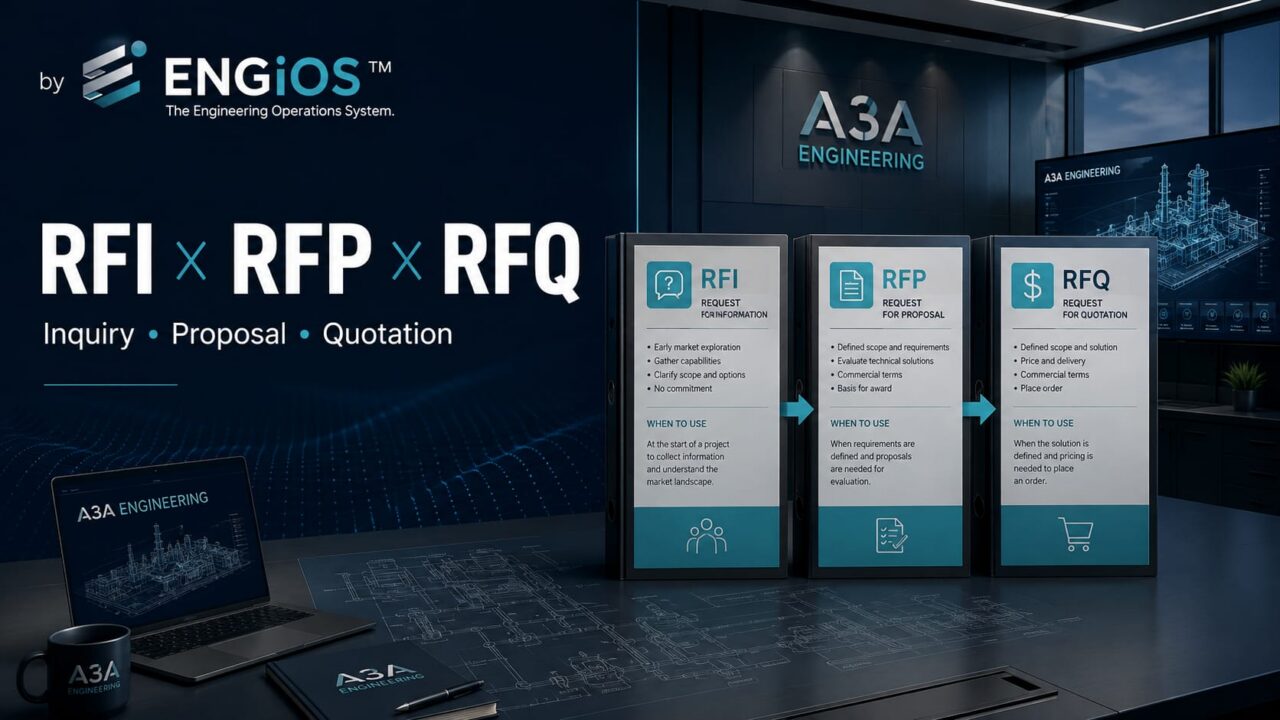
Understand the differences between RFI, RFP and RFQ, when to use each document and how scope maturity defines the Procurement strategy in Engineering.
Check it out!
RFI, RFP and RFQ are different Procurement instruments and should not be treated as three names for the same request to the market. An RFI — Request for Information is used to obtain information and understand capabilities, alternatives and constraints before fully defining the contracting strategy. An RFP — Request for Proposal is used when the owner can already formulate the need and wants to compare solutions, methodologies, technical capability, risks and price. An RFQ — Request for Quotation is more appropriate when the scope and solution are sufficiently defined and the main objective is to receive comparable prices and commercial terms.
The right choice depends on the maturity of the need, the degree of technical uncertainty and the type of decision the owner needs to make. Using an RFQ too early can produce incomparable prices because suppliers made different assumptions. Using an RFP for a fully standardized purchase can create unnecessary complexity. And issuing an RFI as if it were a formal competition can confuse the market and generate responses of limited value.
RFI vs. RFP vs. RFQ: quick comparison
The main difference can be summarized by the question each instrument asks the market.
| Instrument | Main question | Need maturity | Expected response | Typical use |
| RFI | What can the market offer and what alternatives are available? | low to intermediate | information, capabilities, technologies, constraints and references | market investigation |
| RFP | How will you meet this need? | intermediate to high | solution, methodology, team, schedule, risks and price | technical and commercial selection |
| RFQ | How much does this already-defined scope cost? | high | price, lead time, commercial terms and compliance confirmation | comparable quotation |
The sequence RFI → RFP → RFQ can occur, but it is not mandatory. Some procurements begin directly with an RFP because the problem is already sufficiently structured. Standardized purchases may use only an RFQ. And an RFP may include a commercial pricing sheet that performs the quotation function without requiring a separate RFQ.
What matters is that the document matches the decision required at that point in the Procurement process in Engineering Projects.
What is an RFI — Request for Information
An RFI is a request for information from the market. Its primary objective is to reduce uncertainty before finalizing the contracting strategy.
It can be used when the owner still needs to understand available technologies, supplier capabilities, delivery models, lead times, typical requirements, technical limitations, integration conditions, the maturity of a given solution or practices adopted by the market.
In PMBOK 8, the RFI appears in the Procurement process as an instrument for gathering market information before more formal solicitation documents. The logic is consistent with market sounding: learn before specifying.
What an RFI can ask
A well-structured RFI can request:
- description of available solutions;
- architectures or approaches commonly used;
- technical capabilities and limitations;
- applicable standards or certifications;
- references for similar projects;
- regional availability;
- typical Engineering, manufacturing and delivery times;
- owner infrastructure requirements;
- supported integrations;
- licensing or maintenance models;
- support structure;
- perceived risks and constraints;
- indicative cost information when needed for planning.
An RFI does not need to request a final solution. If the owner is still learning about the market, requiring a fully detailed proposal may waste participants’ effort and encourage premature decisions.
An RFI should not be used to obtain free Engineering
There is an important boundary between consulting the market and transferring Engineering work to a supplier that should actually be contracted.
Asking companies to develop designs, complete sizing, detailed studies or an execution-ready solution without a contracting commitment can reduce response quality and drive qualified suppliers away. The RFI should be proportional to the stage of the process and the effort expected from participants.
When the problem requires an independent technical diagnosis, the appropriate path may be an Engineering Technical Consulting or Due Diligence stage before consulting the supplier market.
When to use an RFI in Engineering
An RFI should reduce uncertainty, not transfer to the market an Engineering stage that the owner has not yet structured. When diagnosis and requirements are insufficient, the problem must be matured before competition.
An RFI is especially useful when there is knowledge asymmetry between the owner and the market.
Examples:
- the organization knows the need but does not know which technologies are available;
- different contracting models are possible;
- the market has changed since the last project;
- the solution depends on specialized manufacturers or integrators;
- lead times may compromise the schedule;
- the owner needs to validate whether there is sufficient competition;
- interfaces or prerequisites must be understood before finalizing the scope;
- there are questions about operations, support or maintenance capability.
An RFI can also support CAPEX planning by providing indicative ranges and cost structures. These values, however, should not be confused with a firm commercial proposal if the scope remains open.
What is an RFP — Request for Proposal
An RFP is used when the need already has enough maturity for suppliers to present a structured proposal for how they will meet it.
The question is no longer “what exists in the market?” but “how will your company meet the requirements and under what conditions?”
An RFP in Engineering normally presents the objective, scope, requirements, interfaces, deliverables, schedule, instructions to bidders, evaluation criteria, quality and testing conditions, and commercial information.
What an RFP should allow you to evaluate
Depending on the object, the analysis may consider:
- scope compliance;
- technical solution quality;
- methodology;
- specific experience;
- supplier capability;
- key personnel;
- schedule;
- risk management;
- quality plan;
- testing and commissioning;
- support and warranty;
- life-cycle cost;
- price and commercial terms.
The World Bank establishes in its Procurement framework that evaluation criteria should be proportionate to the nature and complexity of the procurement, stated in the solicitation documents and applied consistently. This logic is also useful as good practice in private processes: suppliers need to know how they will be evaluated before responding.
When to use an RFP in Engineering
An RFP is appropriate when there are relevant differences among possible market responses.
It is common in:
- conceptual, basic and detailed Engineering designs;
- Owner’s Engineering;
- EPC and EPCM;
- systems integration;
- automation;
- infrastructure modernization;
- specialized technical services;
- complex maintenance contracts;
- commissioning;
- critical systems implementation;
- packages where solution, methodology or team influence the outcome.
In these cases, asking only for price can hide important differences. Two suppliers may use the same scope title while considering very different deliverables, tests, responsibilities and assumptions.
What is an RFQ — Request for Quotation
An RFQ is a request for quotation. It works best when the owner has a high level of definition of what will be purchased and needs to receive comparable commercial terms.
PMBOK 8 describes the RFQ as appropriate when price is the primary decision factor and the requested solution is readily available. This does not mean Engineering disappears from the process. It means the Engineering needed to define the object has already taken place before quotation.
A well-structured RFQ can include:
- list of items or services;
- applicable specifications and revisions;
- quantities;
- supply unit;
- delivery or execution location;
- required lead time;
- Incoterm when applicable;
- currency;
- taxes;
- payment terms;
- proposal validity;
- warranty;
- mandatory documentation;
- packaging and transport requirements;
- confirmation of exceptions or deviations.
When to use an RFQ in Engineering
An RFQ is particularly appropriate when the owner already knows what, how much, to what standard and under what condition it needs to buy.
Examples include specified materials, equipment with consolidated requirements, repetitive services with a defined unit scope, spare parts, standardized tests and packages in which technically eligible suppliers have already been prequalified.
Using an RFQ does not eliminate the need to evaluate capability, compliance or risk. These aspects may have been addressed through approval, prequalification, technical specification, vendor list or an earlier Procurement stage.
What changes as Engineering maturity increases
The choice between RFI, RFP and RFQ can be understood as a relationship between uncertainty and maturity.
| Situation | Technical uncertainty | Scope definition | Likely instrument |
| known problem, unknown market | high | low | RFI |
| known alternatives, solution may still vary | medium | medium/high | RFP |
| consolidated solution, comparable suppliers | low | high | RFQ |
| critical scope with solution freedom | medium | high in requirements, open in solution | RFP |
| specified commodity item | low | very high | RFQ |
This table should not be treated as a rigid rule. The main point is to avoid requiring the market to make a decision for which the owner has not yet provided enough information.
RFI, RFP and RFQ can be part of the same process
In larger projects, the instruments may be used at different stages.
Stage 1 — RFI to understand the market
The owner consults manufacturers, integrators, consultants or suppliers to validate technologies, capability, lead times, risks and contracting models.
The responses do not automatically define the winner. They feed planning, requirements, budget and strategy.
Stage 2 — consolidate scope and requirements
Based on Engineering and market information, the owner finalizes requirements, boundaries, reference documentation, selection criteria and contract strategy.
Stage 3 — RFP to select the solution and supplier
Bidders present solution, methodology, team, schedule, risks, deviations and commercial proposal.
Stage 4 — evaluation and negotiation
The technical team compares compliance, requests clarifications and normalizes differences. Engineering Technical Proposal Analysis is decisive at this stage.
Stage 5 — supplemental RFQ when necessary
After solutions or packages are technically equalized, a final revised quotation may be requested to reflect the same scope and conditions.
Not every process needs to follow these five stages. The design depends on risk, complexity, market and internal governance.
The mistake of using an RFQ while technical uncertainty still exists
This is one of the most damaging mistakes in Engineering procurement.
When the owner asks for “three quotations” before defining scope and requirements, each supplier fills the gaps differently. One includes Engineering; another does not. One considers integration; another excludes it. One includes testing; another delivers material only. Prices differ because the objects are different.
The apparent simplicity of the RFQ creates a false sense of objective comparison. In practice, the lowest price may simply represent the proposal with the most exclusions.
The problem becomes worse when the process selects a supplier before technical equalization. The later correction often appears as a revised proposal, change order or renegotiation.
The mistake of using an RFP for a fully standardized purchase
The reverse situation also occurs. If the owner has a consolidated specification, approved supplier, standardized item and clear receiving criteria, requiring a long technical proposal can increase transaction cost without improving the decision.
In this scenario, a structured RFQ accompanied by the specification and commercial conditions may be sufficient.
The principle is proportionality: the more technical decision space is transferred to the supplier, the more important the RFP becomes. The more closed and comparable the object, the greater the usefulness of the RFQ.
The mistake of treating an RFI as informal preselection
The RFI should clearly state its purpose. If the market believes the response will be used to select a supplier, participants tend to submit commercial material and protect information rather than collaborate with a market diagnosis.
Care is also required to avoid creating an undue advantage for a company that informally helped build the requirements. Information relevant to the future competition should be transformed into criteria and documents made equivalently available to participants.
How to structure a useful RFI
An RFI should be short enough to encourage responses and detailed enough to produce comparable information.
One possible structure is:
- organization and problem context;
- purpose of the consultation;
- information already known;
- technical questions to the market;
- questions about capability and experience;
- questions about lead times and availability;
- perceived risks or constraints;
- support and after-sales model;
- response format;
- notice that the RFI does not constitute a contracting commitment, when applicable.
Open-ended questions should be used where uncertainty actually exists. For objective information, tables and standardized fields make comparison easier.
How to structure a useful RFP
The RFP needs to be more complete because it supports a selection decision.
It normally includes:
- objective and scope;
- input data;
- requirements;
- responsibility matrix;
- deliverables;
- schedule and milestones;
- quality, testing and acceptance;
- mandatory response structure;
- compliance matrix;
- evaluation criteria and weights;
- commercial structure;
- contract terms.
The quality of the RFP depends directly on the maturity of Requirements Management in Engineering and interface definition.
How to structure a useful RFQ
The RFQ needs to prevent suppliers from quoting on different bases.
It should present a standardized pricing sheet or structure with description, specification, quantity, unit, lead time, location, conditions and documentation. When there are options, spares, services, mobilization or training, these elements should be separated so the total value can be reconstructed and compared.
It is also advisable to require an explicit declaration of deviations. A quotation that simply sends a total price without confirming compliance may hide relevant exceptions in the supplier’s general terms.
How to choose between RFI, RFP and RFQ: decision matrix
Choosing the right document depends on the maturity of the need. RFP is stronger when solution and methodology must be evaluated; RFQ works when the object is already sufficiently standardized.
A practical approach is to evaluate five questions.
| Question | If the answer is “no” | Indication |
| Do we know the market well enough? | we still need to learn | RFI |
| Are the problem and expected outcome clear? | Engineering needs to mature | RFI or earlier technical stage |
| Are different solutions acceptable? | solution is already fixed | RFQ tends to gain strength |
| Do methodology and capability influence the result? | decision is mainly commercial | RFQ |
| Do we need to score solution, team or risks? | there is no relevant technical differentiation | RFQ; if yes, RFP |
The answer does not need to be binary. In complex projects, an RFP can contain highly prescriptive items and others based on performance. The evaluation process should reflect that combination.
How to govern questions and clarifications
RFI, RFP and RFQ need a formal communication channel.
In an RFI, questions to the market should be consistent across participants to avoid bias. In an RFP, clarifications that change the interpretation of scope or a requirement should be formalized and distributed according to the process rules. In an RFQ, a change in quantity, specification or commercial condition should generate a clear update of the quoted baseline.
Version control is essential. A supplier that quoted revision A cannot be directly compared with another that responded to revision B.
Alternative proposals and deviations
An RFP is the instrument that best accommodates technical alternatives, provided the documentation explains how they should be presented and evaluated.
A good practice is to separate:
- fully compliant base proposal;
- list of deviations;
- optional alternatives;
- cost and schedule impacts of each alternative.
In an RFQ, alternatives tend to be more restricted because the objective is to preserve comparability. If the supplier cannot comply with the specification, the deviation should be explicitly declared.
In an RFI, alternatives are exactly one of the types of information being sought and can help redefine requirements before the formal competition.
Relationship with supplier qualification and approval
RFI, RFP and RFQ do not replace evaluation of supplier capability.
In many processes, the organization maintains a separate qualification stage that verifies experience, production capacity, financial health, certifications, quality system, safety, support, history and references.
After qualification, the RFP or RFQ can focus on the specific package. This reduces repetitive evaluation effort and improves shortlist quality.
Relationship with proposal analysis and equalization
The solicitation document and the evaluation method need to be designed together.
An RFP with a compliance matrix facilitates technical comparison. An RFQ with a standardized pricing sheet facilitates commercial comparison. An RFI with a structured questionnaire facilitates market analysis.
When the solicitation does not define how the response should be organized, equalization work increases significantly. The article on Technical Proposal Analysis goes deeper into criteria, deviations, risks and supplier comparison.
RFI, RFP and RFQ in Brazilian public procurement
The acronyms are widely used in international Procurement and the private sector, but they do not replace the formal instruments established by Brazilian public procurement law.
Law No. 14.133/2021 structures planning and contracting through its own documents and procedures. Depending on the object, preliminary technical studies, terms of reference, preliminary design, basic design, detailed design, bidding documents and other process documents may be required.
Therefore, RFI, RFP and RFQ concepts can help explain the functions of market consultation, solution solicitation and price collection, but their application in a public entity must comply with the applicable legal and regulatory framework.
Application examples in Engineering projects
Modernization of an existing critical system
The company knows it needs modernization but does not know the available architectures or migration requirements. An RFI can map the market and risks. Engineering then consolidates requirements and issues an RFP to select the solution and integrator.
Purchase of standardized equipment
The specification is approved, suppliers are qualified and the comparison depends mainly on price, lead time and warranty. An RFQ is normally sufficient.
Contracting Owner’s Engineering
Methodology, team, experience and governance capability matter as much as price. An RFP is more appropriate because it allows the technical quality of the service to be evaluated.
Long-lead equipment not yet specified
An RFI can validate technologies, manufacturers, lead times and interfaces before finalizing the specification. An RFQ can then be issued once the configuration is consolidated.
EPC or integrated package
Because Engineering, Procurement, construction, risks and performance guarantees are interconnected, a robust RFP is required to evaluate solution, responsibilities and commercial conditions in an integrated manner.
Checklist to avoid choosing the wrong instrument
Before consulting the market, verify:
- we know exactly what decision we want to make with the responses;
- Engineering maturity is compatible with the selected document;
- the RFI seeks information rather than disguised design work;
- the RFP contains enough requirements and criteria for selection;
- the RFQ has comparable scope and commercial structure;
- the market will receive the same information baseline;
- deviations and alternatives will have an explicit format;
- there is a clarification and revision procedure;
- the evaluation was planned before responses are received;
- the technical team will participate in the analysis when there is Engineering differentiation.
How Consulting Engineering supports process definition
In complex contracting, the difficulty is not filling out an RFI, RFP or RFQ template. It is determining the required maturity level, structuring requirements, defining interfaces, selecting criteria, organizing the market response and preserving traceability between need, proposal, contract and acceptance.
Consulting Engineering can support market sounding, preparation of technical documentation, evaluation of alternatives, RFP development, compliance matrix definition, technical analysis and equalization.
The Technical Procurement service integrates this governance with supplier selection and future contracting.
Final considerations
RFI, RFP and RFQ solve different problems. The RFI reduces uncertainty about the market. The RFP structures a competition in which technical quality and solution matter. The RFQ seeks price and terms on an already sufficiently defined baseline.
Choosing the right instrument improves the quality of the information received, reduces equalization effort and avoids comparing proposals that in practice respond to different objects. The decision should follow Engineering maturity and the nature of the risk, not merely a standardized administrative practice.
Procurement governance connects market consultation, requirements, technical evaluation, equalization and contracting. The selected instrument needs to be part of that process, not operate as an isolated form.
Technical references
[1] PROJECT MANAGEMENT INSTITUTE. A Guide to the Project Management Body of Knowledge (PMBOK® Guide) — Eighth Edition. Newtown Square: PMI, 2025. Available at: https://www.pmi.org/pmbok-guide-standards/foundational/pmbok
[2] WORLD BANK. Procurement Regulations for IPF Borrowers. 7th ed. Washington, D.C.: World Bank, September 2025. Available at: https://thedocs.worldbank.org/en/doc/c84273d1b230aeb2b0b8134de5dc8cd7-0290012025/original/Procurement-Regulations-7th-Edition-Sep-2025.pdf
[3] WORLD BANK. Project Procurement Framework. Standard Procurement Documents and procurement resources. Washington, D.C.: World Bank. Available at: https://www.worldbank.org/ext/en/what-we-do/project-procurement/framework
[4] BRAZIL. Law No. 14.133, April 1, 2021. Public Procurement and Administrative Contracts Law. Available at: https://www.planalto.gov.br/ccivil_03/_ato2019-2022/2021/lei/l14133.htm
Frequently asked questions
RFI means Request for Information. It is a request used to understand the market, alternatives, capabilities, lead times and constraints before fully defining a procurement.
RFP means Request for Proposal. It is used when the owner wants structured proposals covering solution, methodology, team, schedule, risks and price for a sufficiently defined need.
RFQ means Request for Quotation. It is a quotation request used when scope and solution are already well defined and the main objective is to compare price, lead time and commercial terms.
An RFI seeks information, an RFP seeks a proposed solution and an RFQ seeks a quotation on an already-defined baseline. The choice depends on the maturity of the need and the degree of technical differentiation among suppliers.
No. An RFI is useful when there is relevant uncertainty about the market or alternatives. If the owner already has sufficiently mature requirements and strategy, it can proceed directly to an RFP.
Yes. An RFP normally includes a commercial proposal, although the evaluation may separate technical and financial components. In some processes, a revised final quotation may be requested after equalization.
An RFQ is inappropriate when suppliers still need to make relevant technical decisions, interpret an open scope or propose different methodologies. In that situation, price alone does not represent equivalent objects.
The acronyms help explain Procurement functions, but they do not replace the formal instruments and procedures required by Law No. 14.133/2021 and the regulations applicable to each public procurement process.
Complementary technical materials
Related solutions
- Requirements, Evidence and Acceptance Criteria Management
- Contract, Scope and Deliverables Management
Related services
- Technical Procurement: specification, equalization, suppliers and contracting support
- Engineering Technical Consulting: diagnosis, strategy and decision support
- Owner’s Engineering: technical governance, inspection and acceptance
Main content on the topic
- Procurement in Engineering Projects: what it is, stages, criteria and supplier management
- RFP in Engineering: how to structure scope, requirements and selection criteria
- Engineering Technical Proposal Analysis: how to evaluate beyond the lowest price