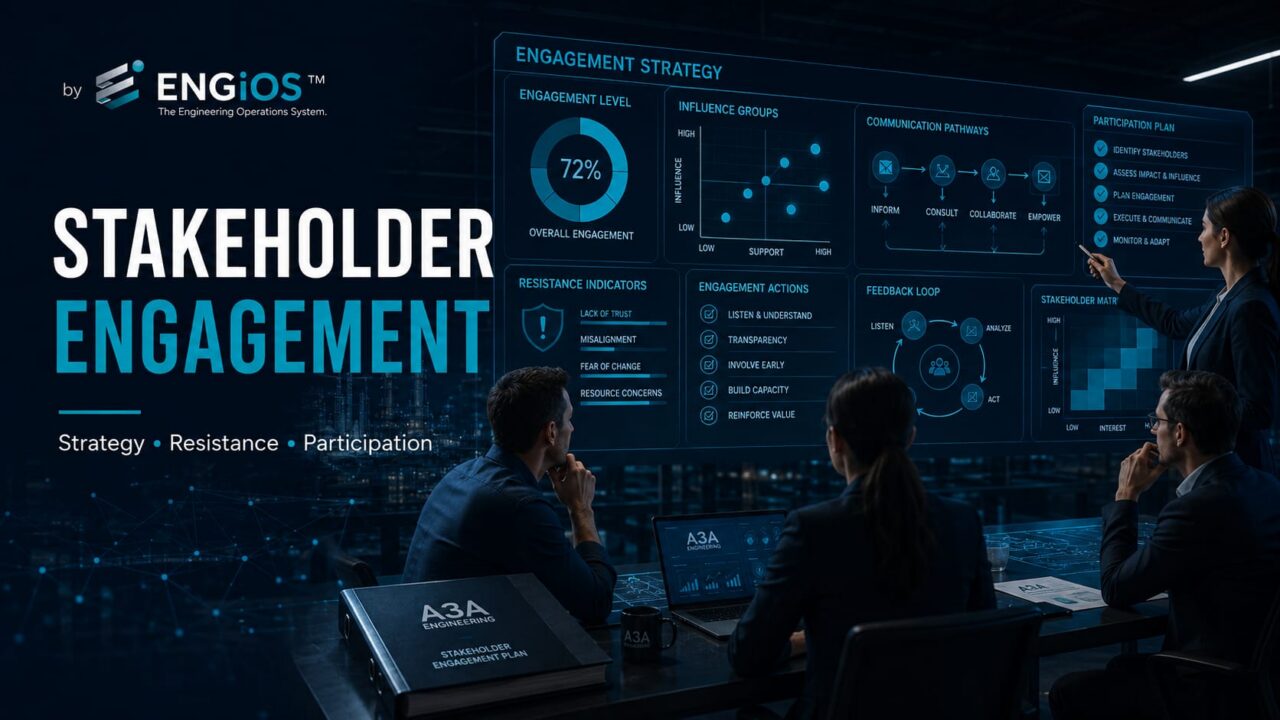
Understand how to plan stakeholder engagement: participation levels, resistance, communication, indicators, and integration with decisions and risks.
Check it out!
Stakeholder engagement is the process of defining and managing the level of participation required from each interested party throughout the project. It turns stakeholder identification and analysis into concrete actions: informing, consulting, involving, collaborating, negotiating, deciding, or monitoring according to each party’s influence, impact, interest, role, and timing.
Engagement does not mean seeking permanent agreement. Engineering projects involve different legitimate interests, technical constraints, contractual limits, and decisions that belong to specific levels of authority. The objective is to obtain sufficient participation to reveal requirements, anticipate resistance, prepare decisions, reduce rework, and create the conditions for deliverables to be understood, accepted, and operated.
A good engagement plan answers not only “who are the stakeholders?” but also “what needs to happen in this relationship for the project to move forward?” The answer should be observable: validate a requirement, provide data, approve an alternative, release access, participate in a test, accept a change, support a decision, or prepare the transition to operations.
What is stakeholder engagement
Engagement is the active relationship between the project and its interested parties. It involves communication, participation, listening, negotiation, feedback, and adaptation of the approach as the context evolves.
Simply attending meetings does not constitute engagement. A stakeholder may attend dozens of meetings without contributing to any decision. Likewise, a party that receives few communications may be appropriately engaged if they are contacted only at the milestones where their contribution is required.
The quality criterion is the effect produced: information understood, requirement validated, decision made, conflict addressed, risk reduced, commitment assumed, or change accepted within governance.
Engagement is not synonymous with communication
Communication is one of the tools of engagement. It defines content, channel, frequency, sender, recipient, and expected feedback. Engagement is broader because it considers relationships, participation, and expected behavior.
| Question | Communication | Engagement |
| What do we need to send? | central | secondary |
| Who needs to participate? | supporting | central |
| What decision or contribution do we expect? | supporting | central |
| Which channel should we use? | central | supporting |
| How should resistance be addressed? | partial | central |
| How should the relationship be adjusted? | partial | central |
| How do we measure response and commitment? | central | central |
The project communication plan should derive from the engagement strategy, not replace it.
Why engagement is critical in engineering projects
Engagement does not mean seeking permanent agreement. The objective is to obtain the participation required so that requirements, decisions, risks, and impacts are addressed at the right time.
See how Stakeholder Mapping organizes who needs to participate
Engineering projects rarely fail only because a solution was technically unfeasible. Many problems arise because requirements arrived late, users were not consulted, operations did not participate in the transition, a supplier received incomplete information, the sponsor did not decide in time, or an external authority was contacted later than necessary.
Appropriate engagement helps to:
- reveal undocumented needs;
- confirm assumptions and constraints;
- build legitimacy for decisions;
- reduce resistance to change;
- anticipate interface risks;
- obtain data at the right time;
- mobilize resources and decision authority;
- prepare operations and maintenance;
- accelerate issue resolution;
- improve acceptance and handover.
How to define the desired engagement level
The project needs to establish a current state and a desired state for each priority stakeholder or group.
A practical scale may be:
| State | Meaning |
| Unaware | does not know the project or its impact |
| Resistant | perceives loss, risk, or incompatibility |
| Neutral | knows the subject but shows neither support nor resistance |
| Supportive | understands and contributes to the objectives |
| Leading | mobilizes others and assumes an active role in the result |
The purpose is not to turn everyone into a “leader.” A regulatory body, for example, may only need to be appropriately informed and participate at formal milestones. An operations team may need to move from neutral to supportive before transition. A sponsor may need to lead decisions that exceed the project manager’s authority.
How to use mapping to plan engagement
Stakeholder mapping reveals relationships, dependencies, and influence. The stakeholder matrix helps prioritize attention.
These instruments should not generate an automatic strategy. The same quadrant may require different approaches depending on the decision at stake.
A stakeholder with high influence and high interest may need to:
- participate in a strategic decision;
- review a technical alternative;
- receive an executive report;
- be consulted before a change;
- act only on exceptions.
Classification provides direction, but context determines the approach.
How to define the engagement strategy
A robust strategy needs to answer six questions:
- what relationship outcome is required;
- what is the party’s current state;
- what change in understanding or behavior is sought;
- what interaction is appropriate;
- who has the legitimacy to manage the relationship;
- what evidence will show that the objective has been achieved.
Inform
Appropriate when the party needs awareness but has no decision-making or contribution role in that matter. Communication should be sufficient, objective, and timely.
Consult
Used when the project needs to obtain data, opinions, validation, or perceptions of impact. Consultation is legitimate only when there is a real possibility of considering the feedback.
Involve
The party participates in developing the solution, especially in interfaces, requirements, and decisions that will directly affect them.
Collaborate
There is joint development, information sharing, and responsibility for outcomes. This is common in test planning, constructability, and transition to operations.
Negotiate
Required when different interests exist and there is room for a solution through trade-offs, compensation, or redefining alternatives.
Escalate
Used when the issue exceeds the parties’ authority or when lack of decision threatens relevant objectives.
How to identify stakeholder resistance
Resistance can be a valuable source of information. Before trying to overcome it, the project needs to determine whether there is a real impact, an ignored requirement, loss of autonomy, or a governance conflict.
Resistance should not automatically be treated as inappropriate behavior. It may reveal important information about the project.
Signs of resistance include:
- recurring delays in responses;
- repeated challenges to the same decision;
- absence from critical meetings;
- refusal to provide data;
- negative comments outside formal channels;
- reopening requirements that have already been discussed;
- verbal support without corresponding action;
- rejection of tests or deliverables at the end;
- frequent escalations without attempting resolution at the appropriate level.
Resistance needs to be diagnosed before it is addressed.
What causes resistance
Unaddressed real impact
The solution may increase operational workload, reduce autonomy, alter routines, or create perceived risk. In this case, resistance is rational.
Lack of information
The party does not understand the reasons, benefits, alternatives, or constraints behind the decision.
Lack of participation
Stakeholders consulted only after a decision tend to perceive the interaction as a formality.
Loss of power or autonomy
Organizational or technological changes may redistribute responsibilities and authority.
History of low trust
Past unfulfilled commitments reduce the credibility of new messages.
Unclear decision criteria
When a choice appears arbitrary, the party questions its legitimacy even if the solution is technically correct.
How to address resistance without turning the project into a persuasion campaign
The objective is not to persuade at any cost. The project should understand the cause and choose a proportional response.
| Cause | Possible response |
| insufficient information | explain context and impacts |
| ignored requirement | review requirement and solution |
| loss of autonomy | clarify roles and governance |
| unmitigated impact | develop a mitigation measure |
| contractual conflict | address through the formal mechanism |
| low trust | honor commitments and close the feedback loop |
| decision without legitimacy | review authority and decision-making process |
When resistance represents legitimate disagreement, it should remain recorded even if the final decision follows another path.
Engagement and conflict management
Engagement reduces the likelihood of late conflict, but it does not eliminate disagreements. On the contrary, a good strategy can bring conflicts to the surface early, when they are less costly to resolve.
Conflict management complements engagement by structuring negotiation, decisions, and escalation when interests or criteria collide.
The key point is to distinguish resistance that requires communication from resistance that requires a technical or contractual decision.
How to engage sponsors and committees
Sponsors do not need to participate in the project’s operational routine. Their role is to provide direction, resources, exception handling, priorities, and decisions above the project manager’s authority.
Engagement with the sponsor should:
- highlight required decisions;
- present impact and trend;
- avoid excessive operational detail;
- show alternatives and a recommendation;
- clarify the consequence of no decision;
- record direction and actions.
Taking only status information to the sponsor wastes the main purpose of this relationship.
How to engage operations and maintenance
Operations and maintenance need to participate early because they will experience the effects of the solution for years.
Typical engagement points include:
- functional requirements;
- accessibility and maintainability;
- intervention windows;
- contingency strategies;
- design reviews;
- FAT and SAT when applicable;
- commissioning;
- training;
- final documentation;
- acceptance and handover.
Engaging operations only at delivery often creates issues that could have been avoided during design.
How to engage suppliers and contractors
Suppliers are stakeholders with a contractual relationship. Engagement should facilitate technical coordination without blurring scope boundaries.
It is useful to establish:
- separate technical and contractual channels when necessary;
- interface owners;
- deadlines for submissions and responses;
- approval criteria;
- treatment of deviations;
- change mechanisms;
- records of commitments.
Collaboration does not authorize informal contract changes.
How to engage regulatory authorities and utilities
External authorities have their own processes, timelines, and criteria. Late engagement can compromise critical milestones.
The strategy should identify:
- required documents;
- formal responsible parties;
- protocols and deadlines;
- points for early consultation;
- required approvals;
- schedule dependencies;
- evidence to preserve.
How to engage communities and external users
Projects with physical, operational, or social impacts may require dialogue with parties that have no direct contractual relationship.
In this context, the project should avoid excessively technical language, ensure legitimate representation, and explain impacts transparently. Consultation should not be confused with unilateral transmission of information.
Engagement throughout the life cycle
The level of participation changes between phases.
Concept development
Focus on needs, constraints, expected value, and alternatives.
Design
Focus on requirements, interfaces, reviews, decisions, and risks.
Procurement
Focus on criteria, responsibilities, suppliers, and governance.
Implementation
Focus on coordination, safety, changes, access, and open issues.
Commissioning
Focus on testing, acceptance criteria, training, and readiness.
Handover
Focus on documentation, knowledge transfer, responsibilities, and operations.
How to connect engagement to requirements
Stakeholders are sources of requirements. Engagement creates value only when contributions are converted into a requirement, decision, action, or traceable record.
Learn about Requirements, Evidence and Acceptance Criteria Management
Stakeholders are sources of requirements. An engagement strategy needs to ensure that relevant contributions are converted into controlled requirements rather than merely recorded in meeting minutes.
The recommended flow is:
- capture the need or constraint;
- assess validity and priority;
- convert it into a verifiable requirement;
- identify the responsible party;
- trace it through the solution and testing;
- communicate the outcome to the stakeholder.
Without closing the feedback loop, the party does not know how their contribution was addressed.
How to connect engagement to risks
Stakeholders can generate, perceive, or help mitigate risks.
The risk register should reflect risks associated with decisions, approvals, interfaces, and acceptance. The engagement strategy may form part of the risk response.
Example: if energization depends on utility approval, the risk is not simply “external delay.” The response may include early consultation, a dedicated owner, prior document review, and a schedule milestone.
How to connect engagement to decisions
Engagement without a decision mechanism creates participation without results.
Each relevant issue should have:
- a person responsible for preparing the decision;
- parties to be consulted;
- decision authority;
- deadline;
- criteria;
- record;
- communication of the outcome.
The RACI Matrix can help structure responsibilities by activity, while the stakeholder matrix guides priority and relationships.
How to measure engagement
Activity metrics such as the number of meetings are insufficient.
More useful indicators include:
- decisions made on time;
- participation rate of required parties;
- responses received within the deadline;
- commitments fulfilled;
- requirements captured before execution;
- late changes caused by a stakeholder who was not involved;
- reopened conflicts;
- quality of feedback;
- gap between current and desired state;
- acceptance of deliverables without reopening criteria.
Engagement assessment matrix
A simple matrix can compare the current state with the desired state.
| Stakeholder | Current | Desired | Gap | Main action |
| sponsor | supportive | leading | mobilization | monthly exception decisions |
| operations | neutral | supportive | understanding | workshops and requirements review |
| critical supplier | supportive | supportive | maintain | technical coordination |
| utility | unaware | neutral | information | early formal consultation |
The matrix should be dynamic. If the project changes, the desired state may also change.
How to review the engagement strategy
Review it when any of the following occurs:
- phase change;
- scope change;
- new supplier;
- leadership change;
- relevant conflict;
- materialized risk;
- decision delay;
- change in attitude;
- new regulatory requirement;
- preparation for acceptance or operations.
Common stakeholder engagement mistakes
Trying to involve everyone in everything
This increases meetings, reduces focus, and dilutes responsibility.
Confusing information with participation
Sending a report does not replace consultation or decision-making.
Consulting after deciding
Participation loses legitimacy and resistance increases.
Treating resistance as a personality problem
This prevents diagnosis of the real cause.
Failing to close the feedback loop
The party contributes but receives no feedback on how their contribution was addressed.
Keeping the strategy static
Influence, interest, and impact change throughout the project.
Exposing sensitive assessments
Classifications of attitude, influence, and conflict require access governance and professional language.
Checklist for a robust engagement strategy
Confirm that:
- priority stakeholders have been identified;
- influence, impact, and interest have been analyzed;
- the current state is based on evidence;
- the desired state has been defined by topic;
- there is a clear objective for each relationship;
- the strategy is proportional to the level of authority;
- the relationship owner is defined;
- the communication plan is aligned;
- associated risks and conflicts have been considered;
- there is a feedback mechanism;
- indicators will be monitored;
- the strategy will be reviewed at project milestones.
Stakeholder engagement and Consulting Engineering
Multidisciplinary projects require coordination among people who do not report to the same hierarchical structure. The client, designers, suppliers, operations, supervision, and authorities have their own responsibilities and interests.
Consulting Engineering can structure engagement without replacing the authority of the parties. Its role is to organize information, prepare decisions, coordinate interfaces, facilitate critical meetings, record commitments, and integrate stakeholders with requirements, risks, schedule, and changes.
In Engineering Project Management, this capability is especially important when the client needs to maintain governance over multiple suppliers and disciplines.
Final considerations
Stakeholder engagement is a results-oriented management practice. It is not measured by the number of interactions, but by the ability to deliver information, obtain contributions at the right time, address resistance, prepare decisions, and sustain commitments.
In engineering projects, the strategy should be dynamic. Stakeholders change in influence, interest, and impact as the project advances. What works during concept development may be insufficient during implementation and inappropriate during handover. Reviewing the strategy based on evidence keeps the relationship connected to the technical objective and project governance.
Technical references
[1] PROJECT MANAGEMENT INSTITUTE. A Guide to the Project Management Body of Knowledge (PMBOK® Guide). Newtown Square: PMI. Available at: https://www.pmi.org/standards/pmbok
[2] INTERNATIONAL ORGANIZATION FOR STANDARDIZATION. ISO 21502:2020 — Project, programme and portfolio management — Guidance on project management. Geneva: ISO, 2020. Available at: https://www.iso.org/standard/74947.html
Frequently asked questions
It is the process of defining and managing the level of participation required from each interested party throughout the project, combining communication, consultation, involvement, collaboration, negotiation, and decision-making according to context.
No. Communication organizes information, channels, and feedback. Engagement is broader and includes participation, relationships, influence, resistance, negotiation, and commitment.
Compare the current state with the state required for the issue in question. A practical scale is unaware, resistant, neutral, supportive, and leading. Not every stakeholder needs to reach the highest level.
First diagnose the cause: real impact, lack of information, lack of participation, loss of autonomy, contractual conflict, or low trust. Then choose a proportional response.
Use outcome indicators such as on-time decisions, fulfilled commitments, responses received, reduction in late changes, quality of feedback, and progress from the current to the desired state.
At phase transitions and whenever there is a change in scope, leadership, supplier, risk, conflict, attitude, regulatory requirement, or preparation for acceptance and operations.
The matrix helps prioritize stakeholders and understand influence, interest, and impact. The engagement strategy turns this analysis into concrete relationship and participation actions.
It can structure communication, prepare decisions, coordinate interfaces, facilitate meetings, record commitments, and integrate stakeholders with requirements, risks, changes, and schedule.
Complementary technical materials
Main content on the topic
- Stakeholder Management in Projects
- Stakeholder Mapping
- Stakeholder Matrix
- Project Communication Plan
- Conflict Management in Engineering Projects
Related technical content
- Requirements Management in Engineering
- Risk Register in Engineering Projects
- RACI Matrix in Engineering Projects
Related solutions
- Requirements, Evidence and Acceptance Criteria Management
- Contract, Scope and Deliverables Management