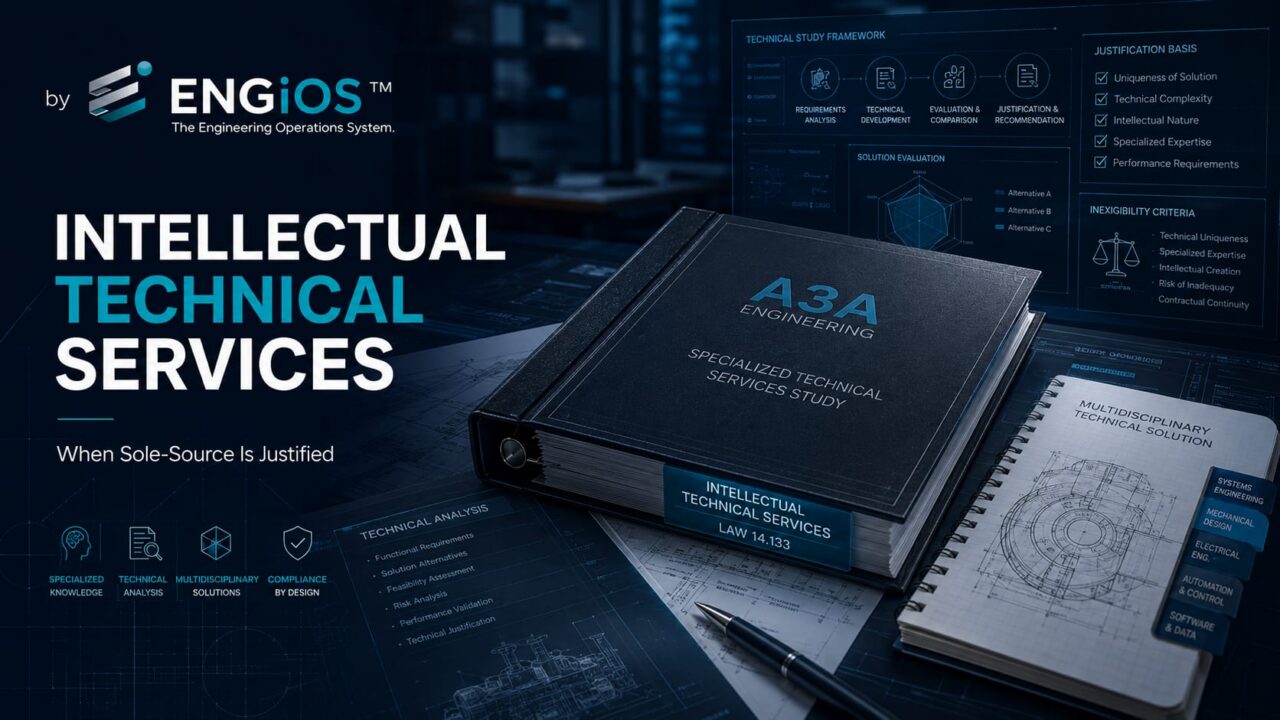
Understand specialized technical services of a predominantly intellectual nature under Brazilian Law 14,133, their relationship with Consulting Engineering, technique and price, and noncompetitive procurement.
Check it out!
Specialized technical services of a predominantly intellectual nature are services in which the contracted result depends on technical knowledge, professional judgment, analysis, conception, coordination, assessment or intellectual capability applied to the object. Brazilian Law 14,133/2021 defines them in Article 6, XVIII and includes, among others, technical studies, planning, designs, technical opinions, consulting, inspection, supervision, management, quality control, analyses, tests and engineering trials.
This classification, however, does not automatically make the service eligible for noncompetitive procurement. To contract directly under Article 74, III, the Administration must still demonstrate the recognized expertise of the professional or company, the essentiality of that specialization to fully satisfy the object and, consequently, the impossibility of competition in the specific case. If competition is feasible, the route remains competitive tendering.
The distinction is decisive because the intellectual nature of the service affects the procurement procedure, evaluation criterion, way the object is specified, method for assessing technical capability and the procurement strategy itself. In Consulting Engineering, treating complex intellectual work as merely standardized service delivery can shift the process toward an inappropriate lowest-price logic and reduce the Administration’s ability to select the technically most appropriate solution.
What Brazilian Law 14,133 Calls a Specialized Technical Service of a Predominantly Intellectual Nature
Article 6, XVIII of Law 14,133 provides a functional definition. This is not a category created by the market, but a legal classification tied to the content of the work performed.
The law includes in this category work relating to:
- technical studies, planning, basic designs and detailed designs;
- technical opinions, expert examinations and assessments in general;
- technical advisory and consulting services;
- inspection, supervision and management of works and services;
- training and professional development;
- quality and technological control;
- analyses, testing and field and laboratory trials;
- instrumentation and monitoring of specific parameters of works and the environment;
- other engineering services falling within the statutory definition.
The common characteristic is that the value of the service does not lie only in the number of hours or the material execution of tasks. It lies in the ability to interpret the problem, formulate criteria, make technical decisions, assess risks, produce a solution and assume professional responsibility for the outcome.
This explains why two providers may perform the same nominal scope and still deliver results with very different levels of quality, depth, safety and usefulness.
Predominantly Intellectual Nature Does Not Mean Absence of Method
A common mistake is to assume that intellectual services are necessarily subjective, informal or impossible to measure. That is not the case.
A Consulting Engineering service can and should have scope, deliverables, stages, acceptance criteria, responsibilities, deadlines, assumptions and measurement mechanisms. Its intellectual nature lies in how the result is produced, not in the absence of contract governance.
For example, a detailed design may require an objective list of documents, disciplines and revisions. Even so, the quality of the outcome depends on sizing decisions, coordination, interface analysis, accumulated experience, standards knowledge and the ability to transform requirements into an executable solution.
Likewise, technical inspection may include reports, inspections and periodic records. But the value of the service lies in recognizing relevant deviations, interpreting evidence, assessing consequences, defining criticality and advising the Administration before a failure becomes cost, delay or loss of performance.
This combination of a controllable process and intellectual content that is not fully standardizable is central to understanding the category.
The Difference Between Common Engineering Services and Consulting Engineering
Brazilian Law 14,133 defines a common engineering service as one related to maintenance, adjustment and adaptation of movable and immovable assets while preserving their original characteristics, provided that performance and quality standards can be objectively standardized.
Specialized technical services of a predominantly intellectual nature involve a different layer: conception, analysis, technical judgment, assessment of alternatives, coordination, management, inspection or production of knowledge applied to the object.
| Aspect | Common engineering service | Specialized technical service of a predominantly intellectual nature |
| Core of the object | standardizable material execution | analysis, conception, judgment or technical knowledge |
| Comparison of proposals | tends to allow greater objectivity | may depend on differentiated qualifications and technical quality |
| Specification | usual market standards may be sufficient | requires definition of the problem, deliverables, capabilities and technical criteria |
| Reverse auction | may apply in statutory cases | does not apply |
| Technique and price | usually not the main axis | preferred when technical quality is relevant |
| Noncompetitive procurement | does not result from the classification | may apply if Article 74 requirements are met |
AGU Normative Guidance 107/2026 reinforced this distinction specifically for Consulting Engineering. It recognizes that services under Article 6, XVIII, items “a”, “d” and “h” are specialized technical services of a predominantly intellectual nature and cannot be treated as common engineering services.
Which Engineering Services Fall Within This Classification
The law does not create an abstract list disconnected from practice. Several common Consulting Engineering activities fit directly within the items of Article 6, XVIII.
Studies, planning, basic designs and detailed designs
These activities require interpretation of needs, definition of requirements, analysis of alternatives, sizing, interfaces, constraints, risks and production of documentation that will guide future decisions or execution.
Procuring a design is not equivalent to buying a drawing. The graphic product is only a partial materialization of the engineering reasoning developed during the work.
Technical consulting and advisory services
Technical consulting typically operates exactly where the Administration needs specialized support to formulate decisions, diagnose problems, review solutions, structure criteria, assess risks or support procurement.
The object should be described by the problem to be solved, expected deliverables and technical responsibility, avoiding reduction of the engagement to generic availability of professionals.
Inspection, supervision and management of works or services
Inspection is not merely recording presence in the field. In complex projects, the activity requires design review, interpretation of specifications, compliance analysis, interface control, validation of measurements, treatment of nonconformities and support for technical receipt.
The Administration may structure technical support for inspection without transferring the public agent’s decision-making powers to the contracted company. Article 117 of Law 14,133 allows third-party support to inspection while preserving institutional responsibilities.
Quality control, testing, trials and monitoring
These services may also be predominantly intellectual when they are not limited to mechanical data collection. Technical value appears in defining the inspection plan, selecting methods, interpreting results, analyzing deviations, correlating them with requirements and issuing conclusions that support acceptance or rejection.
Classification Under Article 6, XVIII Does Not Automatically Authorize Noncompetitive Procurement
Classification as a specialized technical service of a predominantly intellectual nature is not an automatic authorization to contract without competitive tendering.
The correct decision begins with the nature of the object and advances to a concrete analysis of competition, technical quality, recognized expertise and essentiality.
Understand when Consulting Engineering may be procured without competition
This is one of the most important points in the entire subject.
The correct reasoning is not:
specialized technical service → noncompetitive procurement.
The legal chain is more demanding:
specialized technical service of a predominantly intellectual nature → analysis of the need for recognized expertise → demonstration of essentiality → demonstration of impossibility of competition → formal documentation of direct procurement.
The TCU summarizes the hypothesis under Article 74, III in three material requirements: specialized technical and predominantly intellectual nature of the service; recognized expertise of the professional or company; and demonstration that this specialization is indispensable to the full satisfaction of the object.
The initial classification therefore only opens the analysis. It does not replace the concrete justification required for noncompetitive procurement.
When Competition Remains Feasible
There may be several professionals or companies technically capable of performing an intellectual service while it remains possible to structure valid competition.
If the Administration can establish minimum requirements, evaluation criteria and objective factors capable of distinguishing proposal quality, competitive tendering remains feasible. In these cases, competitive tendering using technique and price may be the appropriate instrument for valuing experience, methodology, team and technical solution without abandoning competition.
The existence of specialized knowledge in the object does not, by itself, mean that proposals cannot be compared.
The relevant question is different: can the Administration structure competition that preserves the value of technical quality and allows objective selection of the best proposal for the intended result?
If the answer is yes, noncompetitive procurement should not be used as a shortcut.
When the Nature of the Service May Contribute to the Impossibility of Competition
There are situations in which the provider’s technique and capability are so closely tied to the outcome that objective comparison among offers loses practical usefulness.
This may occur when:
- the outcome depends on highly specific accumulated knowledge;
- the solution requires experience directly related to equivalent problems;
- the intellectual contribution of the professional or team is a central element of the object;
- the Administration needs a demonstrably differentiated approach to a highly complex problem;
- replacement of the professional or team that justified the procurement materially changes the reason for selection;
- relevant technical attributes cannot be adequately reduced to competitive scoring without distorting the selection.
In these situations, the analysis should proceed to recognized expertise, essentiality and impossibility of competition. The article Article 74 of Brazilian Law 14,133: When Consulting Engineering May Be Procured Without Competition examines this stage in detail.
Singularity Is No Longer an Autonomous Requirement
Under Brazilian Law 8,666/1993, discussion of noncompetitive procurement for technical services was strongly associated with the “singular nature” of the object. Law 14,133 did not repeat this requirement as an autonomous condition under Article 74, III.
This does not mean that any consultancy, design or inspection service may be directly procured. The new law shifted the analysis to the relationship among the characteristics of the service, recognized expertise and the demonstration that the work of that professional or company is essential and demonstrably appropriate to fully satisfy the object.
The TCU has emphasized exactly this point: formal singularity was removed, but direct procurement still requires concrete demonstration that useful competition is inadequate for that object.
Recognized Expertise Is Not Synonymous with a Long Résumé
The definition in Article 6, XIX relates recognized expertise to elements such as previous performance, studies, experience, publications, organization, resources and technical staff.
These elements should not be accumulated as a collection of disconnected credentials. They need to demonstrate alignment with the contracted problem.
A company may have decades of activity and still fail to present sufficient evidence for a highly specific object. Likewise, a team with directly comparable experience, relevant technical production and a consistent track record can build a strong demonstration without relying on media notoriety.
The analysis should answer:
- what is the technical complexity of the object;
- which capabilities are critical;
- which evidence demonstrates those capabilities;
- why they are relevant to the outcome;
- why the work of that provider is essential to fully satisfy the object.
Essentiality Connects the Object to the Provider
Recognized expertise describes a quality of the provider. Essentiality explains why that quality is necessary for that specific object.
Without this connection, the justification is incomplete.
For example, an Administration may need consulting support to review a multidisciplinary critical-infrastructure design before tendering. It is not enough to state that a particular company has engineering experience. It is necessary to demonstrate why that company’s experience, methodology, team or technical production addresses the project’s concrete risks and why this matters to the quality of the future procurement.
This relationship must be documented in the process rather than merely presumed.
Specialized Technical Services and the Technique-and-Price Evaluation Criterion
When technical quality materially changes the outcome, lowest price alone may not represent the most advantageous proposal.
The ETP should justify whether competition is feasible and, if so, how technical quality will effectively be valued.
Article 36 of Law 14,133 establishes that the technique-and-price criterion should be selected when the Preliminary Technical Study demonstrates that evaluation and weighting of proposal technical quality are relevant to the Administration’s intended purposes.
For specialized technical services of a predominantly intellectual nature, the law provides that technique and price should be preferentially used.
The logic is consistent: when work quality depends on methodology, experience, team and problem-solving capability, price alone may be an insufficient indicator for selecting the most advantageous proposal.
This also shows why the Administration needs to separate two decisions:
- Is competition feasible?
- If it is feasible, which evaluation criterion can preserve the relevance of technical quality?
The first question separates competitive tendering from noncompetitive procurement. The second structures the competitive procedure.
Why the Reverse Auction Procedure Is Not Appropriate for Consulting Engineering
Article 29 of Law 14,133 requires use of the Brazilian reverse-auction procedure when the object has performance and quality standards that can be objectively defined by usual market specifications. Its sole paragraph excludes specialized technical services of a predominantly intellectual nature.
AGU Guidance 107/2026 made this particularly clear for Consulting Engineering: these services cannot be classified as common merely to allow use of the reverse-auction procedure.
This prohibition protects consistency between the nature of the object and the selection procedure. If the outcome depends on differentiated intellectual capability, reducing procurement to a procedure typical of common services can weaken technical evaluation and transfer risks to later stages of the contract.
How the ETP Should Address This Classification
The Preliminary Technical Study is the appropriate place to organize the reasoning that supports the procurement strategy.
Depending on the complexity of the case, it should explain:
- which public need must be addressed;
- why the object requires specialized intellectual work;
- which outcomes are expected;
- which technical capabilities influence those outcomes;
- whether there is a competitive market capable of meeting the demand;
- whether proposals can be objectively compared;
- whether technical quality needs to be weighted;
- which procedure and evaluation criterion are compatible;
- or, where applicable, which elements indicate impossibility of competition.
The ETP should not begin with the conclusion “tender competitively” or “procure without competition” and then search for justifications. The conclusion should result from analysis of the object and the market.
How to Structure the Terms of Reference or Basic Design
Even for intellectual services, the Administration needs to define what it expects to receive.
A good procurement document should indicate:
- problem and context;
- scope and boundaries;
- products and deliverables;
- technical and regulatory requirements;
- interfaces with internal teams and third parties;
- responsibilities;
- assumptions and exclusions;
- review and acceptance criteria;
- measurement method;
- team requirements when materially related to the object;
- expected documentation and traceability.
The specification should be sufficient to govern the contract without attempting to transform a complex intellectual activity into an artificial sequence of standardized tasks.
Examples of Consulting Engineering Services That May Fall Within This Classification
Depending on the specific case, the classification may include:
Engineering Planning and Studies
Feasibility studies, master plans, diagnostics, technical surveys, alternatives studies and requirements definition may involve multidisciplinary analysis and direct support for investment decisions.
Design Development and Review
Basic Design, Detailed Design, design review, design coordination and multidisciplinary coordination require intellectual production and assessment of engineering solutions.
Owner’s Engineering and Inspection
Technical support to the owner may involve inspection, supervision, interface control, document analysis, quality validation, risk management and support for acceptance.
Technical Procurement and Procurement Support
Specifications, technical bid equalization, proposal analysis, Terms of Reference review and technical support for qualification may depend on specialized knowledge to protect the Administration’s decision.
Commissioning, QA/QC and Acceptance
Test planning, definition of criteria, evidence analysis, treatment of nonconformities and conclusions on technical readiness may fall within the logic of quality control, analyses, tests and trials under Article 6, XVIII, item “h”.
The Same Service May Support Different Procurement Strategies
There is no permanent label applied to a type of service.
A simple, repetitive design with a broadly standardized solution may allow competition to be structured relatively objectively. A highly complex design involving a critical asset and specific interfaces may require a very different analysis.
Likewise, broad and generic consulting should not be procured without competition merely because the word “consulting” appears in Article 6. The object must reveal why differentiated technical capability is necessary and why competition becomes infeasible.
| Question | If the answer is “yes” | Likely consequence |
| Is the service predominantly intellectual? | falls within Article 6, XVIII | moves away from common-service logic |
| Does technical quality materially affect the outcome? | it needs to be weighted | technique and price becomes more relevant |
| Are there useful objective criteria for comparing proposals? | competition is feasible | competitive tendering remains possible |
| Is recognized expertise essential to the object? | material requirement is met | advance the analysis under Article 74, III |
| Is competition effectively infeasible? | direct procurement may apply | document noncompetitive procurement under Articles 72 and 74 |
Classification Errors That Increase Procurement Risk
Calling Consulting Engineering a Common Service to Use Reverse Auction
This classification conflicts with the intellectual nature of the object and with the guidance consolidated by AGU Guidance 107/2026.
Assuming Noncompetitive Procurement Because the Service Is Listed in Article 6
The list defines the service category. It does not replace recognized expertise, essentiality and impossibility of competition.
Using a Generic Résumé as the Only Justification
Experience must relate to the object. The number of certificates alone does not demonstrate essentiality.
Writing a Vague Object
“Specialized consulting” or “engineering support” without deliverables, problem definition, scope and expected outcomes makes both competitive tendering and noncompetitive procurement more difficult to justify.
Choosing the Procedure Before Analyzing the Market
The procurement strategy should result from technical analysis, not be an administrative premise justified afterward.
A Practical Matrix for Choosing the Strategy
The Administration can structure an assessment around four axes:
| Axis | Analysis question | Expected evidence |
| Nature of the object | does it depend on specialized intellectual production? | scope, risks, complexity and deliverables |
| Market | are there capable and comparable providers? | market survey and alternatives |
| Technical quality | do differences in methodology/team affect the outcome? | technical criteria and expected impacts |
| Essentiality | is a particular recognized profile necessary to fully satisfy the object? | alignment between provider evidence and object challenges |
This matrix prevents binary decisions based only on the name of the service.
Relationship with the Direct Procurement Process Under Article 72
In direct procurement, robust technical documentation does not replace the administrative decision: it provides evidence so the Administration can properly justify the process.
If the analysis concludes that noncompetitive procurement applies, the process must be documented under Article 72 of Law 14,133.
This includes documentation of the demand and applicable planning artifacts, expenditure estimate, opinions, demonstration of budget availability, proof of minimum qualification and capability, reason for selection of the provider, price justification and authorization by the competent authority.
The article Direct Procurement Under Brazilian Law 14,133: How to Document the Article 72 Process examines this procedural stage in depth. Price Justification in Noncompetitive Procurement specifically addresses demonstration of economic reasonableness when conventional comparison of proposals is insufficient.
The Role of the Consulting Engineering Company in the Procurement File
The company being considered may provide objective elements for the Administration’s analysis, such as:
- portfolio and previous performance;
- certificates and comparable contracts;
- résumés and team composition;
- studies and technical production;
- proposed methodology;
- organizational structure and technical resources;
- price references and similar procurements;
- detailed technical and commercial proposal.
But the legal conclusion that noncompetitive procurement applies, the reason for selection and authorization of the procurement belong to the Administration. This separation is important to the integrity of the process.
Intellectual Services Require Governance Proportional to Their Technical Relevance
The more the result depends on specialized knowledge, the less appropriate a procurement centered only on price and a generic description of hours becomes.
Governance needs to reflect the intellectual character of the object: clear requirements, responsibilities, verifiable deliverables, an appropriate team, review mechanisms, evidence, traceability and acceptance criteria.
Consulting Engineering adds value when it reduces uncertainty, improves decision quality and protects public investment before, during and after the main procurement.
Final Considerations
Specialized technical services of a predominantly intellectual nature are a central category under Brazilian Law 14,133 for activities in which knowledge, experience, judgment and technical capability directly influence the outcome. In engineering, this category ranges from studies and designs to inspection, management, quality control and other consulting services.
Correct classification produces two fundamental consequences. First, it prevents Consulting Engineering from being artificially treated as a common service merely to use the reverse-auction procedure. Second, it requires the Administration to consciously choose between competition capable of valuing technical quality — normally competitive tendering using technique and price — and direct noncompetitive procurement when competition is effectively infeasible.
The key is not the name of the service, but the relationship among object, complexity, market, relevance of technical quality, recognized expertise, essentiality and feasibility of competition.
Technical references
[1] BRAZIL. Law No. 14,133, April 1, 2021. Public Procurement and Administrative Contracts Law. Articles 6, XVIII and XIX; 29; 36; 72; 74. Available at: https://www.planalto.gov.br/ccivil_03/_ato2019-2022/2021/lei/l14133.htm
[2] BRAZILIAN FEDERAL COURT OF ACCOUNTS. Specialized technical services of a predominantly intellectual nature with professionals or companies of recognized expertise. Procurement and Contracts. Available at: https://licitacoesecontratos.tcu.gov.br/5-10-1-3-servicos-tecnicos-especializados-de-natureza-predominantemente-intelectual-com-profissionais-ou-empresas-de-notoria-especializacao-inciso-iii/
[3] ATTORNEY GENERAL’S OFFICE OF BRAZIL. AGU Normative Guidance No. 107/2026. Consulting Engineering Services under Law No. 14,133/2021. Available at: https://www.gov.br/agu/pt-br/composicao/cgu/cgu/onsagu
Frequently asked questions
They are services defined in Article 6, XVIII of Brazilian Law 14,133 in which the result depends predominantly on specialized knowledge, analysis, conception, judgment or intellectual capability, such as studies, designs, consulting, inspection, management, quality control, testing and engineering trials.
No. Classification under Article 6, XVIII does not automatically authorize noncompetitive procurement. Under Article 74, III, recognized expertise, the essentiality of that expertise to the object and the impossibility of competition must still be demonstrated.
As a rule, no. Article 29, sole paragraph, excludes specialized technical services of a predominantly intellectual nature from the reverse-auction procedure, and AGU Guidance 107/2026 expressly states that Consulting Engineering services cannot be classified as common engineering services.
Article 36 provides for technique and price when the ETP demonstrates that evaluation and weighting of technical quality are relevant. For specialized technical services of a predominantly intellectual nature, the criterion should be preferentially used.
Law 14,133 did not retain singularity of the object as an autonomous requirement under Article 74, III. Current analysis focuses on the nature of the service, recognized expertise, provider essentiality and impossibility of competition.
Yes. Brazilian Law 14,133 itself includes designs, inspection, supervision and management in the definition under Article 6, XVIII, provided that the specific object corresponds to the specialized technical nature established by law.
Complementary technical materials
Related solutions
- Requirements, Evidence and Acceptance Criteria Management
- Project, Program and Portfolio Governance
- Engineering Document Management: GED, EDMS, Revisions and Traceability
Related services
- Engineering Technical Consulting: Diagnosis, Strategy and Decision Support
- Ongoing Consulting Engineering Services
- Technical Planning for Engineering Procurement
- Owner’s Engineering
Main content on this topic
- Noncompetitive Procurement of Engineering Services: When Is It Possible Under Brazilian Law 14,133?
- Article 74 of Brazilian Law 14,133: When Consulting Engineering May Be Procured Without Competition