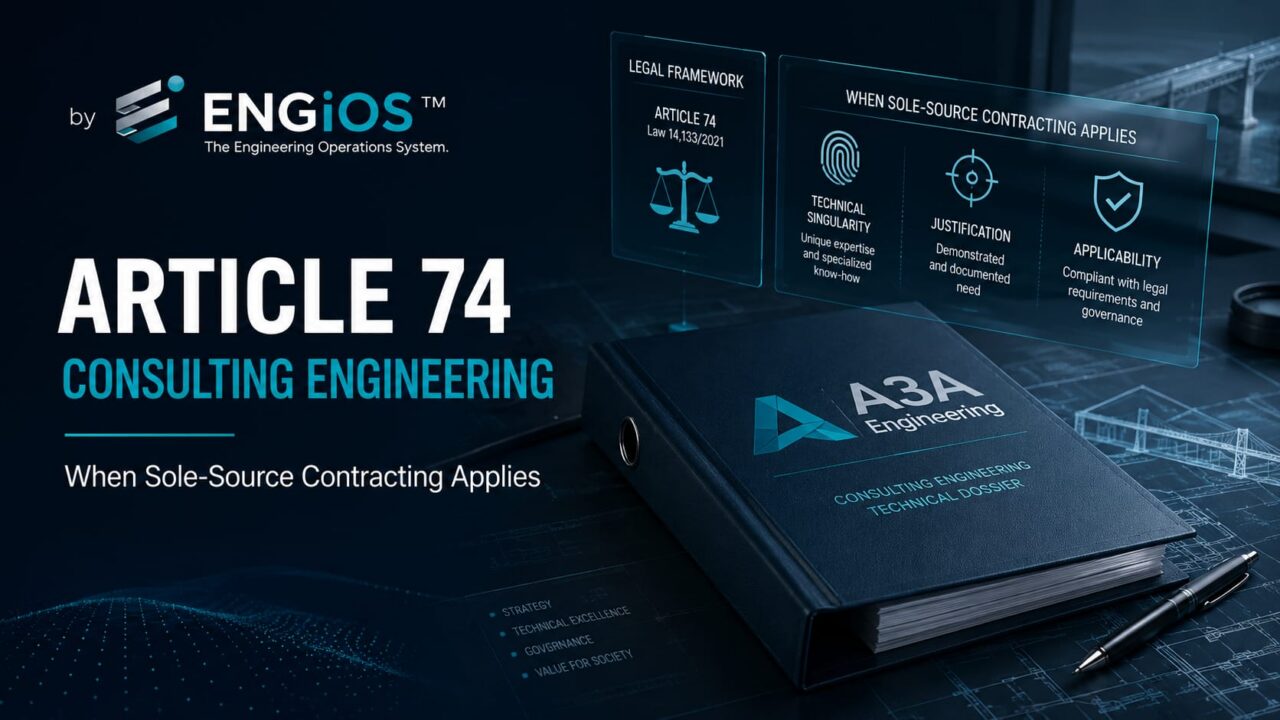
Understand Article 74 of Brazilian Law 14,133 as applied to Consulting Engineering: specialized technical services, recognized expertise, essentiality, impossibility of competition and AGU Guidance 107/2026.
Check it out!
Article 74 of Brazilian Law 14,133 allows noncompetitive procurement when competition is not feasible. For Consulting Engineering, the most relevant hypothesis is item III: procurement of specialized technical services of a predominantly intellectual nature from a professional or company of recognized expertise, provided that the provider’s specialization is essential and demonstrably appropriate to the full satisfaction of the object.
This does not mean that every engineering consultancy, design or inspection service may be directly procured. The process must demonstrate, in a connected manner, the intellectual and specialized nature of the service, the relevant recognized expertise, the essentiality of that provider and the impossibility of effective competition in the specific case. When these elements are absent, the procurement must follow the appropriate competitive route.
What Article 74 of Brazilian Law 14,133 Actually Establishes
The caput of Article 74 sets the governing rule: a competitive tender is not required when competition is not feasible. The law then presents specifically recognized hypotheses, including exclusive suppliers, recognized artists, specialized technical services involving recognized expertise, accreditation and the acquisition or lease of real estate under specific conditions.
For the engineering sector, item III is strategic because it covers activities whose value derives predominantly from knowledge, technical judgment, experience and intellectual capability, rather than only from the material execution of standardized tasks.
A common mistake is to begin with the question “which item allows this company to be hired?”. The correct sequence is the opposite: first the Administration characterizes the need and the service; then it determines whether competition is feasible; only then does it assess the applicable legal framework.
Why Item III Is Especially Relevant to Consulting Engineering
Article 74, III covers specialized technical services of a predominantly intellectual nature performed by professionals or companies of recognized expertise. The statutory list includes activities directly associated with Consulting Engineering, such as:
- technical studies and planning;
- basic designs and detailed designs;
- technical opinions, expert examinations and assessments;
- technical advisory and consulting services;
- inspection, supervision and management of works or services;
- quality and technological control;
- analysis, testing and field and laboratory tests;
- instrumentation and monitoring;
- other engineering services that fall within the predominantly intellectual nature defined by law.
These activities may involve decisions whose outcome depends on the team’s technical repertoire, accumulated experience, ability to integrate disciplines and capacity to interpret risks. This distinguishes them from standardized services in which providers can be compared mainly by price and compliance with usual objective requirements.
The Three Elements That Must Appear in the Justification
Article 74, III does not make every intellectual service eligible for noncompetitive procurement. The decisive issue is demonstrating why the provider’s specialization is essential to that specific need.
The Brazilian Federal Court of Accounts highlights three elements for the hypothesis under Article 74, III:
- the object is a specialized technical service of a predominantly intellectual nature;
- the professional or company has relevant recognized expertise;
- the work of that provider is essential and demonstrably appropriate to fully satisfy the object.
These elements must be demonstrated as an integrated whole. An exceptional résumé unrelated to the problem is insufficient. A complex object does not automatically make a company essential. And a company recognized in the market does not turn an otherwise competitive procurement into a noncompetitive one.
| Element | Question the process must answer | Typical evidence |
| nature of the service | where is the specialized intellectual content? | ETP, Terms of Reference, scope, critical decisions and deliverables |
| recognized expertise | which differentiated capabilities are demonstrated? | previous performance, team, studies, experience, publications, organization and resources |
| essentiality | why are these capabilities decisive for the outcome? | need × risk × capability × evidence matrix |
| impossibility of competition | why does a conventional competitive process fail to reproduce the required selection adequately? | market analysis, object characteristics and technical justification |
Singularity of the Object Is No Longer an Autonomous Requirement
The former Brazilian Law 8,666 associated the procurement of specialized technical services with singularity. Law 14,133 changed this framework. The TCU records that singularity was removed as an autonomous requirement under the current hypothesis.
This does not eliminate the need to demonstrate differentiated characteristics of the case. What changes is the legal reasoning: the Administration does not need to prove that the object is “unique” in the abstract; it must demonstrate that, given the characteristics of the need, the provider’s specialization is essential and demonstrably appropriate to fully satisfy the object.
This distinction reduces artificial arguments. Many services are not unique, but they may require experience and capabilities so relevant to the outcome that provider selection cannot be treated as a simple comparison of homogeneous proposals.
Recognized Expertise Is Not Generic Reputation
Paragraph 3 of Article 74 defines recognized expertise based on the standing of the professional or company in its field of specialization. The law cites previous performance, studies, experience, publications, organization, resources, technical staff and other requirements related to the activities.
The central concept is relevance. The Administration must be able to explain why each item of evidence helps demonstrate capability relevant to the object.
In Consulting Engineering, depending on the case, the following may be considered:
- certificates and contracts for comparable services;
- CAT, ART, RRT and other professional responsibility records;
- experience of key professionals;
- technical and executive education aligned with the challenge;
- technical production and publications in the field;
- participation in projects of similar complexity;
- management, design, inspection, QA/QC or commissioning methodologies;
- required engineering resources, systems, processes and equipment;
- ability to coordinate multiple disciplines and stakeholders.
The process should avoid turning the number of certificates into a criterion for recognized expertise. What matters is the nexus between the demonstrated capability and the outcome the public body needs to achieve.
Essentiality: the Link That Requires the Strongest Justification
One of the most difficult questions is: why is the work of this provider essential to the full satisfaction of the object?
The answer should not be based on preference, a prior relationship or subjective trust. It must arise from the characteristics of the problem.
An analysis framework can follow four steps:
- identify which decisions or risks are critical to the outcome;
- define which capabilities are required to address them;
- demonstrate which evidence proves those capabilities in the provider;
- explain why that combination makes the work demonstrably appropriate to the need.
In a multidisciplinary project, for example, essentiality may lie less in the ability to produce drawings and more in experience coordinating critical interfaces, managing risks, integrating systems, controlling documentation and supporting the owner’s technical decisions.
Impossibility of Competition Does Not Mean There Is Only One Company in Brazil
Noncompetitive procurement of specialized technical services does not necessarily require the physical absence of other providers. The issue is whether effective competition is feasible for selecting the required intellectual work under the concrete conditions of the object.
In activities where technique, experience, method and team strongly affect the outcome, comparison may not be reducible to standardized specifications and lowest price. Even so, the Administration must demonstrate why competitive selection is not appropriate to the case.
The existence of several consulting firms in the market therefore does not resolve the issue by itself. Likewise, the existence of only a few specialists does not automatically prove that noncompetitive procurement is justified.
Consulting Engineering Is Not a Common Service: the Impact of AGU Guidance 107/2026
AGU Guidance 107/2026 separates Consulting Engineering from common engineering services. Where competition is feasible, the route is competitive tendering; when the requirements of Article 74 are demonstrated, noncompetitive procurement may apply.
AGU Normative Guidance No. 107/2026 introduced an important point for classifying Consulting Engineering services. According to the guidance, the services provided for in Article 6, XVIII, items “a”, “d” and “h”, are specialized technical services of a predominantly intellectual nature and cannot be classified as common engineering services.
This removes the use of the reverse-auction logic for these objects. When competition is feasible, the guidance points to competitive tendering, with technique and price as the general rule, except where additional weighting of technical quality is not relevant. When the case satisfies the requirements of Article 74, noncompetitive procurement remains possible.
The decision can therefore be summarized as follows:
When Studies and Designs May Fall Under This Framework
Technical studies, planning, basic designs and detailed designs are expressly listed in the law. But the mere label “design” does not authorize noncompetitive procurement.
A standardized design that is widely available and objectively comparable may be competitively procured. By contrast, a study or design in a critical environment, with a strong need for technical judgment, multidisciplinary integration, significant operational constraints or a high consequence of error may justify deeper analysis of whether differentiated specialization is essential.
The ETP should demonstrate why the service requires differentiated knowledge before the Administration decides on the procurement route.
Can Inspection, Supervision and Management Be Procured Noncompetitively?
They may fall within Article 74, III because they are expressly listed as specialized technical services of a predominantly intellectual nature. However, the classification is not automatic.
The Administration must assess whether the project has characteristics that make differentiated specialization essential: critical systems, high interface complexity, claims analysis, risk management, multiple disciplines, complex commissioning, document control or high-impact decisions.
If the inspection service can be described, sized and compared competitively without depending on a specific provider, competitive tendering remains a valid alternative.
Quality Control, Testing and Monitoring
Item “h” covers quality and technological control, analyses, tests, trials, instrumentation and monitoring. Once again, the nature of the activity matters.
A standardized test performed by many laboratories may be subject to fully viable competition. An investigation requiring a proprietary methodology, interpretation of results, correlation among multiple disciplines and differentiated experience may have a different profile.
The decision should consider not only the equipment used, but the intellectual content required to turn measurement into diagnosis and engineering decisions.
Paragraph 4 Links the Justification to the Team That Will Perform the Service
The team that justified the procurement is part of the logic of noncompetitive award itself. The contract must preserve the participation of the professionals whose experience was considered essential.
Article 74, paragraph 4, prohibits, in procurements under item III, subcontracting companies or using professionals different from those whose qualifications justified the noncompetitive procurement.
This rule protects the consistency of the process. If the Administration stated that a certain track record, team or body of knowledge was essential to direct procurement, performance cannot later be handed to people who were not part of that justification.
The Terms of Reference and the contract should therefore clearly identify:
- professionals whose experience was decisive;
- roles and responsibilities;
- deliverables and decisions under their responsibility;
- evidence of participation;
- how the mobilized team will be inspected.
The justification for noncompetitive procurement must survive contract signature: the capability that justified the choice must appear in actual performance.
Article 74 Does Not Replace the Process Required by Article 72
Even when the noncompetitive procurement hypothesis has been demonstrated, the Administration must properly document the direct procurement. Article 72 requires the demand, planning artifacts when applicable, estimate, opinions, budget compatibility, qualification, reason for the choice, price justification and authorization.
This prevents Article 74 from being used in isolation as a “permission to contract.” The selected item explains why there is no competitive tender; Article 72 organizes how the decision must be documented and controlled.
The HUB on noncompetitive procurement of engineering services examines this chain in greater depth, including the ETP, Terms of Reference, price, team, inspection and acceptance.
Examples of Weak Justification
Some justifications may sound technical but do not demonstrate the necessary requirements:
- “the company has extensive experience”;
- “the object is complex”;
- “we already know the quality of the provider”;
- “the public body needs to trust the team”;
- “the company has many certificates”;
- “competitive procurement would take longer”;
- “the service is intellectual”;
- “the provider submitted the lowest value in an informal comparison”.
These statements may be part of the context, but they do not replace the complete reasoning. It is necessary to connect the need, relevant complexity, essential capabilities, provider evidence and the impossibility of competition.
A Practical Matrix for Assessing Article 74, III
| Question | Required evidence | Expected result |
| Is the service predominantly intellectual? | scope, activities and deliverables | distinction between technical judgment and routine execution |
| What is the actual difficulty of the object? | ETP, risks, constraints and interfaces | concrete complexity, not generic adjectives |
| Which capability is critical? | risk and decision matrix | required technical profile |
| Does the provider have this capability? | track record, team, technical production and structure | demonstrated alignment |
| Why is this capability essential? | nexus between risk and experience | justification of essentiality |
| Is competition not feasible? | analysis of the market and selection method | technical justification for the legal framework |
| Is the price justifiable? | comparables and calculation memorandum | independent economic compatibility |
| Will the key team actually perform? | proposal, Terms of Reference and contract | consistency with paragraph 4 |
The matrix helps avoid processes in which each document tells a different story.
What Changes for the Potential Provider
The company or professional being considered by the Administration should not construct the legal framework for its own benefit. Its role is to provide truthful, complete and traceable technical information so that the Administration can conduct an independent assessment.
A Consulting Engineering company may provide:
- certificates and professional records;
- résumés of key team members;
- track record of relevant projects and contracts;
- portfolio of comparable cases;
- technical production and publications;
- certifications and education;
- organizational structure and resources;
- execution methodology;
- technical proposal with scope and deliverables;
- price-build-up memorandum and comparable references when applicable.
The Administration uses these elements, together with its own studies and controls, to make an independent decision.
How A3A Engenharia Positions Itself in Procurements of This Nature
The procurement route should be a consequence of the problem and technical analysis, not a predetermined decision. A3A Engenharia can present its evidence; the Administration retains independent decision-making authority.
A3A Engenharia operates in Consulting Engineering, design, engineering management, Owner’s Engineering, technical inspection, QA/QC, commissioning and other activities of predominantly intellectual content. When considered by a public body for potential procurement, it can present technical documentation regarding its experience, team, methods, technical production and structure so that the Administration can conduct its analysis.
A3A Engenharia does not replace the public body’s authority to define the legal hypothesis, issue the reason for selection, conduct legal analysis or authorize noncompetitive procurement. This segregation is essential to preserve independence and governance of the process.
Final Considerations
Article 74 of Brazilian Law 14,133 should not be read as a list of shortcuts for direct procurement. It defines situations in which competition is not feasible and, under item III, allows procurement of specialized technical services of a predominantly intellectual nature when the provider’s recognized expertise is essential and demonstrably appropriate to the object.
For Consulting Engineering, the decision needs to be technically mature. The public body must understand the problem, identify critical capabilities, demonstrate the provider’s alignment, assess the impossibility of competition and document the procurement in accordance with Article 72.
The better this chain is documented, the lower the dependence on generic justifications and the greater the legal and technical security for procuring high-level technical knowledge when competitive tendering is not the appropriate instrument.
Technical references
[1] BRAZIL. Law No. 14,133, April 1, 2021 — Public Procurement and Administrative Contracts Law. Available at: https://www.planalto.gov.br/ccivil_03/_ato2019-2022/2021/lei/l14133.htm.
[2] BRAZILIAN FEDERAL COURT OF ACCOUNTS. 5.10.1.3 Specialized technical services of a predominantly intellectual nature with professionals or companies of recognized expertise. Available at: https://licitacoesecontratos.tcu.gov.br/5-10-1-3-servicos-tecnicos-especializados-de-natureza-predominantemente-intelectual-com-profissionais-ou-empresas-de-notoria-especializacao-inciso-iii/.
[3] ATTORNEY GENERAL’S OFFICE OF BRAZIL. AGU Normative Guidance — Guidance No. 107/2026. Available at: https://www.gov.br/agu/pt-br/composicao/cgu/cgu/onsagu.
[4] BRAZIL. Ministry of Management and Innovation in Public Services. SEGES/MGI Normative Instruction No. 2, February 7, 2023. Available at: https://www.gov.br/compras/pt-br/acesso-a-informacao/legislacao/instrucoes-normativas/instrucao-normativa-seges-mgi-no-2-de-7-de-fevereiro-de-2023.
Frequently asked questions
Article 74 establishes that competitive tendering is not required when competition is not feasible and presents hypotheses such as exclusive suppliers, recognized artists, specialized technical services involving recognized expertise, accreditation and certain real estate transactions.
No. For technical services under item III, it is necessary to demonstrate a predominantly intellectual nature, relevant recognized expertise, the essentiality of the provider’s work and the impossibility of competition in the specific case.
Yes, when the service falls within specialized technical services of a predominantly intellectual nature and the requirements of Article 74, III are demonstrated. If competition is feasible, the procurement must follow the appropriate competitive route.
Law 14,133 does not retain singularity as an autonomous requirement for this hypothesis. The TCU emphasizes the technical and intellectual nature of the service, recognized expertise and the essentiality of the provider to fully satisfy the object.
It is the demonstration that the differentiated capabilities of that professional or company are decisive for fully satisfying the Administration’s specific need.
Article 74, paragraph 4, prohibits professionals different from those who justified the noncompetitive procurement from performing under procurements governed by item III, and also prohibits subcontracting companies.
AGU Guidance 107/2026 establishes that certain Consulting Engineering services are specialized technical services of a predominantly intellectual nature and cannot be classified as common engineering services, excluding the reverse-auction procedure for these objects.
Complementary technical materials
Related solutions
- Contract, Scope and Deliverables Management
- Requirements, Evidence and Acceptance Criteria Management
Related services
- Engineering Technical Consulting
- Ongoing Consulting Engineering Services
- Technical Planning for Engineering Procurement
Main content on this topic
- Noncompetitive Procurement of Engineering Services: When Is It Possible Under Brazilian Law 14,133?
- What Is Inexigibilidade? Understanding Direct Procurement Under Brazilian Law 14,133