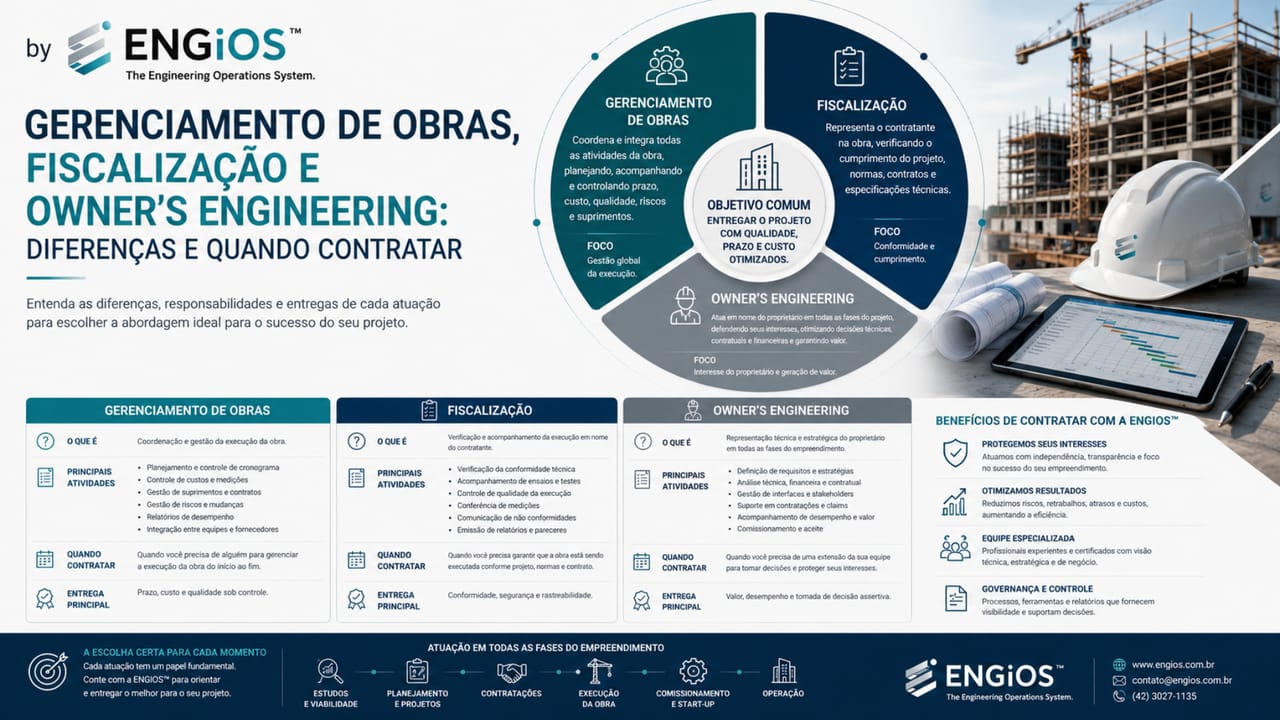
Understand the differences among construction management, inspection, Project Controls, and Owner’s Engineering, and learn which model to hire.
Check it out!
Engaging support for an engineering construction or implementation project is not simply a choice among inspection, management, or Owner’s Engineering. Each function answers different questions, has its own boundaries, and requires clearly defined authority, deliverables, and interfaces.
Inspection verifies whether execution complies with the contract, designs, specifications, and quality criteria. Construction management coordinates scope, schedule, cost, contracts, resources, risks, decisions, and stakeholders. Project Controls provides the analytical basis for performance and forecasting. Owner’s Engineering technically represents the owner and assesses whether decisions, solutions, and deliverables protect the owner’s objectives throughout the project lifecycle.
These functions may coexist. Problems arise when an engagement is given a broad name but a limited scope, when responsibilities are duplicated, or when an essential activity has not been assigned to anyone.
In multidisciplinary projects, maturity does not mean hiring the largest possible number of consultants. It means building a governance architecture proportionate to the risks, with clearly established roles, authority levels, processes, information sources, deliverables, and acceptance criteria.
What problem does the client need to solve?
Before choosing the model, the owner needs to identify the actual gap.
| Project problem | Consequence | Function normally required |
| Execution without independent verification | Defects, nonconformities, and weak progress measurements | Technical inspection |
| Many contractors and interfaces | Conflicts, delays, and fragmented decisions | Construction or project management |
| Conflicting schedule and cost data | Loss of predictability | Project Controls |
| Owner without sufficient technical staff | Dependence on information from contractors | Owner’s Engineering |
| Documents and revisions without control | Use of obsolete information | Document Control or EDMS |
| Outstanding items without an owner or due date | Issues remain open until acceptance | Action-item management and workflows |
| Incompatible designs | Rework and field changes | Design coordination and clash/interface resolution |
| Subjective progress-measurement criteria | Contractual disputes and payments without evidence | Inspection, contract management, and controls |
| Changes without integrated analysis | Cost overruns and late schedule impacts | Management, Project Controls, and Owner’s Engineering |
| Testing without an acceptance strategy | Assets delivered without demonstrated performance | Commissioning and technical assurance |
| Decisions without clear authority levels | Delays, informality, and weak accountability | Project governance |
| Lack of portfolio visibility | Resources allocated without strategic priority | PMO and portfolio governance |
The same project may need more than one response. Inspecting an installation does not replace schedule control; schedule control does not replace the technical validation of a change; and issuing reports does not replace decision-making.
The contract name does not guarantee that the function actually exists. Inspection, management, and Owner’s Engineering must be defined by processes, authority, deliverables, and results—not merely by a broad label.
What is construction management?
Construction management is the integrated coordination of the activities required to achieve the project objectives. The function connects planning, engineering, contracts, procurement, execution, quality, risk, stakeholders, commissioning, and closeout.
Management should organize how the project will be conducted and how decisions will be converted into actions. Responsibilities may include:
- project management plan;
- integration of disciplines and contractors;
- master schedule;
- budgeting and cost control;
- responsibility matrix;
- risk and change management;
- coordination of meetings and decisions;
- contract and interface management;
- deliverable tracking;
- escalation of outstanding items;
- preparation for commissioning and acceptance;
- communication with sponsors and stakeholders.
The Project Management service coordinates the project. The level of authority must be defined in the contract: a management firm may recommend, coordinate, validate information, or receive delegated authority for specific decisions, but it should not automatically assume powers that have not been formally granted.
Are construction management and construction project management the same thing?
The terms are often used interchangeably, but they may have different meanings in each organization.
| Term | Common use | Required caution |
| Construction management | General organization of execution, teams, resources, and routines | May be confused with the contractor’s own management activities |
| Construction project management | Integrated coordination on behalf of the client | Scope and authority must be explicit |
| Construction administration | Operational routine of the executing contractor | Does not necessarily represent the owner |
| Project management | Application of processes to the complete project lifecycle | May begin before construction and continue after handover |
| Project management services | Executive coordination of objectives, people, contracts, and decisions | The term alone does not define the responsibility model |
The name of the engagement is less important than its actual scope. The Terms of Reference should identify processes, deliverables, interfaces, authority levels, and expected outcomes.
What is technical construction inspection?
Technical inspection is the systematic verification that execution complies with contractual and technical requirements. It observes what was performed, records evidence, identifies deviations, monitors corrections, and supports progress measurements and acceptance.
Inspection may cover:
- field inspections;
- verification of materials and equipment;
- checking applicable designs and revisions;
- monitoring construction methods;
- recording occurrences;
- validation of quantities;
- support for progress-payment measurements;
- reporting;
- opening and tracking nonconformities;
- outstanding-item management;
- witnessing inspections and tests;
- verification of final documentation;
- support for receipt and acceptance.
The article on Technical Inspection of Construction and Engineering Services explores evidence, measurement, and acceptance in greater depth.
Inspection does not mean directing the contractor’s means and methods. It also does not replace overall management, because compliance of an isolated activity does not, by itself, indicate whether the project will achieve its schedule, cost, operational capacity, and expected benefits.
What is construction supervision?
Supervision may refer to more continuous technical oversight focused on coordinating and guiding field activities. In some contracts, the term is treated as equivalent to inspection; in others, it has a broader scope.
The engagement should therefore answer:
- does supervision only observe and record?
- may it direct corrective actions?
- does it coordinate work fronts and interfaces?
- does it validate progress measurements?
- does it monitor short-term planning?
- does it have authority to stop an activity under an unacceptable condition?
- does it issue formal instructions?
- does it represent the client before the contractors?
Without these definitions, supervision becomes an ambiguous label. The team may be held accountable for decisions it had no authority to make or may improperly interfere with the contractor’s responsibility.
What is Project Controls?
Project Controls integrates the structures of scope, schedule, cost, physical progress, risk, changes, contracts, productivity, and forecasting.
The function answers:
- what was the approved baseline?
- how much was actually completed?
- where is there variance?
- why did the deviation occur?
- what is the projected completion trend?
- what is the likely final cost?
- which risks and changes have not yet been incorporated?
- what decision needs to be made?
Project Controls is more than schedule updating. The discipline must produce an integrated and defensible view of performance.
In a mature architecture, inspection validates field evidence, contractors update their plans, Project Controls consolidates and analyzes the information, management coordinates responses, and governance makes decisions according to delegated authority.
What is Owner’s Engineering?
Owner’s Engineering is independent technical work oriented toward the interests of the asset owner or project sponsor.
Its purpose is not merely to verify whether the contractor complied with a specification. The function assesses whether technical, contractual, and implementation decisions remain aligned with the owner’s objectives.
The scope may include:
- validation of requirements and assumptions;
- independent review of studies and designs;
- support for the contracting strategy;
- technical bid evaluation;
- interface management;
- supplier document review;
- analysis of changes and deviations;
- verification of technical risks;
- oversight of Project Controls;
- inspection and field audits;
- commissioning and readiness reviews;
- acceptance criteria;
- transition to operations;
- support during warranty and assisted operation.
The article Owner’s Engineering: Technical Governance for Engineering Projects explores this role throughout the lifecycle. The Owner’s Engineering service structures this technical representation.
Construction management, inspection, Project Controls, and Owner’s Engineering: what is the difference?
| Function | Main question | Focus | Typical output |
| Governance | Who decides, using which information and within what authority? | authority and accountability | committees, gates, and recorded decisions |
| Management | How should the project be coordinated to achieve its objectives? | integration and execution | plans, coordination, decisions, and actions |
| Inspection | Does the executed work comply with the requirements and contract? | compliance | inspections, evidence, measurements, and outstanding items |
| Supervision | How should work fronts and interfaces be continuously monitored? | field oversight | guidance, records, and operational coordination |
| Project Controls | Where are we, why did we deviate, and what is the forecast? | performance and forecast | baselines, analyses, curves, and reports |
| PMO | How should multiple projects be standardized and governed? | methods and portfolio | standards, indicators, and assurance |
| Document Control | Which document and revision are official? | controlled information | transmittals, revisions, and distribution |
| Commissioning | Is the system ready and does it perform its function? | performance and readiness | plans, tests, evidence, and acceptance |
| Owner’s Engineering | Do decisions and deliverables protect the owner’s objectives? | independent technical representation | technical opinions, validations, and recommendations |
| Contractor or EPC contractor | How should the contracted scope be executed? | production and delivery | designs, supplies, construction, and tests |
None of these functions should be inferred merely from the name of the firm or contract. The responsibility matrix must establish who prepares, analyzes, recommends, approves, executes, inspects, and accepts.
Does Owner’s Engineering replace inspection?
It may include inspection, but it is not limited to it.
Inspection tends to focus on compliance of the executed work. Owner’s Engineering may begin before procurement, participate in scope definition, and continue through acceptance, warranty, and operational transition.
| Activity | Inspection | Owner’s Engineering |
| field inspection | central | may include or supervise |
| progress-measurement validation | frequent | may review independently |
| contracting-strategy review | normally outside the scope | typical |
| design review | depending on the contract | typical and multidisciplinary |
| change analysis | verifies local impact | assesses overall impact for the owner |
| Project Controls | provides field data | challenges assumptions and forecasts |
| interface management | may record conflicts | acts on integration and resolution |
| commissioning | witnesses and records | governs readiness and acceptance criteria |
| investment decision | normally outside the scope | provides technical support |
| assisted operation | less frequent | may provide oversight |
When the owner contracts only inspection for a complex project, gaps may remain in planning, contracts, interfaces, risks, changes, and executive decisions.
Field compliance does not replace technical representation of the owner. Critical projects require an independent view of solutions, interfaces, risks, changes, forecasts, and acceptance criteria.
Does construction management replace Owner’s Engineering?
Not necessarily.
Management coordinates the project. Owner’s Engineering adds an independent technical perspective focused on protecting the owner’s requirements and interests.
In some contracts, the same consulting firm may perform both functions. In that case, the organization needs to preserve:
- clarity about each role;
- independence of critical validations;
- segregation between preparation and approval;
- traceability of recommendations;
- escalation of conflicts;
- transparency regarding limitations and assumptions.
A team that prepares the baseline, measures its own performance, and approves changes without independent verification concentrates incompatible functions. Segregation should be proportional to project risk.
Which function should be used in each situation?
| Client situation | Recommended model |
| Simple construction, well-defined design, and one contractor | Technical inspection with basic contract management |
| Multiple work fronts and contractors | Integrated management and discipline-specific inspection |
| Unreliable schedule and cost data | Project Controls with baseline and progress-measurement review |
| Owner without a multidisciplinary technical team | Owner’s Engineering |
| Incomplete basic design or critical interfaces | Consulting Engineering and Owner’s Engineering before construction |
| Highly complex EPC contract | Independent Owner’s Engineering, Project Controls, and inspection by sampling or criticality |
| Public works or contract with strong documentation requirements | Inspection, document management, progress measurements, and contract governance |
| Project behind schedule or over budget | Diagnosis, controls audit, and recovery plan |
| Critical asset in operation | Owner’s Engineering, specialized supervision, and operational risk management |
| Large program with multiple projects | PMO, portfolio governance, Project Controls, and assurance |
| Implementation with complex testing | Independent commissioning integrated with management |
| Ongoing contract with variable demands | Ongoing Consulting Engineering services with a service catalog, SLAs, and governance |
The solution may be modular. The client does not need to outsource all management activities, but it must ensure that no critical function remains without a responsible party.
How should the project governance architecture be structured?
A typical architecture may include the following layers:
| Layer | Responsibility |
| Sponsor or executive committee | approve objectives, resources, critical changes, and gates |
| Owner’s representative | consolidate business needs and exercise delegated authority |
| Project management | integrate teams, contracts, decisions, and deliveries |
| Owner’s Engineering | provide assurance and independent technical representation |
| Project Controls | measure performance, analyze trends, and produce forecasts |
| Inspection and supervision | verify execution, evidence, and measurements |
| Engineering and designers | develop and review technical solutions |
| Contractors and suppliers | execute the contracted scope |
| Commissioning | verify functionality, integration, and readiness |
| Document Control | preserve official information and traceability |
| Operations and maintenance | validate operational requirements and receive the asset |
This architecture should be supported by a RACI Matrix in Engineering Projects. RACI does not replace contractual descriptions, but it helps identify gaps and overlaps.
Which decisions require clear authority levels?
Decisions that should not depend on informal arrangements include:
- baseline approval;
- release of designs for execution;
- acceptance of alternative materials;
- scope changes;
- changes to contractual schedule;
- use of contingency;
- approval of progress measurements;
- acceptance of technical deviations;
- closure of nonconformities;
- authorization for energization;
- release for commissioning;
- provisional and final acceptance;
- approval of recovery plans;
- contract closeout.
For each decision, the process should define who prepares the information, who reviews it, who recommends, who approves, and which evidence is mandatory.
How do these functions operate throughout the project lifecycle?
| Phase | Management | Inspection | Project Controls | Owner’s Engineering |
| Feasibility | organizes studies and decisions | normally limited | structures estimates and scenarios | validates assumptions and alternatives |
| Planning | integrates scope, contracts, and resources | prepares the inspection plan | develops baselines and controls | reviews strategy and risks |
| Design | coordinates deliverables and interfaces | may verify document compliance | controls progress and approvals | reviews solutions and requirements |
| Procurement | organizes the process and interfaces | supports inspection requirements | evaluates schedules and costs | analyzes proposals and technical risks |
| Execution | coordinates work fronts, contracts, and decisions | inspects and validates evidence | measures, analyzes, and forecasts | challenges assumptions and protects objectives |
| Commissioning | integrates plans and resources | witnesses tests | controls readiness and outstanding items | governs acceptance criteria |
| Closeout | coordinates documentation and transition | verifies corrections and handover | consolidates performance | recommends acceptance and lessons learned |
| Warranty | manages calls and obligations | verifies corrections | monitors indicators | supports operations and accountability |
The absence of early participation reduces the ability to influence the project. Inspecting a solution that has already been contracted does not necessarily correct poorly defined requirements or an inadequate strategy.
Which deliverables should be defined?
Management deliverables
- project management plan;
- responsibility matrix;
- master schedule;
- communications plan;
- risk management plan;
- contracting strategy;
- minutes and decision records;
- executive reports;
- recovery plans;
- closeout plan.
Inspection deliverables
- inspection plan;
- inspection checklists;
- field diary or field log;
- photographic reports;
- nonconformity records;
- outstanding-item matrix;
- progress-measurement records;
- compliance opinions;
- test records;
- acceptance recommendations.
The Technical Inspection Report in Engineering shows how evidence, outstanding items, and measurements should be organized.
Project Controls deliverables
- Project Controls Plan;
- WBS and coding structures;
- schedule and cost baselines;
- progress-measurement rules;
- S-curve;
- critical-path analysis;
- change and trend log;
- forecast;
- dashboards and performance reports;
- productivity analysis;
- consolidation of risks and contingencies.
Owner’s Engineering deliverables
- owner requirements matrix;
- independent technical reviews;
- technical opinions and technical notes;
- interface analysis;
- change assessments;
- design and execution audits;
- readiness reviews;
- commissioning plans and criteria;
- acceptance matrix;
- executive recommendations;
- operational-transition report;
- warranty oversight.
The contract should define not only the deliverable name, but also its minimum content, frequency, data source, responsibility, review deadline, and acceptance criteria.
How should the information flow work?
Field information needs to move through a controlled process.
- The contractor records production and submits evidence.
- Inspection verifies quantity, quality, and the applicable revision.
- Project Controls consolidates progress and compares it with the baseline.
- Management analyzes interfaces, contracts, and the need for action.
- Owner’s Engineering assesses technical effects and the owner’s interests.
- The competent authority decides according to delegated authority.
- The decision is recorded and converted into an action, change, or instruction.
- Inspection verifies implementation.
- The controls update the forecast.
- Effectiveness is monitored in subsequent cycles.
The flow prevents the same information from being informally validated in meetings and recorded differently in systems, reports, and contracts.
How should inspection and Project Controls work together?
Inspection provides essential evidence for control. However, progress should not be calculated solely from field perception.
| Field information | Use in Project Controls |
| quantity executed and accepted | update of physical progress |
| nonconformity | progress adjustment and rework analysis |
| blocked work front | constraint and forecast review |
| material received | update of supply milestones |
| mobilized workforce | productivity and capacity analysis |
| test completed | milestone recognition and readiness |
| critical outstanding item | risk to acceptance or critical path |
| change executed | verification of authorization and impact |
| progress-payment statement | reconciliation between physical and financial progress |
A measurement may be correct while the project remains behind schedule. Likewise, an activity may be physically complete but create no value if the system is not integrated or accepted.
How should management and Owner’s Engineering work together?
One possible functional separation is:
- management organizes processes, schedules, responsibilities, and decisions;
- Owner’s Engineering critically reviews solutions, assumptions, and impacts;
- Project Controls provides integrated analysis;
- inspection verifies evidence;
- the owner retains final authority.
In smaller projects, functions may be combined. The accumulation of roles must be explicit and accompanied by controls to prevent the same person from preparing, approving, and auditing a critical decision.
How can gaps and overlapping responsibilities be avoided?
The engagement should test every relevant process.
| Process | Verification question |
| requirements | who maintains the reference for what the owner needs? |
| design | who coordinates, who reviews, and who approves? |
| schedule | who prepares, who validates, and who authorizes the baseline? |
| progress | who measures, who verifies, and who consolidates? |
| costs | who provides actuals, who forecasts, and who decides on contingency? |
| risks | who identifies, who responds, and who accepts residual risk? |
| changes | who requests, analyzes, recommends, and approves? |
| documents | what is the official source and who controls revisions? |
| field | who inspects, guides, records, and accepts? |
| nonconformities | who opens, responds, verifies, and closes them? |
| commissioning | who prepares, executes, witnesses, and accepts tests? |
| contract | who administers obligations, measurements, claims, and closeout? |
| operations | who receives the asset, validates training, and approves transition? |
When two firms are shown as responsible for the same approval, the process needs to define precedence and authority. When none is shown, there is a governance gap.
What risks arise from a poorly defined engagement?
Inspection turned into contractor administration
The owner’s team begins directing tasks and making operational decisions without the contractual responsibilities having been revised.
Management firm without authority
The consultant coordinates meetings and pushes schedules but lacks access to data, escalation authority, or responses from responsible parties.
Owner’s Engineering in name only
The contract uses the term but limits the scope to periodic visits and photographic reports.
Project Controls dependent on contractors
Information is consolidated without reviewing criteria, assumptions, baselines, or data quality.
Overlapping technical opinions
Inspection, the designer, the management firm, and Owner’s Engineering issue conflicting guidance without a decision flow.
Lack of segregation
The same team prepares, measures, approves, and audits its own deliverables.
Contracting by headcount
The scope defines positions but not the processes, deliverables, and outcomes that must be produced.
Reports without action
The consultant records problems, but there is no responsible party, deadline, decision, or effectiveness verification.
What benefits does an integrated architecture produce?
| Dimension | Benefit |
| Scope | clearer requirements and deliverables |
| Schedule | integrated view of milestones, constraints, and trends |
| Costs | better control of measurements, changes, and forecasts |
| Quality | consistent evidence and acceptance criteria |
| Contracts | traceable responsibilities and obligations |
| Risks | earlier identification and escalation of exposures |
| Interfaces | coordination among disciplines, suppliers, and operations |
| Decision-making | information prepared for the appropriate authority level |
| Commissioning | readiness verified before operations |
| Owner | technical independence and reduced information asymmetry |
| Knowledge base | data and lessons preserved for future projects |
| Benchmarking | performance comparisons with context and assumptions |
The main benefit is reducing the owner’s dependence on information produced by those who design, supply, or execute the project.
Governance must continue from one decision to the next. Technical records, performance history, criteria, outstanding items, and lessons learned lose value when each demand is handled by a different team without continuity.
How do these functions generate technical knowledge and benchmarking?
The combination of controls, inspection, and Consulting Engineering makes it possible to preserve:
- actual productivity;
- duration of activities and approvals;
- causes of changes;
- contractor performance;
- frequency of nonconformities;
- time required to close outstanding items;
- quantity variances;
- cost behavior;
- test results;
- recurring interface failures;
- effectiveness of recovery plans;
- time between completion, commissioning, and acceptance.
Benchmarking needs to consider size, complexity, technology, location, design maturity, contracting strategy, constraints, and measurement criteria. Comparisons without context may produce unrealistic targets or unfair interpretations.
How should the maturity of the management model be assessed?
| Level | Characteristics | Main limitation |
| 1 — Reactive | professionals act based on individual experience | dependence on individuals and low traceability |
| 2 — Documented | contracts, templates, and meetings are defined | focus on formality |
| 3 — Controlled | responsibilities, baselines, evidence, and active decisions | integration remains partial |
| 4 — Integrated | management, inspection, controls, and OE share a common architecture | requires data governance |
| 5 — Predictive | trends, scenarios, benchmarking, and benefits guide decisions | requires continuous discipline and critical review |
Maturity does not mean centralizing everything in one firm. It means the processes work coherently regardless of how many suppliers are involved.
Which contracting models can be used?
| Model | Application | Characteristics |
| Inspection with defined scope | simple construction or specific contracts | team and frequency proportional to criticality |
| Integrated management | multiple contractors and interfaces | central coordination of schedule, cost, contracts, and decisions |
| Full Owner’s Engineering | owner without a multidisciplinary structure | technical representation throughout the lifecycle |
| Independent Project Controls | need for predictability and assurance | review of baselines, measurements, and forecasts |
| EPCM | management of engineering, procurement, and construction | broad role without necessarily assuming direct execution |
| Ongoing services | portfolio of variable demands | service catalog, hour bank, SLAs, and recurring governance |
| Specialized consulting | defined technical problem | diagnosis, opinion, or decision support |
| Technical audit | need for independent verification | one-off assessment of designs, construction, or controls |
| Project recovery | delay, cost overrun, or conflict | diagnosis, scenarios, and recovery plan |
The model may evolve throughout the project. A consulting firm initially engaged for due diligence may support structuring and later assume Owner’s Engineering, provided that the scope and responsibilities are formally revised.
How should construction management, inspection, or Owner’s Engineering be procured?
The procurement process can follow 12 steps.
- Define the owner’s objectives. Record outcomes, operational requirements, constraints, and success criteria.
- Map risk and complexity. Consider disciplines, contracts, interfaces, criticality, design maturity, and existing operations.
- Assess internal capability. Identify the functions the owner will retain and the gaps to be contracted.
- Design the governance architecture. Define the sponsor, committees, management, OE, inspection, controls, and operations.
- Map processes and decisions. List baselines, changes, measurements, risks, tests, acceptance, and closeout.
- Build the responsibility matrix. Differentiate preparation, analysis, recommendation, approval, and execution.
- Define deliverables and outcomes. Specify content, frequency, source, deadline, and acceptance criteria.
- Size the team. Link competencies and effort to processes and risks, not merely to the number of positions.
- Establish systems and official sources. Determine where documents, schedules, costs, outstanding items, and decisions will be maintained.
- Define indicators and service levels. Measure response time, quality, predictability, and action closure.
- Evaluate experience and independence. Verify track record, team, methodology, conflicts, and integration capability.
- Implement mobilization and periodic review. Reassess the model when the project changes phase or risk profile.
The Complete Guide to Consulting Engineering provides a broad view of technical-support models for clients.
What should be included in the engagement scope?
The Terms of Reference or contract should clarify:
- objectives and boundaries of the role;
- phases covered;
- disciplines and specialties;
- locations and field frequency;
- authority and communication channels;
- owner responsibilities;
- contractor responsibilities;
- deliverables and frequency;
- measurement criteria for consulting services;
- systems and data provided;
- meeting and escalation routines;
- approval matrix;
- track-record and team requirements;
- replacement of professionals;
- confidentiality and information management;
- mobilization and demobilization;
- assumptions and exclusions;
- acceptance criteria;
- closeout and knowledge transfer.
The scope should not generically promise to “guarantee schedule, cost, and quality” without defining processes, authority, available data, and the responsibilities of the other parties.
How should the team be sized?
The team should be sized according to process workload and criticality.
| Factor | Impact on team sizing |
| number of contracts | increases interfaces and administration |
| number of disciplines | requires specialists and coordination |
| geographic dispersion | increases mobilization and supervision |
| simultaneous work fronts | increases field coverage |
| asset criticality | requires assurance and specific competencies |
| design maturity | low maturity increases reviews and changes |
| work regime | may require shifts and coverage during special windows |
| document volume | requires Document Control and review capacity |
| reporting frequency | increases consolidation and validation effort |
| test complexity | requires commissioning specialists |
| contractor quality | influences inspection intensity |
| owner’s internal capability | defines the degree of outsourcing |
A smaller team with clear processes and access to specialists on demand may be more effective than several professionals without coordination and defined deliverables.
How should technical track record and company capability be evaluated?
The assessment should consider:
- experience in comparable projects;
- technical track record compatible with the disciplines;
- experience in management and Owner’s Engineering;
- inspection capability and field presence;
- command of Project Controls;
- experience in contracts and changes;
- interface-management methodology;
- experience in commissioning and acceptance;
- governance of documents and evidence;
- ability to assemble a multidisciplinary team;
- tools and data integration;
- quality of reports and technical opinions;
- responsible use of benchmarking;
- knowledge transfer to the client;
- independence and treatment of conflicts of interest.
Track record should not be assessed only by the number of contracts. It is necessary to verify the function actually performed, project size, complexity, outcomes, and participation of the proposed professionals.
How should technical proposals be evaluated?
An evaluation matrix may consider:
| Criterion | Question |
| understanding of the problem | does the proposal demonstrate understanding of the risks and objectives? |
| methodology | are the processes described in operational terms? |
| team | are competencies and level of effort compatible? |
| deliverables | are outputs and frequencies clear? |
| governance | have authority levels, meetings, and escalation been addressed? |
| independence | are there conflicts with designers or contractors? |
| technology | do systems support traceability without creating unnecessary dependency? |
| benchmarking | are references contextualized? |
| mobilization | are startup and transition planned? |
| continuity | is there coverage for vacations, replacements, and workload peaks? |
| knowledge | does the plan provide for transfer to the owner? |
| price | is the composition consistent with scope, risk, and level of effort? |
Contracting solely on lowest price may reduce precisely the competencies required to verify schedule, quality, cost, and risk.
How should the performance of the contracted consulting firm be measured?
The consulting firm should not be evaluated only by the number of reports issued.
Possible indicators include:
- document review turnaround time;
- time to close outstanding items;
- percentage of inspections completed according to plan;
- quality of evidence;
- forecast accuracy;
- decisions prepared within the required decision window;
- percentage of risks with active responses;
- recurrence of nonconformities;
- change-processing time;
- first-submission approval rate;
- backlog reduction;
- gate readiness;
- satisfaction of owner departments;
- knowledge transfer;
- effectiveness of recommended actions.
Indicators need interpretation. Reducing review time may reduce quality; an increase in the number of nonconformities may represent deterioration of the work or more effective inspection.
Example of an architecture applied to a multidisciplinary implementation
Consider a project involving detailed design, equipment procurement, construction, systems integration, and commissioning.
The owner has a small internal team and hires an EPC contractor for execution. To avoid exclusive dependence on the EPC contractor’s information, the owner establishes:
- an executive committee for critical decisions;
- an owner’s project manager;
- multidisciplinary Owner’s Engineering;
- independent Project Controls;
- discipline-specific field inspection;
- central Document Control;
- a commissioning team with operations participation.
The EPC contractor submits the schedule, designs, progress measurements, and change requests. Inspection validates evidence and quantities. Project Controls verifies the baseline, measures trends, and updates the forecast. Owner’s Engineering reviews solutions, interfaces, and impacts. Management coordinates actions and prepares decisions for the committee.
An equipment change is requested because the original model is unavailable. The analysis is not limited to catalog equivalency. The team evaluates:
- performance and operational requirements;
- electrical, mechanical, and automation interfaces;
- supply lead time;
- impact on the critical path;
- cost and contract;
- maintenance and spare parts;
- testing and documentation;
- residual risk.
The committee decides based on a consolidated technical opinion. The approved change updates designs, contracts, schedule, costs, risks, tests, and documentation. Inspection verifies implementation and Owner’s Engineering oversees acceptance.
This flow demonstrates the difference between inspecting a piece of equipment and governing the decision that changes the project.
Common mistakes when choosing the model
Hiring inspection when the problem is management
The team records deviations, but no one coordinates interfaces, resources, and decisions to correct them.
Hiring management without Project Controls
Meetings and plans exist, but there is no reliable performance and forecast baseline.
Hiring Owner’s Engineering only for site visits
The owner loses the opportunity to review requirements, designs, contracts, changes, and acceptance.
Leaving operations out of the project
The asset is delivered without adequate maintenance, training, documentation, and transition requirements.
Measuring the service by presence
Hours and headcount are controlled, but the quality and effectiveness of deliverables are not verified.
Accepting a generic scope
Broad expressions hide gaps and make accountability difficult.
Duplicating authority
Multiple consulting firms issue instructions to contractors without a single decision flow.
Ignoring independence
The party that produces the information also validates and approves it without assurance proportional to the risk.
Ending the consulting engagement before acceptance
Outstanding items, documentation, warranty, and transition to operations are left without coordination.
When should each model be engaged?
Engage technical inspection when:
- the scope is well defined;
- the main need is to verify execution and measurements;
- clear technical criteria are available;
- the owner retains project coordination;
- interfaces are limited.
Engage project or construction management when:
- there are several contractors or disciplines;
- the owner needs integrated coordination;
- schedule, costs, contracts, and risks require active management;
- decisions and stakeholders need to be organized;
- there is a high volume of interfaces.
Engage Project Controls when:
- baselines are unreliable;
- progress and costs are not integrated;
- the project has lost predictability;
- there are significant changes and trends;
- the owner needs an independent forecast.
Engage Owner’s Engineering when:
- the owner does not have all required competencies in-house;
- the asset is critical or multidisciplinary;
- there is an EPC, EPCM, or multiple contractors;
- technical decisions require independent review;
- risks, interfaces, and acceptance require continuous representation;
- the project needs to be protected from definition through operation.
Engage ongoing services when:
- demands arise over time;
- the volume varies by discipline and period;
- the client’s technical record and knowledge need to be preserved;
- the organization needs specialists on demand;
- SLAs, hour banks, and recurring governance are more suitable than isolated contracts.
Ongoing Consulting Engineering Services make it possible to maintain technical capacity without building a complete internal structure for every specialty.
Conclusion
Project management, technical inspection, Project Controls, and Owner’s Engineering are not different names for the same service. Each function addresses a distinct part of project governance.
Technical inspection verifies compliance and evidence. Project management integrates contracts, teams, risks, schedules, and decisions. Project Controls measures performance and forecasts outcomes. Owner’s Engineering technically represents the owner and verifies whether solutions and decisions protect the asset’s objectives.
The appropriate model depends on complexity, risks, internal capability, contracting strategy, criticality, and project phase. In smaller projects, functions may be combined. In critical projects, independence and segregation of duties need to be strengthened.
A mature engagement starts with the question: which decisions and risks the owner needs to control, which competencies remain in-house, and who will be responsible for preparing, verifying, recommending, approving, and accepting each result.
Technical references
[1] INTERNATIONAL ORGANIZATION FOR STANDARDIZATION. ISO 21502:2020 — Project, programme and portfolio management — Guidance on project management. Geneva: ISO, 2020.
[2] INTERNATIONAL ORGANIZATION FOR STANDARDIZATION. ISO 21505:2017 — Project, programme and portfolio management — Guidance on governance. Geneva: ISO, 2017.
[3] INTERNATIONAL ORGANIZATION FOR STANDARDIZATION. ISO 21511:2018 — Work breakdown structures for project and programme management. Geneva: ISO, 2018.
[4] AACE INTERNATIONAL. Total Cost Management Framework: An Integrated Approach to Portfolio, Program, and Project Management. 2. ed. Morgantown: AACE International, 2019.
[5] PROJECT MANAGEMENT INSTITUTE. A Guide to the Project Management Body of Knowledge and The Standard for Project Management. Newtown Square: Project Management Institute.
[6] INTERNATIONAL ORGANIZATION FOR STANDARDIZATION. ISO 9001:2015 — Quality management systems — Requirements. Geneva: ISO, 2015.
Frequently asked questions
Project management integrates scope, schedule, costs, contracts, risks, teams, and decisions. Technical inspection verifies whether execution complies with designs, specifications, the contract, and quality criteria.
No. Owner’s Engineering may include inspection, but it also covers requirements, designs, contracts, risks, interfaces, changes, commissioning, acceptance, and protection of the owner’s interests.
It may be integrated into the project management structure, but it has the specific function of establishing baselines, measuring performance, analyzing variances, and producing schedule and cost forecasts.
Yes, provided roles, authorities, segregation of duties, and independent validations are clearly defined and proportional to project risk.
When the scope is well defined, interfaces are limited, the owner retains coordination, and the main need is to verify execution, quality, evidence, and measurements.
When the owner needs independent technical representation, has limited internal staff, faces high complexity, or needs to protect requirements and decisions throughout the full project lifecycle.
It should include objectives, phases, responsibilities, authority, deliverables, frequency, team, systems, data sources, meetings, indicators, assumptions, exclusions, and acceptance criteria.
Evaluate technical credentials, comparable experience, team, methodology, independence, multidisciplinary capability, Project Controls, contract management, commissioning, reporting, and knowledge transfer.
Complementary technical materials
1. Choosing the operating model and owner representation
- Owner’s Engineering: Technical Governance for Engineering Projects
- Owner’s Engineering vs Consulting Engineering
- Complete Guide to Project Management
- Complete Guide to Consulting Engineering
- Complete Guide to Engineering Bids and Contracts
- Complete Guide to Cost Engineering
2. Inspection, evidence, open items, and acceptance
- Technical Inspection of Engineering Works and Services
- Engineering Construction Monitoring
- Engineering Technical Inspection Report
- Engineering Acceptance Criteria
- Technical Acceptance Certificate
3. Responsibilities, risks, and contract governance
- Engineering Contract Management
- RACI Matrix in Engineering Projects
- Risk Matrix in Engineering Projects
- Project, Program, and Portfolio Governance
- Contract, Scope, and Deliverables Management
4. Processes, data, and governance support systems
- Open Items, RFIs, and Nonconformities Management
- Indicators, Dashboards, and Executive Reports
- Requirements, Evidence, and Acceptance Criteria Management
- Electronic Technical Document Management
- ENGiOS — Management Platform for Engineering Companies
5. Contracting models and service delivery
- Project Management
- Project Management Services
- Owner’s Engineering
- EPCM — Engineering, Procurement and Construction Management
- Ongoing Consulting Engineering Services
- Commissioning and Technical Acceptance of Electrical Installations
6. Official project management and governance references