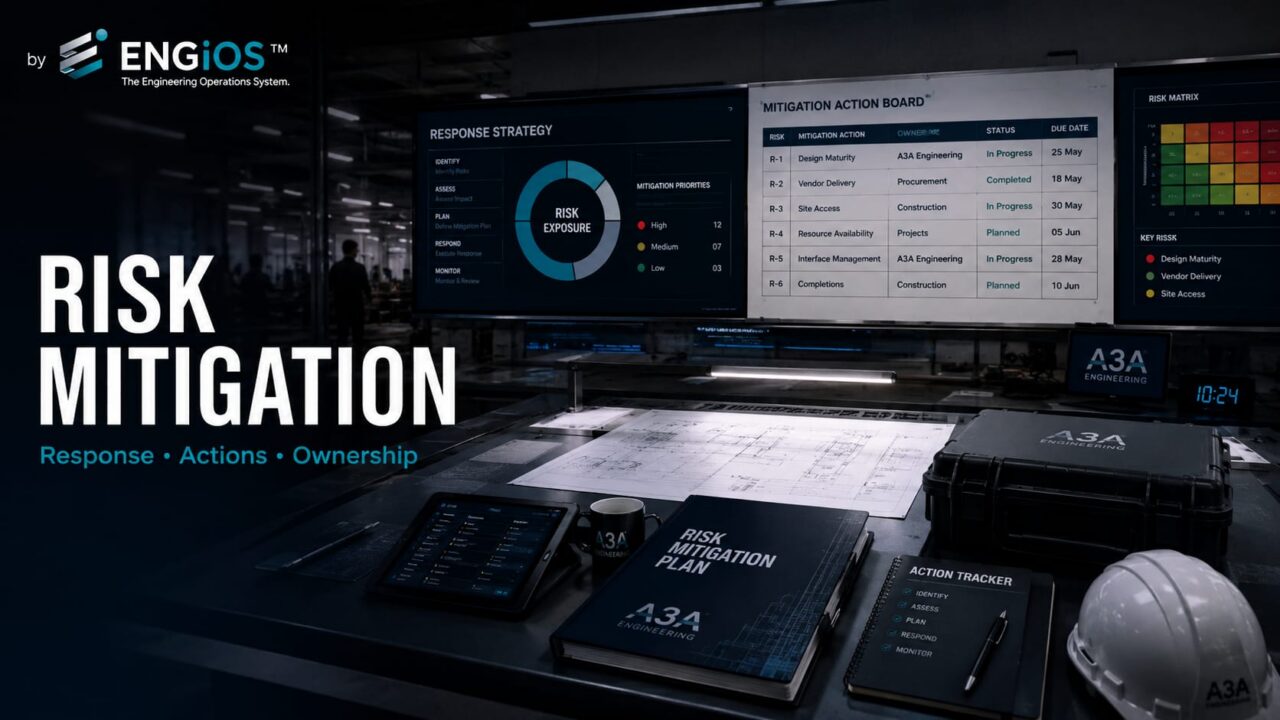
Learn how to structure risk mitigation in Engineering projects, select controls, verify effectiveness, analyze secondary risks, and reassess residual risk.
Check it out!
Risk mitigation in Engineering projects is the set of decisions and controls used to reduce the probability of an event occurring, limit its consequences, or reduce total exposure to a level compatible with the project’s criteria. Mitigation does not mean eliminating all risk; it means deliberately, verifiably, and proportionally modifying exposure relative to the value being protected.
In real projects, mitigation can take very different forms. Reviewing an architecture reduces technical risk. Early procurement reduces schedule risk. Qualifying an alternative supplier reduces single-source dependency. Increasing redundancy reduces the consequence of failure. Improving acceptance criteria reduces the risk of inadequate delivery. An independent design review can reduce the probability of error before manufacturing or construction.
A mitigation response can only be considered effective when there is a clear relationship among cause, control, expected effect, and evidence of result. Creating an administrative action such as “monitor,” “review,” or “train,” without showing how it modifies exposure, is one of the most common weaknesses in risk registers.
Mitigation must also consider secondary risks. A solution that reduces one exposure may increase another: accelerating the schedule may increase rework risk; replacing a supplier may require new qualification; adding redundancy may increase integration complexity. For this reason, treating risks is a technical decision exercise, not merely task execution.
Mitigation within the risk management process
Mitigation occurs after the risk has been identified, analyzed, and evaluated. The organization compares the exposure with its criteria and decides whether it needs to modify probability, consequence, or both.
Risk analysis in Engineering projects helps establish which part of the exposure must be addressed. The risk matrix organizes prioritization, but selecting the treatment requires understanding mechanism, cause, and consequence.
Mitigate, avoid, transfer, and accept are not the same
Mitigation is one form of treatment, but not the only one. Depending on the context, the organization may avoid the activity generating the exposure, share or transfer part of the consequence, accept it knowingly, or exploit associated opportunities.
| Strategy | Logic | Engineering example |
| Avoid | eliminate the condition generating exposure | abandon an unviable technical alternative |
| Mitigate | reduce probability or consequence | review design, test, add redundancy, procure early |
| Share/transfer | distribute part of the exposure | insurance, contract, consortium, warranty |
| Accept | knowingly retain | maintain a low risk under monitoring |
| Exploit opportunity | increase the probability of a positive effect | accelerate a solution with technical or economic gain |
Transfer does not mean elimination. A contract may shift financial responsibility and still leave the client exposed to operational delay, production loss, or reputational damage.
Mitigation must address the right cause
The first question is not “what action can we open?” but “which factor actually determines the exposure?”
Consider the risk of delay in critical equipment. Possible causes include incomplete design, late approval, single-source supply, long lead time, importation, manufacturing capacity, and logistics. Each cause requires a different treatment.
If the problem lies in design approval, hiring expedited transportation does not reduce the probability of delay at the source. If the risk results from a single-source supplier, monitoring weekly meetings may increase visibility without modifying the structural exposure.
The action must have a plausible causal mechanism.
Monitoring is not the same as mitigating. A response only modifies risk when it acts on a cause, reduces probability, limits consequence, or creates a verifiable barrier. Every action should state the mechanism through which it intends to reduce exposure.
Preventive control vs. mitigating control
It is useful to separate controls that act before the event from those that reduce consequences after it occurs.
- Preventive: reduces probability of occurrence.
- Mitigating: limits severity or propagation.
- Detective: identifies deterioration or an event in time to act.
- Corrective/recovery: helps restore the condition after occurrence.
The same system can combine functions. Temperature monitoring detects degradation; redundancy limits failure impact; preventive maintenance reduces probability; a recovery procedure restores operation.
This decomposition improves control selection and helps identify gaps.
How to choose a mitigation strategy
The choice should consider:
- current criticality;
- affected objective;
- dominant cause;
- time available before materialization;
- treatment cost;
- expected effectiveness;
- required resources;
- secondary effects;
- residual risk;
- monitoring capability.
A technically excellent measure may be useless if it cannot be implemented before the critical window. Likewise, a low-cost action that reduces exposure only marginally may be insufficient for intolerable risks.
Mitigating scope risks
Scope risks arise when requirements, boundaries, assumptions, and deliverables are not sufficiently defined.
Strategies include:
- consolidate requirements before contracting;
- make exclusions and interfaces explicit;
- define acceptance criteria;
- review input documentation;
- establish a responsibility matrix;
- create a formal change mechanism;
- validate critical quantities and assumptions;
- perform an independent scope review.
The Requirements, Evidence, and Acceptance Criteria Management solution applies directly when exposure originates from vague or untraceable requirements.
Mitigating technical risks
Technical risks may involve an inadequate solution, incompatibility, insufficient sizing, immature technology, lack of redundancy, or incomplete integration.
Mitigation measures may include:
- architecture review;
- design review;
- independent verification;
- prototype or proof of concept;
- simulation;
- FAT and SAT;
- early integration;
- mockup;
- standards review;
- design margin;
- redundancy;
- performance specification.
The action must be compatible with the risk mechanism. A prototype is useful for technological uncertainty; it does not resolve poorly defined contractual responsibility.
Mitigating schedule risks
Schedule risk is not treated simply by compressing the schedule. Effective mitigation seeks the causes of delay and removes constraints before they reach the critical path.
Examples:
- advance Engineering for long-lead items;
- freeze critical requirements;
- prioritize approvals;
- reserve manufacturing capacity;
- qualify alternative suppliers;
- split deliveries;
- prefabricate;
- prepare work fronts before equipment arrival;
- create intermediate milestones;
- protect operational windows;
- keep contingencies explicitly separate from the baseline.
Monitoring trend and float consumption helps verify whether mitigation is working.
Mitigating cost risks
Cost risks may result from uncertain scope, weak quantities, market variation, rework, logistics, claims, exchange rates, or low productivity.
Mitigation may involve better scope definition, value engineering, contracting strategy, technical leveling, financial contingency, quantity review, supply alternatives, and change governance.
It is important to distinguish reducing cost risk from simply reducing the budget. Cutting a review activity may reduce immediate cost while increasing exposure to rework or future failure.
Mitigation in procurement and suppliers
Procurement requires specific treatment because many exposures are outside the direct control of the project team.
Measures include:
- technical supplier assessment;
- qualification of alternatives;
- dual sourcing;
- early procurement;
- inspection during manufacturing;
- FAT;
- documentation clauses;
- manufacturing milestones;
- monitoring critical sub-suppliers;
- strategic inventory;
- alternative logistics;
- obsolescence plan;
- defined support and warranty.
Contracts, Scope, and Deliverables Management helps connect these controls with contractual obligations and evidence.
Mitigating interface risks
Interfaces are recurring sources of risk because they cross disciplines, systems, suppliers, and responsibilities.
Typical mitigations include:
- ICDs and interface documents;
- responsibility matrix;
- specific coordination meetings;
- freeze points;
- BIM modeling;
- multidisciplinary review;
- change control;
- signal and protocol validation;
- integrated testing;
- clear owner for each boundary.
The article on Interface Management in Engineering Projects explores this governance in greater depth.
Mitigating quality risks
Quality reduces risk when controls detect and prevent deviations before final acceptance.
Actions may include PIT/ITP, hold points, witness points, receiving inspection, traceability, acceptance criteria, audits, functional tests, document control, and verification of corrective-action effectiveness.
Quality risk should be related to the requirement. Without a requirement and objective criterion, inspection may only record an opinion.
Mitigating safety and integrity risks
Safety, integrity, and reliability risks may require specialized techniques. A corporate matrix may prioritize them, but it does not replace HAZOP, FMEA/FMECA, Bow Tie, FTA, LOPA, or specific methods when applicable.
In these contexts, mitigation often involves independent barriers, interlocks, detection, redundancy, inspection, maintenance, and fail-safe criteria.
The principle is to avoid a single failure or error simultaneously degrading all protection layers.
Hierarchy of controls and Engineering
When risk involves occupational safety, process safety, or operations, the hierarchy-of-controls logic is useful: eliminating the source tends to be more robust than relying exclusively on procedures or behavior.
In Engineering, this may mean preferring:
- elimination of the hazardous condition;
- substitution with a lower-risk alternative;
- engineering controls;
- administrative controls;
- personal protective equipment, when applicable.
The hierarchy does not replace specific normative requirements, but it helps assess treatment robustness.
Redundancy as mitigation
Redundancy reduces the consequence of failure when there is sufficient independence among paths or equipment. Duplicating components without analyzing common causes can create a false sense of resilience.
Redundant paths may share power, software, environment, communications, or maintenance. If both paths depend on the same vulnerable point, residual exposure may remain high.
The analysis should consider common-cause failures, capacity of the redundant mode, transfer, testing, and maintenance.
Testing as mitigation
Testing reduces uncertainty and detects failures before delivery or operation. FAT, SAT, integrated testing, commissioning, and performance testing can act as detective controls and prevent future consequences.
A test only reduces risk when it has an objective criterion, a known initial condition, evidence, and treatment of identified failures.
“Testing” without recording the result or repeating the test after correction does not produce a reliable control.
Independent review as mitigation
Independent reviews are especially useful for high-criticality decisions, when the same team that developed the solution may carry unnoticed assumptions or biases.
The review may verify requirements, architecture, calculations, interfaces, standards, constructability, risks, and acceptance criteria.
Independence does not mean opposition to the team. It means increasing the chance of identifying weaknesses before committing manufacturing, construction, or operations.
How to assess mitigation effectiveness
Effectiveness must be verified after implementation. Useful questions include:
- did probability actually decrease;
- was the consequence limited;
- is the control operational;
- is there evidence that it works;
- did the treatment create a new risk;
- is residual risk within the criterion;
- does the control remain valid after changes;
- is there an owner responsible for maintaining effectiveness.
Without this stage, the register may show “action completed” while exposure remains virtually unchanged.
Residual risk
Residual risk is the exposure that remains after considering implemented controls and treatments.
Reassessment must use the same criteria logic as the initial analysis. This allows before-and-after comparison and demonstrates whether mitigation produced a coherent reduction.
If the residual remains above the acceptable limit, the organization should consider additional treatment, a strategy change, contingency, or decision escalation.
The residual does not need to be zero. The decision is whether it is compatible with the project’s objectives and tolerances.
Action completed does not mean risk treated. Technical closure requires implementation evidence, effectiveness verification, and a new reading of residual exposure. If the risk remains above the criterion, the decision must return to governance.
Secondary risk created by treatment
Every change can introduce new exposures. Examples:
- an alternative supplier reduces delay and increases qualification risk;
- a temporary solution reduces unavailability and increases operational risk;
- parallelization recovers schedule and increases interfaces;
- redundancy reduces failure impact and increases complexity;
- additional inventory reduces logistics risk and increases cost and obsolescence.
For this reason, significant treatments should undergo their own risk analysis.
Cost-benefit of mitigation
The decision should not seek to reduce risk at any cost. The organization must compare cost, effectiveness, and value protected.
A low-cost, high-effectiveness measure tends to be a priority. A very expensive measure that only marginally reduces a low risk may not be justified. For intolerable risks, however, safety or compliance criteria may prevail over a simplified economic assessment.
The reasoning should be documented, especially when the organization decides to accept residual exposure because of schedule, technology, or budget constraints.
Owners, deadlines, and evidence
A mitigation action needs:
- responsible executor;
- risk owner;
- deadline;
- resource;
- completion criterion;
- implementation evidence;
- effectiveness criterion;
- reassessment date.
“Review design” is insufficient. Better: “Electrical Engineering will review the single-line diagram and protection coordination by D+10; evidence: approved revision; effectiveness: elimination of the identified incompatibility and reassessment of the risk to moderate level or lower.”
Mitigation and contingency plan
Mitigation and contingency are complementary. Mitigation attempts to reduce exposure before the event. The Engineering contingency plan prepares the response if the scenario still occurs or a trigger is reached.
High-consequence risks often need both layers. An alternative supplier may reduce the probability of delay; a logistics contingency defines what to do if both paths fail.
How to use Bow Tie to visualize mitigation
Bow Tie is useful because it separates threats leading to the critical event from consequences that appear after it.
Barriers on the left seek to prevent the event. Barriers on the right seek to mitigate consequences. This visualization helps identify excessive concentration on a single type of control.
A project with many administrative controls and no technical barriers may require a strategy review.
How to use FMEA/FMECA to prioritize treatments
FMEA and FMECA help decompose failure modes, effects, causes, and criticality. They are useful when the risk is linked to components, functions, or assets.
The article on FMEA and FMECA in Maintenance Engineering presents a detailed application of this reasoning.
How to monitor whether mitigation remains valid
Controls degrade. People change, equipment ages, contracts expire, processes are modified, and assumptions disappear.
Indicators may monitor:
- overdue actions;
- controls without recent evidence;
- increased residual exposure;
- barrier failure;
- event recurrence;
- associated nonconformities;
- risk concentration in a supplier;
- schedule-float consumption;
- cost trend;
- availability of contingency resources.
Governance must review the risk when the control stops delivering the expected effectiveness.
Mitigation must remain alive throughout the project. Changes in scope, supplier, technology, schedule, or operating condition can invalidate controls previously considered sufficient; therefore risk and treatment must evolve together.
Integrate mitigation into project and portfolio governance →
Mitigation and change management
Changes can invalidate treatments. Changing scope, supplier, technology, sequence, or operating condition requires reassessing related risks.
A control designed for one project configuration may not protect the next revision. Risk management and change management therefore need to be integrated.
A relevant change should trigger an explicit question: which risks were created, removed, or changed?
Response quality indicators
In addition to measuring the number of actions, it is useful to assess:
- percentage of high risks with a defined treatment;
- percentage of actions completed on time;
- average exposure reduction after treatment;
- risks that remain critical after action;
- actions without an effectiveness criterion;
- secondary risks not analyzed;
- treatments without an owner;
- time between identification and implementation;
- recurrence after mitigation;
- number of contingencies activated because preventive control failed.
These indicators show whether the organization is modifying risk or merely moving tasks.
Common errors in risk mitigation
The most frequent errors include:
- opening an action without a causal relationship to the risk;
- confusing monitoring with mitigation;
- recording a planned control as implemented;
- not measuring effectiveness;
- not reassessing residual risk;
- ignoring secondary risk;
- focusing only on probability and forgetting consequence;
- transferring contractual responsibility and assuming the risk disappeared;
- applying the same treatment to risks of different natures;
- accepting residual risk above the criterion without a formal decision;
- closing an administrative action without technical evidence.
How to structure a mitigation plan
A simple structure may contain:
| Field | Content |
| Risk | cause, event, and consequence |
| Initial exposure | probability, impact, and class |
| Existing control | measure already operational |
| Gap | reason why exposure is still inadequate |
| Treatment | proposed action |
| Expected mechanism | how the action reduces probability or consequence |
| Responsible party | executor |
| Risk owner | accountable for the exposure |
| Deadline | completion date |
| Evidence | document, test, inspection, or record |
| Effectiveness | verification criterion |
| Residual | new assessment after implementation |
| Secondary risks | new exposures created |
This format supports governance and auditability.
How to integrate mitigation with executive management
High risks need to appear in decision forums, not remain only in technical spreadsheets. Project, Program, and Portfolio Governance can structure decision authority, indicators, escalation, and residual-risk monitoring.
When the response requires comparison of alternatives, independent assessment, or multidisciplinary coordination, Engineering Technical Consulting can support the definition of technically defensible treatments.
Checklist for validating a mitigation
Before closing an action, verify:
- the relevant cause was identified;
- the treatment acts on probability, consequence, or both;
- the action was actually implemented;
- implementation evidence exists;
- effectiveness was verified;
- residual risk was reassessed;
- the residual meets the criterion or was formally escalated;
- secondary risks were analyzed;
- the control has an owner and maintenance mechanism;
- future changes will trigger reassessment.
If the answer is negative for the central points, the risk should not be considered adequately treated.
Final considerations
Risk mitigation is a process of modifying exposure, not a task list. Treatment quality depends on the connection among cause, control, expected effect, evidence, and residual risk.
In Engineering projects, effective responses may involve design, procurement, contracts, quality, testing, interfaces, redundancy, governance, and contingency. The best treatment is the one that verifiably reduces exposure without creating disproportionate secondary risks.
Mature management does not close the risk when the action is marked complete. It verifies effectiveness, reassesses the residual, and keeps the control under monitoring while the exposure remains relevant.
Technical references
[1] INTERNATIONAL ORGANIZATION FOR STANDARDIZATION. ISO 31000:2018 — Risk management — Guidelines. Geneva: ISO, 2018. Available at: https://www.iso.org/standard/65694.html
[2] INTERNATIONAL ELECTROTECHNICAL COMMISSION. IEC 31010:2019 — Risk management — Risk assessment techniques. Geneva: IEC, 2019. Available at: https://webstore.iec.ch/en/publication/59809
[3] PROJECT MANAGEMENT INSTITUTE. Risk Management in Portfolios, Programs, and Projects: A Practice Guide. Newtown Square: PMI, 2024. Available at: https://www.pmi.org/standards/risk-management-in-portfolios
Frequently asked questions
It is the set of measures used to reduce probability, consequence, or total risk exposure to a level compatible with project criteria.
No. Mitigation modifies exposure. Residual risk normally remains and must be reassessed, accepted, treated again, or monitored.
Mitigation acts before the event to reduce exposure. Contingency is prepared to be activated if the scenario still occurs or a trigger is reached.
It is the exposure that remains after implemented controls and treatments are considered. It must be compared with the project’s acceptance criteria.
By verifying implementation evidence and effectiveness criteria and reassessing probability, consequence, and residual risk after treatment.
No. Contracts, insurance, or warranties may share financial consequences or responsibilities, but the project can remain exposed to delay, operational loss, or other effects.
They are new exposures created by the treatment itself, such as greater complexity after adding redundancy or qualification risk after changing suppliers.
The action may have a specific executor, but the risk owner remains responsible for monitoring exposure and ensuring that treatment and reassessment take place.
Complementary technical materials
Related solutions
- Project, Program, and Portfolio Governance
- Contracts, Scope, and Deliverables Management
- Requirements, Evidence, and Acceptance Criteria Management
Related services
Main content on the topic
- Risk Matrix in Engineering Projects
- Risk Analysis in Engineering Projects
- Contingency Plan in Engineering
- FMEA and FMECA in Maintenance Engineering
