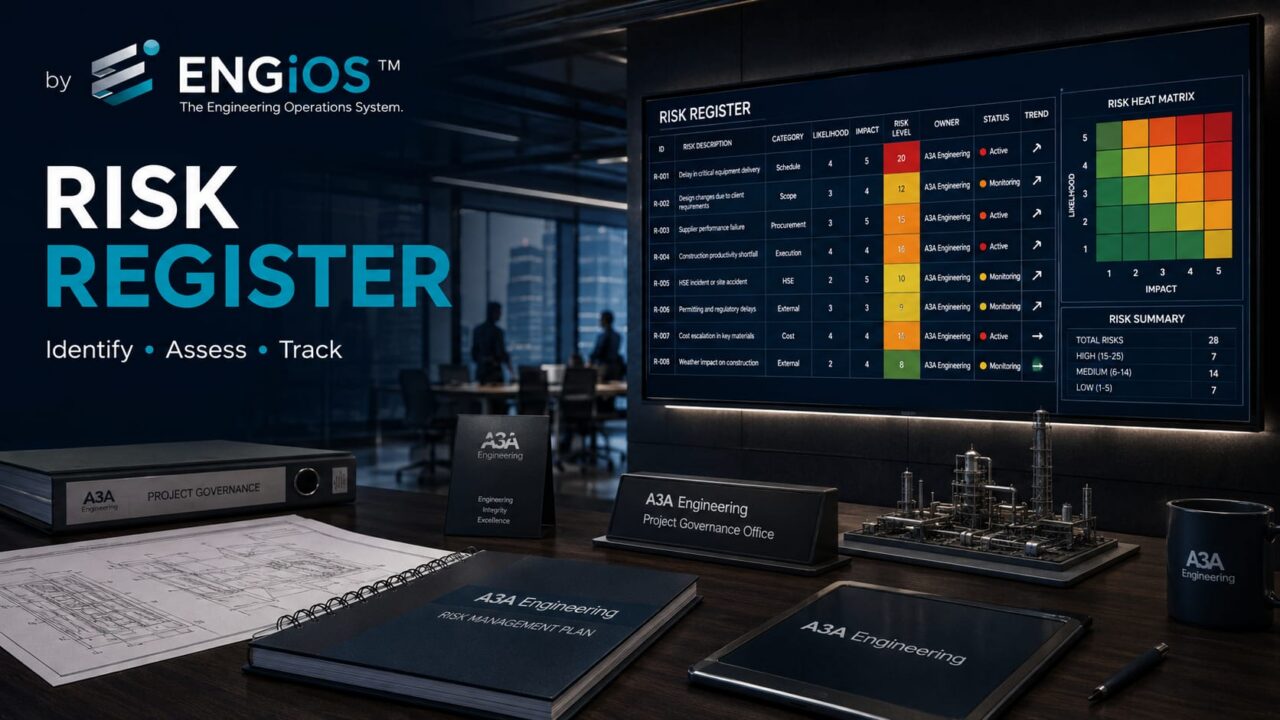
Learn how to structure a risk register in Engineering projects, define fields, owners, triggers, treatments, history, and residual risk.
Check it out!
A risk register is the structured repository that maintains the history of each risk throughout the project: description, cause, event, consequence, classification, existing controls, owner, response strategy, actions, deadlines, triggers, status, and residual exposure. In Engineering, it turns risk management into a traceable and auditable process rather than a one-off discussion held only in workshops or planning meetings.
The register is not intended to replace the risk matrix. The matrix compares criticality; the risk register preserves context, decisions, and evolution. A project can have an excellent visual matrix and still manage risks poorly if there is no living register with owners, evidence, and review history.
The register must also follow the actual project lifecycle. Risks change as requirements are defined, designs are approved, suppliers are contracted, equipment enters manufacturing, construction progresses, testing begins, and operating conditions change. A frozen risk register is only an outdated snapshot of exposure.
What is a risk register and why is it different from the matrix?
A risk register is a structured information base for uncertainties that may affect project objectives. It may exist in a spreadsheet, management system, PMO environment, or integrated platform, but its value does not depend on the tool. It depends on field quality, update discipline, and the ability to connect each risk to decisions, actions, and evidence.
The risk matrix mainly answers the question: which risks are more critical? The risk register answers broader questions: what may happen, why, with what consequence, who owns it, what response was defined, what has already been done, what exposure remains, and when should the risk be reviewed?
This distinction prevents a recurring mistake: treating the color-coded matrix as though it were the complete management system. In multidisciplinary projects, the matrix is a visualization; the register is the operational memory.
| Element | Function | Main information |
| Risk matrix | prioritize | probability, consequence, and class |
| Risk register | maintain traceability | cause, event, consequence, owner, actions, status, and history |
| Response plan | execute treatment | action, responsible party, deadline, resource, and evidence |
| Issue log | control problems that have already occurred | problem, impact, decision, and resolution |
The risk register is the operational memory of risk management. The matrix shows priority; the risk register must preserve cause, decision, owner, actions, evidence, and review history so that exposure is actually governed.
Risk is not an issue, open item, or nonconformity
A risk register loses quality when it receives every matter that concerns the team. Different states must be distinguished.
Risk is an uncertainty that may affect objectives. A problem or issue is something that has already occurred. An open item is an action or decision not yet completed. A nonconformity is failure to meet a requirement. A technical finding is an evidence-based observation. These elements may be related, but they should not be treated as equivalent.
Consider critical equipment with a 24-week manufacturing lead time. Before the contractual date expires, there may be a delay risk caused by late drawing approval. If the approval date has already been missed, the matter is no longer only a risk and has become an active issue. The risk register may still retain secondary risks resulting from the delay, such as loss of the installation window, compressed commissioning, or additional costs.
This differentiation improves governance because each type of information follows an appropriate workflow. Mixing everything into a single list tends to create dozens of items without clear priority criteria.
How to write a risk in a technically useful way
Generic descriptions such as “delay risk,” “supplier risk,” or “incompatibility risk” are insufficient. They do not allow the causal mechanism to be analyzed or an appropriate response to be defined.
A useful structure separates cause → event → consequence.
Example:
> Due to the possibility of late approval of the detailed design by the client, release for manufacturing may occur after the baseline date, shifting supply beyond the implementation window and compromising the contractual energization milestone.
This wording makes it possible to seek evidence: approval lead time, document maturity, manufacturer lead time, schedule float, dependencies, and operating window.
A good description also avoids recording the consequence itself as though it were the risk. “Project delay” is an outcome. The register should clarify the uncertain event that could cause that delay and the conditions that make it plausible.
Essential fields in a risk register
There is no single universal structure. The register should be proportional to the size, complexity, and maturity of the project. Even so, some fields are recurring because they support decision-making.
Identification and context
- unique identifier;
- short risk title;
- category or discipline;
- project phase;
- identification date;
- information source;
- potentially affected objective.
Technical formulation
- originating cause or condition;
- risk event;
- expected consequence or effect;
- relevant assumptions;
- related dependencies and interfaces.
Assessment
- probability or likelihood;
- consequence by dimension;
- criticality;
- assessment rationale;
- existing controls;
- current exposure.
Governance
- risk owner;
- action owner, when different;
- decision authority level;
- response strategy;
- treatment actions;
- required resources;
- target date;
- escalation triggers.
Monitoring
- status;
- trend;
- last review;
- next review;
- implementation evidence;
- residual risk;
- acceptance, closure, or reopening decision.
A register may contain additional fields for response cost, contingency reserve, or links to the schedule, contract, supplier, asset, requirement, or technical document.
What is a risk owner and why should it not be confused with an action owner?
The risk owner is responsible for monitoring the exposure, driving decisions, and ensuring that the defined response progresses. The risk owner does not need to perform every action.
For a supply-delay risk, the project manager may be the risk owner. The action to issue the specification early may belong to Engineering; negotiation with the manufacturer may belong to Procurement; approval may depend on the client. Each action has a responsible party, but someone must remain accountable for the risk as a whole.
Without this distinction, a risk commonly becomes “ownerless” as soon as a task is delegated. The team assumes the matter has been addressed because an action is open, even when exposure remains high.
The register should allow governance to answer quickly: who has the authority and responsibility to drive this risk to an acceptable condition?
How to record probability, consequence, and criticality
The risk register does not need to duplicate every detail of the matrix methodology, but it should record the current classification and the evidence supporting it.
A useful assessment does not contain only “probability 4, impact 5.” It includes a short rationale: supplier history, current drawing delay, number of interfaces, schedule trend, requirements maturity, or any other relevant evidence.
This practice allows the score to be reviewed without depending on the memory of those who attended the previous workshop.
It is also advisable to record consequence dimensions separately when relevant. A risk may have moderate cost impact and critical safety or operational impact. Reducing everything to a single number can hide the true nature of the decision.
Inherent, current, and residual risk
Many registers become confusing because they use a single classification throughout the lifecycle. A more mature structure distinguishes exposure states.
Inherent risk represents a reference exposure before certain controls or treatments. Current risk represents the condition observed at the time of review, considering controls that actually exist. Residual risk represents the expected or observed exposure after additional treatment has been implemented.
This distinction prevents a planned action from being treated as if it had already reduced the risk. A plan that has not yet been implemented should not receive the same credit as a tested and effective control.
The register may maintain two residual views: expected residual, used to justify the strategy, and verified residual, updated after implementation and evidence of effectiveness.
A planned action does not reduce risk until it is implemented and verified. The register must distinguish current exposure, expected residual exposure, and actually observed residual exposure to avoid a false sense of control.
Status: identified, active, under treatment, accepted, or closed
Poorly defined statuses reduce the usefulness of the register. “Closed” may mean that the risk no longer exists, was accepted, that the action ended, or simply that someone stopped monitoring the matter.
A clearer taxonomy may include:
- identified: risk recorded and not yet fully assessed;
- active: current exposure under monitoring;
- under treatment: approved response with actions in progress;
- monitored: no immediate additional action, but subject to a trigger;
- accepted: residual exposure accepted by the competent authority;
- materialized: the event occurred and the matter moved to issue management;
- closed: the risk is no longer applicable or has been eliminated;
- reopened: the condition became relevant again after a context change.
The number of statuses should remain manageable. The purpose is to make the state understandable, not to create bureaucracy.
Risk trend: rising, stable, or falling
Current criticality does not tell the whole story. Two risks may both be classified as “high,” while one is being reduced and the other is deteriorating rapidly.
For this reason, many registers include a trend field. An upward, stable, or downward indicator may be sufficient as long as the criterion is defined.
The trend should reflect evidence: float consumption, accumulated delay, manufacturing progress, improved technical definition, document approval, completion of tests, or deterioration of an assumption.
This information helps project leadership identify risks that require attention before they formally move to a different matrix band.
Triggers and early-warning signs
A risk may remain under monitoring until a specific condition is reached. The trigger defines when the team must act or escalate.
Examples:
- drawing not approved by a specified date;
- supplier without confirmation of raw material by the defined milestone;
- consumption of more than 70% of available float;
- rework rate above a threshold;
- occurrence of a specific failure during FAT;
- confirmed unavailability of the operating window;
- relevant regulatory or normative change.
Well-defined triggers avoid relying on subjective interpretations of “when the risk became serious.”
How to link the risk register to the schedule
Schedule risks should be connected to the milestones and activities they may affect. Without this link, the register remains separate from actual planning.
A manufacturing risk, for example, may affect delivery, installation, energization, testing, and acceptance. The schedule should make it possible to identify the impact chain, available float, and recovery activities.
In more complex projects, some risks may receive identifiers that also appear in the schedule or quantitative analysis model. This facilitates simulations, reviews, and audits.
Integration does not require inserting the entire schedule logic into the register. It is enough to preserve traceability between the risk and the affected time objective.
How to link the register to budget and contingency
Risks with financial impact must inform decisions on reserves and economic exposure. The register may include impact bands, response cost, estimated potential loss, or linkage to the contingency reserve.
It is important not to confuse treatment cost with risk impact. Spending to reduce an exposure may be economically rational when the response cost is lower than the avoided loss or when the consequence is unacceptable under other criteria.
In quantitative analyses, the register may also feed impact distributions and probabilities used in simulations.
How to integrate risks with contracts and suppliers
In Engineering, many risks originate at contractual interfaces. Poorly defined scope, client dependencies, ambiguous acceptance criteria, approval deadlines, single-source supply, lead time, importation, qualification, and warranty are examples.
The register should make it possible to identify the party responsible for the condition, but it should not be used as a mechanism to artificially transfer responsibility. Good management distinguishes contractual risk allocation from managerial responsibility for monitoring.
Even when the contract assigns an obligation to the supplier, the client or Owner’s Engineering may need to monitor the exposure because the final impact still affects the project.
Interface risks in multidisciplinary projects
Interface risks deserve specific treatment because they cross disciplines, companies, and contracting packages.
An incompatibility among architecture, electrical, and telecommunications may not clearly belong to a single team. The risk owner must act on the boundary, coordinating decisions, deliverables, and responsibilities.
Fields such as “affected interface,” “originating discipline,” “dependent discipline,” and “interface document” can add value in complex projects.
Linking the register with interface management reduces the risk that each team assumes the exposure belongs to another party.
Risk Breakdown Structure and categories
Categories help verify coverage and identify concentrations of exposure. A Risk Breakdown Structure (RBS) organizes risk sources into coherent groups.
In Engineering projects, a structure may include:
- requirements and scope;
- design and coordination;
- technology;
- procurement and suppliers;
- contracts;
- construction and field work;
- safety and environment;
- quality;
- commissioning and acceptance;
- operations and maintenance;
- stakeholders and approvals;
- schedule and cost;
- regulatory and permitting.
Categorization should not limit identification. If the team only searches for risks within existing categories, it may fail to recognize emerging or systemic risks.
How to record opportunities
Risk does not need to be treated only as a threat. Uncertainty may also produce positive effects.
An opportunity may involve early procurement, technical standardization, an alternative solution that reduces CAPEX, availability of an additional operating window, supplier consolidation, or use of technology with better performance.
The register may include threats and opportunities, provided the assessment criteria are clear. In some organizations, separate fields improve readability because “high impact” can have opposite meanings for threats and opportunities.
Change history and traceability
A risk register is part of the project’s decision memory. Changing probability from 4 to 2 without recording why the change occurred destroys part of the tool’s value.
The audit trail should make it possible to answer:
- what the previous classification was;
- when it changed;
- who approved it;
- what evidence justified the change;
- which treatment was completed;
- what residual exposure was accepted.
In digital systems, this history may be automatic. In spreadsheets, it may require a history tab or revision fields.
Review cadence: weekly, monthly, or trigger-based?
There is no universal frequency. The cadence should reflect the rate of project change.
A project in the conceptual phase may review risks at decision gates. During manufacturing and implementation, weekly reviews may be necessary. In stable operations, the frequency may be lower.
In addition to cadence, events should trigger extraordinary review: scope change, supplier replacement, baseline revision, test failure, approval delay, regulatory change, or a new field condition.
The combination of cadence + trigger is more robust than relying only on scheduled meetings.
How to conduct a risk review meeting
An effective meeting should not reread the entire register line by line. The focus should be on changes in exposure and decisions required.
A useful sequence is:
- review critical and high risks;
- identify risks whose trend has worsened;
- check overdue actions;
- reassess risks affected by recent changes;
- review newly identified risks;
- decide escalations and acceptances;
- verify risks that can be closed;
- update the next triggers and review dates.
The meeting should produce decisions, not merely administrative updates.
Risk register indicators
Counting how many risks exist provides little insight. More useful indicators look at portfolio quality and dynamics.
Examples:
- critical and high risks by phase;
- risks without an owner;
- overdue actions;
- risks not updated for more than a defined period;
- residual exposure above the acceptance criterion;
- number of materialized risks;
- concentration by category;
- trend of total exposure;
- average time to reduce criticality;
- percentage of treatments with verified effectiveness.
These indicators should support decisions and not encourage artificial behavior, such as closing risks merely to improve a KPI.
Errors that turn the risk register into a “risk graveyard”
Some patterns indicate that the register has lost its management function:
- dozens of risks without a defined owner;
- generic descriptions;
- outdated review dates;
- actions without deadlines;
- classifications without rationale;
- residual risk never updated;
- matters that have already materialized remaining classified as risks;
- items closed without evidence;
- register used only before audits;
- no link to schedule, contract, or project decisions.
The problem is not the spreadsheet or software. It is the disconnect between the register and actual governance.
When the risk register becomes merely a spreadsheet filled out for meetings, risk management has already disconnected from the project. The register must feed decisions, the schedule, contracts, responses, and escalations—not just produce status.
Spreadsheet or system: what really changes?
Spreadsheets can work well on smaller projects, provided there is version control, update discipline, and clear accountability. Systems add value when volume, number of users, or integration needs make spreadsheets fragile.
A digital environment can provide automatic history, alerts, permissions, dashboards, and links to documents, schedules, contracts, requirements, actions, and evidence.
Even so, automating a poor process only accelerates the production of low-quality information. The correct sequence is to define the method, fields, responsibilities, and governance first; then choose the tool.
Risk register in Owner’s Engineering and PMO
In Owner’s Engineering, the register can function as a governance instrument among the client, designers, suppliers, contractors, and operations.
The Owner’s Engineer does not need to assume ownership of every risk. The role may include consolidating exposures, challenging assessments, checking consistency, monitoring responses, facilitating escalation, and ensuring that critical risks are visible to the competent authority.
At the PMO level, the register can be consolidated across a program or portfolio to identify common risks, dependencies among projects, and systemic exposures.
Criteria for a technically defensible risk register
A robust risk register should allow another qualified professional to understand the decision logic without relying on the team’s memory.
Check whether:
- each risk has a clear causal description;
- the assessment has a rationale;
- existing controls are recorded;
- risk owner and action owners are distinguishable;
- actions have a deadline and evidence;
- triggers are defined when applicable;
- residual risk is reassessed;
- classification changes have history;
- acceptance decisions record the authority level;
- the register is reviewed when context changes.
Final considerations
The risk register is a central element of project governance because it turns uncertainty into traceable information. Its value is not in the number of columns or the sophistication of the software, but in its ability to connect cause, exposure, accountability, response, evidence, and decision.
In Engineering, a living risk register must follow requirements, interfaces, suppliers, schedule, cost, contracts, quality, safety, commissioning, and operations. When these links are preserved, the register stops being an administrative list and becomes the operational memory of risk management.
The final objective is not to keep every risk open indefinitely. It is to allow the team to know which exposures require action, which can be monitored, which were reduced, which materialized, and which were consciously and formally accepted.
Technical references
[1] INTERNATIONAL ORGANIZATION FOR STANDARDIZATION. ISO 31000:2018 — Risk management — Guidelines. Geneva: ISO, 2018. Available at: https://www.iso.org/standard/65694.html
[2] PROJECT MANAGEMENT INSTITUTE. Risk Management in Portfolios, Programs, and Projects: A Practice Guide. Newtown Square: PMI, 2024. Available at: https://www.pmi.org/standards/risk-management-in-portfolios
[3] HM TREASURY. The Orange Book: Management of Risk — Principles and Concepts. London: HM Treasury, 2026 update. Available at: https://www.gov.uk/government/publications/orange-book/the-orange-book-management-of-risk-principles-and-concepts
Frequently asked questions
It is the structured repository that maintains the description, assessment, owners, responses, actions, status, evidence, and history of each risk throughout the project.
The matrix compares criticality among risks. The risk register preserves the complete context of each exposure, including cause, consequence, owner, treatment, deadlines, status, and history.
At a minimum: identifier, risk description, cause, event, consequence, probability, impact, criticality, controls, risk owner, response, actions, deadlines, status, last review, and residual risk.
Governance must define responsibilities. The risk owner should ensure that the risk is updated, while the PMO, project manager, or risk function may consolidate and control the quality of the register.
Frequency depends on project dynamics. In addition to a defined cadence, changes in scope, supplier, schedule, requirement, contract, or test results should act as review triggers.
Its history may remain, but the occurred event should move to the issue-management workflow. New risks resulting from the materialization should be assessed separately.
No. Spreadsheets can work for smaller projects. Systems add value when collaboration, history, alerts, integration, and larger information volumes are needed.
It is the exposure that remains after controls and treatments. It must be reassessed based on measures actually implemented, not merely planned actions.
Complementary technical materials
Related solutions
- Project, Program, and Portfolio Governance
- Contracts, Scope, and Deliverables Management
- Requirements, Evidence, and Acceptance Criteria Management
Related services
- Engineering Risk Management
- Engineering Technical Consulting
- Technical Planning for Engineering Procurement and Contracting
Main content on the topic
- Risk Management in Engineering Projects
- Risk Matrix in Engineering Projects
- Risk Analysis in Engineering Projects
- Risk Mitigation in Engineering Projects