
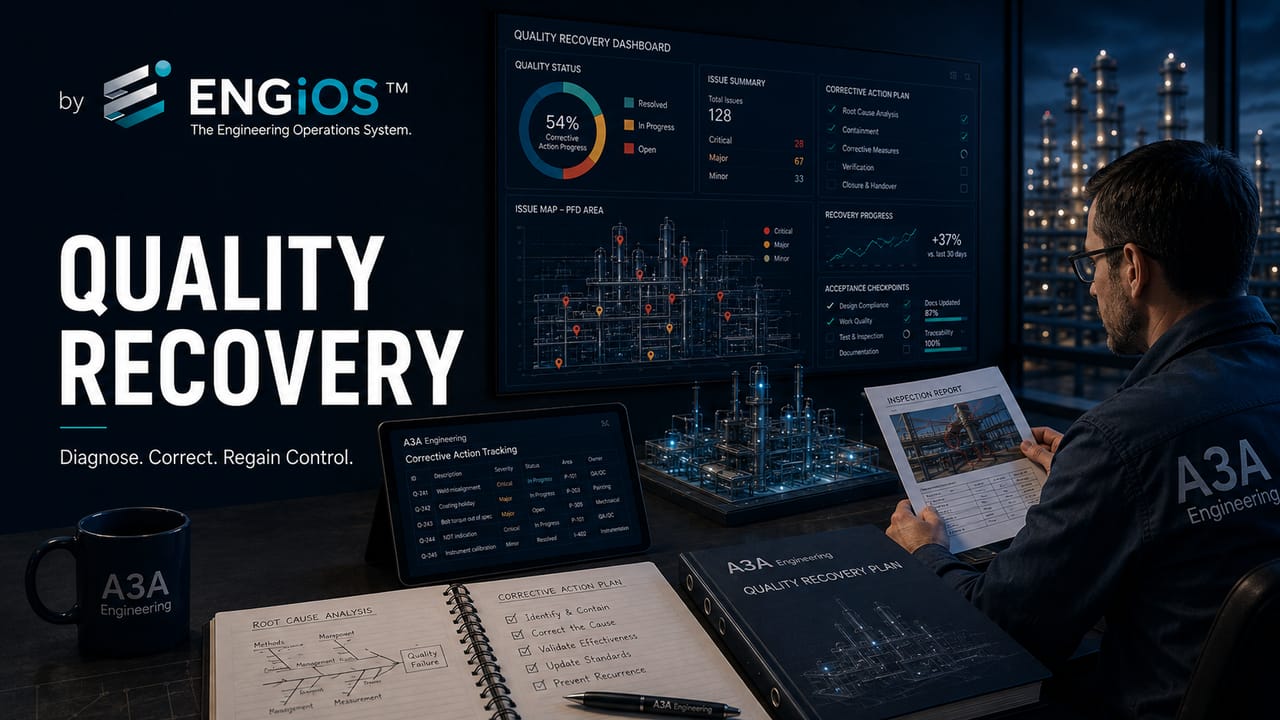
Construction quality failures: learn when to hire Technical Audit, supervision, Owner’s Engineering, inspections, commissioning, and technical acceptance services.
Check it out!
When a construction project presents quality failures, the correct engagement depends on the actual condition of the problem. Not every situation requires the same response: an isolated nonconformity may be handled by the contractor itself; a recurring pattern of defects may require a technical audit; lack of control during execution may call for reinforced supervision; conflicts among design, suppliers, and field conditions may justify Owner’s Engineering; and a project close to handover may require a readiness diagnosis, open-item remediation, commissioning, and technical acceptance.
The most common mistake is to immediately hire a company to “fix the project” without first separating cause, extent, and responsibility. This can generate rework on top of rework, destroy useful evidence, mix correction with independent validation, and make it harder to determine who should bear the cost. In material situations, the first engagement should establish a technical baseline: what complies, what does not comply, what has not yet been demonstrated, which risks exist, and which actions are required.
Quality recovery should follow a rational sequence: diagnose → classify → stabilize → define responsibility and solution → correct → reinspect/retest → update documentation → decide acceptance. The company hired to perform repairs may be part of the solution, but it should not be the sole source of evidence regarding the effectiveness of its own correction when the Owner’s risk is high.
First: identify what type of problem exists
A quality failure can describe very different situations. Before hiring any service, the problem must be characterized technically.
| Observed situation | Main question | Most appropriate initial response |
| isolated defect and clear requirement | how should it be corrected and demonstrated? | NCR, correction, reinspection/retest |
| many similar defects | is there a systemic cause? | audit + cause analysis + action plan |
| construction progresses without evidence | can the executed condition be demonstrated? | supervision/QA-QC + document audit |
| design and field conditions diverge | which configuration is valid? | Design Review/engineering + change control + As-Built |
| suppliers disagree at interfaces | who is responsible for integration? | Owner’s Engineering/interface management |
| materials or equipment are questionable | does the supply meet the specification? | inspection, traceability, testing, vendor quality |
| construction is close to commissioning | is the system truly ready? | readiness review + open-item remediation |
| construction is complete, but doubts remain | what can be accepted? | technical audit + technical acceptance |
| failure already affects operation | what is the risk and immediate action? | technical diagnosis, containment, and recovery plan |
This classification prevents hiring a generic solution for a specific problem. An execution contractor may be suitable to repair, but not necessarily to perform an independent Technical Audit. A designer may clarify a requirement, but cannot replace inspection of the physical condition. Technical supervision verifies ongoing execution; when the problem involves interfaces, multidisciplinary decisions, and project governance, Owner’s Engineering may be the appropriate layer. Reconstructing months of history, evidence, and causes, however, normally requires a dedicated audit.
Technical diagnosis before the correction plan
When the extent of the failures is still uncertain, starting directly with correction can destroy evidence, treat symptoms, and create new costs. An independent baseline separates physical condition, requirement, evidence, and criticality before the decision.
When the problem is material or its extent is uncertain, the first useful deliverable is an independent technical diagnosis. The objective is not to assign blame, but to establish verifiable facts.
The diagnosis should cross-reference contractual and technical requirements, physical condition, documentation/evidence, and the history of changes, RFIs, NCRs, approvals, tests, and open items. From this, each finding can be classified as compliant, noncompliant, unverifiable due to lack of evidence, pending testing, or subject to a formally accepted deviation.
This distinction is decisive. Lack of evidence is not automatically proof of a physical defect; at the same time, apparent operation does not prove compliance with every requirement. The recovery plan must know which problem it is addressing.
When to hire a Technical Engineering Audit
A Technical Audit is especially appropriate when the Owner needs to answer “what is the actual condition?” before deciding how to act. It is useful when there are conflicting reports, a large volume of open items, suspected noncompliance, inconsistent documentation, delays associated with rework, or a need for an independent opinion.
The scope may include field sampling, review of designs and specifications, analysis of NCRs, material traceability, verification of tests, comparison between As-Built documentation and the executed condition, review of final documentation, and evaluation of the effectiveness of the quality system.
A well-structured audit does not end with a defect list. It should identify the affected requirement, evidence, criticality, potential extent, recommendation, need for additional investigation, and consequence for acceptance or operation.
When to hire reinforced technical supervision
If construction continues progressing while the backlog grows, two fronts are required: recover existing deviations and prevent new nonconformities from being produced in still-open work fronts.
If failures continue to arise because construction is still underway, diagnosing the past alone will not solve the future. The work fronts that continue to advance must be controlled.
Reinforced supervision may include review of PIT/ITP, presence at critical points, sampling inspections, material validation, NCR follow-up, photographic records, measurement tied to evidence, and verification of stages before physical closure.
An effective model combines recovery of existing deviations with prevention of new deviations. Without the second track, the project may consume resources correcting ten problems while producing another fifteen.
When to hire Owner’s Engineering
Owner’s Engineering becomes especially useful when the problem extends beyond one discipline or one contractor. Examples include poorly defined interfaces, fragmented technical decisions, divergences between design and field conditions, uncoordinated changes, incompatible supplies, and lack of a single view of the Owner’s interests.
Owner’s Engineering does not replace designers, contractors, or suppliers. It coordinates requirements, decisions, interfaces, risks, quality, and acceptance from the Owner’s perspective. In a construction recovery effort, it can structure governance, the responsibility matrix, technical prioritization, change decisions, evaluation of correction proposals, and integration among specialists.
When to hire specialized inspections and testing
Some questions can only be resolved by measurement or testing. This occurs when the condition is not visible, when performance must be demonstrated, or when the extent of a defect must be determined.
Testing should start from an engineering question. Generically “doing tests” can generate data without decision-making value. The hypothesis, method, sampling, instruments, tolerances, criteria, and interpretation must be defined.
Examples include electrical testing, continuity and insulation testing, thermography when technically applicable, link certification, OTDR/OLTS, leak testing, dimensional measurements, NDT, technological control, functional testing, calibration, and integrated testing.
When to hire design review or Design Review
If defects originate in incompatibilities, deficient specifications, or an inadequate solution, repairing execution without reviewing the design may simply reproduce the problem.
Design Review should analyze requirements, solution, interfaces, constructability, maintainability, accessibility, verifiability, and the impact of changes. A design revision may need to be issued before field corrections are released.
It is also important to distinguish a design error from a change required by field conditions. Engineering Change Management should record the reason, impact analysis, approvals, and baseline update.
NCR: when it is sufficient and when it is not
An NCR is appropriate for controlling an identified deviation. But a large volume of NCRs does not replace a systemic analysis.
If nonconformities are independent and well understood, the NCR workflow may be sufficient: requirement, deviation, containment, disposition, correction, retest, and closeout. When recurrence or patterns across areas or suppliers exist, the question changes from “how do we close this NCR?” to “why does the process keep generating this type of NCR?” In that case, audit, cause analysis, and systemic corrective action are required.
How to prioritize findings
A long list without criticality paralyzes decision-making. Findings should be classified by risk and by their effect on the project: safety, standards compliance, functionality, cascading failure, durability, difficulty of later access, impact on commissioning, operation/maintenance, correction cost, and uncertainty caused by lack of evidence.
Criticality defines the order of action, but it does not turn a minor open item into something disposable. Low-criticality items still need an owner, deadline, and closeout condition.
Containment before permanent correction
In some scenarios, it is not possible to wait for the final solution before acting. Containment prevents worsening, propagation, or exposure to risk. It may involve suspending a work front, segregating material, de-energizing a system, blocking shipment, restricting operation, freezing a configuration, or discontinuing use of a given procedure.
Containment is not correction. It controls risk while the cause and permanent solution are analyzed.
Who should develop the correction solution
The answer depends on the nature of the problem. The design engineer may need to revise the solution; the manufacturer may issue a repair procedure; specialists may validate the method; the contractor executes it; and the Owner or its engineering representative evaluates impact and acceptance according to contractual authority.
The important point is to prevent a material change from being implemented through an informal field decision. The solution should define the affected requirement, intended final condition, method risks, verifications, documents to be revised, approval authority, and acceptance criterion.
Reinspection and retesting are part of the correction
“Work corrected” is not a sufficient status. The correction must be verified by the appropriate method. If a connection was redone, a new inspection or measurement may be required. If a parameter was changed, a functional test should demonstrate the result. If a weld was repaired, applicable tests must be repeated. Retest evidence is what allows an NCR to be technically closed.
How to avoid conflicts of interest in validation
In troubled construction projects, separating execution of the correction from validation of the result becomes more important. The company responsible for the repair naturally knows its solution best, but the Owner may require independent verification for critical items.
This independence can be selective. It is not necessary to hire a third party for every minor correction; it should be concentrated where failure consequence, uncertainty, and history justify it. Independent QA/QC, technical audit, and Owner’s Engineering are different instruments that can fulfill this role according to the problem.
The role of commissioning in recovery
When the project approaches handover, commissioning helps turn physical corrections into functional evidence. However, it should not begin before a readiness review.
The readiness review checks physical condition, NCRs, punch list, documentation, calibrations, interfaces, safety, utilities, and configuration. Only then should progressive testing advance from equipment to subsystems and integrated systems.
A project with many problems may need to replan the commissioning sequence by technically recovered systems rather than follow the original date-driven schedule.
When to hire independent technical acceptance
If the main question is “can we accept this construction project?”, the service must connect physical condition, evidence, open items, and contractual obligations.
Technical Acceptance can review inspections, tests, NCRs, punch list, As-Built documentation, Data Books, Quality Dossier, warranties, manuals, and other deliverables to recommend acceptance, conditional acceptance where appropriate, or non-acceptance.
This stage does not correct the project; it supports a documented decision by the contracting party.
What not to do in a construction project with quality failures
- correct before recording and preserving relevant evidence;
- replace materials without investigating whether other batches have the same problem;
- close an NCR solely based on the executor’s statement;
- treat all findings as having the same criticality;
- accelerate commissioning without readiness;
- accept As-Built documentation that does not correspond to field conditions;
- leave documentation until after final payment;
- change the design based on verbal instruction;
- hire only labor when the root cause lies in engineering or governance.
Recovery must protect the traceability of both the problem and the solution.
How to structure a quality recovery plan
| Workstream | Expected output |
| baseline | findings matrix and current condition |
| risk | criticality and priority |
| containment | immediate risks controlled |
| cause | technical and systemic causes evaluated |
| engineering | approved solutions and changes |
| execution | corrections implemented |
| verification | inspections, tests, and retests |
| closeout | evidence, As-Built, dossier, and acceptance decision |
The plan should be controlled by system rather than only by discipline, especially when the final objective is commissioning and operation.
Indicators for monitoring recovery
Management must show whether the project is converging toward control. Useful indicators include open/closed NCRs, recurrence, average closeout time, reinspection approval rate, blocking punch-list items, percentage of complete evidence, systems ready for commissioning, failed retests, and critical documentation gaps.
A reduction in the total number of NCRs can be misleading if the few remaining items are precisely the most critical. Indicators must be monitored together with criticality.
How to choose between Audit, Supervision, and Owner’s Engineering
| Owner’s need | Primary engagement |
| determine the actual condition of a construction project | Technical Audit |
| prevent new deviations during execution | Technical Support for Supervision / QA-QC |
| coordinate decisions, contracts, and interfaces | Owner’s Engineering |
| demonstrate performance | inspections, testing, and commissioning |
| decide whether the project can be accepted | Technical Acceptance |
In a complex case, the response may be an integrated team combining these workstreams under a single governance structure. The key is to build the scope around the decision the Owner needs to make.
How to contract without creating an overly open-ended scope
“Solve the project’s quality problems” is a dangerous description. The Terms of Reference should define an initial diagnostic phase, systems covered, sampling, available documents, deliverables, criticality criteria, limits of responsibility, authority, interfaces, and a mechanism for approving additional services when findings reveal a greater extent.
A phased approach reduces commercial uncertainty: diagnosis and baseline; recovery plan; support for correction/supervision; verification and commissioning; acceptance/handover. This prevents the Owner from contracting an undefined amount of corrective work before knowing the actual extent.
Documentation must be recovered together with the construction project
Physically correcting the project without updating documents creates a new nonconformity. Drawings, lists, parameters, NCRs, test records, manuals, and As-Built documentation must reflect the final condition.
If recovery changes equipment configuration, logic, route, material, or interface, design and operating documentation must be updated through the appropriate formal workflow. The final Quality Dossier must tell a coherent story: requirement, deviation, decision, correction, verification, and accepted configuration.
When legal or contract management involvement is necessary
Engineering should establish the technical facts; decisions regarding financial responsibility, penalties, warranty, and contractual disputes may require legal and commercial functions. It is important not to mix these roles.
A technical report should be clear about requirement, evidence, and impact, while avoiding legal conclusions outside its professional scope. At the same time, contemporaneous field records, NCRs, communications, and approvals are essential for any later contractual decision.
Final considerations
A construction project with quality failures must first recover its ability to produce reliable facts. Before choosing who will correct the problems, the Owner should understand condition, extent, criticality, and cause. The right engagement may be a properly managed NCR, Technical Audit, reinforced supervision, Owner’s Engineering, specialized testing, Design Review, commissioning, technical acceptance — or an organized combination of these workstreams.
The principle is to maintain sufficient independence among diagnosis, execution, and validation at the highest-risk points. Recovery ends only when the physical correction has been verified, the documentation represents the actual condition, and sufficient evidence exists for a technical acceptance decision.
Quality problems that span multiple contracts and disciplines are rarely solved by a single executor. Owner governance must coordinate requirements, interfaces, changes, corrections, and acceptance criteria.
Technical references
[1] INTERNATIONAL ORGANIZATION FOR STANDARDIZATION. ISO 9001:2015 — Quality management systems — Requirements. Geneva: ISO, 2015. Available at: https://www.iso.org/standard/62085.html
[2] INTERNATIONAL ORGANIZATION FOR STANDARDIZATION. ISO 10005:2018 — Quality management — Guidelines for quality plans. Geneva: ISO, 2018. Available at: https://www.iso.org/standard/70398.html
[3] INTERNATIONAL ORGANIZATION FOR STANDARDIZATION. ISO 19011:2026 — Guidelines for auditing management systems. Geneva: ISO, 2026. Available at: https://www.iso.org/standard/19011
Frequently asked questions
When extent and cause are still uncertain, the most useful first step is usually an independent diagnosis or Technical Audit to establish a baseline of findings, risks, and evidence before defining corrections.
Not necessarily. Its primary role is to verify condition, requirements, evidence, extent, and risks. Execution of corrections may be contracted separately or performed by the responsible contractor.
When construction is still progressing and new deviations continue to be produced. Reinforced supervision acts preventively on active work fronts while the existing backlog is recovered.
When problems involve multiple disciplines, contracts, interfaces, changes, and decisions that need to be coordinated from the Owner’s perspective.
It may perform its own quality control, but for critical items the Owner may require reinspection, testing, or independent validation to increase confidence in acceptance.
It can reveal failures and verify functional corrections, but it does not replace diagnosis, inspections, and execution control. Systems should reach commissioning in a ready condition.
An acceptable physical condition, NCRs and open items treated according to criticality, completed testing, consistent documentation, As-Built records, dossiers, and sufficient evidence to support the acceptance decision.
Additional technical materials
Related solutions
- Open Items, RFIs, and Nonconformities Management
- Requirements, Evidence, and Acceptance Criteria Management
- Process, Workflow, and Technical Approval Management
- Project, Program, and Portfolio Governance
Related services
- Technical Engineering Audit
- Technical Support for Supervision
- Owner’s Engineering
- Equipment Commissioning
- Technical Acceptance of Construction and Engineering Services
- Design Review — Technical Design Review and Validation
Main content on the topic
- Independent QA/QC in Engineering
- Quality Audit
- Nonconformance Report (RNC/NCR)
- Engineering Punch List
- Acceptance Criteria in Engineering
- How to Prevent Nonconformities from Reaching Commissioning
- Construction Data Book
- Quality Dossier in Engineering
