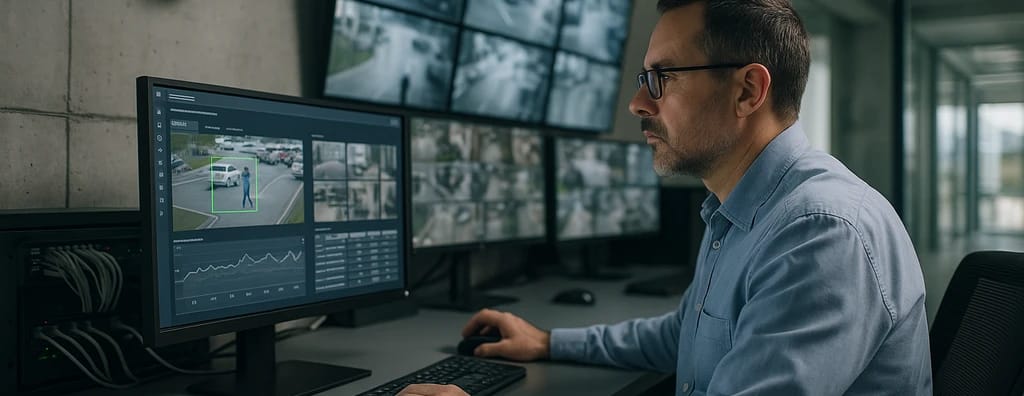
The growing demand for video surveillance systems capable of generating value from large volumes of video has driven the development of analytical solutions based on artificial intelligence. The ability to identify relevant events, automate decisions, and extract structured metadata from complex scenes represents a decisive technological advantage for security, operations, and the management of diverse […]
Check it out!
The growing demand for video surveillance systems capable of generating value from large volumes of video has driven the development of analytical solutions based on artificial intelligence. The ability to identify relevant events, automate decisions, and extract structured metadata from complex scenes represents a decisive technological advantage for security, operations, and the management of diverse environments. Challenges such as detection accuracy, scalability, interoperability, and operational compliance are at the center of this evolution.
This article addresses the theoretical and practical principles of artificial intelligence-based video analytics in Closed-Circuit Television (CFTV), detailing system architecture, implementation requirements, types of analytics, performance criteria, integration with other security solutions, and technical recommendations for maximizing efficiency and effectiveness in engineering projects.
Read on!
[elementor-template id=”24446″]
Fundamentals of Artificial Intelligence-Based Video Analytics
Video analytics systems use advanced algorithms to examine, in real time or retrospectively, the visual content captured by cameras, identifying objects, patterns, and predefined events according to programmed logic. By incorporating artificial intelligence, especially deep-learning techniques, the capacity for detection, classification, and extraction of characteristics from objects and behaviors in dynamic scenes is expanded.
- Metadata Extraction: Automatic generation of structured descriptions of scene content — such as the presence of people, vehicles, physical attributes, movement, and interactions — enabling programmed or event-driven responses.
- Reduction of False Positives: Artificially trained algorithms provide greater accuracy in differentiating events of interest from irrelevant conditions, even in environments with interference and visual noise.
- Operational Scalability: Intelligent solutions enable continuous and efficient monitoring of tens to thousands of cameras without exclusive dependence on human intervention.
Architecture of Analytical Systems in CFTV
The architecture of analytical systems for CFTV can be classified according to where data processing and integration take place:
- Edge Processing: IP cameras with embedded processing capabilities run analytical algorithms locally, optimizing latency and reducing data traffic on the network.
- Centralized Server Processing: Video streams are transmitted to dedicated servers that execute computationally intensive analytical functions and centralize metadata, enabling management and multi-camera correlation.
- Hybrid Solutions: Integrate distributed processing across edge devices, local servers, and cloud environments, balancing flexibility, performance, and specific operational requirements.
Regardless of the architecture, recommended practices include physical network segregation, application of security protocols, and modular scaling of the analytical infrastructure.
Types of Video Analytics and Practical Applications
The following are examples of artificial intelligence-based video analytics applicable to CFTV:
- Object Detection and Classification: Differentiation of people, vehicles (by type), animals, or static objects, with advanced classification (clothing, colors, accessories, helmets, bags, etc.).
- Behavior Recognition: Identification of abnormal movement patterns, presence in restricted areas, falls, and atypical behaviors that may indicate risks or standards violations.
- Environmental Analysis and Counting: Quantification of people or vehicles in specific zones, detection of movement against prohibited flows, and monitoring of occupancy in critical spaces.
- Multisensory Event Association: Integration of visual detection with audio analysis, enabling, for example, classification of alerts based on specific sounds combined with video analysis to contextualize the event.
These applications enhance proactive monitoring, ensure traceability across multiple scenarios, and support operational and strategic decision-making.
Analytical Metadata and Data Intelligence in Electronic Security
The metadata generated by analytics are fundamental components for automation and efficient searches across large volumes of video. They include:
- Object Identification: Metadata structure information such as the type, quantity, and visual attributes of detected objects.
- Time-Stamped Events: Recording of event occurrences with associated date, time, scene location, and operational context.
- Relationship Patterns: Associations among multiple events detected over time, enabling predictive and retrospective analyses.
Proper use of this metadata enables rapid searches, automated report generation, and visualization in tables and charts to support management and technical audits.
Technical Criteria for Implementing Analytics in CFTV Systems
Proper implementation of artificial intelligence-based analytics requires compliance with rigorous technical criteria that directly affect system performance and reliability:
- Optical and Field-of-View Configuration: Testing and adjustment of camera positioning, lighting control, focus, and obstruction limitation are essential to prevent shadowed areas, pixelated images, or unwanted blur.
- Analytical Parameter Adjustment: Detection thresholds, zones of interest, noise sensitivity, and mask filters must be configured according to the actual operating environment.
- Operational Validation and Testing: Simulations under real conditions must be performed to assess performance, false-alarm rates, and response capability for critical events.
- Perform periodic audits to ensure the analytics remain appropriate for the environment.
- Record adjustments and results, promoting operational control and traceability.
These measures ensure the expected performance and adherence to standards and contractual requirements in security projects.
Benefits and Operational Gains from Using AI Video Analytics
The adoption of video analytics in CFTV provides direct and indirect gains for security operations, risk management, and automation:
- Increased Efficiency: Reduced dependence on human operators, allowing security teams to focus their efforts on critical or priority events.
- Improved Response Time: Automatic notifications and immediate alarm generation through synthesized detection, minimizing latency in threat identification.
- Strategic Management: Transformation of raw data into information for predictive analysis, optimizing institutional processes and policies.
- Traceability and Audit: Structured recording of critical events, facilitating audits and standards compliance.
Technical Challenges and Recommendations for CFTV Analytics Projects
The engineering of AI-based analytical systems presents significant technical challenges:
- Maintaining Accuracy: Continuous algorithm adjustment, retraining in changing environments, and updating reference datasets to improve accuracy.
- Interoperability: Compatibility among different manufacturers, integration with VMS (Video Management Software) platforms, and adherence to standards such as ONVIF for IP devices.
- Scalability: Ability to incorporate new streams, sensors, and analytical functions through a modular architecture without performance degradation.
- Information Security: Protection of metadata and video streams through encryption, robust authentication, network segregation, and access auditing.
Prior analysis of the environment profile, precise specification of functional objectives, and careful selection of the technologies best suited to the project profile are recommended.
Conclusion
The integration of artificial intelligence-based video analytics into CFTV is a fundamental pillar for automation, efficiency, and operational intelligence across a range of security and urban-management scenarios. From a technical perspective, proper implementation requires compliance with applicable standards, careful configuration of capture devices, algorithm calibration, and continuous performance analysis. Strategic use of metadata enables rapid incident response, traceability, and support for data-driven decisions.
Over the long term, the evolution of analytics combined with AI enhances proactive monitoring, reduces operating costs, and supports the development of resilient environments, making it a fundamental driver for modern electronic security engineering projects.
Final Considerations
Thank you for reading this technical article on artificial intelligence-based video analytics applied to CFTV. To explore electronic security, automation, and systems engineering topics in greater depth, follow A3A Engenharia de Sistemas on social media and keep up with our specialized publications and market updates.
