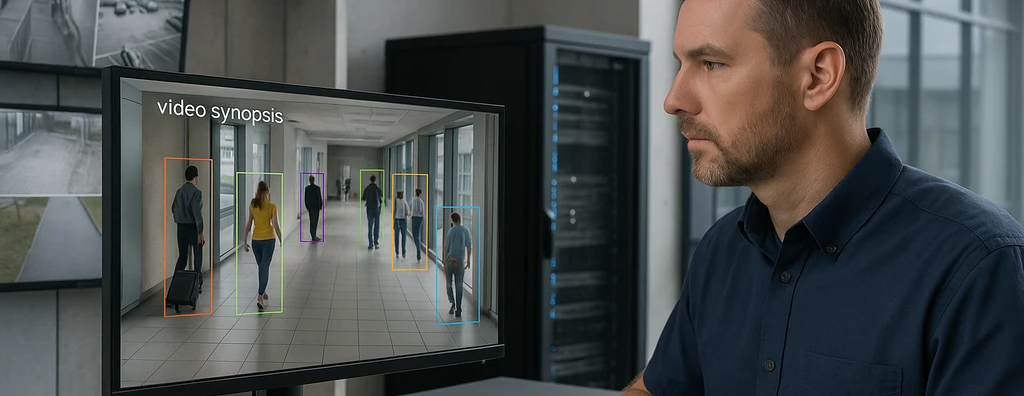
Understand the practical applications of video synopsis in electronic security systems, including forensic agility, operational scenarios, metadata integration, and compliance requirements.
Check it out!
The advancement of video monitoring architectures has driven the use of computer vision and automated analysis in electronic security systems. Analytical solutions are designed not only to record images, but also to understand, extract, and correlate events of interest, responding to the growing demand for operational efficiency and reduced forensic review time. In environments with multiple cameras and a high flow of objects and people, identifying relevant occurrences is a central challenge, both for asset protection and for risk management.
This article details the practical applications of video synopsis in electronic security systems, exploring specific operational scenarios, concrete benefits, integration mechanisms, and different segments of activity according to reference principles and technical standards. The objective is to present an in-depth overview of how this technology optimizes operations across various markets and contributes to faster, better-grounded decisions.
Read on!
[elementor-template id=”24446″]
Concept of Video Synopsis and Regulatory Context
Video synopsis consists of techniques for extracting, synthesizing, and reorganizing relevant events from long recording sequences, enabling fast and objective review. According to ABNT NBR IEC 62676, this process is performed through video content analysis algorithms capable of detecting activities, identifying behavior patterns, and generating metadata that support investigative audits.
- Analytical algorithms segment moving objects, correlate trajectories, and classify anomalous behaviors.
- Structured metadata index facts, people, and vehicles, enabling searches by specific attributes such as color, size, and carried objects.
Strategic Benefits of Video Synopsis in Electronic Security
- Forensic agility: Reduction of review time from hours of footage to minutes, facilitating event detection and immediate response.
- Optimization of operational resources: Frees teams for proactive monitoring rather than exhaustive and manual review.
- Reduction of storage requirements: Focusing on relevant events reduces the need to maintain large volumes of raw video.
- Compatibility with integrated management: Expands interoperability with alarm, access control, and building automation systems, enhancing automatic responses.
Practical Application Scenarios by Segment
Urban Monitoring
Video synthesis is applied in crime prevention, public area control, and incident identification on streets and squares. By centralizing critical events such as off-hours circulation, anomalous gatherings, and restricted-zone delimitation, the technology supports monitoring agents and public authorities in prioritizing essential occurrences.
Banks and Financial Institutions
Video synopsis mechanisms increase efficiency in identifying atypical behavior patterns at ATMs, queues, vaults, and restricted-access areas. Monitoring through metadata enables rapid reaction to attempts of fraud, violence, or intrusion.
Retail
In the retail sector, video synopsis reduces losses by facilitating the detection of theft, suspicious behavior in aisles, and integration with point-of-sale systems. Analytical resources make it possible to track entry and exit flows, contributing to logistics planning and anti-sabotage strategies.
Transportation
Applied to stations, rail yards, airports, and urban terminals, video synopsis makes it possible to quickly identify abandoned objects, intrusions into restricted areas, and precise passenger flow control. Automated detection reduces the operational vulnerability window and optimizes security team response time.
Industry
Industrial and logistics environments use video synopsis for perimeter monitoring, identification of PPE violations, detection of flow in prohibited directions, and monitoring of sensitive equipment. Data correlation allows video analysis to be integrated with sensor alarms and building management systems (BMS), ensuring coordinated action in the face of incidents.
Healthcare and Education
Hospitals, clinics, daycare centers, and educational institutions benefit from the rapid identification of anomalous situations, access control, unauthorized movement, and protection of sensitive areas, raising the standard of asset and personal security.
Integration and Operational Flexibility: Video Synopsis in Advanced Solutions
Systems based on open standards offer broad compatibility with video management platforms (VMS), access control, perimeter alarms, and building automation. Operational flexibility is possible through:
- Expandability: Modular architectures allow gradual growth as the camera fleet and operational complexity increase.
- Response automation: Automatic triggering of actions such as sending notifications, activating post-event recording, or integrating with access control upon incident detection.
- Integrated building management systems: Video can be triggered by equipment failure events, fire alarms, or other occurrences, centralizing all responses in the BMS.
Operators can share, review, and export synthesized critical clips for audit and immediate response according to the company’s security protocols.
Operational Flow: From Detection to Forensic Response
- Continuous capture and analysis: Intelligent cameras monitor in real time, employing motion detection, object segmentation, and classification by type, color, and behavior.
- Metadata generation: Each identified event is indexed automatically, simplifying future searches and occurrence tracking.
- Synthesis and export: Video synopsis software gathers relevant events into compact sequences while maintaining the traceability required for internal audits and forensic processes.
- Audit and decision-making: Operators validate the integrity of the synthesized recordings, export evidence, and trigger operational or legal responses, as the case may be.
Considerations on Efficiency, Privacy, and Regulatory Compliance
The implementation of video synopsis must consider privacy requirements and regulatory adherence. The use of structured metadata optimizes event search and reconstruction, while masking mechanisms and access control ensure protection of sensitive data. ABNT NBR IEC 62676 requires traceability, integrity, and authentication of records, which are fundamental for corporate, industrial, and sensitive areas subject to audits or external investigations.
Conclusion
Video synopsis stands as a strategic element for increasing the efficiency and effectiveness of electronic security systems across different market segments. Its ability to synthesize and correlate essential information drastically reduces the time required for analysis, maximizes operational precision, and contributes to more agile responses in critical scenarios. By integrating with management and automation platforms, it enhances systemic action and raises the level of incident control and prevention.
The correct parameterization and integration of this technology, associated with compliance with technical standards and privacy policies, ensure procedural robustness and suitability for contemporary security demands. Video synopsis is expanding its application to new sectors, promoting convergence among intelligence, flexibility, and operational efficiency.
Final Considerations
The adoption of video synopsis solutions represents a decisive step in the modernization and optimization of electronic security systems. Thank you for reading this article, and we invite you to follow A3A Engenharia de Sistemas on social media to receive technical updates, specialized analyses, and content on trends and best practices in integrated security.
