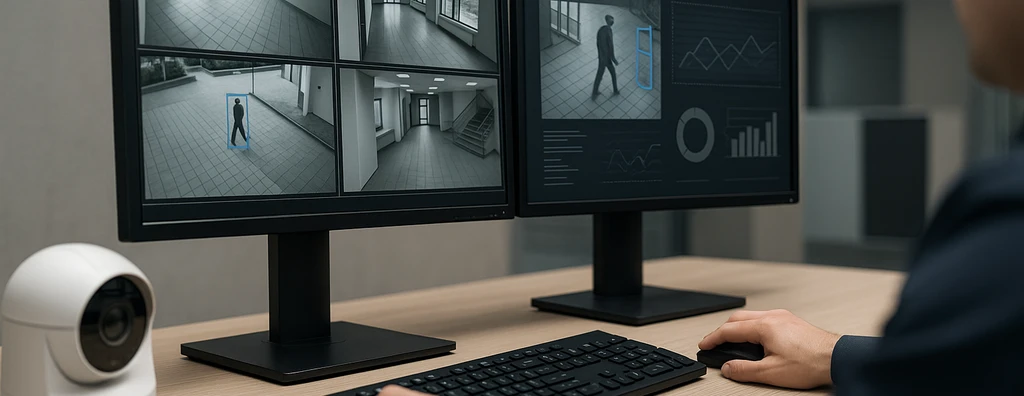
Understand how video analytics work in electronic security systems, including architectures, interoperability, use cases, technical challenges, and best practices for high-performance projects.
Check it out!
The evolution of video monitoring systems has been marked by advances in computer vision and artificial intelligence technologies, driving a significant transformation in surveillance and security mechanisms. Video analytics play a central role in this landscape, adding intelligence to monitoring, reducing dependence on human analysis, and establishing new levels of efficiency and real-time response. Rigor in defining architectures, regulatory standards, and robust integration among devices and software is decisive in ensuring system effectiveness, interoperability, and scalability.
This article explores in detail how video analytics work in electronic security systems, their different architectures, processing and analysis mechanisms, technical and specialized applications, regulatory requirements, challenges related to accuracy and reliability, as well as market trends and recommendations for high-performance projects.
Read on!
[elementor-template id=”24446″]
Technical Overview of Video Analytics
Video analytics are systems designed for the automated analysis of image streams captured by cameras, scene parameters, and metadata generation to support decision-making in security environments. They are based on computer vision algorithms, mathematical models, and increasingly artificial intelligence resources to extract relevant information such as:
- Motion detection and tracking
- Recognition of objects, vehicles, and people
- Automatic event classification
- People counting and flow analysis
- Automatic license plate recognition (LPR/ANPR)
- Perimeter analysis and intrusion detection
- Monitoring of restricted areas and identification of atypical behavior
Architectural Models
There are four predominant architectural models for video analytics in security:
- Camera-based (edge): The embedded processor operates within the image acquisition device itself, optimizing latency and reducing network data traffic.
- Server-based: Analysis is centralized on dedicated servers, enabling greater computing power, multi-camera integration, and large-scale parallel processing.
- Cloud-based: Processing takes place in remote infrastructures, providing resource elasticity and centralized management, but requiring highly available and reliable networks.
- Hybrid architectures: These combine edge and cloud/server approaches, assigning part of the processes to the device and part to the centralized backend, optimizing resources and ensuring operational flexibility.
Essential components include cameras suited to the scenario, dedicated processors (with support for AI and analytics algorithms), and video management systems (VMS) capable of receiving, cataloging, and acting on analytical metadata integrated into the operational workflow.
Standardization and Interoperability
Standardization ensures interoperability and reliability in video analytics projects. The ABNT NBR IEC 62676 series establishes a consolidated regulatory reference for video monitoring systems in security, covering:
- Part 1: General system and performance requirements
- Part 2: Video transmission protocols
- Part 3: Analog and digital video interfaces
- Part 4: Application guidelines
These references help standardize minimum requirements, define functional criteria, performance parameters, and integration mechanisms, and are applicable to detection, triggering, and analysis as well as to communication, control, and management processes in analytical systems.
Interoperating systems from different manufacturers depends on adherence to standardized protocols, open interfaces (ONVIF, RTSP, among others), and the incorporation of semantic metadata layers into the video stream.
Functional Stages and Processes
Video analytics operate through a logical processing flow composed of multiple stages:
- Image acquisition: Capture of the video stream according to defined compression parameters, resolution, lighting conditions, and frame rate.
- Pre-processing: Sharpness adjustment, noise control, light compensation, electronic stabilization, blur removal, and image preparation for subsequent analysis.
- Motion/object detection: Application of algorithms to differentiate elements of interest from the background, tracking movements, shapes, patterns, and anomalies.
- Context analysis: Advanced mechanisms, often based on artificial intelligence, refine detection by distinguishing the type of relevant object, behavior, or event.
- Metadata generation: Each relevant datum is structured and transmitted as metadata, enabling automated responses, indexing, and efficient search within the VMS.
- Notification and automation: Critical events are immediately reported to operators, building automation systems, or other integrated security devices.
Testing and Validation Strategies
Regular testing, proper parameterization, and field verification are essential to ensure the accuracy of analytics, adjusting factors such as detection zones and sensitivity levels. It is equally critical to monitor environmental variables that influence video quality and algorithm performance.
Use Cases and Technical Scenarios
Video analytics are extensively used in a variety of contexts, each with specific technical requirements:
- Perimeter detection: Applied mainly in outdoor areas to identify unauthorized access attempts, virtual line crossing, and intrusion into restricted zones.
- Monitoring of controlled access areas: Enables strict control over the flow of people and vehicles by associating facial recognition or automatic license plate reading.
- Behavioral analysis: Identifies suspicious patterns of movement or loitering in sensitive locations, supporting preventive responses.
- Protection of critical infrastructures: Automates alerts to protect substations, data centers, and sensitive facilities, speeding operational response time.
- Counting and flow analysis: Optimizes the use of resources in high-traffic environments, supporting security, logistics, and building operations decisions.
- Real-time incident management: Integrates with alarm, access control, lighting, and audio systems for coordinated response.
Deep Learning and Adaptive Models
The use of artificial intelligence, especially deep neural networks, raises the level of video analytics by enabling dynamic learning, adaptation to scenarios, and improved discrimination between legitimate events and false alarms.
- Reduction of false positives and negatives: Continuous learning improves recognition of correct patterns, minimizing improper incidents and optimizing operational accuracy.
- Flexibility for new events: AI-based systems can be trained to recognize emerging threats and atypical situations, responding to customized project requirements.
- Sophisticated metadata extraction: AI makes it possible to perform detailed contextual extraction, for example, distinguishing an abandoned object from legitimate movement within the perimeter.
Robust AI implementations require adequate computing power, integration with databases, and a continuous update architecture to maintain high relevance as the operating environment changes.
Evaluation Parameters and Best Practices
The accuracy of video analytics is determined by indicators such as:
- False positive rate: Events incorrectly classified as threats.
- False negative rate: Failures to signal relevant events.
These elements are influenced by environmental factors (lighting, weather), camera positioning, optical quality, sensitivity parameter adjustment, and algorithm performance.
Best Practices for Maximizing Efficiency
- Careful assessment of the installation scenario and selection of appropriate cameras
- Proper configuration of the field of view and zoning of critical areas
- Parameterization and calibration of algorithms according to the real dynamics of the environment
- Regular testing and preventive maintenance of the technology park
- Continuous monitoring of the integrity of video streams and metadata
Following these practices is essential to ensure high availability and effectiveness in security systems monitored by video analytics.
System Synergy
Video analytics integrated with access control, alarm, lighting, IP audio, and building automation systems maximize infrastructure efficiency. Centralizing metadata in video management systems enables:
- Automatic activation of responses (door locking, light triggering, sending commands to audio systems for alerts)
- Decision-making based on correlated detection from multiple sensors
- Integrated incident tracking and generation of cross-referenced reports
- Centralized management of the event lifecycle and optimization of human resources
Evolution and Outlook
The established trend is the migration of analytics to the edge, leveraging embedded capabilities in smart cameras with high-performance processors and support for AI algorithms directly on the device. Edge processing reduces latency, saves bandwidth, and offers greater resilience to network failures.
At the same time, the convergence of cloud computing and hybrid architecture enables large-scale analysis, remote algorithm updates, and continuous integration with new functionalities.
Current limitations remain related to environmental restrictions (extreme lighting, weather), device computing capacity, calibration complexity, and interoperability challenges, which are being progressively mitigated by the adoption of standards and advances in AI.
Video analytics represent a strategic vector for raising the level of intelligence, automated response, and efficient management in electronic security systems. The application of regulatory concepts, architectural integration, tuned parameterization, and the conscious adoption of artificial intelligence technologies are pillars for robust, scalable projects aligned with the growing complexity of monitored environments.
Reference projects should prioritize adherence to the ABNT NBR IEC 62676 series, alignment of expectations with clients and stakeholders, and constant technological updating to meet emerging demands and the increasing complexity of threat scenarios.
Thank you for reading this article. To stay up to date on best practices, innovations, and trends in electronic security systems, follow A3A Engenharia de Sistemas on our social networks and keep up with our specialized engineering content.
