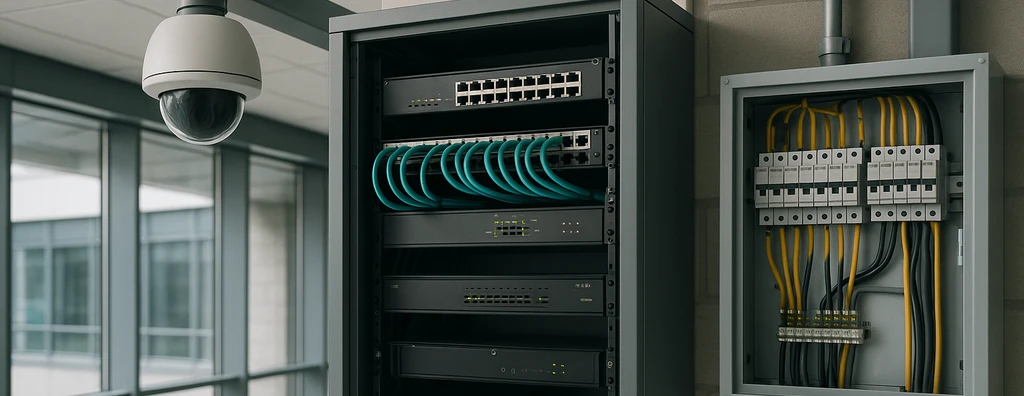
Understand how engineering integrates electronic security, communication networks, and electrical installations in smart buildings, with emphasis on automation, resilience, and operational continuity.
Check it out!
Engineering applied to everyday life encompasses the convergence of multiple disciplines aimed at optimizing critical building systems, with emphasis on electronic security, communication networks, and electrical installations. The current landscape demands interoperability between components, efficient information management, and adherence to strict normative requirements, especially with regard to protecting people, assets, and operational continuity. Among the main challenges are system scalability, mitigation of systemic risks, and the need for intelligent integration between heterogeneous platforms, under growing demands for automation and remote monitoring.
This article technically and thoroughly addresses the role of engineering in everyday life, emphasizing the integration of electronic security systems, networks, and electrical installations in buildings. We will highlight normative requirements, methodologies for risk assessment, principles of building automation, and practical guidelines for the specification, implementation, and maintenance of intelligent, safe, and efficient environments.
Take a look!
[elementor-template id=”24446″]
Integration of Electronic Security Systems in the Building Context
Engineering applied to building electronic security must consider the systemic architecture of surveillance, access control, intrusion alarms, fire detection, and integrated communication, aiming at rapid response to events and compliance with current standards.
- Event Management: Video management platforms (VMS) make it possible to receive, process, and associate notifications from access control devices, points of sale, alarms, and IP cameras. The integration of these alerts allows the generation of records, image association, and real-time notifications for operators working locally or remotely.
- Centralized Administration: Large systems require solutions that provide centralized configuration, firmware updates, audit logs, and monitoring of operational status, including notification modules for failures or deviations in recording devices, cameras, or controllers.
Systemic integration makes it possible to create automatic routines, such as triggering lighting when movement is detected in environments or timed shutdown of air conditioning in unoccupied areas, optimizing energy resources and increasing the level of safety.
ABNT NBR IEC 62676 extends requirements for the recording of critical events with date, time, and origin identification, including alarms, failures, violations, changes in operational parameters, and system user entries and exits – all validated for each required security grade.
Building Automation and System Interoperability
Modern building automation systems depend heavily on engineering in the integration of supervisory software, programmable controllers, and diverse subsystems. The use of standard protocols for data exchange is a requirement to ensure scalability and flexibility, especially when different manufacturers make up the solution.
- Lighting and HVAC Control: The use of sensors integrated with occupancy monitoring of environments enables automatic control of lighting, air conditioning, and ventilation according to programmable criteria.
- Residential, Commercial, and Industrial: In industrial environments and data centers, remote video monitoring supports the visual inspection of sensitive processes without the need for the operator to be physically present, favoring operations in critical locations such as clean rooms, areas with chemical agents, or remote substations.
- Integration through APIs: The adoption of open programming interfaces (APIs) and compliance with standards such as ONVIF guarantee interoperability in IP video platforms, enabling coordination among access control, audio, intrusion detection, and automation through SCADA, BMS, or VMS systems.
Network Requirements for Integrated Systems
Network infrastructure is an essential pillar for the integration and operation of critical building systems. Network design must provide for redundancy, scalability, and security, compatible with the requirements of automation and electronic security systems.
Topologies and Physical Media
- Structured Cabling: Adoption of Category 5e, 6, or higher to support Ethernet applications (Fast Ethernet, Gigabit Ethernet) compatible with video bandwidth and control data requirements. Installation according to horizontal routing and vertical backbone recommendations, with clear identification and expansion capability.
- Optical Networks: Use of single-mode or multimode fiber to interconnect buildings or critical segments, ensuring low latency and high availability.
- Wireless Alternatives: WLAN networks based on IEEE 802.11 standards, with robust security configurations (WPA, WPA2), may be used in areas where fixed cabling is not feasible or as redundancy to wired connections.
Switching, Routing, and Management
- Logical Segmentation: Use of VLANs to isolate different traffic types (video, data, voice), minimizing interference risks and facilitating management.
- Routing Protocols: Use of protocols such as OSPF, EIGRP, RIP, and IS-IS, according to the required architecture and scalability, ensuring efficient communication and dynamic contingency in case of link failures.
- Management Tools: Implementation of monitoring and management protocols such as SNMP, NetFlow, and CDP, providing mechanisms for diagnostics, auditing, and network performance tuning.
Electrical Installations for Integrated Systems: Design and Maintenance Criteria
Proper sizing of electrical installations is an essential factor for the continuous operation of integrated systems. Installation engineering must be based on the following aspects:
- Determination of General Characteristics: The design must consider intended use, maximum demand, distribution schemes, available power sources, segmentation by critical services, and evaluation of external influences. NBR 5410 specifies the need for precise quantification of loads, simultaneity factors, and permissible voltage drops.
- Selection of Components: All devices must comply with relevant technical standards and have electrical, operational, and environmental characteristics compatible with the intended use. It is essential to provide compensatory measures for elements that do not originally fully meet these requirements.
- Protection and System Independence: The design of the installations requires physical and electrical separation between power, control, and signaling circuits, preventing mutual influences and disturbances.
- Emergency Shutdowns: Criteria for implementing rapid disconnection devices in strategic locations, allowing immediate response in risk situations.
- Maintainability and Accessibility: All components must be installed in such a way as to facilitate inspections, preventive maintenance, and possible replacements, with adequate minimum free space.
The frequency of maintenance interventions depends on the complexity, criticality, and environmental influence of the environment and must be carried out only by duly qualified professionals, according to established technical guidelines.
Interconnection between Security, Networks, and Electrical Systems: Systemic Guidelines
The convergence between security systems, networks, and electrical installations imposes systemic guidelines aimed at maximizing safety, efficiency, and availability. For this purpose:
- Multidisciplinary Standardization: Integration requires compliance with the specific technical standards of each subsystem (intrusion, fire, video, access control, electrical); in eventual overlaps, the most restrictive requirements prevail.
- Cross-diagnostic Capability: Comprehensive records of electrical events, communication failures, access attempts, and alarms contribute to a systemic analysis of risks and to rapid corrective action.
- Responsive Automation: The use of Operational Intelligence enables the automatic activation of loads, access blocking, or alert sending based on the correlation of events originating from the various integrated systems, increasing the operational resilience index.
Best Practices for Projects and Implementation
Integrated engineering projects require careful analysis of load requirements, capacity reserve, physical and logical redundancy, as well as accessibility for inspection and maintenance. The following best practices stand out:
- Technical Documentation: Preparation of comprehensive descriptive reports and single-line diagrams, covering logical network topologies and electrical architectures with indication of critical subsystems.
- Lifecycle Management: Planning for firmware updates, scheduled hardware replacement, and periodic review of parameter settings, always maintaining historical records of interventions.
- Access and Security Management: Definition of strict policies for user credentialing, authentication, remote access records, and function segregation strategies based on the principle of least privilege.
- Testing and Commissioning: Execution of tests for the functional validation of all integrated components, including contingency tests and failure simulation to assess systemic responses.
Conclusion
Engineering applied to the contemporary building environment must orchestrate, in a synergistic way, electronic security, communication networks, and electrical installations under multidisciplinary competencies. The use of standardized solutions, centralized management tools, and robust network architecture provides a high degree of automation, safety, and operational continuity.
From a long-term perspective, the following key points stand out:
- Need for constant technological updating and cross-standardization to ensure interoperability between systems;
- Importance of continuous training for operational and maintenance teams;
- Valuation of electrical and IT projects that incorporate, from the design stage, criteria of expandability, ease of maintenance, and fault tolerance;
- Use of automation and remote monitoring as a fundamental strategy for sustainability, energy efficiency, and mitigation of emerging risks;
- Rigor in documentation, access policies, and event records to comply with audits and regulatory requirements.
These guidelines allow greater predictability, operational efficiency, and rapid response to incidents, bringing benefits to both companies and end users.
Final Considerations
As presented, success in applying engineering to everyday life is structured on disciplinary integration, execution in accordance with technical standards, and the constant pursuit of systemic efficiency. We appreciate you reading this article and invite you to follow A3A Engenharia de Sistemas on our social media channels to stay up to date with reference content in engineering, technology, and systems integration.