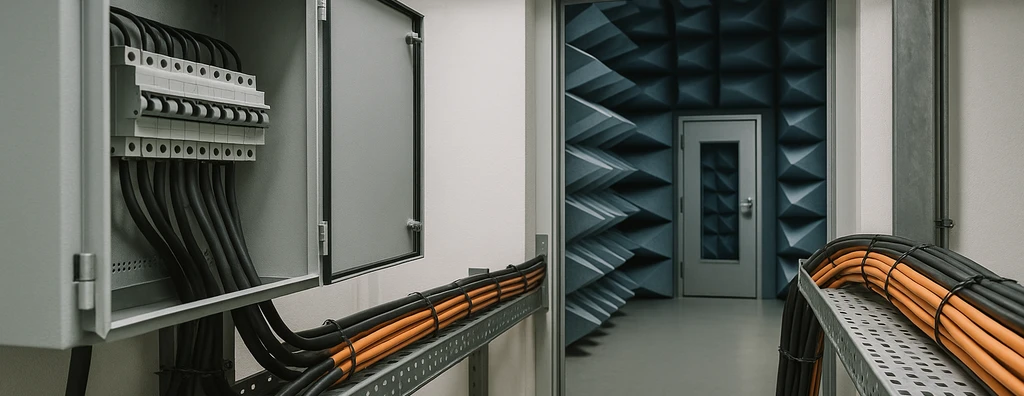
Learn the main electromagnetic compatibility challenges in critical environments, including EMI sources, grounding, shielding, cable segregation, surge protection, and risk mitigation strategies.
Check it out!
Electromagnetic compatibility (EMC) is one of the main challenges to the safety, integrity, and reliability of electrical, electronic, and communication systems in critical environments. The generation and propagation of electromagnetic interference (EMI) can significantly compromise the performance of industrial, medical, building control, automation, and electronic security equipment. The growing density of technology, the integration of critical systems, and the intensive use of sensitive devices require rigorous measures to ensure immunity to electromagnetic disturbances and uninterrupted operation of essential services.
This article addresses the main challenges related to electromagnetic compatibility in critical environments, with emphasis on analyzing coupling mechanisms, assessing risks, identifying typical EMI sources, mitigating risks, and selecting technical solutions based on recognized national and international standards. It details aspects related to grounding, shielding, cable segregation and routing, filtering, and protective devices, with examples in hospital environments, data centers, industrial plants, and airports.
Take a look!
[elementor-template id=”24446″]
Understanding Electromagnetic Compatibility (EMC) and Critical Environments
EMC refers to the ability of equipment, systems, and installations to function properly in an electromagnetic environment without causing or suffering interference. The concept is based on two essential pillars: emissions (levels of radiated or conducted energy generated by the equipment) and immunity (the ability to withstand environmental disturbances without significant functional degradation).
- Critical environments are characterized by the presence of systems that require high availability, such as operating rooms, data center operations rooms, monitoring centers, or automated production lines. In these contexts, service fluctuations, data loss, or sudden failures can result in high exposure to operational, financial, or even life-safety risks.
Typical electromagnetic coupling mechanisms include conductive, capacitive, inductive, and radiated coupling, and they are intensified by the presence of power lines, data cables, industrial equipment, and radiofrequency fields.
Main EMC Standards and Technical References
Compliance with technical standards is essential to ensure EMC in critical environments. The main references include:
- ABNT NBR 5410 – Low-voltage electrical installations, which defines criteria for separation and impulse voltage withstand.
- IEC 61000-4-9 and IEC 61000-4-10 – Immunity tests for intense magnetic fields and damped oscillatory magnetic fields.
- IEC/TR 61000-5-2 – Guidelines for grounding and cable routing.
- IEC 61643-12, 61643-21, and 61643-22 – Surge protective devices for power distribution systems and telecommunications networks.
- IEC 61000-6-3 and IEC 61000-6-4 – Applications for residential, commercial, industrial, and laboratory environments.
- ANSI/TIA/EIA-607 – Specifications for grounding and bonding of telecommunications systems in commercial buildings.
These standards govern electromagnetic emission limits, immunity test criteria, recommendations on circuit segregation, shielding requirements, and EMI mitigation strategies, defining best practices for engineering projects and compliance audits.
Sources of Electromagnetic Interference in Sensitive Environments
Identifying EMI sources is an indispensable step in diagnosing and preventing failures in critical environments. Among the most relevant sources are:
- Industrial Equipment: motors, generators, frequency inverters, transformers, elevators.
- Lighting: fluorescent systems, electronic ballasts, LED panels.
- Medical Equipment: CT scanners, magnetic resonance imaging systems, defibrillators.
- IT Infrastructure: servers, storage systems, uninterrupted power supplies (UPS).
- Power and Data Networks: crossings between power and signal cables, non-segregated distributions.
- Electronic Security Systems: alarm panels, CCTV cameras, and access control with data transmission in shared environments.
It is essential to avoid routing data cabling together with conduits shared with power circuits, especially in areas with a high concentration of electromagnetic equipment or those subject to lightning events.
Specific EMC Challenges in Hospitals, Data Centers, and Industrial Plants
Hospital environments require rigorous control over emissions and immunity, given the presence of highly sensitive medical equipment. For example, MRI machines can generate fields capable of inducing currents in nearby conductors.
- Data centers require physical segregation between power and data infrastructures, proper grounding, and surge protection. Operational continuity depends on minimizing EMI in environments with high concentrations of sensitive electronic equipment.
- Industrial plants face challenges from intense sources of electromagnetic noise originating from motors, drives, and high-current lines, requiring physical isolation, robust shielding, and strict control of grounding topology.
In airport environments, the need to integrate navigation, security, and building automation systems makes advanced EMC practices essential because of the diversity and density of sources that generate electromagnetic disturbances.
Impact of EMC on the Safety of Electronic and Communication Systems
The operational integrity of electronic security systems (such as alarms, CCTV, and access control) depends on immunity to EMI disturbances to avoid false alarms, loss of detection, and monitoring downtime. IEC 62599-2 defines immunity requirements for components of fire and intrusion alarm systems, establishing that the video surveillance system (VSS) must remain operational without functional degradation during EMC testing.
- When deploying communication networks, especially for critical systems, minimum separation between power and data cables, use of shielded conduits, proper grounding, and surge protection devices targeted to the application profile must be ensured.
- IEC 62676-1-1 emphasizes the need for physical and logical protection of monitoring components, as well as the integrity of interconnections.
To ensure that devices are not influenced by EMI from external sources (or that they do not affect other systems in the environment), the integrated use of filters, shielding, topological addressing strategies, and good installation practices is mandatory.
Strategies for Mitigating Electromagnetic Interference
Effective EMI control is based on the coordinated application of design and installation actions, described below:
- Cable and Component Segregation: Whenever possible, maintain minimum physical distances between power cables (>300V) and data cables, following technical standard recommendations.
- Shielding of Environments and Lines: The use of physical shielding (Faraday cages, equipotential metallic conduits) is highly recommended for highly sensitive environments.
- Structured Grounding: Grounding systems must be interconnected and equipotential as specified by rules such as ANSI/TIA/EIA-607. It is necessary to ensure low-impedance connections and maintain electrical continuity between metallic infrastructure parts.
- Surge Protection: Surge protective devices (SPD) in both power and signal networks, selected according to IEC 61643, are essential to limit the entry of transients and prevent damage caused by lightning events or switching operations on the grid.
- Filtering and Conditioning: The use of line filters and power conditioners improves equipment immunity against conducted noise.
Organizational measures such as proper positioning of technical rooms, planning dedicated cable paths, and using segregated distribution panels are an essential part of mitigation.
Cable Routing and Segregation Criteria
Proper cable routing in critical environments can only be designed through a detailed understanding of the electromagnetic environment. Essential aspects include:
- Keep data cables away from EMI-generating sources such as motors, power panels, transformers, and fluorescent fixtures.
- Never install data cabling in conduits shared with power cabling.
- Respect minimum distances between parallel cables, such as:
- Six inches (approx. 15 cm) from fluorescent lighting sources.
- Four inches (approx. 10 cm) from antenna cables and grounding conductors.
- Two inches (approx. 5 cm) from power cables up to 300 V.
- Prefer the use of grounded metallic trays and ducts to enhance the effect of physical shielding.
Careful segregation and the use of separate paths for power and data significantly reduce the likelihood of unwanted coupling.
Electromagnetic Shielding: Principles and Applications
Shielding consists of using metallic enclosures, cages, or barriers around equipment or environments in order to block the propagation of incident electromagnetic fields. The degree of shielding effectiveness depends on factors such as material conductivity, the integrity of grounded connections, and barrier thickness.
- Line shielding can be applied to data cables, panels, or racks using metallic tubes, conductive tapes, or metallic blankets. When properly grounded, these solutions reduce noise induction and protect against incident fields and fast transients.
Spatial shielding solutions can be combined with specific routing strategies to create protection zones against lightning and surges of external origin.
Equipotential Grounding and Surge Protective Devices
Equipotential grounding is a fundamental pillar of the EMC strategy. Proper grounding systems ensure that electrical potentials remain uniform among structural metallic parts, equipment, and enclosures, eliminating potential differences capable of inducing EMI.
- In technical areas, individual grounds must be interconnected by equipotential busbars, following the recommended topology for each type of installation (star, mesh, radial).
- After grounding planning, the installation of surge protective devices becomes mandatory, especially for power, telecommunications, and signal lines.
- SPD devices must be sized according to the type of surge (lightning-induced or switching) and follow the selection criteria established in IEC 61643 standards.
All grounding connections and branches must be physically inspectable and maintained with low electrical impedance, otherwise functional efficiency may be lost.
Specific Requirements for Electronic Security Systems
Electronic security systems such as CCTV, alarms, and access control are inherently vulnerable to electromagnetic disturbances because of the interdependence of electronic components, IT equipment, and communication networks.
- It is recommended to specify equipment designed to operate in compliance with standards such as IEC 62599-1 and IEC 62599-2, which define immunity classes, test scenarios, and admissible degradation limits.
- The communication network topology of the system should prioritize shielded segments and segregated routing, while also providing redundancy in main signal and power interconnections.
- Installation environments for servers, recorders, and switches must be provided with physical and logical protection, restricting unauthorized access and facilitating diagnosis in case of failure in sensitive segments.
The integrity of the system is built not only on the detection and physical blocking of intrusion attempts, but also on protection against accidental or intentional EMI.
EMC Risk Assessment Methodologies and Testing
Electromagnetic risk assessment must be part of the preliminary analysis of every project in a critical environment. This assessment includes:
- Mapping potentially disruptive sources in the environment.
- Modeling electromagnetic coupling paths (conductive, capacitive, inductive, and radiated).
- Classifying the criticality of systems and identifying sensitive components.
- Applying immunity tests performed according to standards such as IEC 61000-4-9 and IEC 61000-4-10 to evaluate equipment response to intense magnetic fields and damped oscillations.
Detailed records of field measurements, test reports, and action plans for mitigating nonconformities must be maintained, feeding the continuous improvement cycle of EMC requirements.
Best Practices for Projects and Installations in Critical Environments
Using proven practices during design and execution routinely reduces maintenance costs, downtime periods, and the risk of inadvertent failures.
Main practices include:
- Anticipating segregation of electrical and logical infrastructure from the architectural base design stage.
- Preserving exclusive routes and minimizing intersections between power and telecommunications paths.
- Using properly grounded and segregated panels, boards, and racks.
- Correctly sizing SPD and filtering at entry points and transfer points between subsystems.
- Applying preventive inspection and maintenance routines to grounding connections and shielding.
Integration between electrical engineering, IT, and electronic security areas is fundamental to the effectiveness of EMC strategies, requiring multidisciplinary technical coordination and unrestricted documentary traceability.
Considerations on Operational Continuity and Failure Management
Managing operational continuity in critical environments requires permanent monitoring of EMC conditions and contingency plans for exceptional situations such as direct lightning strikes, transient overvoltages, or grounding failures.
- Each manager is responsible for ensuring that monitoring systems, alarms, and electromagnetic parameter records are integrated into supervisory systems.
- Rapid-response plans for incidents must include periodic immunity testing, redundancy of critical paths, and detailed documentation of restoration procedures.
The robustness of systems results directly from alignment between electromagnetic protection strategies, regulatory updates, and continuous training of multidisciplinary teams.
Conclusion
Electromagnetic compatibility represents a strategic component of the life cycle of critical systems in industrial environments, hospitals, data centers, and electronic security installations. Success in implementing EMC depends on integration among engineering disciplines, adoption of reference standards, and advanced risk mitigation methodologies. Proper segregation, shielding, grounding, and careful use of protective devices are essential to avoid electromagnetically induced failures and ensure operational continuity.
By adopting a systemic approach to EMC, greater resilience is provided to projects, reducing maintenance costs, safety risks, and unplanned outages. Periodic risk assessments, incorporation of standards-based testing, and diligent recording of operating conditions are recommended as part of the engineering decision-making process.
Final Considerations
Based on this in-depth analysis of the challenges and technical solutions for electromagnetic compatibility in critical environments, the ongoing need for technological updates, regulatory compliance, and integrated project management becomes clear. Thank you for reading this technical article, and we invite everyone to follow A3A Engenharia de Sistemas on our digital channels for more specialized content and industry updates. Follow A3A Engenharia de Sistemas on social media!