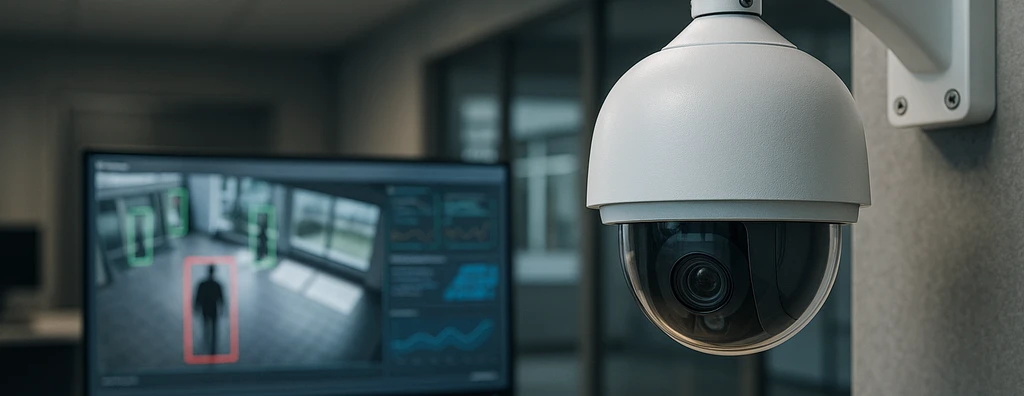
A technical review of myths and truths about smart cameras, computer vision, analytics, integration, privacy, and cybersecurity in residential and corporate security.
Check it out!
Computer vision applied to smart cameras has redefined the concept of monitoring in residential and business environments, incorporating automation, advanced video analysis, event detection, and autonomous responses to threats. The implementation of these technologies brings challenges and dilemmas, such as the need for processing infrastructure, adherence to technical standards, data management and regulatory compliance, in addition to concerns about the actual effectiveness and limitations of systems based on artificial intelligence.
In this article, the main myths and truths surrounding the universe of smart cameras will be addressed in a technical and comprehensive manner, distinguishing effective capabilities from unfounded expectations. Topics include system architecture, operational limitations, integration with other security platforms, normative requirements such as NBR IEC 62676, video analytics algorithms, privacy, and ethical aspects, with emphasis on residential and corporate applications.
Take a look!
[elementor-template id=”24446″]
Foundations of Smart Cameras and Computer Vision Analysis Systems
The advancement of smart cameras is based on the ability to perform video analysis through local processing (edge) and IP video platforms, meeting performance, interoperability, and integration flexibility requirements. Smart cameras go beyond image capture by embedding deep learning modules and event processing, acting as contextual sensors capable of:
- Detecting, classifying, and tracking people, vehicles, and objects in real time;
- Issuing automatic alerts and creating incident reports;
- Generating metadata that feeds building automation, access control, and perimeter management systems;
- Integrating forensic analysis, facial recognition, automatic license plate recognition, and behavioral analytics into the security ecosystem.
In the normative context, implementation must be guided by standards such as NBR IEC 62676, which standardizes architecture, interoperability, and minimum performance required for video monitoring systems, while also proposing guidelines for integration with alarm systems, access control, and smart networks.
System Architecture: Edge, Server, Cloud, and Hybrid Models
Smart camera systems can be classified according to their operational architecture:
- Camera-based (edge): Analysis is processed locally in the camera hardware, optimizing bandwidth and latency. Ideal for real-time response and disconnected environments.
- Server-based: Processing is centralized, enabling more complex analysis and high scalability, but requiring robust IT infrastructure and data flow control.
- Cloud-based: Favor scalability, maintenance, and remote updates, in addition to integration among different facilities. They require rigorous information security policies.
- Hybrid architecture: Combines the advantages of the previous models, distributing tasks among the camera, server, and cloud according to requirements for performance, redundancy, and resilience.
All architectures depend on advanced image processing, algorithms optimized for specific hardware, and open platforms, facilitating integration with third-party systems through APIs and standardized protocols.
Video Analytics: Features, Limitations, and Practical Applications
Main Analytic Capabilities
- Motion and intrusion detection;
- People and vehicle counting;
- Queue and overcrowding detection;
- Automatic license plate recognition (LPR);
- Facial recognition and identification of behavioral patterns;
- Definition of zones of interest for directed monitoring;
- Ambient audio analysis and anomalous sound behavior.
Modules such as AXIS Object Analytics, Perimeter Defender, Scene Metadata, Audio Analytics, and Face Detector exemplify the range of resources embedded in modern systems. Each function has inherent limitations related to factors such as lighting, resolution, camera positioning, environmental noise, and weather variations.
It is essential to consider error margins and periodic calibration of algorithms to avoid false alarms and ensure accuracy.
Myths and Truths About Smart Cameras in Residential and Business Security
- Myth: Smart cameras completely eliminate the need for human operators.
In practice, automation reduces supervision demands, but critical decision-making in atypical events or contextual interpretation still depends on trained operators. - Truth: Video analysis is limited by environmental factors.
Lighting changes, visual obstructions, poor positioning, and weather variation can impact the performance of embedded algorithms. - Myth: Features such as facial recognition are infallible.
Despite advances in deep learning, factors such as low resolution, viewing angle, use of accessories, and lighting conditions affect accuracy, making it necessary to validate results before critical actions. - Truth: Smart systems optimize event response.
When properly configured, systems can generate automatic notifications, record evidence, and assist in loss mitigation, increasing the efficiency of the security cycle. - Myth: Simply installing the equipment guarantees security.
Inadequate selection, lack of integration, poor maintenance, and failure to observe technical standards all impair system efficiency. - Truth: Standards such as NBR IEC 62676 are essential.
Compliance with technical standards ensures minimum performance, interoperability, and adequacy of smart systems within broader security controls.
Integration of Smart Cameras into Security Infrastructure
Smart cameras integrate with alarm panels, access control, building automation systems, audio solutions, and building management platforms, providing real-time data and events for coordinated actions. The adoption of open standards and specific APIs allows:
- Alarms to be triggered from analytic events, such as perimeter crossing or suspicious behavior detection;
- Information to be shared with video management platforms (VMS) for later forensic analysis;
- Biometric authentication to complement access control in high-security buildings;
- Audio and video data to converge for the recognition of anomalous situations, supporting integrated emergency response.
Effective integration favors predictive analysis, adding value to the complete security cycle and facilitating the centralization of operational controls.
Cybersecurity and Information Protection in Smart Cameras
Technical Requirements for Protection
- Cybersecurity platform integrated in hardware and software;
- Granular user account management and privilege control;
- IP filtering for restricted access to authorized devices;
- Automated updates and permanent firmware maintenance for devices;
- Physical protection of network and camera components;
- Adoption of end-to-end encryption and strong authentication for remote access.
The security of smart video systems is an integral part of the project life cycle and must be aligned with the other controls in the environment, including IT systems, building automation, and wireless network (WLAN) resources, following standards such as ISO/IEC 27001, WPA2/WPA3, and industry best practices.
Legal, Ethical, and Privacy Aspects in Smart Camera Systems
The use of smart surveillance systems raises relevant legal and ethical considerations, especially regarding the processing of personal data, the right to privacy, and the responsible use of technology. Among the essential points are:
- Implementation of transparent policies for capture, storage, retention, and disposal of images and metadata;
- Application of privacy-by-design techniques, such as dynamic masking of sensitive areas (for example, AXIS Live Privacy Shield);
- Clear communication to users and occupants of monitored areas regarding the use of cameras and aggregated data;
- Continuous monitoring of compliance with technical and legal requirements, adapting to applicable regulations.
Normative compliance and respect for fundamental rights are indispensable to the legitimacy and sustainability of smart security projects.
Criteria for Selection, Design, and Maintenance of Smart Camera Solutions
- Camera type and position: The choice among fixed, PTZ, dome, bullet, and other models is determined by the operational need of the project.
- Image quality and resolution: The definition of sensors and lenses must consider coverage area, lighting levels, and identification requirements for forensic analysis.
- Network functionality: Evaluation of connectivity, support for VLANs, QoS, redundancy, and open protocols for integration;
- Embedded analytic resources: Definition of algorithms compatible with the risks to be mitigated, as well as analysis of accuracy against the application scenario;
- Maintenance and updating: Structuring of a rigorous predictive maintenance policy, including firmware updates, periodic calibration tests, and verification of physical components;
- Integration with perimeter controls, automation, audio, and smart systems: Interoperability planning to ensure integrated responses to critical events;
- Documentation and training: Creation of technical manuals and operator training focused on the safe and correct use of smart systems.
The adequacy of these criteria to normative and operational requirements is fundamental to the success and longevity of security systems based on smart cameras.
Systemic Benefits of Introducing Smart Cameras
- Operational efficiency: Reduced response time, process automation, and minimization of human error;
- Enhanced security: Early detection capability, predictive analysis, and real-time threat mitigation;
- Resource optimization: Intelligent information management to support strategic decision-making in mission-critical environments;
- Scalability: Ease of expanding systems without compromising performance or reliability, thanks to hybrid models and distributed integration;
- Robust evidence: Generation of reliable records and metadata to support forensic analysis and reduce operational failures.
Conclusion
The spread of smart cameras represents a paradigm shift in residential and business security, integrating computer vision, embedded analysis, automation, and connectivity. It should be emphasized that the success of these solutions stems from technical rigor, alignment with industry standards, and systemic integration, never from blind faith in unfounded technological promises.
Understanding inherent limitations, applying engineering best practices, and maintaining continuous monitoring are essential elements for extracting the full potential of smart systems, mitigating risks, and meeting the highest requirements for trust, operational response, and compliance with current legislation.
Decisions related to design, implementation, and maintenance should always be anchored in in-depth technical analysis, user training, and full observance of ethical and legal implications.
Final Considerations
As explored in this technical analysis, the value of smart cameras lies in their correct integration with processes, people, and standards, overcoming myths and highlighting essential truths for modern security.
Thank you for reading this article. To stay updated on trends, technical projects, and engineering solutions, follow A3A Engenharia de Sistemas on social media.
