
Understand how computer networks are classified by geographic scope, from PAN and LAN to MAN, WAN, SAN, and interplanetary networks.
Check it out!
Computer Networks can be classified as Personal Area Networks (PANs), Local Area Networks (LANs), Wide Area Networks (WANs) and many others.
In this article, we take a closer look at each type of geographic-scope classification.
Take a look.
[elementor-template id=”24446″]
How Are Networks Classified by Scope?
Computer networks can be classified according to their geographic reach, which directly influences the architecture and the specific implementation and management challenges of each network type.
These classifications may range from extremely small networks on the nanometer scale to vast global networks such as the Internet. Each type of network has distinct characteristics and is used for different applications:
Nanonetworks
Nanonetworks consist of a communication infrastructure between nanomachines, which are devices designed to operate at the molecular scale.
There are several challenges associated with implementing these networks, including the need for new approaches to modeling, simulation, experimentation, and technology standardization.
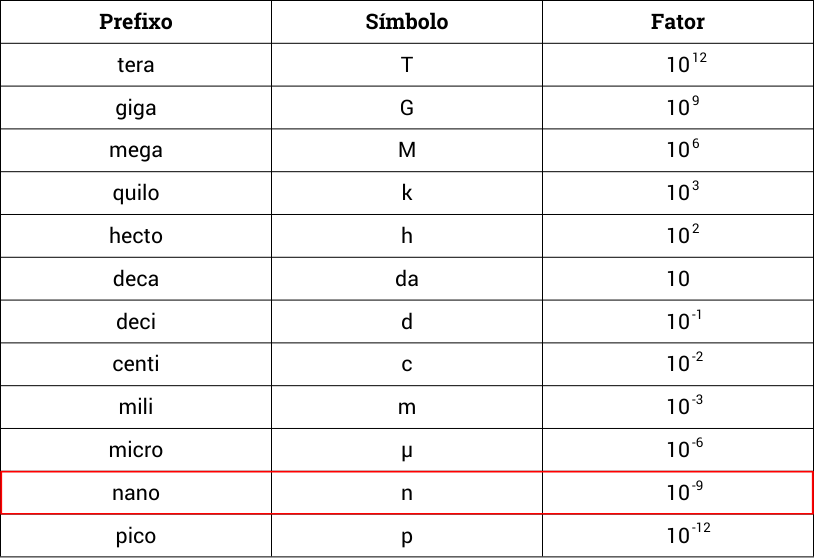
With great potential to revolutionize disease treatment and ecosystem preservation, nanonetworks represent a very active and multidisciplinary research topic involving Physics, Chemistry, Biology, Engineering, and Computer Science.
The main implementation challenges include reducing component size, achieving efficient energy management, mitigating interference at the molecular scale, and developing communication protocols suited to the specific requirements of these systems.
NFC (Near-field Communication)
Near-field Communication, or NFC, is a wireless communication technology that allows data exchange between devices located just a few centimeters apart.
This technology is widely used in everyday applications such as contactless payments, device authentication, and access control systems.
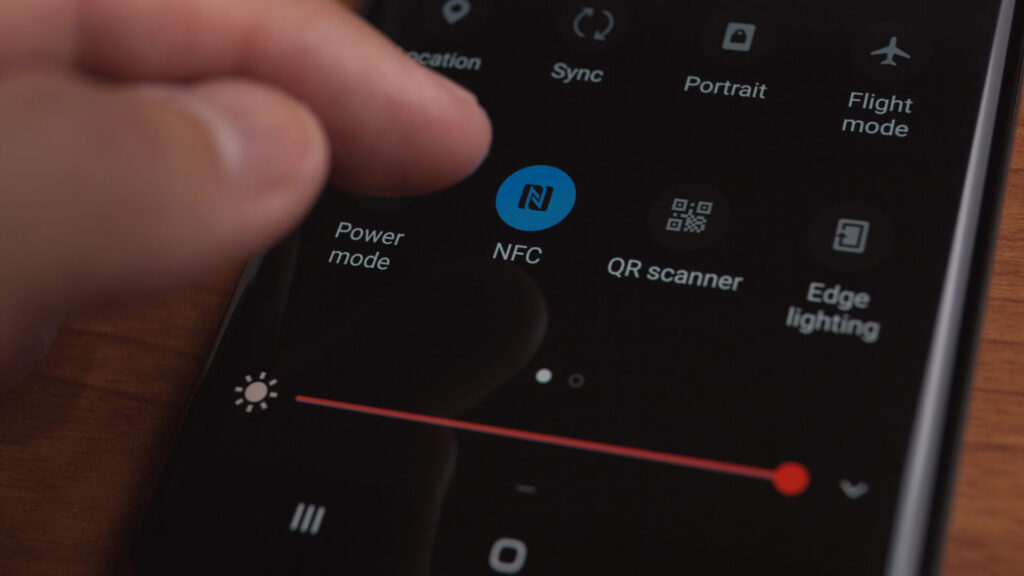
NFC provides a practical and efficient way to transmit information quickly, such as sharing small files and configuring smart devices with a simple tap.
BAN (Body Area Network)
Body Area Networks, or BANs, refer to communication between portable electronic devices used on the human body.
These devices may be wearable, such as smartwatches, fitness bands, and augmented reality glasses, or implantable, such as medical sensors and vital-sign monitoring devices.

Recent advances in this field have enabled innovative technologies that promise to transform medical procedures.
There are already prototypes of ingestible devices capable of traveling through the gastrointestinal tract, capturing and transmitting images in real time to external devices, offering a far less invasive alternative than traditional endoscopic methods.
PAN (Personal Area Network)
Personal Area Networks, or PANs, are short-range communication networks designed to interconnect electronic devices in the user’s immediate vicinity, generally within a radius of up to 10 meters.
PANs are designed to support direct communication between devices such as smartphones, computers, speakers, headphones, and remote controls.
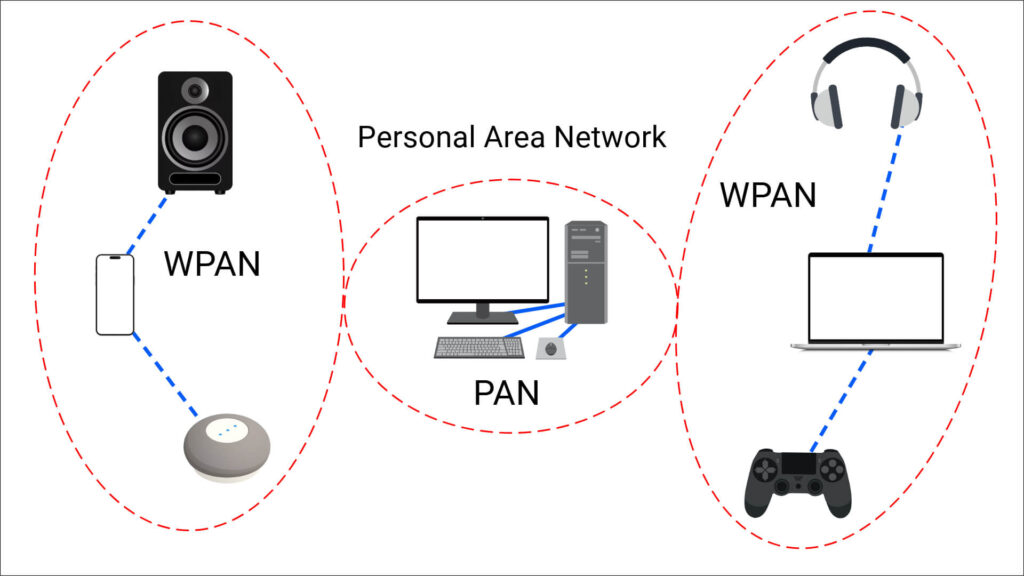
These networks operate predominantly through wireless communication technologies such as Bluetooth and Zigbee, which are optimized for low power consumption and data rates suited to synchronization and device control. However, they can also be implemented using wired technologies such as USB for direct device connection.
NAN (Near-me Area Network)
Near-me Area Networks, or NANs, refer to a type of communication that enables direct interaction between nearby devices without the need for centralized network infrastructure.
NANs are characterized by automatic configuration, where devices connect autonomously. In environments such as supermarkets, for example, NANs can be used to deliver information about promotions directly to customers’ devices without requiring a manual connection to the local Wi-Fi network.
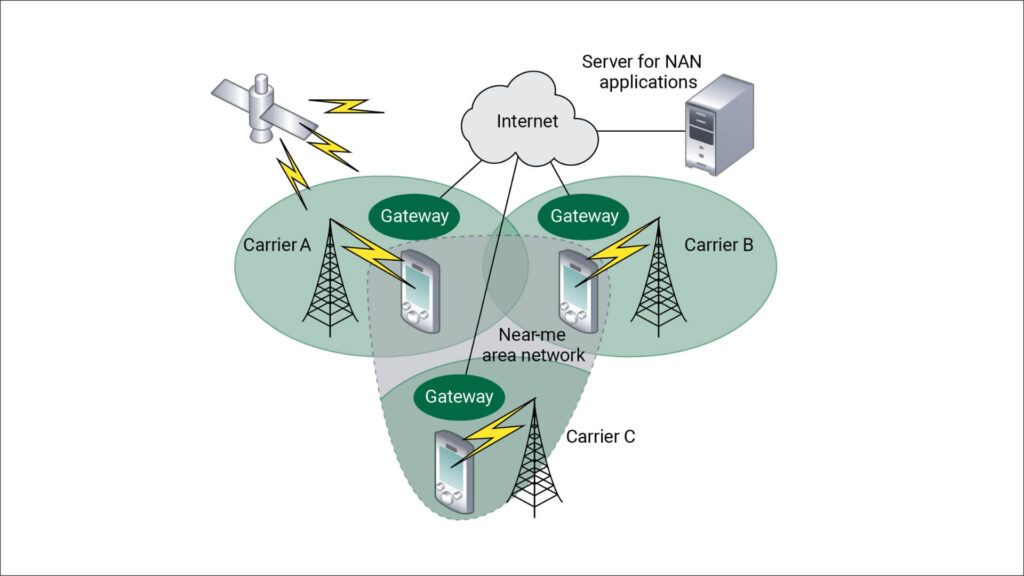
This technology enables fast and efficient communication, supporting applications ranging from interaction in public spaces to advanced security and automation solutions.
LAN (Local Area Network)
Local Area Networks, or LANs, are systems for interconnecting computers and electronic devices within a limited geographic area, such as a residence, school, laboratory, or commercial building.
The architecture of a LAN is defined by a combination of topologies, access technologies, and communication protocols. These components are designed to ensure interconnectivity and data transmission with integrity, security, and high availability.
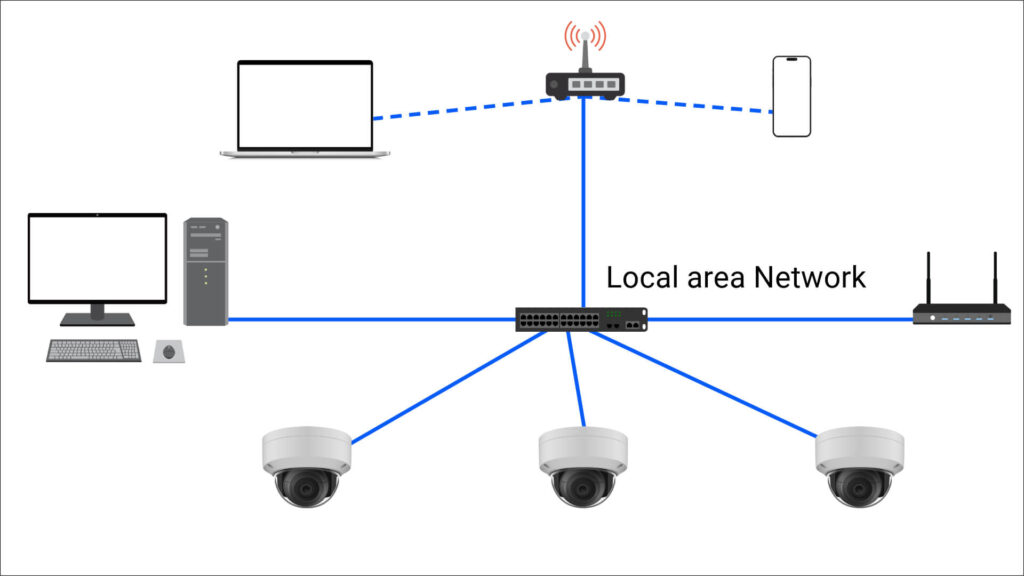
LANs are built to facilitate the sharing of hardware, software, and service resources among connected devices, such as printers, servers, files, and Internet connections.
They may be divided into several categories based on their structure:
WLAN (Wireless Local Area Network)
A Wireless Local Area Network, or WLAN, enables communication between devices in a local area without the need for direct cabling between equipment.
This type of network is characterized by mobility and ease of installation, allowing users to connect to the network from different locations within the coverage area.
With the continuous advancement of Wi-Fi technologies, WLANs have evolved constantly, delivering improvements in speed, security, and capacity. Even so, these networks are predominantly implemented in environments where cable installation is impractical, such as hard-to-access locations, historic buildings, or temporary installations.
In corporate and industrial environments, exclusive dependence on wireless networks is less common due to concerns about stability and performance.
Although Wi-Fi offers convenience, wired networks provide advantages in performance and reliability.
Wired connections use a dedicated physical medium for data transmission, providing lower latency, higher transfer rates, and more stable communication, with less susceptibility to interference.
For this reason, LANs often combine wired and wireless technologies, taking advantage of the best of both worlds and creating networks that efficiently meet a wide variety of connectivity needs while optimizing overall network performance.
HAN (Home Area Network)
Home Area Networks, or HANs, are local networks that interconnect devices inside a residence. Typically, these networks use a centralizing piece of equipment supplied by Internet providers that combines router, switch, and Wi-Fi access point functions into a single device, simplifying the network infrastructure.
Today, many devices can be connected to a home network, such as computers, televisions, smartphones, appliances, and security cameras. This integration expands connectivity and functionality in residential environments, driven by the evolution of the Internet of Things (IoT).
HANs continue to evolve with automation and smart-control technologies, providing greater convenience, energy efficiency, and security for users.
VLAN (Virtual Local Area Network)
VLANs, or Virtual Local Area Networks, refer to a network segmentation technique that allows the creation of virtual local networks on top of an existing physical infrastructure.
This segmentation organizes data traffic logically, without the need to physically separate devices into different networks.
A VLAN is configured with logic similar to that of a subnet, but with one crucial difference: every data frame traveling through the network carries additional information called the VLAN ID or VLAN Tag. This identifier groups devices into virtual networks regardless of their physical connection to network hardware.
A common VLAN application is network segmentation for monitoring systems. By isolating video traffic in a specific VLAN, it is possible to ensure that other critical applications on the network are not impacted, preserving performance.
CAN (Campus Area Network)
A Campus Area Network, or CAN, is a type of local network designed to cover areas that extend beyond a single building, such as university campuses or corporate complexes.
MAN (Metropolitan Area Network)
A Metropolitan Area Network, or MAN, is a type of computer network designed to interconnect users and computing resources across a geographic area that covers a metropolitan region.
The term metropolitan refers exclusively to the geographic extent of the network and does not imply anything about the demographic characteristics of the covered area.
In geographic terms, MANs cover an area larger than a Local Area Network (LAN) and smaller than a Wide Area Network (WAN).
Typically, a MAN can span an entire city or large urban area, interconnecting multiple LANs and connecting different buildings, university campuses, business facilities, and other distributed sites within the metropolitan area.
WAN (Wide Area Network)
A Wide Area Network, or WAN, is a type of computer network that interconnects several local networks (LANs) across a vast geographic area, spanning cities, states, or even countries.
Consider a company that has a manufacturing plant in Manaus and an office in Sao Paulo. The company needs an efficient way to share information between these two locations. A WAN enables the company to do exactly that.
The company would not need to run a cable between Manaus and Sao Paulo, which would be expensive and impractical. Instead, it would contract a telecommunications service provider to supply the necessary network infrastructure.
The telecommunications service provider owns and operates the network infrastructure that connects the company LANs in Manaus and Sao Paulo, forming a WAN.
The Internet is the best-known example of a WAN. It connects billions of devices around the world, allowing users and computers in one place to communicate with users and computers elsewhere.
Some authors refer to the Internet as a Global Area Network (GAN) because of its truly global reach. However, terminology may vary, and the Internet is commonly referred to as a WAN.
SAN (Storage Area Network)
Storage Area Networks, or SANs, are specialized networks designed to provide high-performance access to storage devices, such as hard drives and disk arrays, within a dedicated network infrastructure.
IAN (Internet Area Network)
An Internet Area Network, or IAN, is an advanced telecommunications network concept that uses the Internet Protocol (IP) to interconnect voice and data endpoints in a cloud environment, replacing traditional LAN and WAN networks.
In an IAN, all communication services and applications are hosted in the cloud by a managed service provider (MSP).
IAN allows connection points, or endpoints, to communicate and exchange information securely over the public Internet, eliminating dependence on a specific physical location.
This is possible because communication applications and services have been virtualized. Endpoints only need a broadband connection to access the network and use the services.
Service virtualization is a fundamental characteristic of the IAN, where communication services such as VoIP, videoconferencing, email, and collaboration applications are virtualized and accessible in the cloud. This enables dynamic scalability and efficient resource allocation according to demand.
Interplanetary Networks
An interplanetary network is a communication network that connects devices on different planets or celestial bodies using technologies such as radio, laser, or satellites.

An interplanetary network is a challenge for science and engineering because it involves problems such as delays, losses, interference, and security in the transmission of data between network points.
NASA (National Aeronautics and Space Administration) is one of the main agencies developing and testing an interplanetary network called IPN (Interplanetary Internet). IPN has already been used to send commands to and receive data from space missions such as Mars Science Laboratory, which carried the Curiosity rover to Mars, and Deep Impact, which launched a projectile against a comet.
The successful implementation of the Interplanetary Internet could revolutionize the way we explore space, enabling more effective communication between Earth and space missions.
This could pave the way for more complex and ambitious missions in the future, including human exploration of other planets.
Conclusion
Network classification is essential for understanding the different ways devices communicate and interconnect, meeting specific needs related to performance, security, scalability, and reach.
“Understanding the different criteria for network classification is essential to properly size any communication solution. A well-defined classification makes planning, security, and system integration easier, preventing mistakes and bottlenecks in Corporate Network projects.”
— Eng. Altair Galvao, specialist in networks and telecommunications infrastructure
Frequently Asked Questions
Networks can be classified mainly by geographic scope (LAN, MAN, WAN, PAN), connection method (wired or wireless), topology (star, ring, bus), and functionality (client-server, peer-to-peer).
In addition to scope, networks can be classified by physical or logical topology, transmission technology, purpose, protocols used, and security level.
They generally refer to:
LAN (Local Area Network)
MAN (Metropolitan Area Network)
WAN (Wide Area Network)
PAN (Personal Area Network)
In the TCP/IP model, the four layers are:
Application
Transport
Internet
Network Access
These are the layers of the OSI Model:
Physical
Data Link
Network
Transport
Session
Presentation
Application
The main elements are:
Devices (hosts, computers, servers)
Transmission media (cables, radio waves)
Communication protocols
Network software
The main standards governing structured cabling are ABNT NBR 14565 (Brazil), ISO/IEC 11801 (international), and ANSI/TIA-568 (USA).
In Brazil, structured cabling projects should mainly consider ABNT NBR 14565 and ABNT NBR 16869.
ABNT NBR 14565 is the main standard and establishes the general requirements for the design, installation, administration, and performance of structured cabling systems in commercial, industrial, and residential environments. It covers topology, cable categories, identification, documentation, and best practices to ensure efficiency and interoperability.
ABNT NBR 16869 complements NBR 14565 by providing detailed guidance for infrastructure planning, test execution, optical and metallic link configuration, and automated infrastructure management. It is especially relevant for complex environments such as data centers and large corporate installations, but can also be applied in other contexts.
ABNT NBR 14565 is the Brazilian standard that establishes requirements and best practices for the design, installation, and administration of structured cabling systems in commercial, industrial, and residential environments. It addresses topology, performance, identification, and cabling system documentation.
In addition to NBR 14565, ABNT has other important standards for network infrastructure, such as NBR 16264 (optical cabling), NBR 16415 (cabling systems for residential buildings), and NBR 5410 (low-voltage electrical installations), among others related to infrastructure and safety.
ISO/IEC 11801 is the main international standard for structured cabling, specifying standards for the design, installation, and performance of cabling systems in commercial, industrial, and data center buildings. It serves as a global reference and as the basis for several national standards.
ANSI/TIA-607 is an American standard that addresses grounding and bonding requirements in structured cabling systems. It defines practices to ensure electrical safety and minimize electromagnetic interference in network systems.
Relevant Links
eBook – Why hire a Structured Cabling Project?
Structured Cabling Technical Standards
Network Certification for Structured Cabling Systems
Consulting for Structured Cabling Projects
Structured Cabling Installation
How to avoid common problems in Structured Cabling Systems?
Normative References
“NBR 14565 – Structured Cabling for Commercial Buildings” – ABNT (Brazilian Association of Technical Standards)
“ISO/IEC 11801 – Generic Cabling for Customer Premises” – ISO/IEC (International Organization for Standardization) and International Electrotechnical Commission
“ANSI/TIA 568 – Generic Telecommunications Cabling for Customer Premises” – ANSI/TIA (American National Standards Institute and Telecommunications Industry Association)
“What are the structured cabling services and their respective technical responsibilities?” – CREA (Regional Council of Engineering and Agronomy)
“Structured Cabling Systems: the Fact File” – CommScope
