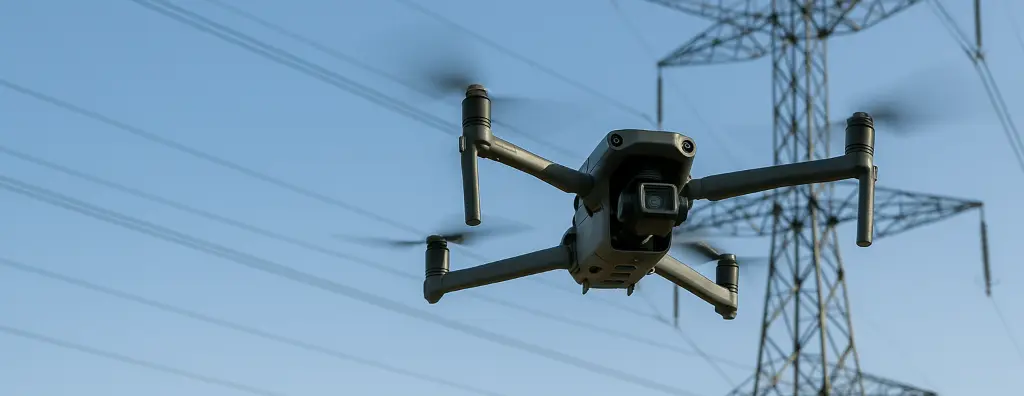
See how AI-equipped drones are transforming route mapping in telecom and energy engineering projects with greater precision, safety, and technical reliability.
Check it out!
Artificial Intelligence in engineering projects – Telecom and Energy. The application of AI in engineering is leaving the theoretical, sometimes almost futuristic, space and gaining ground in practical solutions directly applied in the field.
In this article, we present a real case study of the application of Artificial Intelligence in Engineering Projects. We show how drones with embedded intelligence are optimising a critical stage: route mapping for power transmission lines and optical links.
More than technological innovation, the integration between AI and aerial surveying is redefining standards in infrastructure projects, where route accuracy and reliability of technical documentation are essential for approval, safety, and feasibility.
Based on a project conducted by our Engineering team, we evaluate how intelligent drones are replacing traditional surveying, accelerating deliveries, reducing operational risks, and increasing the technical quality of route definition.
[elementor-template id=”24446″]
What Are AI Drones and How Do They Work?
Drones with Artificial Intelligence are unmanned aerial devices that integrate embedded technologies for autonomous navigation, computer vision, and machine learning to perform tasks with greater precision, safety, and autonomy. In engineering projects, they are increasingly used to replace or complement traditional topographic surveying.
Embedded intelligence allows the drone to go beyond simply flying over coordinates. It can identify obstacles, adjust altitude according to terrain, record relevant elements such as poles, structures, and natural paths, and capture high-resolution georeferenced images with centimetric precision when equipped with RTK (Real-Time Kinematic).
After the flight, this data is processed by software that also uses AI, such as photogrammetric engines that generate orthomosaics, digital terrain models, and point clouds. The result is a technical base ready to be used in optical and electrical network projects, compatible with CAD and GIS platforms.
Technology and Embedded Resources in Drones Applied to Engineering
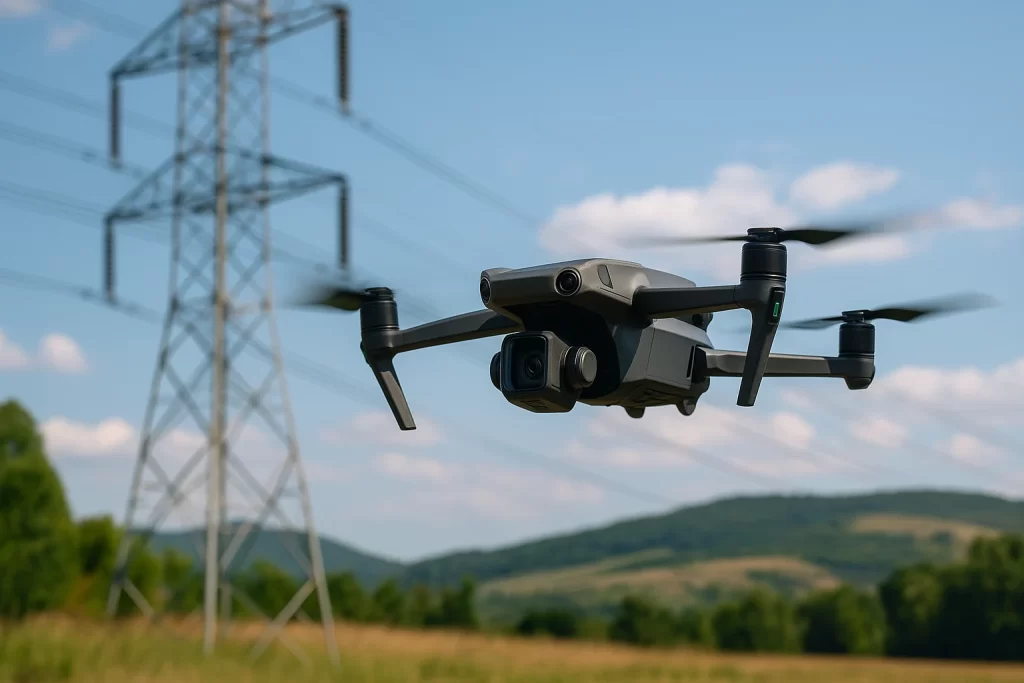
Drones used in technical projects require capabilities far beyond those found in recreational or consumer drones. These devices are designed to perform centimetric-precision surveys, operate safely in critical environments such as areas with energised electrical networks, and deliver data compatible with professional engineering platforms.
Main Features
| Feature | Technical Function |
|---|---|
| GNSS with RTK/PPK | Ensures positioning with error below 3 cm, essential for surveying |
| High-resolution camera with mechanical shutter | Captures images without distortion, ideal for orthophotogrammetry |
| IMU (Inertial Measurement Unit) | Stabilises the flight and maintains alignment during mapping |
| Anti-collision sensors and computer vision | Detects and avoids obstacles in real time |
| Autonomous flight planning by software | Allows the drone to follow programmed routes with exact overlap |
| Compatibility with photogrammetric software | Generates orthomosaics, surface models, and point clouds |
| Integration with control points (GCPs) | Increases geodetic accuracy for high-demand projects |
Professional drones versus recreational drones: what are the real differences?
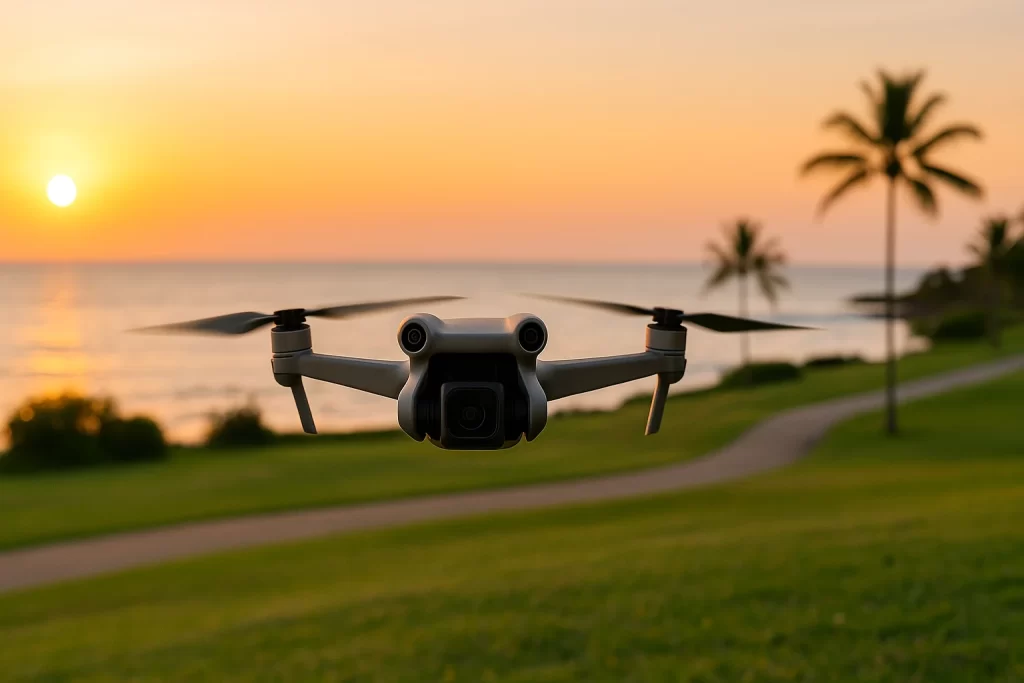
Although visually similar, professional drones used in engineering have purposes, structure, and performance that are completely different from popular drones used for entertainment, casual shooting, or aerial photography.
| Characteristic | Professional Drone (Engineering) | Recreational Drone |
|---|---|---|
| Positioning Accuracy | Centimetric (with RTK/PPK) | Ranges from 1 to 5 metres |
| Camera | Calibrated sensor, 20-45 MP, mechanical shutter | Automatic camera, 12-20 MP, autofocus |
| Flight Planning | Automated missions with overlap and GSD control | Manual control or basic waypoint |
| Flight Time | 30 to 50 min with industrial batteries | 20 to 30 min, lower autonomy |
| Purpose | Engineering, surveying, technical inspections | Leisure, hobby, recreational filming |
| Generated Technical Documentation | Orthomosaic, vector plan, point cloud, UTM coordinates | Photos and videos without technical value |
| Price | BRL 35,000 to BRL 80,000+ | BRL 3,000 to BRL 12,000 |
In short: a recreational drone shows where you have been. A professional drone with AI and RTK shows exactly where each element of your project is.
Practical Applications in Projects
Route Mapping for Optical Fibre in a Rural Area
Imagine that your team needs to map a 5 km route between two critical structures at a plant, passing through a mixed area with vegetation, road crossings, and rural distribution network poles, in order to deploy aerial optical fibre.
With a professional drone (e.g. DJI Mavic 3 Enterprise RTK)
- The mission is planned with 75% image overlap and a GSD of 2.5 cm/pixel
- The drone automatically records the exact position of each pole with 2 to 3 cm accuracy
- The flight follows an automated route, respecting contour lines and obstacles
The images are processed in photogrammetric software, generating:
- Georeferenced orthomosaic
- Digital terrain model (DTM)
- Vector route plan
- Spreadsheet with UTM coordinates for the poles
The result is compatible with AutoCAD, QGIS, and documentation for approval by the utility company.
With a recreational drone (e.g. DJI Mini 3 Pro)
- The flight is performed manually with low-precision GPS support
- The images capture the landscape with reasonable quality, but without scale or alignment control
- It is not possible to georeference pole positions with technical accuracy
- The generated material is useful only as visual support, without value for executive design
- The images do not meet the requirements of bodies such as utility companies or municipalities
A recreational drone may help you “see” the route.
A professional drone with AI and RTK shows exactly where, how, and with what level of reliability you can execute the project.
The Importance of Route Mapping in Technical Projects
Accurate route mapping is an essential step in telecommunications and power distribution projects, especially when infrastructure will be deployed over existing aerial networks. Before any execution, it is necessary to understand the exact route path, identify obstacles, validate technical feasibility, and document every support point, such as poles, spans, and crossings.
In optical projects, for example, the fibre route needs to follow a safe, economical, and technically feasible logic. In distribution networks, routing must consider safety limits, coexistence with other infrastructures, and the real availability of the pole network.
This is where mapping with AI-equipped drones offers a concrete advantage: it makes it possible to collect field data with high precision, speed, and minimal operational risk, replacing slow and inaccurate manual surveys.
In addition, the technical documentation generated by this kind of survey is not merely visual. It is a legal, technical, and contractual input, used in project approval by utilities such as Copel, Cemig, Enel, and Celesc, and necessary for ART issuance and executive drawing preparation.
Case Study: The Route Mapping Challenge in Distribution Networks
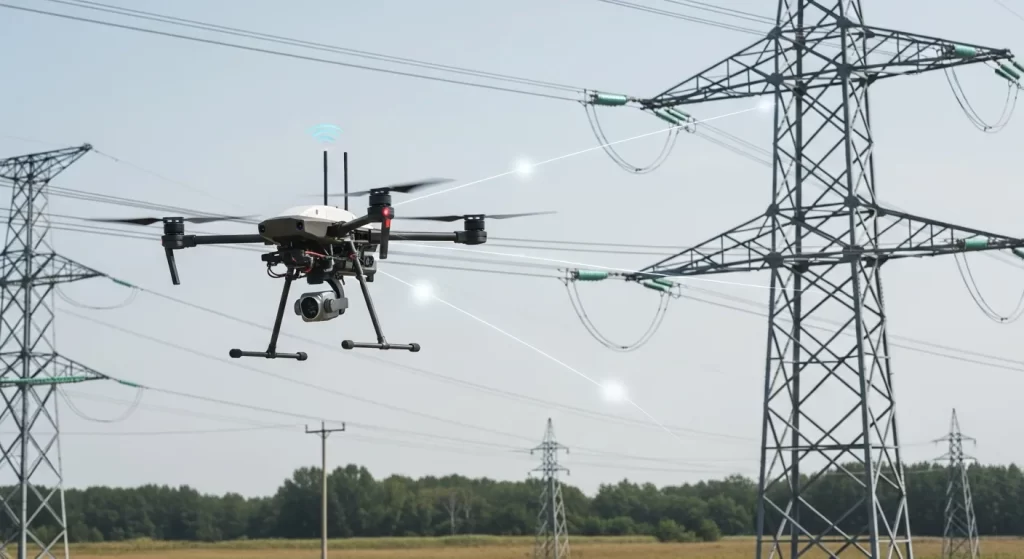
In expansion or reinforcement projects for power distribution networks, especially in areas with mixed infrastructure covering both urban and rural stretches, it is common for the documentation on the actual position of aerial network poles to be outdated, incomplete, or unavailable. This kind of scenario creates a direct barrier to defining the route of the new network.
In a typical engineering project aimed at interconnecting operational structures through an overhead distribution line, the route needs to consider not only the availability of existing poles but also safety requirements, clearances, spans, and interference with other infrastructures such as roads, fences, and vegetation.
In this context, the most effective solution has been the use of drones with RTK and embedded intelligence, capable of mapping the entire right-of-way with centimetric precision, generating supporting materials such as:
- Georeferenced orthomosaics
- Digital terrain models (DTM)
- Automatic identification of poles
- Extraction of UTM coordinates and vector documentation compatible with CAD platforms
This approach eliminates the need for extensive manual surveying, reduces field time, and provides a robust technical basis for executive project development. In many cases, the collected data is also used to support the approval request submitted to the utility company responsible for the area of implementation.
Direct Benefits of AI Applied to Drones in Engineering
The integration of Artificial Intelligence into drones used in engineering is not merely a technological advancement. It represents a paradigm shift in how technical field surveys are performed.
By employing embedded AI, intelligent sensors, and computer vision algorithms, drones become capable of performing tasks that once required days of manual work, while also eliminating operational risks and significantly increasing the quality of the collected data.
| Benefit | Impact on Engineering |
|---|---|
| Centimetric precision with RTK and embedded AI | Makes it possible to generate reliable drawings and technical reports ready for utility approval |
| Automated flight and data collection | Reduces field time and eliminates the need for physical access along the full route |
| Autonomous identification of structures, poles, crossings, obstacles | Speeds up processing and vectorisation of the drawing |
| Three-dimensional terrain modelling and orthomosaic generation | Supports engineering decisions in projects involving slopes, rivers, hillsides, and dense vegetation |
| Generation of documentation compatible with CAD/GIS platforms | Integrates data into the design workflow with precision and agility |
| Operational safety in critical areas | Reduces team exposure to risks near energised lines or hard-to-access terrain |
In short, AI applied to drones makes it possible to replace manual surveying with an automated process that is safer, faster, and far more accurate.
Final Considerations
The application of Artificial Intelligence in drones used for route mapping represents a concrete advance in field engineering. In telecommunications and energy projects, where route precision and documentation reliability directly affect approval and execution, this technology delivers superior results.
Replacing manual surveying with automated processes using RTK drones equipped with AI provides clear gains in efficiency, safety, and technical quality, especially in linear works, remote interconnections, and regions with restricted access. In addition, the generated data is compatible with modern design workflows and integrates easily with tools such as AutoCAD, QGIS, and BIM platforms.
Our View
At A3A Engenharia de Sistemas, we understand that technology must be applied with technical criteria, responsibility, and a clear purpose. That is why we constantly study solutions capable of making our projects more efficient and robust, without compromising precision, regulatory compliance, and execution feasibility.
The integration of AI drones into surveying and technical mapping processes is part of our commitment to practical innovation, the kind that solves real problems, shortens deadlines, and raises the standard of delivered engineering. We are prepared to apply this approach whenever it represents a legitimate advantage for project success.
Explore More About AI Applied to Engineering
Artificial Intelligence is already a consolidated engineering resource. The use of intelligent drones in route mapping is just one of several applications that are transforming the way we design, execute, and monitor technical works.
If you work in telecommunications, energy, infrastructure, or technology, follow our content series on AI in Engineering:
👉 Also read: AI in Engineering – Introduction to the strategic use of Artificial Intelligence
👉 Coming soon: AI applications in security systems, video analytics, and critical infrastructure automation
Do you have a project that demands technical precision in the field?
Talk to our team and discover how to apply AI in practice with safety, reliability, and engineering vision.
🔗 Get in touch | Follow A3A Engenharia on LinkedIn | Visit our technical portfolio
