
Understand the factors that define internet performance and how to choose the ideal plan for streaming, gaming, browsing, and everyday network use.
Check it out!
With the growing offer of higher-speed plans from providers, many consumers wonder what the ideal capacity is to meet their specific needs.
Many simply subscribe to larger plans without even knowing why.
Understanding the variables involved, such as transfer rate, network traffic, and the requirements of each type of application, is essential to correctly size the capacity needed for your network.
In this article, we will explore the factors that influence the choice of an internet plan, allowing a clearer understanding of how each usage scenario requires different performance levels.
Take a look!
[elementor-template id=”24446″]
How to Measure Network Performance?
The term “speed” is widely used to describe network performance, but technically it is not the most appropriate expression for evaluating the quality or efficiency of a data communication link.
Contrary to what many believe, performance does not translate directly into the speed at which data travels.
Network performance is actually a combination of several parameters that affect how data is transferred and received. Let’s understand them:
Data Transfer Rate
The transfer rate is the direct measure of a network’s capacity to transport data over a given period of time, usually expressed in megabits per second (Mbps), and more recently gigabits per second (Gbps) have also become common.
This metric indicates the volume of information that can be sent or received per unit of time, and it can be said that it is the main metric for determining the efficiency of a network.
To make it easier to understand, we can use an analogy with a highway:
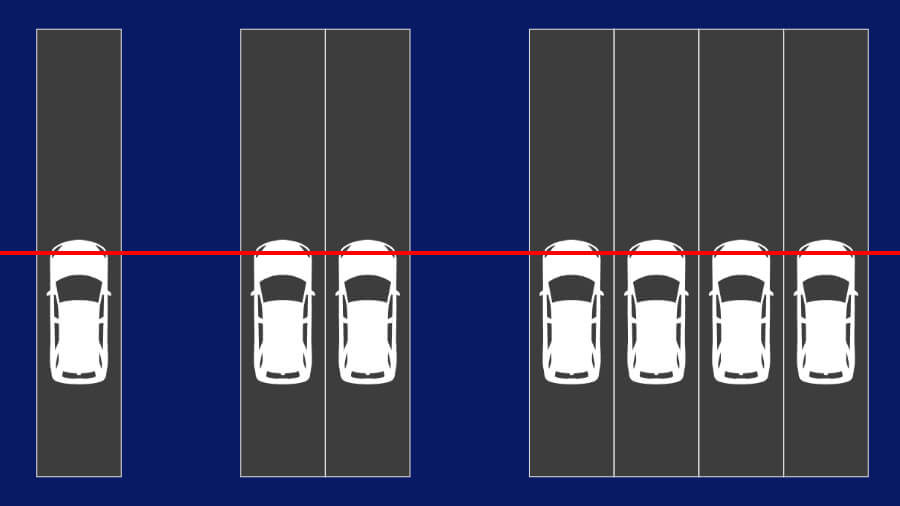
The transfer rate can be influenced by several factors, such as the type of physical connection (transmission medium), network traffic, and hardware configuration.
Bandwidth
Bandwidth consists of the “size” of the frequency range that a communication channel can use to transmit signals, measured in Hertz (Hz).
Bandwidth is inherent to the physical medium.
For example, a CAT5e twisted-pair cable has a nominal bandwidth of 100 MHz, which means it can use a range of up to 100 million frequency cycles per second.
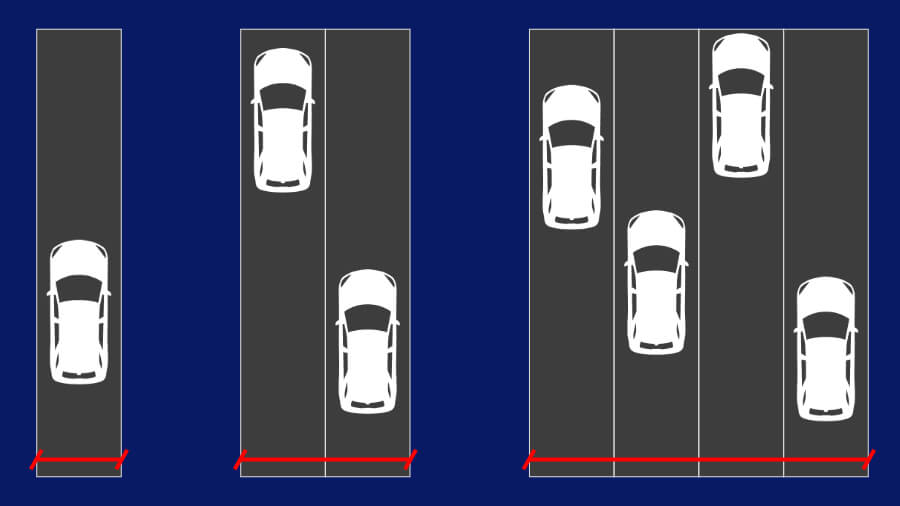
In the context of computer networks, bandwidth is usually translated into bit rate terms (Mbps, Gbps), because there is a direct relationship between the amount of available frequencies and the amount of information that can be transmitted per unit of time.
Maximum Theoretical Transfer Rate
However, bandwidth is not the only factor that defines the maximum theoretical transfer rate of a channel.
A clear example of this is the comparison between CAT5 and CAT5e cables, which have the same bandwidth of 100 MHz but different transmission capacities. CAT5e can transmit up to 1 Gbps, while CAT5 is limited to 100 Mbps.
This happens because, in addition to bandwidth in Hz, factors such as modulation and resistance to interference also influence channel efficiency.
More advanced modulation techniques allow more data to be transmitted per signal cycle, optimizing the use of available bandwidth.
Throughput
When you subscribe to an internet plan, what you are paying for is data transfer capacity.
Latency
Latency is one of the main factors that affect network performance. It refers to the time it takes for a data packet to travel from its source to its destination, and it is commonly expressed in milliseconds (ms).
Although it is often confused with transfer rate, latency measures the total delay in packet delivery, which can have a significant impact on time-sensitive applications such as videoconferencing, online gaming, and VoIP calls.
Jitter
Jitter is a metric that measures the variation in delay (latency) between successive packets transmitted over a network.
In an ideal scenario, data packets travel at regular intervals, but in real networks those intervals may vary due to congestion, routing, or other factors, resulting in jitter.
Jitter, also expressed in milliseconds (ms), has a direct impact on real-time applications such as VoIP calls, videoconferencing, and online gaming, where consistency of data flow is critical.
External Factors That Influence Network Performance
Network performance is influenced by a series of external factors that affect the efficiency and quality of data transmission.
The metrics used to measure performance are the result of the physical and environmental conditions in which the network operates, as well as the quality of the installation and the compatibility of the components.
These external factors can directly impact the network’s ability to achieve its theoretical capacity.
In an ideal network, the transfer rate would be close to maximum capacity, and latency would be minimal and stable.
However, external influences often degrade these results, moving them away from theoretical values.
Interference
Interference is one of the main external factors that can degrade network performance, especially in environments that use copper cabling or wireless systems.
It occurs when unwanted electrical signals generated by external sources affect the integrity of the signals transmitted by the network, resulting in data loss, increased latency, and, in severe cases, connection interruptions.
Signal Attenuation
Attenuation is the gradual loss of signal intensity as it travels through a transmission medium, such as copper cables, optical fiber, or even radio waves in wireless networks.
This phenomenon is natural and occurs in any communication system, being one of the main factors that limit transmission distance and quality in data networks.
When the signal weakens too much, it can result in packet loss, communication errors, and a reduction in transfer rate.
Network Traffic
Network traffic refers to the amount of data being transmitted simultaneously over a network at a given moment.
When many devices or applications are sending and receiving data at the same time, congestion may occur, which directly affects network performance.
Heavy traffic can result in a reduction in effective transfer rate, increased latency, packet loss, and variations in response time (jitter), affecting user experience and application performance.
Hardware
Hardware plays a crucial role in network performance, because it is responsible for processing, forwarding, and transmitting data between devices.
The quality, capacity, and configuration of physical network components, such as routers, switches, cables, and network adapters, directly affect transfer rate, latency, and overall data communication reliability.
Inadequate choices or undersized hardware can result in bottlenecks, packet loss, and instability.
Installation Conditions
The installation conditions of a data network are decisive for its performance and stability.
Even with the right hardware and quality infrastructure, poor installation can seriously compromise transfer rate, latency, and network reliability.
Problems such as badly positioned cables, poor connections, and physical or electromagnetic interference are examples of issues that can arise from improper installation, resulting in packet loss, excessive attenuation, and interference.
Requirements of Common Applications
Video Streaming
Streaming applications, such as movie, series, and live-broadcast platforms (Netflix, YouTube, Twitch), require a continuous and relatively high transfer rate to maintain image quality and avoid interruptions (buffering).
For example, Full HD (1080p) streams may require 5 to 10 Mbps, while 4K HDR content frequently exceeds 20 Mbps.
In addition, the higher the video quality and the greater the number of simultaneously connected devices, the greater the required capacity.
If a household has multiple users consuming high-resolution video at the same time, the sum of individual demands must be considered when sizing the plan.
Online Gaming
Modern online games, especially multiplayer titles, have slightly different requirements.
Although the nominal transfer rate does not need to be as high as with video streaming, latency (response time) is a critical factor.
Connections with latency below 50 ms usually provide a satisfactory experience, keeping gameplay smooth.
The transfer rate itself, in most cases, can be around 5 Mbps. However, link stability and the absence of packet loss are essential to avoid freezes and delays during gameplay.
Web Browsing
Traditional internet browsing, such as accessing news sites, blogs, e-commerce platforms, or social networks, is relatively light in terms of transfer rate.
Even 5 to 10 Mbps connections already provide fast loading for most pages.
However, if usage involves videoconferences, webinars, or frequent file sharing, the required capacity may increase.
HD videoconference applications, for example, require between 2 and 5 Mbps of stable bandwidth per session.
Thus, for use predominantly based on browsing and social media, mid-range plans are usually sufficient, as long as latency and stability are acceptable.
Final Considerations
When analyzing the capacity of an internet link, it is necessary to look beyond the simple marketing message of “more speed.”
Before subscribing to a plan with rates of 300, 500, or even 1,000 Mbps, it is important to reflect on the practical use that will actually be made of the connection.
In many households, an intermediate speed may be fully adequate, more than meeting the needs of streaming, occasional online gaming, and smooth browsing.
In addition, the quality of the internal network (routers, cabling, Wi-Fi) and the number of devices connected simultaneously may be bottlenecks just as important as the capacity provided by the ISP.
Internet speed is, in a sense, a commodity.
In a world where a broad offer of ultra-fast plans is available, it may seem tempting to acquire the fastest package on the market.
However, if the goal is cost-effectiveness and rational use of resources, evaluating usage profiles, the number of users, and the activities performed makes it possible to choose a more modest plan that is still satisfactory.
In this way, it is possible to balance cost, performance, and comfort.
