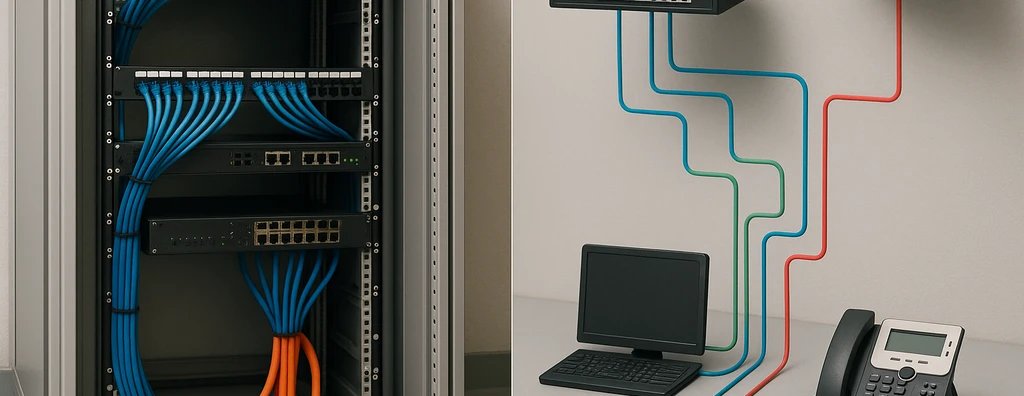
Robust corporate networks depend on precise integration between their physical and logical layers to ensure performance, operational effectiveness, and security.
Check it out!
Robust corporate networks depend on precise integration between their physical and logical layers to ensure performance, operational effectiveness, and security. Technical understanding of the differences and synergies between physical networks and logical networks is fundamental when designing, operating, and maintaining high-availability IT infrastructures, especially in the face of demands such as technological evolution, integration of multiple applications, and resilience against failures.
This article analyzes in depth the concepts of physical network and logical network, their main differences, typical applications, and best practices for design and implementation. The objective is to provide a technical reference for project decision-making and execution, contributing to operational excellence and reliability of IT infrastructures in business environments.
Check it out!
[elementor-template id=”24446″]
Physical Network Fundamentals
The physical network forms the material foundation of data communication systems. It is composed of the entire set of tangible elements responsible for transporting electrical, optical, or radio-frequency signals, including cables such as UTP twisted pair, optical fiber, and coaxial media, connectors, connection panels, racks, switches, routers, termination points, and the supporting infrastructure of ducts and raceways. This layer must be designed according to engineering principles that ensure compliance with requirements related to distance, electromagnetic interference, losses, attenuation, and bandwidth capacity.
- Structured cabling: Includes the hierarchical and standardized arrangement of access points, following standards such as cable categories and recommended uses for horizontal links, vertical links, and backbone connections.
- Physical Topologies: Examples of implemented architectures include hierarchical star, ring, or bus topology, each with implications for performance, redundancy, and maintenance.
- Active and Passive Equipment: Includes switches, routers, optical media converters, distribution panels, patch panels, and transceivers, each playing critical roles in signal transport and integrity.
The physical design must consider factors such as future expandability, resilience through dual approach, path or link redundancy, and compliance with technical regulations, minimizing single points of failure.
Technical Aspects of the Logical Network
The logical network comprises the organization of data flows, addressing, logical-functional segmentation, routing policies, segregation, and the application of protocols. This layer is abstract, existing on top of the physical topology, and defines how devices interact, how logical paths are established, and how data is managed throughout the network.
- Logical Topologies: These may differ radically from the physical topology. For example, a physically star-based network may operate logically as a bus, depending on switch and router configuration.
- Addressing and Naming: Includes IP address allocation, subnet segmentation, VLAN definition, and application of naming conventions. These definitions are essential for scalability, performance, and security.
- Protocols and Policies: Involve configuration of routing protocols, access control, logical security, load distribution, and VLAN implementation.
- Logical Management and Monitoring: Uses centralized management tools for asset control, traffic visibility, and the application of QoS policies.
The logical design is detailed in the definition of virtual links, logical redundancy, failover protocols, and strategies to guarantee high availability, data integrity, and secure segregation by departments or critical areas.
Technical Differences: Physical Network vs. Logical Network
- Materiality: The physical network is composed of tangible elements, while the logical network exists as representation in the upper layers of the OSI model, typically from Layer 2 onward.
- Purpose: While the physical network provides the transport medium for signals, the logical network defines the path, treatment, control, and segmentation of data flows.
- Modifiability: Logical changes, such as creating new VLANs or subnets, can be implemented without physical changes, whereas modifications to the physical network involve material intervention and possibly scheduled downtime.
- Resilience and Redundancy: Physical redundancy implies duplicated cables or equipment. Logical redundancy can rely on dynamic protocols, alternate paths, and automated failover.
- Practical example: A physical star topology may support several coexisting logical topologies, such as a virtual bus through VLANs or segmentation by department.
Main Topologies and Architectures
Common Physical Topologies
- Hierarchical Star: Centralized arrangement with core, distribution, and access switches. It favors scalability and fault isolation.
- Ring: Used for fault tolerance in certain critical environments, with path recovery in the event of rupture.
- Bus: Historically used, now uncommon, limited in scalability and susceptible to failures.
Common Logical Topologies
- Virtual Bus: Segmentation by VLANs, allowing multiple logical broadcast domains on the same physical structure.
- Hierarchical Network: Logical layers grouped by function, separating core, distribution, and access according to data flow and security needs.
Descriptive Diagram
Textual diagram example:
[Users/Devices]
|
|
[Access Switch]
|
[Distribution Switch]
|
[Core Switch]
|
[Gateway/Firewall/Internet]
On top of the same physical infrastructure, multiple logical networks may coexist, defining specific flows and restrictions according to protocol configuration and segmentation policies.
Typical Applications and Use Cases
- Corporate Sectors: Deployment of resilient physical networks with hierarchical topologies and logical management through VLANs, segmented IP addressing, and customized routing policies.
- Data Centers: Very high degree of physical redundancy through duplicated links, switches, and routers combined with multiple overlaid logical networks that separate production, management, and backup using failover and high-availability protocols.
- Industrial Environments: Need for robust cabling and rapid physical recovery, complemented by logical segmentation for security and prioritization of critical traffic through QoS.
- Corporate Campuses: Extensive structured cabling infrastructure, with segmentation by blocks, sectors, or departments through VLANs and distributed logical access and security policies.
Security in Physical and Logical Networks
Security must be addressed both in physical design, preventing unauthorized access to the infrastructure, and in logical configuration, ensuring the integrity, confidentiality, and availability of data:
- Physical Security: Protection of technical rooms, racks, and cable pathways, identification of access points, implementation of physical entry control mechanisms, protection against external interference, and environmental monitoring.
- Logical Security: Application of authentication protocols, VLAN segmentation, access control through lists and specific policies, firewalls, encryption, and traffic monitoring.
- Redundancy for Continuity: Logical and physical solutions together guarantee continuity of services even under failure of individual components, using automatic failover strategies, alternate paths, and load balancing.
Best Practices for Design, Implementation, and Management
- Integrated Planning: Start the project with joint analysis of expansion, security, and logical-physical flexibility needs, considering current and future demand.
- Hierarchy and Modularity: Apply hierarchical architecture both physically and logically, facilitating maintenance, growth, and segmentation.
- Technical Documentation: Map the entire physical and logical infrastructure, including topology diagrams, addressing spreadsheets, and asset management information.
- Implementation of Redundancy: Design redundant physical routes and logical paths, adopting high-availability protocols and dynamic load balancing such as GLBP and HSRP.
- Multilayer Security: Adopt security mechanisms from physical layers to logical layers, using unified access controls and appropriate segmentation.
- Centralized Management and Monitoring: Use management platforms for proactive monitoring of availability, performance, and failures, with alerts and automated responses.
- Team Enablement: Keep teams updated on best practices in both physical operation and logical management, with focus on incident prevention and rapid response.
Conclusion
Deep understanding of the differences, interrelationships, and roles of physical and logical networks is a central requirement for the success of IT infrastructure projects. Technical alignment between the layers ensures performance, scalability, security, operational flexibility, and resilience in the face of failures or environment migrations. Investing in planning, adoption of best practices, and use of appropriate technologies leads to robust infrastructures capable of supporting current and future strategic demands of organizations.
It is essential that project decisions consider integration from cabling to logical segmentation, prioritizing documentation, redundancy, multilayer security, and centralized management. This approach prepares the environment for technological transformations, secure growth, and continuity of operations even under adverse events.
Final Considerations
Based on what has been covered, the need for a systemic and multidisciplinary approach to network projects in corporate environments becomes evident. Thank you for reading this article, and we invite you to follow A3A Engenharia de Sistemas on our channels and social media for more technical content and sector updates.