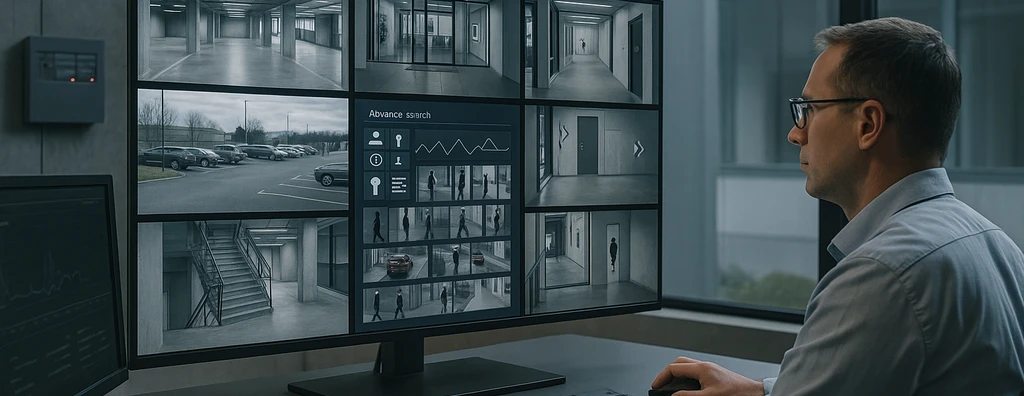
The evolution of artificial intelligence technologies in video surveillance systems has transformed electronic security by integrating advanced analytics and interpreting massive image sequences into actionable information.
Check it out!
The evolution of artificial intelligence technologies in video surveillance systems has profoundly transformed the approach to electronic security by integrating advanced video analytics and interpreting massive sequences of images into actionable information in real time. The growing volume of data generated by high-definition cameras has imposed significant challenges on manual analysis and continuous monitoring, requiring solutions that enhance automation, precision, and operational efficiency in critical, industrial, urban, and corporate environments.
This article explores in detail the main features of AI-powered video synopsis, including advanced search capabilities, intelligent alert generation, and process automation. The objective is to present, with technical rigor, its mechanisms, benefits, practical limitations, and implications for electronic security projects and integrated surveillance systems.
Check it out!
[elementor-template id=”24446″]
Fundamentals of AI-Powered Video Synopsis
AI-powered video synopsis is based on automated video analysis techniques that extract information without the need for constant review by human operators. Modern solutions apply deep learning algorithms to:
- Detect and classify different objects such as people, vehicles, animals, and static or moving items;
- Generate rich descriptions of scene content through metadata, including location, trajectory, interactions, and attributes;
- Correlate events across multiple video streams for the synthesis of relevant incidents;
The central concept of video synopsis lies in visual condensation, where multiple events recorded over long time intervals are presented simultaneously in a single sequence, preserving the integrity of the information while drastically reducing the time needed for review.
AI-based analysis enhances contextual inference mechanisms, making it possible to distinguish anomalies, behavioral patterns, and situations outside predefined standards, thereby promoting proactive monitoring.
Technological Architectures and Integration with Security Systems
The architectures of systems that employ video synopsis with AI analytics can be classified according to where data processing takes place:
- Edge-based: processing performed directly on intelligent cameras, allowing real-time response and reduced network traffic.
- Server-based: processing occurs centrally, aggregating data from multiple sources for complex analyses and advanced correlations.
- Cloud-based: scalability and remote access, with AI applications and massive storage.
- Hybrid architecture: a combination of the previous models to optimize cost, performance, and flexibility.
Integration typically takes place through open protocols aligned with interoperability standards, enabling communication among video management systems (VMS), access control, intrusion detection, building automation, and audio analytics. Video synopsis can be easily connected to legacy systems and modern platforms, adapting to the growth of operational demands.
Advanced Video Search: Mechanisms and Practical Applications
Advanced search features based on video synopsis employ enriched metadata, enabling refined filters and precise location of events of interest. The main mechanisms include:
- Attribute-based search: identification of people, vehicles, or objects based on color, size, direction, speed, and presence in specific areas.
- Temporal search: rapid location of occurrences within defined time ranges, grouping similar events and eliminating irrelevant periods.
- Correlation of multiple events: cross-analysis among different cameras and sensors, increasing accuracy in investigations.
With advanced video synopsis techniques, it becomes possible, for example, to identify within seconds all occurrences of unauthorized access during a specific shift, locate abandoned luggage, or track the movement of suspicious vehicles across monitored perimeters.
- Automation of search criteria through configurable logical rules;
- Generation of reports and export of records in formats compatible with audits and legal proceedings;
- Significant reduction in response time for investigative processes.
Intelligent Alerts and Automated Notifications
Using artificial intelligence, video synopsis systems expand the ability to generate real-time alerts through the identification of predefined critical events. These alerts are based on policies and business rules established according to operational and normative requirements:
- Detection of atypical movement in restricted areas;
- Recognition of suspicious behavioral patterns such as loitering, crowds, and intrusions;
- Identification of objects left behind or removed from sensitive areas;
- Synchronization with building automation systems, enabling autonomous responses such as triggering sirens, blocking access, and notifying response teams.
Alerts can be routed through multiple channels, including operational dashboards, mobile devices, email notifications, SMS, or direct integration with alarm protocols. The detail present in the metadata, such as event type, exact time, and visual evidence, supports fast and accurate handling of detected occurrences.
Automation in Surveillance Systems and Operational Efficiency
The automation provided by AI-powered video synopsis enables the execution of automatic response workflows and reduces human intervention in repetitive activities. Some practical examples include:
- Activation of specific recordings when events are detected;
- Triggering of physical and virtual alarms in real time;
- Generation of synthetic reports for managers and regulatory bodies;
- Automated updates of operational status dashboards;
- Active monitoring of device health through self-diagnosis;
Automation directly impacts operational efficiency by enabling immediate response to critical situations and contributing to regulatory compliance and lower costs associated with traditional video surveillance operations.
Systemic Benefits and Technical Advantages of Video Synopsis
- Time efficiency: analysis and review of large volumes of video in just a few minutes.
- Increased accuracy: AI algorithms minimize false positives and false negatives in the detection of relevant events.
- Improved auditing and compliance: records and evidence with metadata facilitate documentation for investigations and legal proceedings.
- Scalability: solutions adaptable to different sizes of operations and sectors.
- Interoperability: support for multiple protocols and integration with existing systems according to market standards.
These advantages are enhanced when deployed in flexible and robust network architectures that combine edge devices, local servers, and cloud applications according to project requirements.
Technical Challenges and Operational Limitations
Despite the advances, the implementation of AI-powered video synopsis faces limitations and technical challenges such as:
- Camera quality and positioning: coverage failures, low resolution, inadequate lighting, and incorrect positioning compromise the effectiveness of the analysis.
- Complexity of monitored scenarios: highly dynamic and crowded environments may require algorithm customization and frequent calibration.
- Processing latency: in highly demanding environments, the delay between event capture and notification can become a restrictive factor.
- Infrastructure costs: need for high-performance processing, massive storage, and adequate bandwidth.
- Legal and ethical considerations: compliance with applicable legislation on privacy and data protection, especially for facial and biometric analysis.
It is recommended to conduct preliminary technical analyses, field tests, and validation of algorithms before broad implementation of video synopsis features in critical environments.
Applicable Technical Standards and Reference Frameworks
AI-powered video synopsis systems must observe normative standards to guarantee interoperability, information security, and regulatory compliance. The following are particularly relevant:
- IEC 62676: defines requirements for closed-circuit video surveillance systems, covering minimum criteria for performance, transmission, and data processing;
- Open integration protocols: guide the interface with management systems, access control, and automation platforms;
- Complementary cybersecurity and data protection standards applicable to the transmission and storage of sensitive information.
Alignment with these standards ensures reliability and long-term value of investments, while maximizing normative and operational adherence of deployed systems.
Case Studies and Practical Applications
The application of AI-powered video synopsis is broad and spans several sectors:
- Corporate environments: monitoring of public areas, offices, parking lots, and restricted access zones, providing immediate detection of incidents and operational deviations;
- Critical infrastructure: refineries, ports, airports, and electrical substations, where video synthesis optimizes emergency response and periodic audits;
- Public sector: urban monitoring, traffic management, and real-time detection of incidents such as theft, accidents, and vandalism;
- Industry: automation of logistics processes, loss prevention, asset tracking, and environmental control in production lines.
Operational results often include increased detection, better use of the operational workforce, and reduction of direct and indirect costs associated with security and oversight.
Conclusion
The incorporation of AI-supported video synopsis redefines the paradigms of electronic monitoring and forensic analysis, delivering substantial gains in efficiency, precision, and automation. Advanced search resources, intelligent alerts, and operational automation give electronic surveillance systems a new level of effectiveness, making them indispensable for complex and demanding security scenarios.
Strict compliance with technical standards, integration criteria, and best engineering practices is essential to unlock the full potential of these systems, while technical and legal challenges impose the need for continuous and specialized evaluation. The refinement of AI-powered video synopsis solutions will continue to evolve, adapting to the growing demand for predictive and responsive security.
Final Considerations
Based on the analysis presented, it is possible to see that the careful adoption of AI-powered video synopsis resources significantly enhances the operational and strategic outcomes of electronic security projects of any size. Thank you for reading this article, and we invite you to follow A3A Engenharia de Sistemas on social media to stay updated on trends, best practices, and engineering solutions in security systems, networks, and electrical infrastructure.