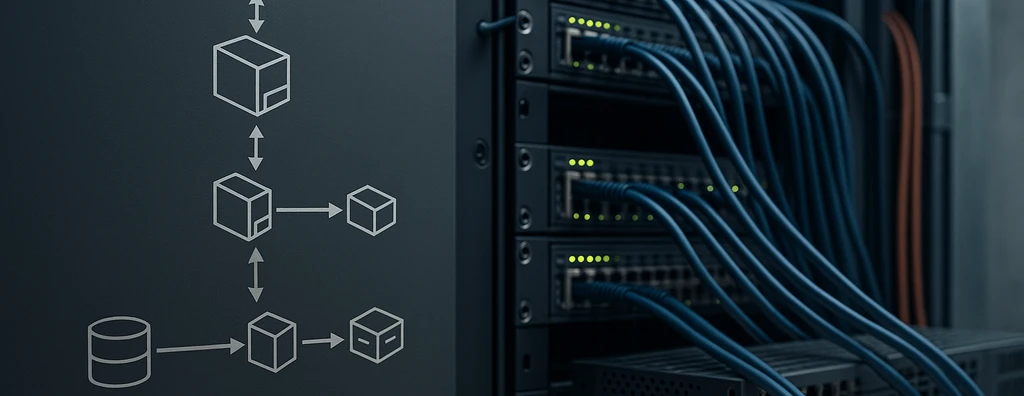
Data communications and computer networks constitute the structural basis of information systems in modern organizations.
Check it out!
The field of data communications and computer networks constitutes the structural basis of information systems in modern organizations, promoting connectivity, application integration, and support for essential mission-critical services. Constant advances in information transmission, infrastructure expansion, and the evolution of technological architectures highlight the central role of these communications in corporate, industrial, and governmental environments. However, challenges such as the need to ensure quality of service, scalability, data security, device interoperability, and the adoption of standards and protocols become indispensable points of attention in network engineering.
This article presents the technical fundamentals of data communications and computer networks from an engineering perspective. Communication models, network architectures, transmission principles, flow control, switching, and protocols are detailed, along with topics related to security and application integration. The goal is to equip engineering professionals with a systemic understanding and with the practical applicability of technologies and standards relevant to the design, operation, and management of corporate and industrial network environments. Check it out!
[elementor-template id=”24446″]
Overview of Data Communications
Data communications involve the transmission, reception, and processing of digital information between interconnected computer systems. This process is enabled by a basic model made up of data sources, transmitters, physical media, receivers, and final destinations. The typical architecture defines specific roles and functions for each element in order to optimize the efficiency and reliability of the information flow.
- Data Source: Originates the information to be transmitted (for example, a workstation, sensor, or application server).
- Transmitter: Converts the data into signals compatible with the transmission medium (modulators, interface cards, routers).
- Transmission Medium: Physical or logical channel through which the signals travel (metallic cables, optical fibers, radio frequency).
- Receiver: Captures the transmitted signal, performing decoding and correction of possible errors.
- Destination: Final delivery element for the data, generally represented by computer systems or embedded devices.
The principles established in international standards provide interoperability between solutions, and the adoption of reference models such as the OSI Model is essential to support the standardization of interfaces and protocols in these communications.
Communication Models and Network Architectures
In the context of data communications, the use of reference models is fundamental to ensure process standardization, facilitate integration between different technologies, and enable system evolution. The following models stand out:
- OSI Model (Open Systems Interconnection): Proposes seven functional layers that segregate responsibilities, from physical transmission to the application level.
- TCP/IP Model: Structured into four main layers: Application, Transport, Internet, and Network Access, and is the primary model for networks currently in operation.
Layer Structure
- Physical Layer: Responsible for transmitting bits over the physical medium, defining electrical, optical, and mechanical characteristics.
- Data Link Layer: Ensures error-free delivery between adjacent elements, with functions such as media access control and error detection/correction.
- Network Layer: Performs packet routing, logical addressing, and congestion control.
- Transport Layer: Ensures end-to-end communication, with flow control and reliability.
- Upper Layers: Manage session, presentation, and applications.
Both models serve as a reference for the development, integration, and analysis of any communication architecture geared toward network engineering.
Data Transmission: Technical Fundamentals
Data transmission is based on principles of multiplexing, encoding, and flow control, requiring a deep understanding of physical media and of the techniques available to optimize bandwidth and minimize errors. The main topics that guide this process are:
- Multiplexing: Allows channel sharing between multiple flows, whether by time division (TDM), frequency division (FDM), or code division (CDM).
- Encoding: Includes techniques used to convert digital data into signals suitable for transmission (NRZ, Manchester, 4B/5B, etc.), favoring synchronization and robustness against noise.
- Flow Control: Uses protocols to manage speed between transmitter and receiver, preventing data loss in the reception buffer.
- Error Detection and Correction: Is based on algorithms such as CRC and automatic repeat techniques that preserve packet integrity.
The appropriate selection of methods is directly related to the specific characteristics of the project, the nature of the transmitted data, and the system’s performance requirements.
Classification of Computer Networks
Computer networks can be grouped according to geographical scope, operational criteria, topology, and transmission technology. The main categories evaluated in engineering projects are:
- Local Area Networks (LAN – Local Area Network): Cover small geographical areas, typically corporate or industrial environments, adopting star, bus, or ring topologies, with standards such as Ethernet and Wi-Fi predominating.
- Metropolitan Area Networks (MAN – Metropolitan Area Network): Interconnect multiple LAN environments within a metropolitan area, using technologies such as FDDI, Metro Ethernet, and optical networks.
- Wide Area Networks (WAN – Wide Area Network): Cover larger geographical distributions, connecting branches, data centers, and links between cities or countries; protocols such as MPLS, Frame Relay, and ATM are applied in this context.
The choice of network architecture depends essentially on the combination of capacity, redundancy, security, and implementation cost requirements.
Main Communication Protocols
Protocols are sets of rules and procedures that make efficient and reliable communication between devices possible. The following stand out:
- Ethernet (IEEE 802.3): The foundation of LAN networks, using collision detection methods and half/full duplex operation.
- Wi-Fi (IEEE 802.11): An essential protocol for local wireless networks, using specific modulation techniques and multiple-access control mechanisms.
- TCP (Transmission Control Protocol): Connection-oriented, it provides reliability and flow control and is used at the transport layer of the TCP/IP model.
- UDP (User Datagram Protocol): A connectionless protocol that prioritizes speed over reliability, ideal for streaming and voice over IP applications.
- IP (Internet Protocol): Responsible for packet addressing and routing in a global topology, defining IPv4 and IPv6.
The correct application and interoperability of protocols directly impact the availability, performance, and scalability of data communication systems.
Switching and Network Structures
The switching process in networks determines how packets, frames, or circuits are established and delivered between source and destination. The main methods are:
- Circuit Switching: A dedicated channel established for the entire duration of the communication, typical of traditional telephone networks. Suitable for transmissions with strict latency and synchronization requirements.
- Packet Switching: Data is divided into units (packets) with dynamic routing through the network. It optimizes bandwidth use and supports scalability, being essential to the Internet.
- Cell Switching: Technologies such as ATM use fixed-size cells, facilitating the integration of voice, data, and video with quality-of-service guarantees.
Structure of Modern Networks
Corporate and industrial networks combine different switching and routing techniques to support mission-critical applications, prioritizing availability, flexibility, and adaptation to variable workloads.
Quality of Service (QoS) and Traffic Management
Quality of Service (QoS) encompasses mechanisms and policies intended to control network traffic performance, ensuring requirements such as priority, guaranteed bandwidth, latency, and reduced jitter for sensitive applications.
- Packet Prioritization: Packet classification and marking tools (DiffServ, IEEE 802.1p) segment critical flows.
- Policing and Shaping: Active traffic management to avoid congestion and ensure minimum service levels.
- Queues and Scheduling: Queuing algorithms (FIFO, WFQ, PQ) organize packet output according to service attributes.
QoS planning becomes vital in converged environments that integrate data, voice, and video, directly influencing decision-making in the design and operation of multiservice networks.
Security in Data Communications
Security must be incorporated from the network design stage onward, considering authentication, encryption, access control, integrity, and information availability.
- Authentication and Access Control: Robust mechanisms for identifying and authorizing users and devices, based on standards such as IEEE 802.1X and protocols like RADIUS/TACACS+.
- Data Encryption: Protection of transmitted data, using symmetric/asymmetric algorithms and protocols such as TLS/SSL and IPsec.
- Firewalls and Intrusion Prevention Systems: Structures positioned at strategic points in the network to filter, monitor, and block unauthorized access.
- Redundancy and Resilience: Implementation of topologies and protection devices to ensure service continuity in the face of failures or attacks.
Standards and Best Practices
The adoption of technical standards for segmentation, continuous system updates, and centralized policy management is essential for compliance and risk mitigation in corporate and industrial environments.
Network Interconnection and the Internet of Things (IoT)
In the current scenario, the integration of different networks, protocols, and devices is fundamental to enable Internet of Things (IoT) solutions and machine-to-machine (M2M) communications. Network engineering must consider:
- Gateways: Intermediate elements that perform protocol translation, data normalization, and physical/logical integration between heterogeneous networks.
- Communication Standards: Use of low-consumption, low-latency, and highly reliable protocols, such as MQTT, CoAP, and industrial protocols (Modbus, Profibus).
- IoT Security: Segmentation and isolation policies, strong device authentication, and continuous monitoring of M2M traffic.
The convergence between IP, specialized networks, and automation demands integrated projects, support for remote updates, and centralized device management mechanisms.
Network Management and Monitoring
Efficient network management ensures continuous availability, performance, and security, supporting proactive diagnostics and predictive maintenance. The main technical aspects are:
- SNMP (Simple Network Management Protocol): The main protocol for monitoring and managing devices in IP networks, enabling metric collection, alert generation, and remote equipment control.
- Fault Management: The ability to identify, isolate, and remediate problems, minimizing service impacts.
- Configuration Management: Inventory, versioning, and centralized control of network device changes.
- Security and Updates: Patch application, permission review, and continuous auditing to maintain compliance and resilience.
Supervision tools and policies integrate with automation systems to provide real-time visibility and support strategic decision-making.
Integration of Services and Applications in the Network Environment
Modern corporate environments demand smooth integration between applications, data services, voice systems, and video systems. This process requires:
- Service-Oriented Architectures (SOA): Standardization of interfaces and protocols for interoperability between heterogeneous systems.
- Converged Networks: Enabling the infrastructure to support multiple traffic types (data, voice, video) without impairing performance or security.
- Network Functions Virtualization (NFV) and SDN: Use of programmable architectures for dynamic resource allocation, logical segmentation, and traffic-policy automation.
Adopting integration best practices provides business agility, scalability, and operational resilience.
Conclusion
Computer network engineering is grounded in consolidated principles of transmission, protocols, multilayer architecture, switching, and security. Correct understanding and application of these concepts are mandatory for the creation of robust, scalable, and resilient infrastructures capable of supporting growing demands for mobility, application convergence, and integration of smart devices. The available technological and normative alternatives provide a high degree of customization and specialization, guiding technical decisions that directly impact operational efficiency and business continuity.
By addressing topics such as communication models, network classification, QoS mechanisms, advanced security, and systems integration, this article provides essential foundations for professionals involved in the specification, deployment, and evolution cycles of corporate and industrial data networks. In the current context, marked by the acceleration of digital transformation and by the centrality of information, network engineering stands out as a strategic area for the sustainability of operations and technological innovation.
Final Considerations
As demonstrated, a solid understanding of the fundamentals of data communications is indispensable for engineers and network professionals working in complex and demanding environments. The disciplined adoption of methodologies, alignment with technical standards, and continuous updating regarding best practices ensure safer, more efficient projects that are better aligned with market reality.
Thank you for reading this article, and we invite you to follow A3A Engenharia de Sistemas on our social networks for technical updates, exclusive content, and industry news. Your participation is fundamental to consolidating a technical community of excellence.
