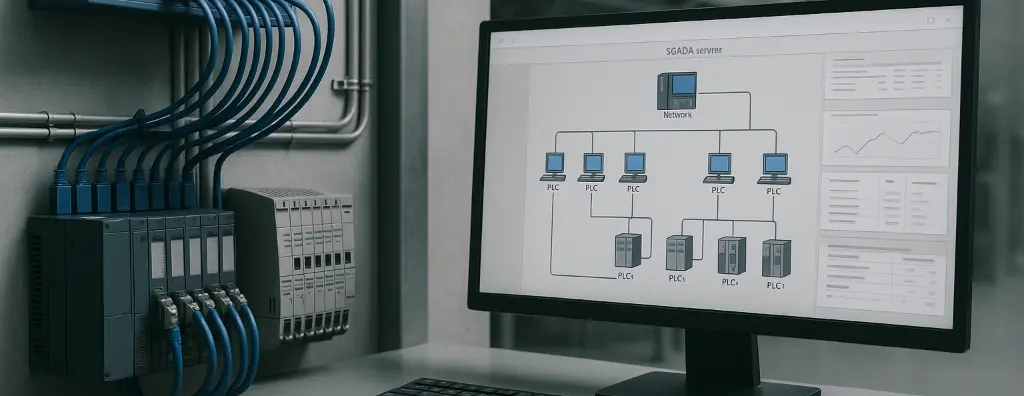
Industrial networks play a central role in automation, control, and supervision processes in high-criticality production environments, integrating field devices, programmable logic controllers (PLCs), operator stations, and SCADA (Supervisory Control and Data Acquisition) systems. The growing demand for performance, interoperability, and operational resilience requires network architectures with fault tolerance, low latency, and advanced cybersecurity mechanisms. Increasing […]
Check it out!
Industrial networks play a central role in automation, control, and supervision processes in high-criticality production environments, integrating field devices, programmable logic controllers (PLCs), operator stations, and SCADA (Supervisory Control and Data Acquisition) systems. The growing demand for performance, interoperability, and operational resilience requires network architectures with fault tolerance, low latency, and advanced cybersecurity mechanisms. Increasing system complexity demands the adoption of consolidated standards, deterministic protocols, and rigorous OT/IT integration policies to ensure continuity, traceability, and efficiency of industrial operations.
This article details the main requirements of industrial networks, the fundamental protocols and technologies, safety and SCADA integration criteria, and technical best practices for implementation in automation plants. It provides a systemic view focusing on robust technical solutions, interoperability, diagnostics, and maintenance, as well as recommendations for supporting electrical infrastructure.
Check it out!
[elementor-template id=”24446″]
Network Topologies and Architectures
Network architectures in industrial environments are based on specific topological models to ensure availability, low latency, and fault isolation. The main models include:
- Bus Topology: Traditionally used in field networks, it facilitates linear interconnection between devices but has limitations in terms of resilience and scalability.
- Ring Topology: Widely employed as it supports redundancy protocols, allowing for fast path reconvergence in case of failure.
- Hierarchical Star Topology: Adopted in large plants, it favors logical segmentation, broadcast domain control, and the implementation of security policies at network boundaries.
In addition to physical topologies, hierarchical routing architectures and VLAN (IEEE 802.1Q) segmentation stand out, providing traffic isolation and simplified maintenance.
Essential Design Criteria
- Availability and Fault Tolerance: Redundancy of physical and logical paths, use of fast convergence protocols, and fault-tolerant equipment.
- Real-Time and Determinism: Guarantee of packet delivery within strict time constraints for control applications (services guaranteed by Integrated Services and DiffServ-based QoS).
- Centralized Management: Implementation of in-band and out-of-band monitoring systems with capabilities for predictive diagnostics, active inventory, and dynamic segmentation.
Field and Backbone Protocols
- Fieldbus and Modbus: Widely used protocols for real-time device communication, with bus topologies and facilities for cyclic and acyclic data exchange.
- PROFIBUS: A deterministic high-performance protocol for demanding industrial environments, supporting reliable data transfer, extended diagnostics, and native integration with automation devices.
- PROFINET: An Ethernet-based solution prepared for industrial automation applications, combining the ease of the TCP/IP suite with specific layers for real-time and fault tolerance.
- Industrial Ethernet: Adoption of the IEEE 802.3 standard modified for noisy environments and precise synchronization needs, with support for EtherChannel, full-duplex, and high throughput.
- OPC (OLE for Process Control): Standard interface for integration between supervisory applications, SCADA systems, and various industrial devices.
Protocol Selection Criteria
- Compatibility with real-time requirements.
- Interoperability with multi-vendor devices.
- Diagnostic and centralized management capacity.
- Resilience against electrical disturbances and communication failures.
- Regulatory support for cybersecurity and traceability.
Vertical and Horizontal Integration Structure
Integrating industrial networks with SCADA systems requires the use of standardized interfaces and interoperability layers. Hierarchical structures favor abstraction between field, control, supervision, and management levels, enabling:
- Vertical Communication: Data exchange between sensors, PLCs, cell controllers, SCADA servers, and ERPs.
- Horizontal Communication: Synchronization of processes and operations between different automation islands and production lines.
Essential Components for Integration
- Gateways and Protocol Converters: Allow interconnection between different standards (e.g., Modbus/Profibus/Ethernet-IP), promoting interoperability without impacting performance.
- OPC Servers: Centralize access between SCADA and field devices using standardized data exchange methods.
- Time Synchronization: Adherence to precise synchronization enables reliable event logging, diagnostics, and operation tracking.
Diagnostics, interconnection monitoring, and data labeling procedures are also critical elements for industrial environments integrated with SCADA.
Performance-Critical Attributes in Automation Environments
- Determinism: Ability to guarantee periodicity and predictability of data delivery, fundamental for closed-loop control.
- Latency: Strict requirements for the maximum acceptable time for transmission between source and destination, especially in continuous or discrete process control.
- Fault Tolerance: Implementation of redundant paths, automatic failover, and self-recovery mechanisms for industrial network elements.
These factors guide both hardware selection (industrial switches, robust cables) and protocol parameterization, establishing foundations for high operational availability.
Scalability and Management
- Modular expansion of network segments without performance degradation.
- Centralized management through integrated platforms with incident reporting and predictive failure analysis (in-band and out-of-band monitoring).
Protection and Integrity Requirements
In industrial environments, security requirements cover everything from physical measures (component location, perimeter protection) to logical controls and hardening procedures. Highlights include:
- Fault Detection: Constant monitoring of physical and logical elements, supporting incident diagnosis and response.
- Protection Against Unauthorized Access: Implementation of access control lists, multi-factor authentication, and system privilege segregation.
- Communication Encryption: Required for links outside protected perimeters, ensuring data confidentiality and integrity (encrypted connections, digitally signed certificates).
- Vulnerability Management: Requires constant firmware updates, strict access control, and continuous analysis of exposure to cyberattacks (sniffing, spoofing).
Secure Architecture and Segmentation
- Network segmentation by trust domain (VLANs and industrial firewalls).
- Physical isolation of critical systems.
- Defense-in-depth policies with multiple layers of protection on devices and links.
Additional Requirements
- Proprietary solutions can add operator authentication, role-based access control, and non-repudiation in specific layers of the SCADA or monitored industrial system.
- Monitoring of interconnection interfaces, event synchrony, and detection of data manipulation and violation.
Electrical and Regulatory Requirements
The operational reliability of industrial networks also depends directly on the electrical infrastructure that supports them. The following points stand out:
- Grounding and Protection: The TN-S scheme is recommended according to ABNT NBR 5410, providing segregation between neutral and ground, reducing electromagnetic interference and raising the safety standard.
- Surge Protection: Use of surge protection devices (SPD) on all energized line inputs, following ABNT NBR IEC 61643-1 and ABNT NBR 5419 guidelines.
- Isolation Interfaces: Installation of isolation transformers, use of class 2 isolation equipment, and physical separation of power and data systems to mitigate industrial interference.
- Dedicated Power Supply: Stabilized power supplies provided for network and SCADA system operation, with support for uninterruptible power devices (UPS).
Installations and Technical Standards
- Mandatory reference to ABNT NBR 5410 for low voltage installations.
- Adoption of lightning protection recommendations according to ABNT NBR 5419 and impulse withstand defined by table 31 of ABNT NBR 5410.
- Observance of international recommendations of IEC 60364 for low voltage installations and IEC 61000-4-5 for electromagnetic compatibility.
Advanced Diagnostic and Management Mechanisms
Efficient management of industrial networks requires tools for proactive diagnosis, identification of points of failure, and real-time event correlation:
- Continuous Monitoring: Adoption of in-band and out-of-band systems for monitoring link performance, bandwidth occupancy, packet integrity, and latency analysis.
- Alarming and Predictive Analysis: Implementation of alarms for critical events (link failure, throughput degradation, temperature or power anomalies).
- Event Logging: Capture and storage of centralized logs, allowing for event traceability and forensic diagnosis support.
Maintenance and Expansion Policies
- Preventive maintenance based on diagnostics, aiming to detect anomalies before relevant operational impacts occur.
- Detailed documentation of network segments, modular expansion plans with careful impact assessments.
- Continuous training of technical teams in the operation and update of management platforms, as required by the lifecycle of industrial systems.
Guidelines for SCADA-Integrated Industrial Network Projects
- Selection of Technologies According to Regulatory and Operational Requirements: Adopt IEEE 802.3 standards for industrial Ethernet infrastructure, with validation by TIA-568-B.2-ad10 and ISO 11801 Class E for structured cabling, as well as the use of PoE according to IEEE 802.3af/at where feasible.
- Network Segmentation and Access Policies: Employ VLANs, industrial firewalls, and user account management as basic preventive measures against escalating threats.
- Vertical/Horizontal Integration Based on Open Protocols: Favor applications and interfaces adhering to OPC, Modbus, or PROFINET, facilitating future maintenance and interoperability.
- Technical Documentation: Maintain detailed records of configuration, IP addressing, critical routes, and backup/recovery guidelines for the SCADA-integrated environment.
- Electrical Planning and Protection: Strictly follow ABNT NBR 5410 recommendations for low voltage electrical installations and ABNT NBR IEC 61643-1 for SPD, ensuring safe support for network asset operation.
Industrial networks represent the backbone of modern automation, requiring excellence in design criteria, choice of protocols, integration with SCADA systems, and the adoption of robust security and management layers. Alignment with technical standards, both for electrical infrastructure and cybersecurity, is an essential condition for operational resilience, traceability, and scalability in critical installations. The continuous evolution of protocols and OT/IT integration practices imposes constant updating of projects and teams, especially in the face of digitalization and the growing challenges of cyber threats in the context of Industry 4.0. For engineering decision-making, a multidisciplinary approach is recommended, with a focus on interoperability, diagnostic-oriented maintenance, and rigorous implementation of normative best practices. The success of SCADA-integrated projects depends on the harmonious convergence between electrical, automation, data network, and cyber defense requirements, consolidating industrial networks prepared for the future and for high-criticality demands.
