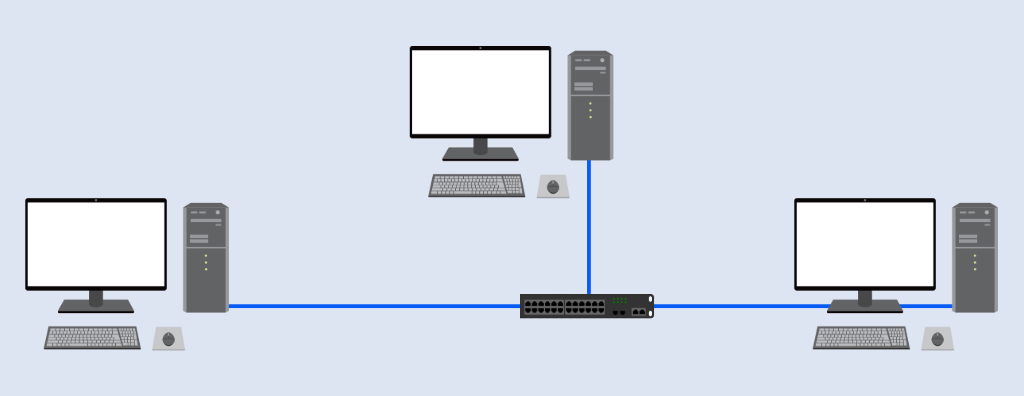
A Local Area Network (or LAN), is an interconnection infrastructure confined to a limited geographical area – such as a residence, school, laboratory, or commercial building. These networks are widely used to connect computers and electronic devices, allowing for resource sharing and information exchange. In this article, we will cover the main components and configurations […]
Check it out!
A Local Area Network (or LAN), is an interconnection infrastructure confined to a limited geographical area – such as a residence, school, laboratory, or commercial building.
These networks are widely used to connect computers and electronic devices, allowing for resource sharing and information exchange.
In this article, we will cover the main components and configurations of LANs, including physical and logical aspects that ensure performance, reliability, and security of these networks.
Check it out!
[elementor-template id=”24446″]
Although the vast majority of modern local networks are connected to the Internet, this is not an intrinsic characteristic.
In fact, LANs precede the Internet itself, with the first implementations occurring in companies in the late 1970s, focused exclusively on internal communication and resource sharing.
Common examples of LANs include a home Wi-Fi network, an educational institution’s network, or an organization’s internal network.
Depending on the application, a LAN can be structured in different ways to meet specific performance, scalability, and management needs.
Types of Local Area Networks
Local Area Networks can vary from simpler configurations, such as those found in homes or small businesses, to more complex structures that interconnect several nearby buildings (also known as Campus Area Networks or CANs).
Let’s explore each of them in detail:
Home Area Network (HAN)
A Home Area Network (or HAN) is a Local Area Network configuration that interconnects computers, smartphones, printers, and other IoT devices in a domestic environment.
This type of network enables internal communication between these devices and allows connection to external networks, such as the Internet, ensuring integration and resource sharing within the residential environment.
Wireless Local Area Network (WLAN)
Wireless Local Area Networks (or WLANs) are a type of Local Network that uses wireless technologies, such as Wi-Fi, to interconnect devices.
WLANs are extremely popular today, especially in homes and locations where cabling installation is unfeasible.
In this configuration, communication between devices is generally mediated by a wireless access point (Access Point) or a router, which manages data traffic and ensures connectivity within the network.
However, in scenarios where devices are sufficiently close, it is possible to configure direct communication between them using a point-to-point (P2P) topology.
Campus Area Network (CAN)
When Local Area Networks (LANs) are implemented to cover multiple buildings in the same location, such as in universities, technology parks, or large corporations, they are called Campus Area Networks (or CANs).
These networks are designed to integrate and interconnect different buildings or facilities within a campus, providing efficient and secure communication between various departments and warehouses.
A Campus Area Network can be considered a collection of interconnected LANs, and some authors even classify them as a distinct network type due to their complexity and scale.
Physical Configuration of a LAN
The physical configuration of a LAN refers to the structuring of the physical components that make up the local network, ensuring connectivity and efficiency in data traffic.
Network Equipment
Network equipment consists of the essential devices that allow interconnection between different nodes (devices) within the LAN, ensuring communication and data management.
Switch
A switch is a network device that connects multiple devices within a LAN and uses MAC addressing to forward data to the correct device. It operates at Layer 2 of the OSI model (Data Link Layer) and is crucial for segmenting the network, improving performance, and reducing data collisions.
Access Point
The Access Point is a device that allows wireless (Wi-Fi) connection of devices to the local network. It converts a wired network signal into a wireless signal, operating at Layer 1 (Physical) and Layer 2 (Data Link) of the OSI model. Modern APs support multiple Wi-Fi standards (such as 802.11ac and 802.11ax) to offer varying connection speeds and security through protocols like WPA3.
Router
The router is a device that forwards data packets between different networks, allowing communication between the LAN and external networks, such as the Internet. It operates mainly at Layer 3 (Network) of the OSI model, using IP addresses to determine the best path for sending data packets. In a LAN, the router may include additional functions such as firewall, NAT (Network Address Translation), and DHCP server.
Cabling Infrastructure
The cabling infrastructure is the physical foundation that allows data transmission between devices in a LAN. Correct choice of cabling and proper installation are essential to ensure network integrity and speed.
Transmission Media
Transmission media refers to the physical materials that carry electrical or optical signals between network devices.
Topology
Network topology describes how devices are physically connected in a LAN.
Logical Configuration of a LAN
The logical configuration of a LAN involves defining parameters that control how data is addressed, segmented, and managed on the network.
Addressing
Addressing in a LAN refers to assigning IP addresses to devices, allowing them to communicate within the network and with external networks.
DHCP
DHCP is a protocol that automates the assignment of IP addresses, subnet masks, gateways, and DNS servers to devices on the LAN. A DHCP server responds to requests from devices entering the network, assigning an available IP address from a configured pool, ensuring there are no IP conflicts.
Manual Addressing
Also known as Static IP, manual addressing involves assigning fixed IP addresses to specific devices. This is useful for devices that need a constant IP address, such as servers, network printers, and routers. While offering greater control, it requires more administrative work and care to avoid IP conflicts.
Subnet Masks
The subnet mask determines the part of the IP address that identifies the network and the part that identifies the hosts within that network. For example, a subnet mask of 255.255.255.0 indicates that the first three octets of the IP address represent the network, and the last octet identifies the device within that network. This allows for the creation of subnets within a larger LAN.
Network Segmentation
Network segmentation involves dividing a LAN into smaller segments to improve performance, security, and traffic management.
Subnets
Subnets are logical divisions of a larger network, created to isolate traffic and manage the use of IP addresses. Subnet segmentation reduces unnecessary traffic and can improve security by isolating groups of devices. Subnets are defined using subnet masks to delineate the subnet size.
Virtual Local Area Network (VLAN)
A Virtual Local Area Network (or VLAN), is a network segmentation technique that allows for the creation of independent logical networks within a single physical infrastructure.
How does the connection between Local Networks and the Internet work?
Connecting a Local Area Network (LAN) to the Internet is a process that involves interaction with an Autonomous System (AS).
An Autonomous System (AS) is a set of IP networks managed by a single administrative entity, such as an Internet Service Provider (ISP). Each AS has control over a block of IP addresses and can establish its own routing policies.
The relationship between LANs and the Internet can be seen as a series of hierarchical connections: a LAN connects to an AS, which in turn connects to other ASs, forming the vast mesh of networks that make up the Internet. This allows two computers, each in its own LAN and potentially thousands of miles apart, to communicate by sending data through this chain of connections.
Final Considerations
A LAN is composed of physical and logical elements that work together to create an efficient communication infrastructure.
From residential networks to large corporate networks, these local networks represent the essential foundation of all connectivity, ensuring efficient and secure data exchange.
