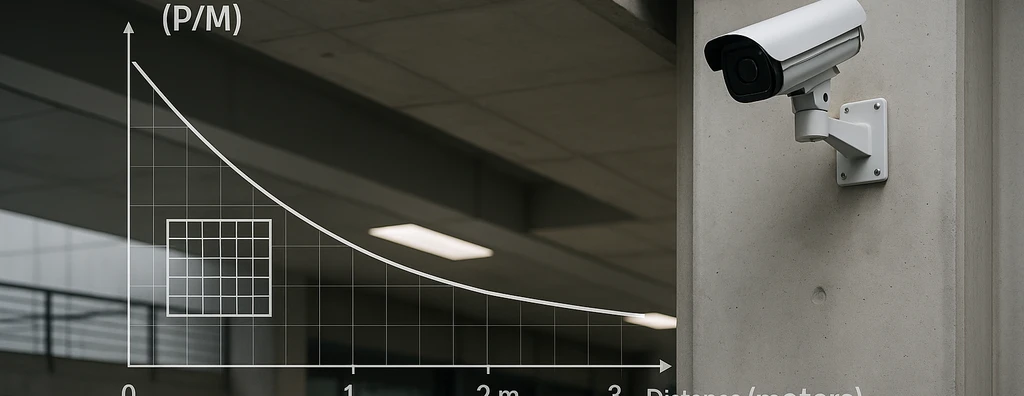
Technical study on pixels per meter (PPM) in surveillance projects, covering DORI criteria, sensor resolution, and systemic efficiency.
Check it out!
Pixel density per meter (PPM) is one of the main parameters for defining the operational efficiency of video surveillance systems. In electronic security projects, the correct specification of pixel density directly affects the quality of the captured image, the ability to identify people, vehicles, and objects, and compliance with regulatory guidelines. The structural challenge lies in balancing camera resolution, monitored area, scene distance, and the feasibility of data storage and transmission, considering inherent compromises in optical performance, lighting, compression, and specific operational requirements for detection, observation, recognition, or identification.
In this article, we will present essential concepts, calculation methods, regulatory foundations, criteria for DORI classification, and practical guidelines for the correct dimensioning of pixel density per meter in surveillance projects. The objective is to support assertive decision-making in security systems engineering, promoting efficiency, regulatory adherence, and performance aligned with real application contexts.
Check it out!
[elementor-template id=”24446″]
Fundamentals of Pixel Density per Meter
Pixel density per meter (PPM) is the metric that defines the number of useful pixels arranged along a linear meter of the monitored scene. This parameter is decisive in ensuring that the camera system meets the visibility and detailing requirements predicted for each operational purpose. The direct relationship between pixel density, camera sensor resolution, scene distance, and field of view defines the system’s ability to meet, for example, facial identification criteria, license plate reading, detection of anomalous activities, and eventual audits for legal or forensic purposes.
The main factors influencing pixel density are:
- Sensor Resolution: Higher resolution implies potential for greater detailing, with megapixel sensors being standard for high-criticality applications.
- Field of View: Directly linked to the lens and scene distance, it determines how many meters of the environment will be contained in the captured image.
- Distance to the Object: Interferes with the projection of the object in terms of the number of pixels on the image plane.
- Coverage Angle: Excessive angles can result in pixel dispersion and compromise the fidelity for identification.
Relationship between Resolution, Monitored Area, and Pixel Density
The fundamental equation for calculating pixel density per meter in video surveillance systems starts with the following parameters:
- Horizontal Resolution (in pixels) of the camera sensor.
- Width of the real monitored area (in meters) corresponding to the area effectively captured by the camera’s field of view.
The calculation is performed using the expression:
Pixel density per meter (PPM) = Camera horizontal resolution (px) / Width of monitored scene (m)
In applications requiring high accuracy, such as facial identification, it is recommended to use cameras that provide at least 250 px/m in the width of the monitored scene, following standards derived from international recommendations (such as NBR IEC 62676-4).
Practical Example
For a 1920×1080 pixel (Full HD) camera installed to cover an 8-meter wide gate:
- Horizontal Resolution: 1920 pixels.
- Monitored Width: 8 meters.
- PPM = 1920 / 8 = 240 PPM.
This configuration is sufficient for recognition situations and is at the limit for identification, considering operational safety margins. It is worth noting that density must be validated for the exact plane in which identification is desired (distance, height, and perspective must be considered).
DORI Classification: Technical Criteria for Detection, Observation, Recognition, and Identification
The DORI classification — Detection, Observation, Recognition, and Identification — establishes technical levels for pixel density specification in compliance with operational requirements in electronic security projects. Each criterion requires different ranges of PPM, based on standards such as NBR IEC 62676-4 and international video surveillance practices.
| Criterion | Pixel Density (PPM) | Operational Description |
|---|---|---|
| Detection | ≥ 25 PPM | Allows verifying the presence of a person or object in the scene, without detailing. |
| Observation | ≥ 63 PPM | Enables distinguishing some general characteristics, such as clothing. |
| Recognition | ≥ 125 PPM | Allows recognizing a person already known, considering facial and body details. |
| Identification | ≥ 250 PPM | Provides sufficient detailing for positive identification, even in adverse conditions. |
For specific criteria of critical projects — such as access control, sensitive perimeter, or forensic auditing — it is recommended to adopt borderline densities, predicting safety margins that compensate for variations in lighting, movement, and image compression.
Standardization and Technical Recommendations for Specification and Validation
The regulation of video surveillance projects requires alignment with international and national standards, notably NBR IEC 62676-4, which deals with performance requirements and test methods for CCTV systems. Among the established parameters, pixel density per meter is central to validating the appropriate level of detailing for each purpose.
- Standards recommend that pixel density calculation be based on the average width of a human face (typically 16 cm), allowing easy translations of operational needs into concrete technical parameters.
- When preparing descriptive memorials, executive projects, and technical specifications, tables and diagrams containing the zoning of pixel density for each monitored point should be presented.
The documentary validation of projects must include:
- Calculation of pixel density per meter for each camera and monitored area;
- Indication of the DORI criterion met;
- Method for adjusting the field of view to adapt the PPM to the operational objective;
- Criteria for camera selection and positioning aimed at systemic performance;
- Safety margin for possible degradation in low lighting conditions or dynamic scenes.
Operational Challenges and Factors Affecting PPM Efficiency
The efficiency of pixel density per meter can be impacted by a series of factors extrinsic and intrinsic to the video surveillance project. Noteworthy elements include:
- Inadequate Lighting: Poor light conditions reduce the operational effectiveness of the nominal pixel density, with high-resolution cameras generally being more sensitive to light deficiency.
- Image Processing and Compression: Compression algorithms can result in loss of detail, especially in areas subject to frequent movements or sudden light variations.
- Optical Quality: Low-performance lenses can compromise image definition even with high-resolution sensors.
- Angle Distortion: Excessive angles relative to the object’s plane can disperse pixels and hinder proper scene projection.
- Display and Visualization: The resolution of the final monitor for analysis also conditions the real ability to take advantage of the recorded detailing.
Performing practical in situ tests is recommended for density calibration, fine-tuning of angles, and validation of adherence to operational requirements, considering environmental contextual factors.
Procedures for Calculation and Dimensioning of Pixel Density per Meter
The precise determination of pixel density per meter, from the conceptual stage to post-installation verification, must follow rigorous technical processes, according to the stages listed below:
- Definition of areas and operational objectives: Map all zones of interest of the project and determine the applicable DORI criterion.
- Determination of minimum required resolution: Calculate, for each monitored scenario, the minimum camera resolution to reach the necessary PPM, taking the effective field of view into account.
- Field of view simulation: Use simulation tools to predict pixel distribution along critical areas (for example, design software or dedicated technical spreadsheets).
- Dimensioning and choice of cameras: Select camera models that offer the required resolution level, combining lenses, distances, and positioning to meet or exceed the target PPM.
- Testing and validation: Perform functional trials, adjust field parameters, and validate adherence through measurements with real images.
Dimensioning Textual Flow
[Defined area of interest] \u2193 [Established DORI criterion] \u2193 [PPM Calculation] \u2193 [Camera selection and positioning] \u2193 [Practical validation]
Best Practices for CCTV Project Specification regarding Pixel Density
- Use zoning tables and plans indicating areas and respective projected DORI and PPM criteria.
- Provide a technical reserve of at least 10% on the minimum density to compensate for degradations resulting from environmental variables.
- Select cameras with resolution and sensitivity compatible with the desired level of detailing and scene dynamics.
- Prioritize high-quality lenses, optical compatibility, and low distortion.
- Arrange cameras to avoid acute angles, which reduce the effective projection of the object on the horizontal plane.
- Ensure minimum recommended lighting for the type of sensor used, especially in areas critical for identification.
- Detail the calculations and criteria used, consolidating them in the project’s technical memorials.
- Periodically validate, through technical inspections and reviews, the adherence of projected parameters to the system’s effective performance.
Conclusion
Pixel density per meter represents a fundamental parameter in the architecture of video surveillance systems, directly influencing the efficiency, operability, and compliance of electronic security projects. Correct dimensioning, supported by regulatory criteria and oriented toward the real needs of each scenario, ensures that CCTV systems fulfill their objectives of prevention, response, and forensic auditing.
The relationships between resolution, field of view, monitored area, and DORI criteria establish a solid basis for technical specification, mitigating risks of underdimensioning or overdimensioning resources. The importance of fine-tuning and in situ validation is also highlighted to ensure that pixel density per meter, designed and implemented, is maintained even given operational and environmental variabilities.
Thus, the adoption of practices aligned with international standards, the systematic use of calculation methodologies, and rigorous technical documentation become essential instruments for achieving efficient, auditable video surveillance systems capable of supporting decision-making processes in the most diverse security engineering contexts.
Final Considerations
We thank you for reading this technical article on pixel density per meter in surveillance projects. For constant updates and applied engineering content in security, networks, and electrical, follow A3A Engenharia de Sistemas on our social media.
