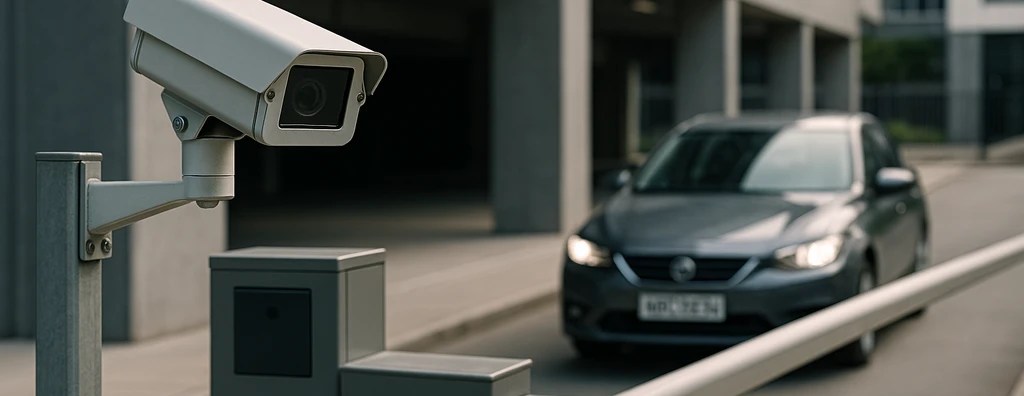
Computer vision and AI technology for automatic license plate recognition (LPR) in urban mobility and access control.
Check it out!
Computer vision technology applied to automatic license plate recognition (LPR — License Plate Recognition) has become fundamental for urban mobility operations, vehicle access control, and intelligent monitoring in electronic security. The advancement of artificial intelligence algorithms and the evolution of optical devices have enabled the automation of processes previously dependent on manual intervention, expanding operational scope and precision. However, the effective implementation of LPR requires mastery of technical factors involving image capture, environmental configurations, and integration with management systems.
In this article, we explore the functioning of LPR systems, technological architecture, engineering specifications, deployment challenges, integration with security platforms, and strategic applications for urban and institutional environments. The goal is to provide a reference for efficient development, specification, and operation of solutions based on automatic license plate recognition.
Check it out!
[elementor-template id=”24446″]
Principles of Operation of License Plate Recognition (LPR)
LPR comprises the capture and automated processing of vehicle plates through specific cameras and dedicated algorithms. The LPR system is composed of three main modules:
- License Plate Capture: Images of vehicles are obtained by cameras configured with optimal focus, exposure, and lighting parameters — with adjustments for daytime and nighttime conditions — to ensure plate legibility in various environmental scenarios.
- Analytical Processing: Software embedded in the camera, on a local server, or in the cloud performs character extraction and comparison with databases, enabling automatic responses.
- Storage/Action: Extracted data is archived in a database for future reference and integrated with automation systems, such as gate control, access records, or alert generation.
Recognition occurs in real-time, allowing for automated decisions and the creation of auditable records for future analysis.
LPR System Architecture: Edge, Centralized, and Hybrid Processing
The architecture of LPR systems is defined by where the analytical processing occurs:
- Edge: The recognition algorithm is executed directly on the camera, reducing the need for bandwidth and storage, and allowing for high scalability with less dependence on central infrastructure.
- Centralized Server: Images are transmitted to a dedicated server, which processes multiple streams simultaneously; attention to bandwidth and network robustness is recommended.
- Cloud/Hybrid Approach: Enables distributed processing to ensure flexibility, high availability, and balancing of computational resources. The hybrid approach can allocate critical decisions at the edge and long-term storage or predictive analysis in the cloud or centralized servers.
Regardless of the architecture, integrations with video management systems (VMS) and market protocols, such as ONVIF, are recommended to ensure interoperability. Integration allows correlating events, automating audits, and adding metadata information to institutional repositories.
Technical Requirements and Essential Parameters for Plate Capture
LPR performance is strongly influenced by image capture quality. To ensure reading accuracy and operational reliability, rigorous attention to the following engineering parameters is recommended:
- Resolution and Pixel Density: The camera must be able to offer adequate density to distinguish plate characters regardless of the vehicle’s distance and speed.
- Lighting: The presence of internal or external infrared (IR) illuminators is fundamental for captures in nighttime environments and with low luminosity, without blinding drivers or degrading plate sharpness.
- Positioning and Alignment: The angle between the camera and the plate needs to be minimized, ensuring practically orthogonal incidence. Alignment errors result in reading errors and reduce the hit rate.
- Optical Settings: Shutter times, gain adjustment, contrast control, and use of filters (polarizers and infrared-pass) directly impact legibility and must be adjusted according to the operational scenario.
- Environmental Conditions: Protections against weather, dust, and vibration are essential to ensure availability and avoid performance degradation.
Furthermore, it is indispensable to perform field tests and regular validation for record quality assessment, adjusting parameters according to seasonal variation in light and traffic flows.
Functional Flow in LPR for Control and Automation
The typical operational flow of LPR in vehicle access control environments can be described by the following stages:
- Vehicle detection and license plate image capture.
- Image processing by the embedded IA application or server, extracting the plate number.
- Plate lookup in predefined permission lists (white/black lists or period and access criteria).
- Confirmation of access permission or generation of alert for manual/supervisory action.
- Record of the event with association of image, time, and decision made (release, blockage, report generation).
This process occurs in real-time, being scalable for high flows and critical environments. The management of lists and schedules is performed by software integrated with access automation platforms and VMS, promoting auditing and traceability.
Technical Challenges: Limitations, Accuracy, and Failure Mitigation
LPR, although mature and precise, presents important challenges:
- High-Speed Reading: Current IA algorithms are optimized to register plates from vehicles at speeds exceeding 100 km/h, but variations in lighting and movement can affect accuracy.
- Obstruction and Dirt: Dirty or partially obstructed plates reduce precision and require algorithms capable of handling partial situations; operational procedures for periodic cleaning are recommended.
- Environmental Interference: Reflections, light variations, adverse weather, and the occurrence of glare from headlights or direct sunlight are common degradation factors, mitigated by specific camera settings and the use of optical filters.
- Plate Standardization: Changes in layout, fonts, regional standards, and validity affect algorithms. Regular update of reference databases is recommended.
- Legal and Regulatory Foundations: Captured data must meet requirements for privacy protection, confidentiality, and local legislation for logging, auditability, and secure storage.
Integration with Security, Mobility, and Operational Analysis Systems
The integration of LPR with video management systems (VMS), access control platforms, and centralized databases enhances its applications beyond mere vehicle registration, allowing:
- Monitoring of sensitive areas and parking: Allows automated control, entry and exit registration, irregular stay warnings, or unauthorized access attempts.
- Urban Mobility: Supports smart city operations, providing vehicle flow data, identification of vehicles of interest, and predictive analysis of patterns for traffic management.
- Tracking and Auditing: Each recorded event generates detailed metadata — identification, time, image, decision — ensuring traceability and the preparation of customized reports.
- Automation and Related Actions: Integration with other analytics and sensors for process automation, alarm generation, and operational responses (opening gates, activating lighting, sending real-time reports).
Requirements for Electrical Infrastructure, Network, and Maintenance for LPR
The operation of LPR systems requires appropriate infrastructure:
- Data Network: Stable backbone, structured cabling according to technical standards, and IR switches compatible with PoE, ensuring centralized power and secure camera communication.
- Power Supply: Dedicated and protected circuits, with surge and brownout protection devices, in addition to contingency for critical power failures.
- Controlled Environment: Proper physical installation of cameras, protecting against vandalism and weather, ensuring ideal alignment and accessibility for preventive maintenance.
- Tests and Diagnostics: Regular procedures for checking focus, angle, brightness/contrast adjustment, in addition to automated diagnostics for performance monitoring and early fault detection.
Predictive maintenance, monitoring of device status, and remote analysis of critical indicators raise system availability and operational reliability.
Strategic Considerations for LPR Projects in Mobility and Security
For an LPR system to deliver concrete results in security and mobility, a systemic approach is recommended:
- Define clearly the project goals, including expected automation, integration, and auditing levels.
- Select optical devices and processing servers compatible with the predicted vehicle flow and local environmental characteristics.
- Implement secure network protocols and information access control.
- Train teams for operation, parameter adjustments, and rapid intervention in occurrences.
- Ensure permanent adherence to legal and regulatory requirements for the use, storage, and processing of sensitive data.
Furthermore, periodic evaluation of algorithms and physical conditions of the environment is recommended for continuous adjustment of settings and updating dose databases, maintaining high levels of accuracy and efficiency.
Conclusion
License Plate Recognition systems represent a strategic vector of automation and intelligence in mobility, security, and access control operations. From a technical point of view, the importance of camera alignment and calibration, the careful definition of optical parameters, native integration with VMS and automation platforms, and the secure and auditable management of the generated metadata stand out. The adoption of technology, combined with predictive analysis and predictive maintenance, provides immediate operational gains and enables the evolution of urban and corporate environments to new levels of efficiency and security.
By considering engineering specifications, maintenance adjusted to the criticality of the scenario, and responsible use of data, engineering and operations professionals can achieve excellence in availability, traceability, and real-time response in environments under continuous surveillance.
Final Considerations
Thank you for reading this technical article on License Plate Recognition and its applications in mobility and security. To delve deeper into related topics and obtain exclusive information on systems engineering, automation, and integration, follow A3A Engenharia de Sistemas on social media and keep up with our next publications.