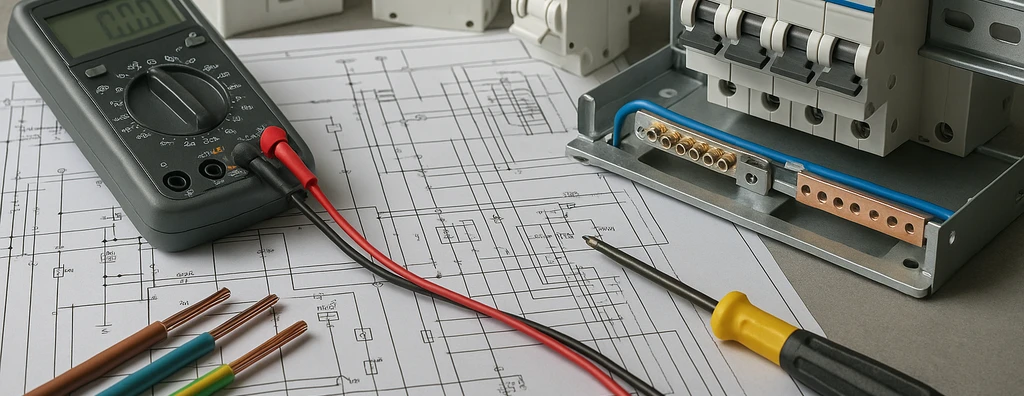
Fundamental stages and standards for low-voltage electrical projects, focusing on safety, NBR 5410, and best engineering practices.
Check it out!
The development of low-voltage electrical projects is an essential discipline for the safety, reliability, and sustainability of modern buildings. These projects range from residential installations to industrial complexes, considering the most distinct uses, energy demands, and interfaces with other building systems. The rigorous adoption of technical standards, associated with the careful analysis of usage characteristics and intrinsic risks, is decisive in ensuring the integrity of people, the protection of property, and full compliance with current legal requirements.
In this article, the main stages of the process of preparing low-voltage electrical projects, the most relevant regulatory recommendations, the detailing of the mandatory technical requirements according to ABNT NBR 5410 and other complementary standards, as well as fundamental considerations for dimensioning, specification, execution, and maintenance of these installations will be addressed.
Check it out!
[elementor-template id=”24446″]
Regulatory Scope and General Guidelines for Low-Voltage Projects
ABNT NBR 5410 — Low-Voltage Electrical Installations, establishes the conditions that must be met by electrical installations aiming at the safety of people and animals, the proper functioning of the electrical system, and the conservation of property. This standard is applicable to electrical installations in buildings of any occupancy — residential, commercial, industrial, institutional, and agricultural —, including external areas, prefabricated structures, temporary installations, and event locations.
The regulatory requirements range from design to execution, inspection, maintenance, and eventual alterations of the installations. In addition to NBR 5410, the following stand out as complementary regulations: ABNT NBR 5419 for protection against lightning discharges, ABNT NBR IEC 61643-1 for surge protection devices (SPD), among others applicable.
- Fundamental Objectives: Guarantee of personal safety, protection of domestic animals, physical integrity of structures, continuity of operation, and respect for the limits of thermal rise and voltage drop.
- Scope of Application: Indoor and outdoor environments, new fixed installations, renovations, expansions, and temporary energy structures.
Phases of the Low-Voltage Electrical Installation Design Process
- Planning and Data Collection:
- Study of the building and analysis of its occupancy, load demand, and construction characteristics.
- Evaluation of external influences (physical, chemical, and mechanical agents, humidity, presence of explosive atmospheres, etc.).
- Characterization of available power supply points (public grid, own generation, backup, uninterruptible sources).
- Determination of Power and Demand:
- Calculation of consumption power and evaluation of simultaneous demand, considering current standards and specific tables.
- Distribution of the load between circuits, distribution boards, and disconnection criteria.
- Conception and Schematization:
- Definition of the general distribution scheme, organization of circuits, and safety resources.
- Identification of maintenance requirements and future expansions.
- Technical Detailing:
- Specification of conductors, switching devices, protection against overload, short-circuit, electric shocks, and surges.
- Dimensioning of boards, busbars, conduits, and grounding systems.
- Documentation and Memorials:
- Preparation of single-line diagrams, multi-line diagrams, material lists, descriptive memorial, and calculation memorials.
- Preparation of floor plans, legends, construction details, and technical flowcharts.
- Approval and Technical Licensing:
- Compliance with requirements of regulatory bodies, energy utilities, and municipal inspection.
- Inclusion of technical reports, ART (Record of Technical Responsibility), and other required records.
Technical Specifications and Dimensioning Criteria
The safe and economical dimensioning of low-voltage electrical systems demands precise calculations, respect for the limits imposed by technical standards, and detailed consideration of operational and environmental conditions.
Main Aspects for Dimensioning:
- Electrical Conductors: Dimensioned according to current carrying capacity, type of insulation, ambient temperature, grouping, and installation method. Limits for voltage drop and thermal rise established by ABNT NBR 5410 must be respected.
- Circuit Breakers and Fuses: Selected according to interrupting capacity, characteristic curve, and coordination with overload and short-circuit protection. The adoption of residual current devices (RCD) for critical sections is recommended.
- Distribution Boards (Panelboards): Must enable functional disconnection and individual protection of circuits. The physical layout must allow for thermal dissipation, easy access, and future expansion.
- Surge Protection Devices (SPD): Applied according to the assessment of the level of exposure to lightning discharges and grid transients.
- Grounding (Earthing) Systems:
- Design and execution in accordance with ABNT NBR 5410, ABNT NBR 5419, and ABNT NBR 15749, dimensioning electrodes, conductors, and connections to ensure low impedance and effectiveness in dispersing leakage currents.
- Measurement of grounding resistance and evaluation of potentials on the soil surface are mandatory actions in system acceptance.
- Electromagnetic Compatibility: Observation of minimum distances between power conductors, telecommunications circuits, and equipotential grounding for interference mitigation.
Protection, Safety, and Reliability of Installations
Low-voltage projects must provide protection systems capable of limiting human exposure to electric shocks, ensuring the integrity of the installation in the face of overloads and short circuits, and minimizing the risk of fire.
Specific Protection Mechanisms:
- Protections against electric shocks: Implementation of RCD devices in outlet circuits, wet areas, and external use points. Supplementary protection is mandatory in accessible parts where the risk is accentuated.
- Protection against overcurrent, short-circuit, and insulation faults: Use of appropriate disconnection and locking devices, in addition to selective coordination of protections to limit areas affected by an eventual fault.
- Surge protection: Adoption of SPDs compatible with the system for efficient diversion of lightning surges and switching surges originating from the grid or internal systems.
- Equipotentialization and functional and protective grounding: Interconnection of metallic masses and conductive structures, reducing dangerous potentials and ensuring proper performance of the protection system.
Additional Requirements:
- Division of circuits: Proper separation between essential circuits (lighting, alarm, emergency) and non-essential ones, allowing partial operation under adverse conditions.
- Ease of inspection and maintenance: Provision of access points, standardized identification of circuits, and systematized records of interventions.
Documentation, Testing, and Approval of Installations
Documentary compliance is essential both to meet legal requirements and to ensure the traceability and permanence of the solutions employed.
Mandatory Technical Documentation:
- Single-line and Multi-line Diagrams: Represent the topology of the circuits, location of devices, and interconnections.
- Descriptive and Calculation Memorial: Details methodology, technical justifications for dimensioning, types of materials, and equipment specified.
- Material and Parts List: Detailed specification of conductors, devices, boards, and accessories.
- Records of tests and inspections: Inclusion of measurement reports, grounding resistance reports, continuity tests, functional tests of protection devices, and operational tests.
Mandatory Tests:
- Verification of the continuity of protective conductors and equipotentialization.
- Measurement of insulation resistance of circuits.
- Functional test of protection devices.
- Confirmation of the polarity of active conductors in outlets and accessories.
- Verification of the effectiveness of the grounding system.
Final approval depends on full compliance with the requirements of ABNT NBR 5410 and complementary standards, resulting in the issuance of formal documents, photographic records, and ART.
Best Practices and Recommendations for Quality and System Integration
- Standardization and Identification: Application of color codes, symbologies, and standardized labels on boards, devices, and distribution lines.
- Adoption of technical reserves: Provision of surplus circuits and spaces for future expansions and facilitation of maintenance interventions.
- Coordination with automated systems: Harmonious integration with building automation systems, supervisors, electronic security, IT, and HVAC, respecting minimum distances and avoiding undue crossings.
- Interface with other systems: Planning the coexistence of supply circuits, lighting, general and specific purpose outlets, logic, telecommunications, security, and emergency devices.
- Continuous regulatory update: Monitoring ABNT standard revisions and international benchmarks (IEC 60364, IEC/TS 60479) for the adoption of best engineering practices.
- Continuous technical training: Involvement of qualified professionals and periodic training of design, execution, and operation teams.
Maintenance, Records, and Post-Installation Procedures
The life cycle of low-voltage electrical installations requires the implementation of preventive, corrective, and predictive maintenance routines, as per technical recommendations described in the memorials and regulatory records.
- Preventive maintenance plans: Periodic inspection of distribution boards, protection devices, grounding continuity, and equipotential connections.
- Checklists and inspection plans: Detailed listings of critical items, verification points, periodicity, and those responsible for monitoring.
- Gestión documental: Systematic archiving and updating of memorials, intervention records, inspection reports, and ART of the maintenance performed.
- Gestión de indicadores de desempeño: Monitoring of events such as unexpected device operations, recurring faults, and trip records, aiming at corrective actions and systemic improvements.
- Continued training: Periodic update of operational teams for the adoption of new technologies and regulations.
Low-voltage electrical projects require a holistic approach and mastery of technical standards to meet rigorous criteria for safety, performance, and reliability. From planning to maintenance, adherence to the specific requirements of ABNT NBR 5410 and complementary ones ensures that electrical systems are prepared for contemporary operational challenges. Exhaustive detailing, precise documentation, and management of maintenance routines are key elements to avoiding accidents, ensuring the continuity of production processes, and facilitating compliance with regulatory bodies and utilities.
By adopting a structured methodology, based on best engineering practices and constant regulatory updates, it is possible to maximize the performance of the installations, extend their useful life, and facilitate integration with other building systems. This translates into tangible gains for the operation, maintenance, and value of the building assets.
Final Considerations
We thank you for following this technical deep dive into low-voltage electrical projects. To become a reference in engineering, continue following our content and follow A3A Engenharia de Sistemas on social media. Always count on our expertise to raise the standard of quality and innovation in your projects and operations.