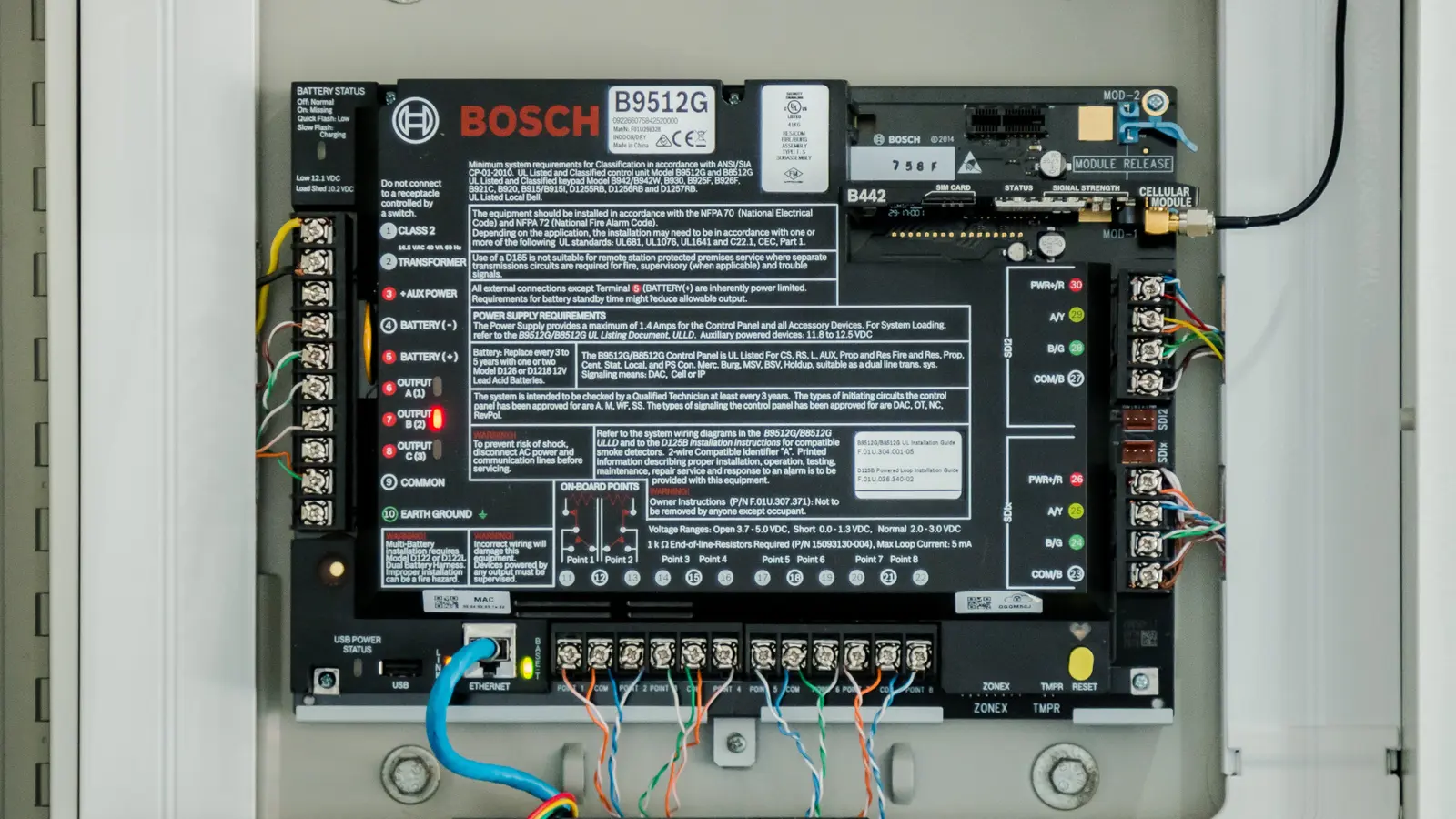
The Bosch B9512G is a multi-service control panel designed to unify the electronic security system architecture in environments that require logical centralization, operational scalability, and integration between subsystems traditionally handled separately.
Rather than operating intrusion, fire detection, and access control as independent layers, the equipment consolidates these functions into a single control platform, simplifying operation and reducing infrastructure fragmentation.
In practice, this means the panel takes on a central role within the security architecture, coordinating events, areas, users, field devices, and operator interfaces within a unified logic.
This model is especially relevant in corporate, commercial, and institutional environments that need to maintain consistency between monitoring, alarm response, access management, and technical system administration.
Main features and capabilities
The primary structural differentiator of the Bosch B9512G lies in the native integration of three critical security domains: intrusion, fire, and access control. In many projects, these disciplines are deployed on separate platforms, with different operator interfaces and their own administration workflows. This arrangement tends to increase operational complexity, hinder user training, and raise the effort required for maintenance and troubleshooting.
With the B9512G, the logic is different. The panel allows the operator to interact with a unified system rather than three parallel systems. This has a direct impact on operational clarity, event consistency, and the organization of response routines. A single control core can monitor alarm points related to intrusion, gas, or fire, while simultaneously managing functions associated with physical access.
This convergence is particularly useful in installations where events have operational correlation. An intrusion alarm in a restricted area, for example, may require contextual review of recent access activity, the arming status of the area, and video confirmation on an associated platform. When the architecture is conceived in an integrated manner from the outset, the system responds more effectively, with less reliance on parallel procedures and a lower risk of losing context.
Another important aspect is the ability to structure the site into up to 32 areas. This segmentation allows the physical and operational reality of the installation to be represented within the panel’s logical environment. Areas can be configured according to sectors, floors, critical zones, tenant units, or functional blocks, supporting arming policies, delegated operation, and segmented event handling.
In electronic security projects, capacity should not be interpreted solely as the number of supported points. What matters is how that capacity translates into a usable, manageable, and scalable architecture. The Bosch B9512G supports up to 599 individually identifiable points, enabling the construction of systems with the granularity required for both small- and large-scale applications.
Individual point identification is technically relevant because it improves event traceability and operational precision. Rather than working with generic groupings, the team can clearly identify which device triggered a given condition, which area it belongs to, and what automated or operational response should be applied. This is decisive in environments with multiple sectors, distinct occupancy routines, and requirements for rapid response.
The panel also supports up to 2,000 users and up to 32 access control doors when appropriate modules are used. This capacity allows the system to go beyond functioning as an event monitoring center and to act as a platform for managing permissions and physical circulation in environments that require more structured control.
When correctly designed, this capability supports operational models with different user profiles, area-based permissions, specific schedules, and integration between access status and security status. From a logical engineering standpoint, this expands the ability to define consistent rules across credentials, protected sectors, and system response.
The B9512G incorporates an integrated Ethernet port for Conettix IP alarm communication and remote programming, with compatibility with modern IP networks, including IPv6, IPv4, automatic IP, and universal Plug and Play. This set of features positions the panel in alignment with contemporary network infrastructures, reducing dependence on legacy media and facilitating its integration into corporate architectures based on IP communication.
For systems engineering, this point is central. IP communication is not merely a connectivity attribute; it defines how the panel will be supervised, programmed, integrated, and maintained throughout the solution’s lifecycle. In distributed environments, the presence of onboard Ethernet simplifies the communication topology and improves the equipment’s compatibility with existing networks, provided that the infrastructure’s segmentation, availability, and security requirements are observed.
In addition to communication through the built-in Ethernet interface, the panel can communicate via compatible plug-in modules capable of transmitting events over the public switched telephone network or cellular networks. This flexibility is important in scenarios where the event transmission strategy must account for redundancy, communication contingency, or adaptation to specific local infrastructure conditions.
In practice, the specification of the communication medium must consider operational criticality, continuity policy, network availability, site topology, and remote maintenance requirements. It is not simply a matter of enabling a channel, but of defining how the panel will behave within the installation’s overall supervision and response strategy.
The Bosch B9512G was designed to operate alongside a wide variety of components from the Bosch architecture itself, enabling the construction of solutions that are more cohesive from a functional and interoperability standpoint. This compatibility includes keypads, IP cameras, access readers, smoke detectors, intrusion detectors, and wireless transmitters.
The keypads available for compatible series expand user interface flexibility. Options include a color touchscreen, a two-line LCD keypad, and a two-line capacitive touch keypad. The use of programmable text allows the interface to be adapted to the operational needs of the environment, supporting clearer messages for handling critical events and reducing ambiguity in day-to-day interaction.
In the video domain, the panel can integrate directly with Bosch IP cameras. This association is technically relevant because it brings the security event closer to visual verification, reducing the time between occurrence and decision-making. In more comprehensive architectures, the Bosch Video Management System adds an additional layer of operation, with graphical representation of alarm events and arm/disarm control via software.
This integration between panel and video does not transform the B9512G into a video monitoring system, but positions it as an orchestration element within a converged architecture. Events generated by the panel can be contextualized with images, and operations occur with greater consistency across detection, verification, and response.
At the detection layer, the panel is compatible with Bosch intrusion detectors and smoke detectors, including photoelectric options and models with thermal detectors. In the wireless domain, integration with RADION components expands deployment flexibility, particularly in retrofit scenarios, civil construction constraints, or situations requiring expansion with minimal physical impact on the existing infrastructure.
Also noteworthy is the compatibility with the B901 Door Controller, a fully supervisable and addressable SDI2/SDI bus device used for access control integration with Bosch B Series and G Series panels. This component is essential when the architecture requires orderly expansion of controlled doors while maintaining supervision and logical consistency with the rest of the system.
In an integrated security architecture, the B9512G consolidates functions that go beyond simple alarm reception. Its functional set addresses both day-to-day operation and the technical administration and modular expansion of the system.
- Integrates intrusion, fire, and access control into a single operating platform.
- Enables monitoring of alarm points related to intrusion, gas, or fire.
- Supports system segmentation into up to 32 areas, promoting logical organization by sector or operation.
- Allows combining wired and wireless devices for greater installation flexibility.
- Enables integration of up to 32 access control doors using the B901 module.
- Supports optional use of the D9210C module for up to 8 of the 32 doors.
- Provides IP communication via an integrated Ethernet port for alarm transmission and remote programming.
- Supports local or remote programming through RPS software, as well as basic programming via keypad.
- Incorporates integrated USB to facilitate local programming with RPS.
- Operates with programmable keypad shortcuts, context-sensitive on-screen help, and a bilingual user interface.
- Enables integration with Bosch IP cameras and BVMS for graphical representation of events and arm/disarm commands via software.
- Compatible with keypads, detectors, readers, RADION wireless transmitters, and other components of the Bosch architecture.
Technical Specifications
The panel’s objective parameters define its applicability in projects of different sizes and segmentation levels.
- Up to 599 individually identifiable points.
- Up to 32 areas.
- Up to 32 access control doors.
- Up to 2,000 users.
- Integrated Ethernet port.
- IPv6 and IPv4 compatibility.
- Automatic IP support.
- Universal Plug and Play support.
- Integrated USB for local programming.
- Conettix IP alarm communication.
- Compatibility with plug-in modules for PSTN communication.
- Compatibility with plug-in modules for cellular network communication.
- Four alarm output patterns.
- Programmable siren test.
- Direct replacement for models D9412GV4, D9412GV3, D9412GV2, and D9412G.
Applications and environments
The Bosch B9512G is applicable to environments that require centralized security management, area segmentation, and integration between multiple subsystems. Its adoption makes the most sense when operations need unified logic across detection, access, and event communication.
- Corporate buildings with multiple sectors and the need for area-based partitioning.
- Commercial facilities that combine intrusion, fire, and access control in a single operation.
- Institutional environments with a large number of supervised points and multiple user profiles.
- Retrofit projects requiring direct replacement of compatible Bosch panels from previous lines.
- Architectures with integration between alarm events and IP video verification.
- Sites requiring gradual expansion through wired and wireless devices.
- Distributed operations that require remote programming and communication over modern IP networks.
Engineering Considerations
The correct specification of the Bosch B9512G begins with the logical modeling of the operation. Before defining the number of points or doors, the system must be structured according to risk areas, access policies, occupancy routines, user profiles, and event criticality. The panel’s nominal capacity is relevant, but its architectural performance depends on how that capacity is distributed and configured.
Attention must also be paid to integration interfaces with field devices and complementary subsystems. The choice between wired and wireless devices, the adoption of access modules, the use of video integration, and the definition of communication methods must be consistent with the available infrastructure and the client’s operational strategy. In well-designed projects, each component is incorporated with a clear function within the architecture, avoiding overlap, supervision gaps, or unnecessary complexity.
In terms of connectivity, the presence of integrated Ethernet favors convergence with current IP networks, but requires attention to network topology, addressing, availability, and traffic segregation criteria. Panel communication cannot be treated as a simple extension of the corporate network without prior analysis of operational impact. In critical environments, engineering must validate the robustness of communication, contingency methods, and the panel’s adherence to remote administration policies.
Another essential aspect is the end-user experience. Features such as a bilingual interface, on-screen help, and programmable shortcuts have real value when the system is delivered with coherent parameterization, intelligible naming conventions, and an operational workflow compatible with the facility’s routine. A technically advanced panel loses efficiency when deployed without usability criteria, without proper commissioning, or without alignment between the configured logic and actual operations.
At A3A Engenharia de Sistemas, the application of the B9512G is carried out with a focus on architecture, interoperability, and functional validation. This involves specifying the panel within a broader solution, correctly defining its integrations, structuring the system’s logical segmentation, and ensuring that communication, devices, interfaces, and operational rules function as a consistent whole. In higher-demand security systems, it is this engineering coherence that transforms technical capability into operational reliability.